Eye Dominance Shooting Guide: Fix Your Aim Today
- Mo-Su 10.00 – 20.00
- +372 555 85 416
- sale@laskmine.ee


An after-action review (AAR) is a short, structured team conversation held after an activity. You compare what was supposed to happen with what actually happened, work out why the two differ, and agree what to do next time. It is a qualitative review that helps people collectively identify what worked, what did not, why, and how to improve. It is not a blame session. Done well, it takes 30 to 60 minutes and leaves the team with two or three concrete changes.
This guide gives you the four core questions, a step-by-step method, advice on who to invite and when, a worked example from a team event, and the mistakes that turn an AAR into a ritual nobody believes in.
The method was developed by the US Army. Wharton’s Knowledge platform places its origin in the 1970s, as a way to help soldiers learn from both mistakes and successes. The Army’s own training circular describes an AAR as a guided analysis of an organization’s performance, led by a facilitator with the event participants, to improve future performance.
Since then the method has spread far beyond the military. Health agencies use it after emergencies, project teams use it after launches, and companies use it after events and training days. The scale varies a lot. The WHO describes formats that range from quick informal debriefing sessions to larger workshops with broad multisectoral participation. The same source is clear that an AAR is not an external evaluation of individual or team performance. It is a constructive, collective learning opportunity.
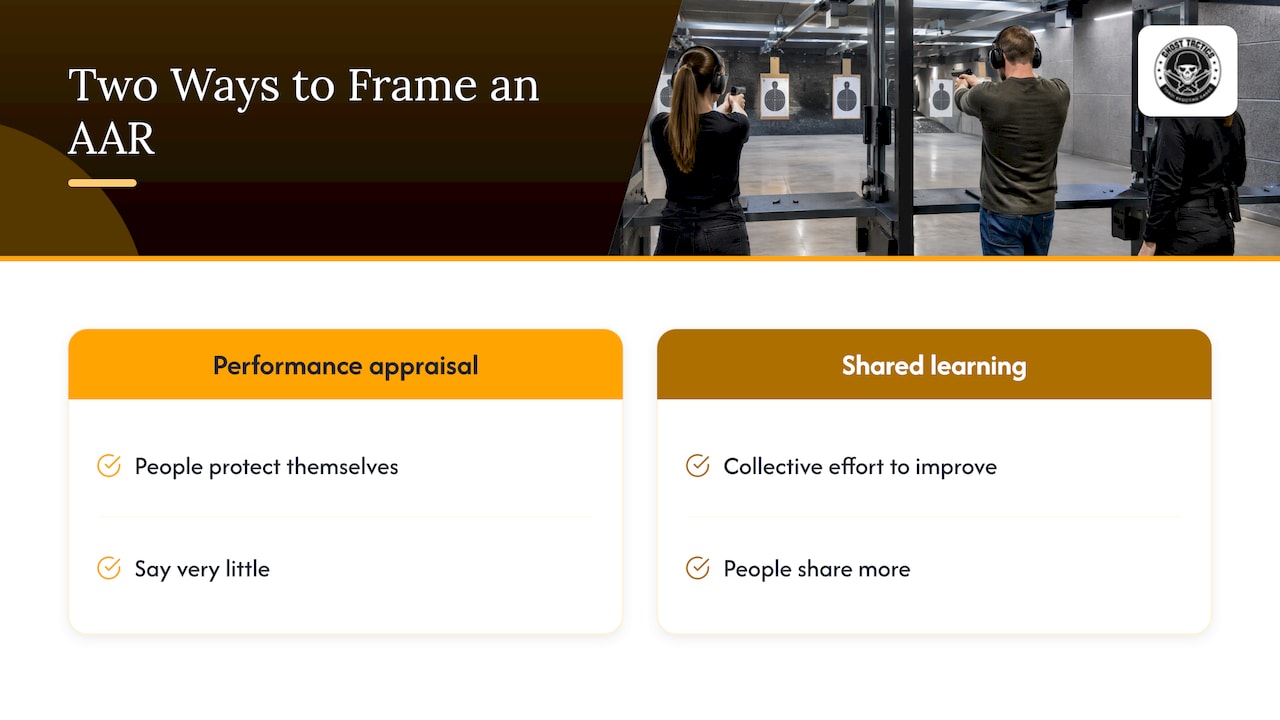
That last point matters most in practice. If people believe the session is a performance appraisal, they will protect themselves and say very little. If they believe it is a shared effort to get better, they will tell you things no report would capture.
The questions look simple, and that is the point. People In Need’s guidance notes state that all AARs ask four fundamental questions:
Other organizations phrase them differently, but the logic is identical. Wharton’s version asks what you intended to accomplish, what you did, why there was a difference between strategy and execution, and what you will do to adapt or repeat your success. The Gates Foundation’s tool uses a shorter sequence: what was supposed to happen, what did happen, what did you learn, and what will you do differently next time.
If you want a quick way to remember the flow, think of three blocks:
The second question is where most teams go wrong. People jump straight to opinions about what was good or bad. Spend the first part of the session just establishing what actually took place, in order, without judgment. Different people often remember the same event very differently, and that difference is useful information in itself.
You do not need special software or a day off site. You need a room, a facilitator, the right people and a way to record what is decided. Larger formal reviews do take far longer: the US emergency management agency FEMA outlines an eight-step process that runs about 6 to 12 months after a real-world incident. A team AAR after a project or an event is a much lighter version of the same logic. The European Centre for Disease Prevention and Control uses three stages: preparation, the review itself, and follow-up. That is a good frame for a team of any size.
Decide what you are reviewing. “The project” is too big. “The handover between sales and delivery in week three” is reviewable. Write down the original objective in one or two sentences, so everyone starts from the same intent. Pick a facilitator who can run the discussion without defending their own decisions. Where possible, gather objective records of the event: photos, schedules, messages, results, video. The Quality Improvement Center for Workforce Development reports that AARs are particularly effective when they include objective records of the event such as video or documents.
Open by stating the purpose and the rules. This is a learning session, not a complaint session. Everyone’s view counts equally. What is said stays focused on actions and processes, not on people. The WTO Library notes that the military phrase “name-less, rank-less” is used to create a safe environment where everyone can speak frankly without blaming each other. Managers should say this out loud and then behave accordingly.
Read out the objective and the plan. Ask whether everyone understood it the same way. Misaligned expectations are often the first and biggest finding.
Walk through the timeline. The Gates Foundation guide suggests giving participants a couple of minutes to think before anyone speaks, then going around the room, or asking quieter members first. This stops the most senior or most talkative person from setting the story for everyone else.
Start with strengths. It is not politeness. A team that understands why something worked can repeat it. The same Gates Foundation tool stresses that the leader should help the team look into the reasons behind success and specify the contributing factors and circumstances that other teams could adapt.
For each problem, ask “why” until you reach something you can change. “Communication was bad” is a symptom. “We had no single person who confirmed the schedule the evening before” is a cause you can fix.
The WHO’s debrief facilitator’s manual ends with a third session called “Way Forward”, where the group decides how to take the action plan forward. Do the same. Limit the list to a few actions that people actually commit to. Each one needs an owner and a date.
End by linking what you observed to the recommendations. Then put a follow-up in the calendar, so the actions are checked within a few weeks. Without this step, the review is a pleasant conversation and nothing else.
When. Hold the review at a natural milestone or soon after the activity finishes, while memories are fresh. The Asian Development Bank guide describes the AAR as a tool used when a critical milestone has been reached, so the team closest to the work can discuss successes and failures openly and carry the lessons into the next phase. That gives you several natural triggers:
APQC recommends building reviews into project phases, stage gates and roles, so they happen by default instead of when someone remembers. Do not wait for a failure. Reviewing a success is how a good result becomes a repeatable one.
Who. The WTO Library describes the AAR as a short meeting involving all team members involved in that action. In practice that means:
Keep it small enough that everyone can speak. Six to ten people works well. For bigger groups, split into smaller circles and collect the main points afterward.
Honesty is the whole value of the exercise, and it does not appear by itself. APQC stresses that honest reviews depend on psychological safety: a shared belief that the team is safe for speaking up and admitting what you would do differently.
A few habits build that safety:
A review that produces no document is forgotten by the following week. Keep the record short: one page is enough.
| Section | What goes in it |
|---|---|
| Objective | One or two sentences on what the activity was meant to achieve |
| What happened | Three to five key facts, in order |
| Sustain | What worked and why, so it can be repeated |
| Improve | The causes of problems, not just the symptoms |
| Actions | Owner, task, deadline |
| Follow-up date | When the team checks progress |
Share the page with the participants first and then, if it helps others, with the wider organization. APQC points out that the value of an AAR comes from reuse: when the next team can find and apply what you learned, the organization avoids repeating the same mistakes and repeats its successes. Store the pages in one place that people can search, and refer to them at the start of the next similar project.
Team events are an ideal subject for a first AAR. Everyone shared the same experience, nobody’s career depends on the result, and the lessons about communication and teamwork carry straight back to the office.
Imagine a department of twelve people that spent an afternoon on a team activity and meets two days later for a 45-minute review.
Objective. “Get the new sales and support colleagues working as one group, and leave everyone feeling more confident speaking up.”
What actually happened. Participants recall that the groups formed by department at the start, that instructions were clear but one team misunderstood the scoring, and that the most hesitant colleagues became the most engaged once they had completed the first task.
What went well, and why. The mixed pairs worked because each person had a defined role. The short safety briefing at the beginning gave everyone the same footing, regardless of experience.
What can be improved. Teams self-sorted by department because nobody had assigned them. The scoring rules were explained once, verbally.
Actions.
Notice that none of the actions is about a person. Each is a process change that someone can do and someone can check.
The best reviews are built on a recent, shared, concrete experience in which everyone had the same task and the same information. A supervised session at a shooting range is a good example, which is why many teams in Tallinn choose it for corporate events. At Tondi Lasketiir, no experience is required, every session is supervised by professional instructors, safety training is included, and the range is indoors, so the group starts from the same point whatever each person’s background. We offer a wide selection of firearms, and our events are built around communication, teamwork and individual confidence, the same themes a good review brings out afterward.
If you plan this kind of event for a company, these pages go deeper:
To get a review structure right, it also helps to understand the event itself. Our guide on how to diagnose shooting errors and fix them uses the same logic of comparing intention with result and looking for the cause.
If you want a shared experience your team can review together, our corporate formats on the events page cover several needs. The “Turvaline ettevõte” security-awareness package starts from 80 EUR per person. “Vali ise kolleegidele pakett”, where you choose the content for your colleagues, starts from 25 EUR per person. We also run an introductory drone training for companies, from 85 EUR per person. All sessions take place at our indoor range in Tallinn, under the supervision of professional instructors, with safety training included and no prior experience needed. Planning a larger group? Our guide to what a team event costs at the range will help you set a budget.
The evidence for AARs is encouraging. The QIC-WD summary of research reports that AARs have positive effects on attitudes such as satisfaction and confidence, on knowledge, on processes such as communication, leadership and teamwork, and on task performance. The same summary notes that longer AARs of more than 20 minutes are more effective for individual reviews than for team ones. So for a team, keep the session tight and well structured, and spend the time you save on the action list.
Those benefits line up with what most organizations want from team activities in the first place: better communication, more confidence and smoother cooperation. Combining a memorable shared event with a structured review is a simple way to capture them.
The four questions are: what was supposed to happen, what actually happened, what went well and why, and what can be improved and how. Work through them in that order. Establish the facts before you discuss causes or solutions.
For a team after a project phase or an event, 30 to 60 minutes is usually enough. Informal debriefs can be shorter. Large formal reviews after major incidents are a different undertaking and can take months.
Do it soon after the activity or at a project milestone, while people still remember the details. Good triggers include the end of a phase, a customer event, a training day, or any surprising result, positive or negative.
Invite the people who took part in the activity, the person who set the objective, and a neutral facilitator. Keep the group small enough that everyone can speak, and ask the most senior person to speak last.
No. It focuses on the activity and the process, not on individual performance. The WHO describes it as a constructive, collective learning opportunity and not an external evaluation of individuals or teams.