Terms and conditions

Tondi Shooting Range user and customer conditions

Purpose:
1.1. The purpose of these User and Client Terms and Conditions is to provide the principles of the Shooting Range User Agreement with respect to the Client using the Shooting Range services.
1.2. The user and customer conditions apply to the contract entered into upon purchase of the Visiting Card and the one-time service.

Key terms:
2.1. In the Terms of Use and Customer, the following terms are used with the following meanings:
2.1.1. "Booking Rules" - the part of the user and customer conditions that stipulates the procedure and conditions of pre-registration when purchasing the service;
2.1.2. „Lasketiir“ - service provider Tondi Lasketiir OÜ;
2.1.3. "Customer" - a person using the services of the Shooting Range on the basis of purchasing a Visiting Card or a one-time service;
2.1.4. "Visiting Card" - a multiple card of the shooting range for a regular customer;
2.1.5. "Shooting Package" - the service offered by the Shooting Range, the rights of which are defined in the Price List and provided on the Shooting Range website.
2.1.6. "User and Customer Terms and Conditions" - these User and Customer Terms and Conditions, which apply to the Customer using the services of the Shooting Range in case of purchasing a Visitor Card or a one-time service.

Use of a shooting range
3.1. The Client has the right to use the Shooting Range and the services offered therein in accordance with the conditions set out in his Shooting Package or in accordance with the conditions valid for the Visiting Card. When using the Shooting Range, the Client follows the instructions of the Shooting Range staff.
3.2. The shooting range services are provided only by persons authorized by the shooting range. The Client is prohibited from providing any services to the Shooting Range to third parties without the written consent of the Shooting Range.
3.3. The shooting range can be used by persons from the age of 16. Persons aged 12-15 (incl.) Use the Shooting Range only with an adult and / or consent (eg Shooting Packs "Junior and Senior", "Children's Birthday" or "Youth Birthday"). Persons under the age of 12 are not allowed to use the Shooting Range.
3.4. The client can access the Shooting Range on the basis of a previous reservation. The shooting range has the right to demand the presentation of an identity document to confirm a previous reservation and / or to confirm the age of the Customer.
3.5. If the Customer is not able to use the service offered by the Shooting Range at the time previously booked, he must cancel his reservation in accordance with the procedure provided in the "Booking Rules".
3.6. The Client who does not have a reservation can use the services offered by the Shooting Range only if there are free times.
3.7. The shooting range has the right to make changes in the Shooting Packages and other services offered at any time.
3.8. For extraordinary or reasons beyond the control of the Shooting Range (eg in case of an instructor's illness, bomb threat, fire, accident, their danger, etc.), the Shooting Range has the right to cancel the times previously reserved for the use of the service or restrict the use of the service. The Client will be notified as soon as possible.
3.9. The staff of the shooting range advises and instructs the Client on issues related to the use of the services provided, including the equipment, and keeps the used equipment in working order. The client uses the equipment according to its intended use and instructions received from the shooting range staff.
3.10. The Client behaves in accordance with good manners in the Shooting Range and treats the property in the Shooting Range prudently. Smoking and the consumption of alcohol or stimulants are not allowed in the shooting range. Pets are not allowed on the shooting range. The personnel of the Shooting Range have the right to temporarily remove the Shooting Range from the Shooting Range or to file a claim for damages in violation of any previous obligation or rule.

Terms of purchase and sale
4.1. The Client of the Shooting Range pays the Shooting Range for the service on the basis of an invoice according to the amount of fees provided in the price list. It is possible to pay for the service in cash or by bank card at the shooting range on site. On the website of the shooting range, it is possible to pay for the time via a bank link.
4.2. In the event of a delay in the payment of any fee under the Agreement, the Shooting Range has the right to demand late payment interest of 0.15% of the amount payable per day for each day of delay in payment until full payment of the amount due.
4.3. The shooting range has the right to withdraw from the sales contract entered into via the e-store and not to deliver the ordered goods or provide the service in the following cases:
- the goods have run out of stock;
- the price or features of the goods have been displayed incorrectly in the e-shop due to a system error;
- if the Client does not meet the conditions established by the Shooting Range.
4.4. If it is not possible for the Shooting Range to fulfill the order, the Shooting Range will contact the Customer and return the paid amount when the Customer has managed to make an advance payment for the goods.
4.5. The delivery partner of the shooting range is Itella Estonia OÜ (Itella SmartPost). The maximum delivery time is 8 working days. The ordered product is delivered via the parcel machine service.


Payment
5.1. The prices of the products sold in the shooting range online store are given in Euros without transport costs. VAT will not be added. Prices in the online store and sales showroom in Tallinn may differ.
5.2. Payment can be made via Swedbank, SEB Pank, LHV Bank, Luminor, Pocopay and Coop Pank Internet Bank. Also Paypal
CLOSE

Frequently Asked Questions

With which public transport are it possible to come from the center of Tallinn to the Weapons and Tactics Training Center?

Trams no. 3 and 4, stop “Tondi”
b. Buses no. 5, 18, 36, stop “Kalev”
c. Taxi – Be sure to add an approximate cost.


What is SLICE?

The SLICE payment method allows you to pay interest and service fees in three equal installments for purchases of € 75-800. You don’t pay a cent more than the actual cost of the product! You can choose the SLICE payment method in the last stage of the purchase, ie on the checkout page, if the purchase amount is between 75-800 euros. You will make the first installment only one month after the purchase and the second and third installments in the following months. Paying with SLICE is quick and easy. The purchase is confirmed in a few moments and there is no need to sign a credit agreement. The option to pay with the SLICE payment method is marked with the SLICE logo on each product!

The service is provided by Inbank AS

CLOSE
en
Drone Operation Training in Estonia: What You Need

Drone Operation Training in Estonia: What You Need

21.11.2026

Good drone operation training in Estonia has two parts: the official knowledge certificate your drone may require, and real flight practice with someone who can correct you. The certificate comes from the national authority, Transpordiamet. The flying skill comes from hours at the controls. At Tondi Shooting Range in Tallinn, our drone training for companies (Esmane droonikoolitus ettevõttele) starts from €85 per person and puts you at the controls in a supervised, indoor setting, with no experience required.

This guide is for beginners, visitors to Estonia and teams from Estonia, Finland, Sweden, Denmark and the UK who want to know what to learn, what the law asks, and how to get practical skills fast.

Tondi Shooting Range
Build Practical Drone Flying Skills
Tondi Shooting Range offers supervised, indoor company drone training with professional instructors, combining hands-on practice with safety training.

Visit

TL;DR

  • Drones under 250 g, or drones with a C0 label, need no formal exam in Estonia. Heavier drones without a C0 label need A1/A3 competence, which you earn through Transpordiamet’s online exam.
  • Passing a theory test does not teach you to fly. Hovering, precise turns, landings and emergency reactions come from supervised practice.
  • Our company drone training starts from €85 per person, and sessions are supervised by professional instructors with safety training included.
  • Before every real flight, check the official drone map, stay in sight of your drone and keep below 120 m.

Table of Contents

What “drone operation training” actually covers

People use the phrase for three different things, and mixing them up is the most common beginner mistake.

  1. Legal competence. Knowing the rules and, for heavier drones, holding a certificate.
  2. Operator registration. A separate obligation for the person or company responsible for the drone.
  3. Practical flying skill. The hands-on ability to keep a drone steady, plan a flight and react when something goes wrong.

The first two are paperwork you complete with the authority. The third is what makes you safe, and it is where most beginners need help. Online courses cover theory well. They cannot watch your thumbs on the sticks.

What Estonian rules require before you fly

Estonia applies the European open-category rules. Here is what a beginner needs to know, according to Transpordiamet’s drone guidance.

  • You must keep the drone in visual line of sight (or use an observer).
  • The maximum height is 120 m, and local restrictions can set a lower limit.
  • You may not carry dangerous goods or cause harm to people or property.
  • Remote pilots in the open category must generally be at least 16, with exceptions such as C0-marked aircraft and flights under qualified supervision.

Do you need a certificate?

It depends on the drone. Formal training and an exam are not required for drones under 250 g or for C0-marked drones, though you must know the manufacturer’s instructions. Drones of 250 g or more without a C0 marking need remote-pilot competence.

Since 1 January 2024, drones without a class label can fly in subcategory A1 if they weigh up to 249 g, or in A3 if they weigh 250 g or more.

The A1/A3 online exam

For most beginners with a mid-size consumer drone, A1/A3 is the relevant certificate. According to the authority’s certificate page, you study its learning materials, apply through its LOIS system, pay a €10 state fee and pass an online multiple-choice exam of 40 questions with at least 75% correct.

The A2 certificate is a step up. EASA explains that A2 requires the A1/A3 training and exam, declared practical self-training and an additional theoretical exam. It matters if you want to fly closer to people: the standard distance from uninvolved people is 30 m, which can be reduced to 5 m with low-speed mode under the applicable conditions.
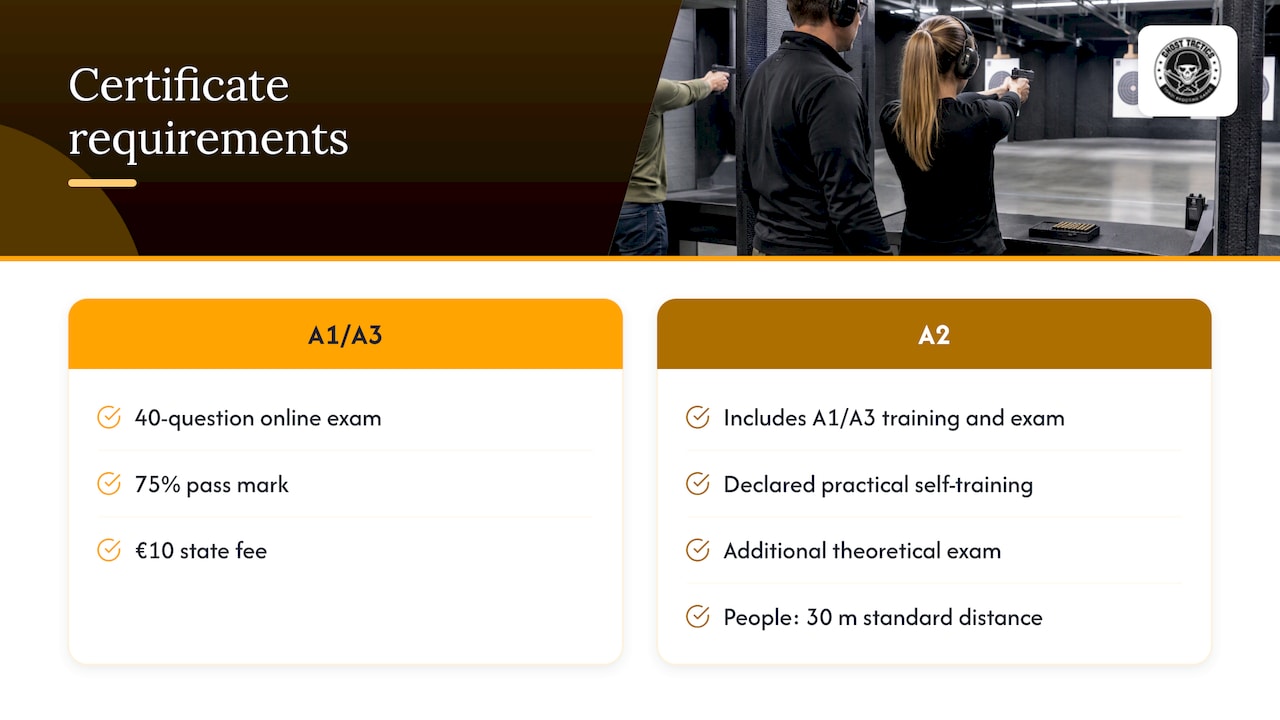
A1 A3 and A2 exam requirements compared

If you plan flights beyond visual line of sight or above 120 m, you are in the specific category, which the Estonian Aviation Academy treats as a different level of operation from beginner flying.

For a plain-language walk-through of the rules for residents and visitors, see our guide to drone laws in Estonia.

Registration is separate

Competence is about you. Registration is about the operator. Registration is required for open-category drones of at least 250 g or capable of transferring more than 80 joules on impact, for most drones with sensors that capture personal data, and for all specific-category operations, with stated exceptions for toys and drones under 250 g. A company can register as the operator. The operator number is valid for one year, and issue and renewal each cost €10.

Our step-by-step page on registering a drone in Estonia through LOIS covers the process.

Why flying practice matters more than the exam

A multiple-choice test confirms you know that you must keep line of sight. It does not tell you what to do when a gust pushes the drone toward a wall or a person walks into your landing area.

The European practical-skills guidance, published through Transpordiamet, gives a useful picture of what real training includes:

  • take-offs and landings
  • stable hovering
  • precision maneuvers inside a defined area
  • coordinated turns
  • straight flight at a constant altitude
  • changes of direction, height and speed
  • following a path and returning home
  • contingency exercises, such as a person entering the area or another aircraft approaching

The same guidance says to repeat flights until your skills are reasonable, and to practice on an aircraft with similar flight characteristics, control scheme and weight to the one you will actually fly. Two lessons follow. Skill builds with repetition, not with reading. And the best practice is on a machine that feels like your own.

Is it hard to learn?

Most people find the basics easier than expected. A drone holds itself steady for you, so the first minutes are about gentle inputs rather than force. What takes time is judgment: reading wind, planning around obstacles and staying calm when something unexpected happens. The official guidance does not set a fixed number of hours. It says to fly as many times as you need to gain reasonable skill, and that is the honest answer.

Safety checks that apply to every flight

Trained pilots build habits before they build tricks. These come from the official sources and apply whether you fly in Tallinn or elsewhere in Estonia.

  1. Check the drone map. Restrictions are location-specific and may set a lower ceiling than 120 m. Transpordiamet advises checking before each flight. Our page on checking the map and staying below 120 meters shows how.
  2. Confirm your competence and registration. Do this before you pack the bag, not at the launch site.
  3. Inspect the aircraft. The practical-skills guidance lists aircraft condition, secured removable parts, software status, battery suitability and a working control link.
  4. Plan location, altitude and time. The Estonian Data Protection Inspectorate’s joint guidance recommends planning in advance and keeping spectators and uninvolved people at a safe distance, marking the launch and landing area if needed.
  5. Respect weather. The Estonian Aviation Academy warns that cold reduces battery endurance and wind affects performance. That matters in an Estonian winter.

If you are visiting, our overview of flying a drone in Tallinn puts these checks in a local context. Our drone safety in Estonia page covers the latest alerts.

Practical drone training at Tondi Shooting Range

Tondi is the largest shooting range in the Baltic region, and alongside firearms training and team events we offer drone technology sessions. The point is simple: you learn to control a drone by flying one, with a professional instructor next to you, in a controlled indoor space.

What that gives you:

  • No experience required. Sessions start from zero.
  • Professional supervision. Every session is supervised by professional instructors.
  • Safety training included. You start with safety, not tricks.
  • Indoor setting. Wind, cold batteries and rain do not cancel your session, which matters from October to March.

Our sessions fit three kinds of visitors. Teams get a shared challenge in which communication decides who succeeds. Tourists and groups of friends get an unusual activity they cannot do at home. Security-minded teams can look at our drone training for security teams, which covers indoor FPV tactics in five modules.

For events where the group wants to fly the same day, see our event drone safety course.

Not a replacement for the official certificate

The A1/A3 exam is a step the law gives to Transpordiamet. You complete it with the authority, online, for a €10 fee. Our training is where you build the flying habits that the certificate assumes you will develop.

Corporate drone training: how to organize it

Companies search for this for two reasons. Some need staff to operate drones at work. Others want a team activity with real skill content. In both cases the organization matters.

For employers who operate drones, Transpordiamet’s operator guidance says an operator with more than one remote pilot should write operating procedures, name a responsible remote pilot for each operation, and make sure pilots and support staff know the manual, procedures and competence requirements. It also recommends keeping flight logs and requires the operator to address possible radio interference with the control link.

A group session is a practical way to start. Everyone flies the same exercises, instructors watch each pilot, and the company sees who has the temperament for operational work. It also works as team building: a drone challenge forces clear instructions, patience and shared responsibility.
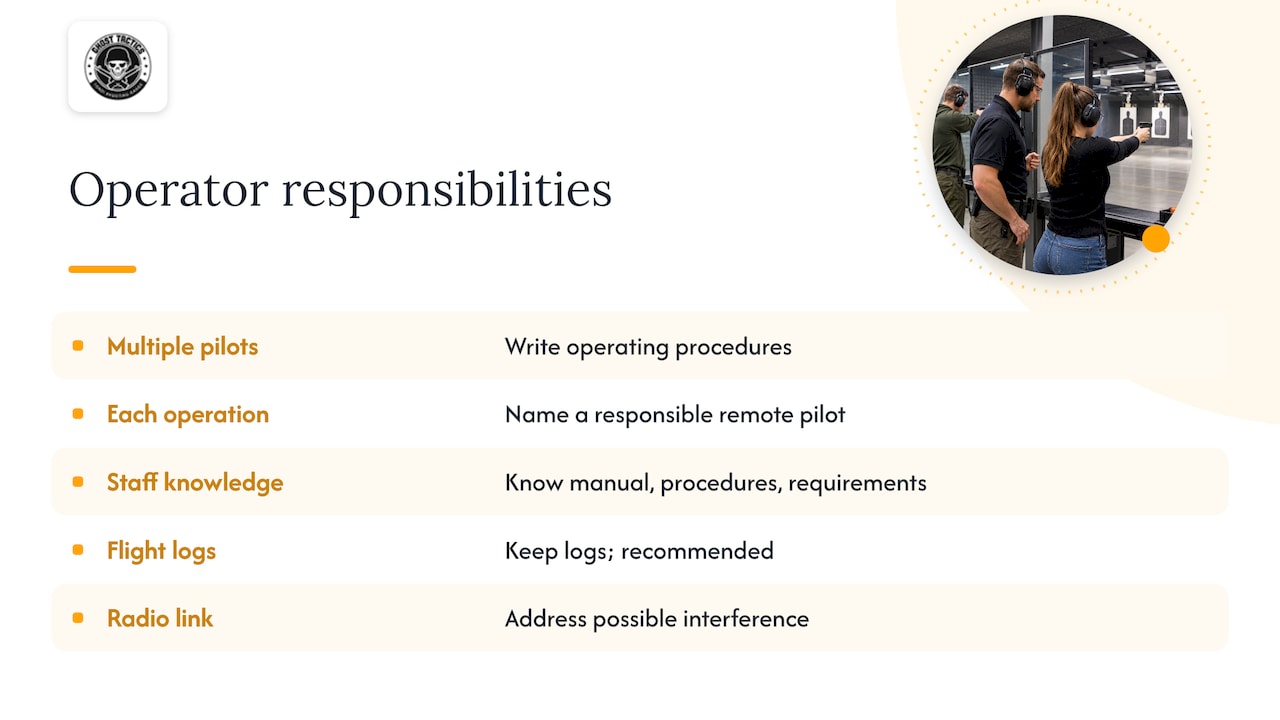
Corporate drone training: how to organize it

What it costs

Our Esmane droonikoolitus ettevõttele (initial drone training for companies) starts from €85 per person. The Turvaline ettevõte (Safe Company) package starts from €80 per person, and Vali ise kolleegidele pakett (choose-your-own colleague package) from €25 per person. Details are on our group events page. For budgeting a full team day, read our corporate event cost guide and our overview of team building in Tallinn. The winter indoor team events page helps if you are planning for the dark months.

A simple path from beginner to confident pilot

  1. Pick your drone class. Under 250 g or C0-labeled means no exam. Heavier means A1/A3.
  2. Register as operator if your drone falls into the registration categories. It costs €10 and lasts a year.
  3. Take the online exam if your drone needs it: 40 questions, 75% to pass.
  4. Practice with an instructor. Do the exercises listed above until they feel automatic.
  5. Rehearse on a simulator between sessions. Our guide to the best drone simulators explains how to set up your controller.
  6. Check the map and the weather before every real flight.

Step four is where a Tondi session fits. If you want to try it as a gift, our gift cards include several packages, listed on the gift card page.

Book your session

If you want to fly with an instructor beside you, our group drone training is the place to start. Choose a format and book on our group and corporate events page, or tell us your group size and we will help you plan it. Planning a team day that mixes drones and shooting? Our corporate planner’s safety guide explains how events run at Tondi, and our range offers a wide selection of firearms for groups that want both experiences.

FAQ

Do I need a license to fly a drone in Estonia?

Not always. Drones under 250 g and C0-marked drones need no formal exam. Heavier drones without a C0 label need A1/A3 competence, earned through the authority’s online exam. Registration is a separate duty for many drones.

How much does the A1/A3 exam cost?

The state fee is €10, and the exam is an online test of 40 multiple-choice questions with a 75% pass mark. The fee is listed on Transpordiamet’s certificate page.

Can complete beginners join your drone training?

Yes. No experience is required, sessions are supervised by professional instructors, and safety training is included. The session is held indoors, so weather does not interfere.

How much does corporate drone training cost?

Our initial drone training for companies starts from €85 per person. Other group packages start from €25 per person, depending on the format you choose.

What is the 1:1 rule for drones?

There is no official rule by that name in the Estonian guidance we use. The rules that apply are keeping the drone in visual line of sight, flying at most 120 m high (or lower where local limits say so) and checking the drone map before each flight.

Sources