Nearly 75 Years Later: Why the 1911 Still Matters at the Range
- Mo-Su 10.00 – 20.00
- +372 555 85 416
- sale@laskmine.ee




The shooting merit badge is a Scouting America award that certifies a Scout has learned safe firearms handling, marksmanship fundamentals, and shooting discipline under certified supervision. Known formally as the Rifle Shooting merit badge, it is one of the most structured and safety-intensive badges in the entire merit badge program. Scouts work with .22 caliber rifles, air rifles, or muzzleloading rifles to meet specific scoring standards. The badge is governed by Scouting America standards and requires NRA-certified instructors on-site for every live-fire event. Earning it means a Scout has done far more than pull a trigger.
The Rifle Shooting merit badge is a formal recognition that a Scout has mastered the core principles of marksmanship, firearm safety, and responsible gun handling. It sits within Scouting America’s broader merit badge shooting program, which covers everything from range commands to rifle maintenance. The badge is not a casual activity. It is a structured curriculum with documented requirements, certified oversight, and measurable performance standards.
Scouts choose one of three shooting platforms to complete the badge: modern .22 caliber rifles, air rifles (BB or pellet), and muzzleloading rifles. Each platform has its own scoring targets and proficiency thresholds. The air rifle path is especially useful for younger Scouts or those without prior experience, since it teaches the same fundamentals as live-fire shooting in a lower-stakes environment.
The badge also covers firearm history, ammunition types, and the ethical responsibilities that come with handling a weapon. Scouts learn range commands, proper shooting positions, and how to clean and store a rifle safely. This breadth is what separates the shooting sports merit badge from a simple target-shooting activity.
The shooting badge requirements are specific, measurable, and non-negotiable. Scouts must demonstrate both knowledge and skill before a merit badge counselor signs off on completion.
The core shooting requirement is five groups of five shots on approved targets. The scoring threshold depends on the target type used:
Each group must meet the minimum score to count. Scouts who fall short on a group must repeat it. This standard pushes Scouts to develop real consistency, not just occasional accuracy.
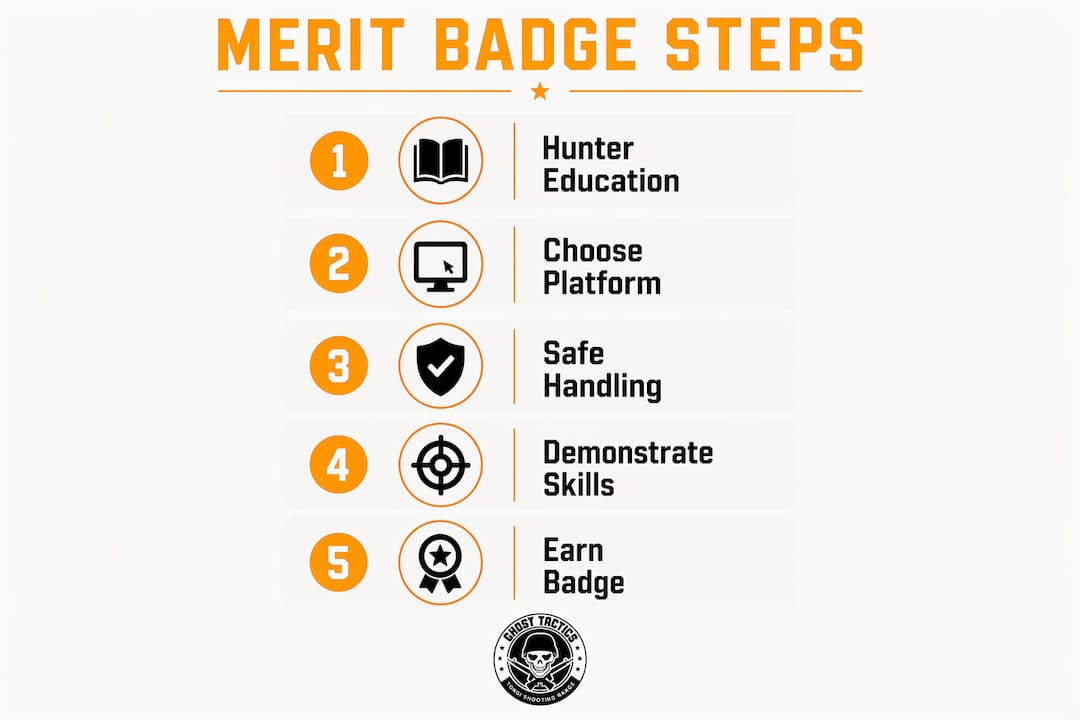
A state-recognized hunter education course or documented knowledge of local hunting laws is mandatory before any live-fire shooting begins. This requirement connects marksmanship to legal responsibility. Scouts learn that owning and operating a firearm carries obligations that extend well beyond the range.
Beyond shooting scores, Scouts must also:
These requirements make the merit badge shooting program one of the most thorough youth shooting certifications available in the United States.
| Requirement | Details |
|---|---|
| Shooting platform | Choose from .22 caliber rifle, air rifle, or muzzleloader |
| Scoring standard | Five groups of five shots meeting target-specific point thresholds |
| Legal prerequisite | Hunter education or state hunting law knowledge |
| Safety knowledge | Range commands, safe handling, and storage rules |
| Rifle maintenance | Cleaning and basic upkeep after shooting sessions |
The biggest barrier to hosting a scout shooting badge event is not the badge itself. It is meeting the strict safety and certification requirements that Scouting America mandates for every live-fire activity.
Since September 1, 2024, every Scout unit must have at least one adult who has completed the online Range Activity SAFEty training. That online training, however, does not replace the need for certified personnel on the range. NRA-certified Firearms Instructors and Range Safety Officers must be physically present during all shooting activities. Units that rely solely on the online training for live-fire events get shut down.
Program Hazard Analysis, known as PHA, is another requirement that many new leaders overlook. PHA documentation identifies and mitigates risks before a shooting event takes place. Skipping this step is a compliance failure, not just a safety gap.
Pro Tip: Book your NRA-certified instructor and Range Safety Officer at least six to eight weeks before your planned shooting event. Certified personnel are in high demand, and last-minute requests frequently result in cancellations.
The supervision requirements exist for a clear reason. Firearms are unforgiving of mistakes. Certified oversight creates a structured environment where Scouts can focus on learning without unnecessary risk. Laskmine, for example, operates with certified instructors who understand both the technical and safety sides of professional shooting instruction.
Commercial ranges are also a valid venue option. Certified commercial ranges can host merit badge shooting activities as long as all Scouting America safety and certification criteria are fully met. This opens up more scheduling flexibility for units that do not have access to a council-owned range.
The shooting merit badge is designed as a disciplined introduction to focus, patience, and respect, not just a shooting activity. That distinction matters. The skills Scouts develop on the range transfer directly into everyday life.
Marksmanship demands concentration. A Scout who learns to control breathing, steady a sight picture, and squeeze a trigger without flinching is practicing the same mental discipline required for academic focus, athletic performance, and professional work. These are not abstract benefits. Scout leaders consistently observe that Scouts who complete the shooting skills merit badge show measurable improvements in patience and self-control.
Respect for firearms is another core outcome. Scouts who handle rifles under certified supervision develop a realistic understanding of what firearms can and cannot do. That understanding replaces fear or recklessness with informed caution. It is one of the most practical safety lessons a young person can receive.
The badge also builds accountability. Scouts are responsible for their own scores, their equipment, and their behavior on the range. There is no team to absorb individual mistakes. That personal accountability is a character-building experience that few other merit badges replicate at the same intensity.
Preparation separates Scouts who complete the badge on their first attempt from those who need multiple sessions. These steps make the process straightforward.
Pro Tip: Review the shooting fundamentals of sight alignment and trigger control before your first session. Scouts who understand these concepts before they pick up a rifle progress significantly faster than those who learn them cold on the range.
The merit badge counselor meeting is often underestimated. Scouts who arrive with completed paperwork, documented hunter education, and a clear understanding of the requirements finish faster and with less stress. Preparation is the skill that makes every other skill easier.
The Rifle Shooting merit badge certifies marksmanship, firearm safety, and personal discipline under NRA-certified supervision, making it one of the most structured youth shooting certifications in the United States.
| Point | Details |
|---|---|
| Three shooting paths | Scouts choose from .22 caliber rifles, air rifles, or muzzleloading rifles to complete the badge. |
| Scoring is specific | Five groups of five shots must meet target-specific point thresholds to count toward completion. |
| Certified supervision is mandatory | NRA-certified instructors and Range Safety Officers must be present for all live-fire events. |
| Life skills are the real outcome | Focus, patience, and personal accountability are the core benefits beyond marksmanship. |
| Preparation wins | Completing hunter education and securing certified personnel early removes the biggest barriers. |
Most people outside Scouting assume the shooting merit badge is just about hitting targets. After spending time around shooting sports and youth programs, I can tell you that assumption misses the point entirely.
The badge is one of the few merit badges where a Scout cannot fake their way through. The scoring standards are objective. The safety requirements are documented. The certified instructor is watching every move. That combination of accountability and structure is rare in youth programming, and it produces something genuinely valuable: a young person who understands that a firearm is a tool that demands respect, not a prop.
What I find most compelling is how the badge handles fear. Many Scouts arrive at the range nervous. By the end of a properly run session, that nervousness has been replaced by confidence grounded in real competence. That shift does not happen by accident. It happens because the program is built around progressive skill development under expert guidance.
The certification requirements frustrate some unit leaders, and I understand why. Securing NRA-certified instructors takes planning. PHA documentation takes time. But those requirements exist because the alternative is a poorly run event where someone gets hurt. The structure is the point. Leaders who embrace it run better programs and produce better Scouts.
— Tõnis
Scouts working toward their Rifle Shooting merit badge need more than a target and a firearm. They need a certified environment where fundamentals are taught correctly from the start.
Laskmine offers shooting range access and structured training programs designed for exactly this kind of goal-oriented practice. The Tondi Shooting Range provides a professional setting where certified instruction meets real range challenges. Whether you are a Scout preparing for your first scoring session or a leader organizing a group event, Laskmine’s range programs give you the environment and expertise to get it done right. Visit Laskmine to find the training option that fits your unit’s timeline and skill level.
The official name is the Rifle Shooting merit badge, administered by Scouting America. It covers marksmanship, firearm safety, and rifle maintenance across three platform options.
Air rifles, including BB and pellet guns, are a fully approved platform for the Rifle Shooting merit badge. They teach the same core fundamentals as live-fire rifles and are a strong starting point for beginners.
A certified NRA Firearms Instructor and a Range Safety Officer must be present for all live-fire merit badge activities. Online Range Activity SAFEty training alone does not meet Scouting America’s requirements.
Scouts must fire five groups of five shots, with each group meeting the minimum score for the target type used. Groups that fall short must be repeated until the standard is met.
Commercial ranges are allowed for merit badge shooting events as long as they meet all Scouting America safety and certification requirements, including certified personnel on-site.