Best Tallinn Adrenaline Activities: Shoot at Tondi Range
- Mo-Su 10.00 – 20.00
- +372 555 85 416
- sale@laskmine.ee





Security risk awareness, means recognizing threats before they escalate and reacting with a trained, controlled response instead of panic. In practical terms, the fastest way to build that skill is through supervised firearms and tactical shooting training, where you rehearse the same scan patterns, decision points, and communication habits that keep people safe outside the range. The core outcome is sharper situational awareness and better team coordination under pressure.
The single best next step is booking a supervised course at a certified range. Estonian instructor regulation sets a minimum 80-hour training certificate for anyone teaching firearm handling, and documented sessions like Tondi Shooting Range’s IPSC Turvakoolitus dates show what real, structured practice looks like.
Situational awareness improves fastest through supervised, repetitive tactical drills led by certified instructors, not through unsupervised practice or theory alone.
| Point | Details |
|---|---|
| Core definition | Turvariskide teadlikkus, in practical terms, means firearms and tactical training that builds real-world situational awareness and decision discipline. |
| Instructor standard | Estonian regulation requires firing instructors to hold at least an 80-hour certification covering theory and hands-on handling. |
| Safety framework | OE safety rules mandate a range officer, pre-fire checks, PPE, and a rehearsed stop command before any live fire. |
| Team payoff | Corporate groups report clearer communication and faster group decisions after shared tactical drills. |
| Where to train | Tondi Shooting Range offers supervised, no-experience-required sessions at the largest indoor shooting range in the Baltic region. |
Every course starts with the same foundation: safety before speed. Once that’s solid, instructors layer in the skills that translate directly to real-world awareness.
Course formats generally fall into a few categories. An introductory safety session covers firearm mechanics and range rules for people who’ve never held a gun. An IPSC-style tactical course adds live-fire drills under time pressure. Practical shooting sessions focus on repetition and technique. Team events combine shooting stations with group challenges.
Each drill maps to a specific outcome. Malfunction clearing builds calm problem-solving. Target ID sharpens perception and cuts decision latency. Movement drills teach you to read a space instead of freezing in it. Together, they build the kind of confidence that shows up long after the session ends.
You don’t need any shooting background to walk in the door. First-time shooters, curious tourists, and couples looking for a different kind of date night all show up regularly, alongside groups with a sharper goal in mind.
Corporate teams get the most measurable payoff. Shared stress, shared instructions, and a shared goal force people to communicate more clearly than they would in a normal meeting room. A bachelor or bachelorette party gets the same adrenaline with a lighter tone. Team leaders often book sessions specifically to see how their people handle pressure and unfamiliar tasks.
Teams that go through a shared drill tend to report faster, clearer verbal commands afterward, along with quicker group decisions when something unexpected happens mid-exercise. Pairing the shoot with a short discussion on team communication afterward locks in the lesson.
Pro Tip: Book a mixed session that alternates individual drills with paired exercises. Watching a teammate handle pressure builds more trust than any icebreaker game.
Not all firearms instruction is created equal, and this is where a lot of casual range visits fall short. Estonian regulation requires anyone certifying as a firing instructor to complete at least an 80-hour instructor training program covering both theory and hands-on firearm handling. That’s a meaningful bar, and it’s the reason supervised sessions at a certified range produce different results than an unsupervised trip to a casual range.
Safety protocol matters just as much as instructor credentials. Estonia’s OE safety rules for live-fire exercises spell out mandatory roles, pre-fire checks, and stop-command procedures that every participant rehearses before firing a single round.
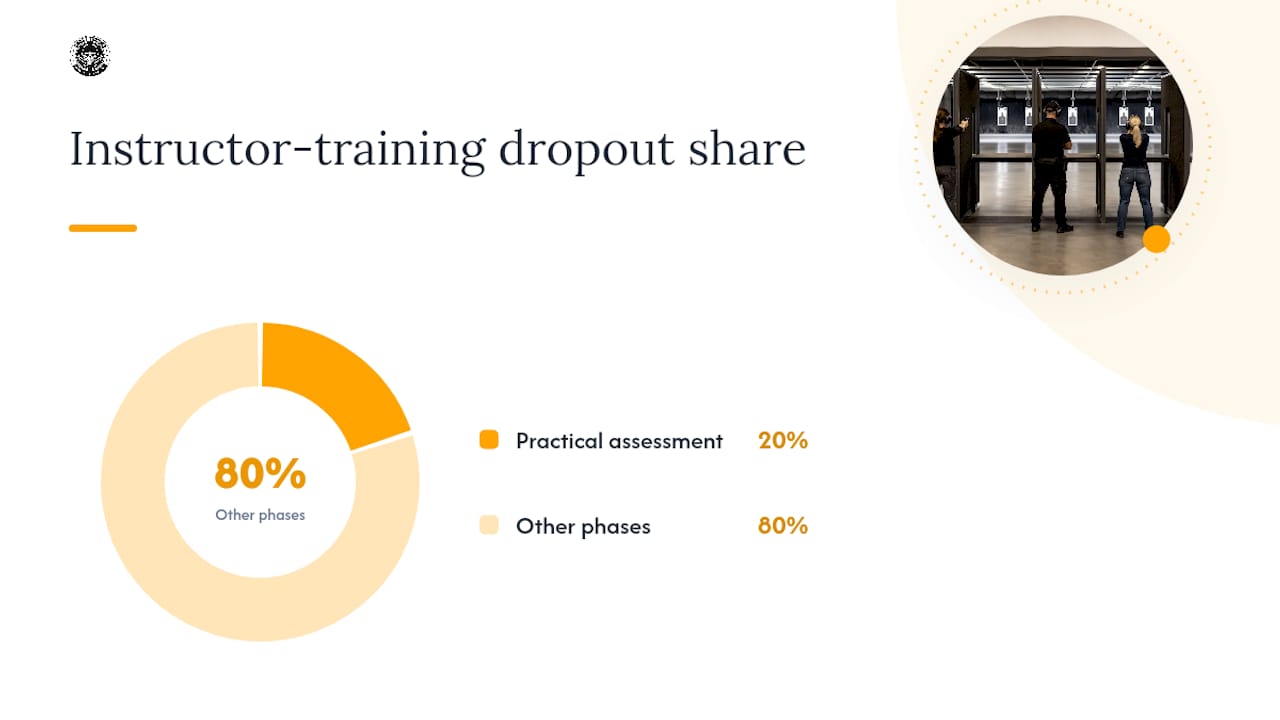
Roughly one in five course dropouts in early instructor training happens during the practical assessment phase, which is exactly the point. That assessment weeds out anyone who hasn’t internalized the stop-command reflex or basic handling discipline.
Instructor feedback is what actually converts repetition into skill. A structured supervision process with real-time correction builds the reflexes that unsupervised practice never will. Instructors watch scan patterns, correct grip and stance, and flag hesitation before it becomes a habit. That loop between drill and correction is the actual mechanism behind better situational awareness, not the number of rounds fired.
Awareness isn’t a mindset you adopt. It’s a set of trained reflexes, and each drill targets a different piece of that chain.
Progression matters here. Documentation from tactical shooting competitions shows how staged drills escalate across an event, from basic safety checks to multi-stage, high-tempo tasks. Courses follow the same logic: base-level handling first, then complexity layered in only once the fundamentals are reflexive.
Instructors typically assess progress through direct observation. Are your scan patterns automatic, or are you still thinking through each step? Is your stop-command response instant? Those questions matter more than raw accuracy scores when the goal is awareness, not marksmanship.
Pro Tip: Ask your instructor to run one drill “cold,” without a warm-up rep. It’s the fastest way to see whether a skill has actually become reflexive or if you’re just following the pattern from the last rep.
Preparation is simpler than most first-timers expect. Wear closed-toe shoes and clothing that won’t interfere with movement. A high-collared shirt is a smart choice since it keeps hot brass away from your neck. Everything else, including eye and ear protection, is provided on-site.
Sessions are supervised from the moment you walk in, and no prior experience is required at any point. Basic on-site medical readiness protocols and a designated safety officer stay in place throughout, per the same OE safety framework that governs instructor-led live-fire exercises. If you’re booking for a group, check what a first-timer needs to know beforehand so everyone arrives on the same page.
Live-fire drills expose something most people never confront directly: how their mind behaves under acute stress. Heart rate spikes, tunnel vision narrows the field of view, and fine motor control degrades. Tactical training doesn’t eliminate that stress response. It teaches you to function through it.
The mechanism is repetition paired with feedback. When a stop command triggers an instant, unthinking halt, or a malfunction clears without a flicker of hesitation, you’re watching your own nervous system get retrained to default to a procedure instead of a freeze. That shift shows up outside the range too, in how calmly someone handles an unexpected work crisis or a confrontation on the street.
Mindset development here isn’t about aggression. It’s about decision discipline: pausing to identify a threat correctly before acting, rather than reacting to the first thing that moves. Instructors reinforce this by rewarding controlled, deliberate responses over fast but sloppy ones. A participant who hesitates half a second to properly identify a target is doing exactly what the drill is designed to teach.
Corporate groups often notice this shift fastest, since the stakes feel higher in front of colleagues. Pairing the physical drills with a short discussion on psychological safety afterward reinforces the lesson: teams that feel safe speaking up about a mistake during a drill tend to catch hazards earlier, both on the range and back at the office.
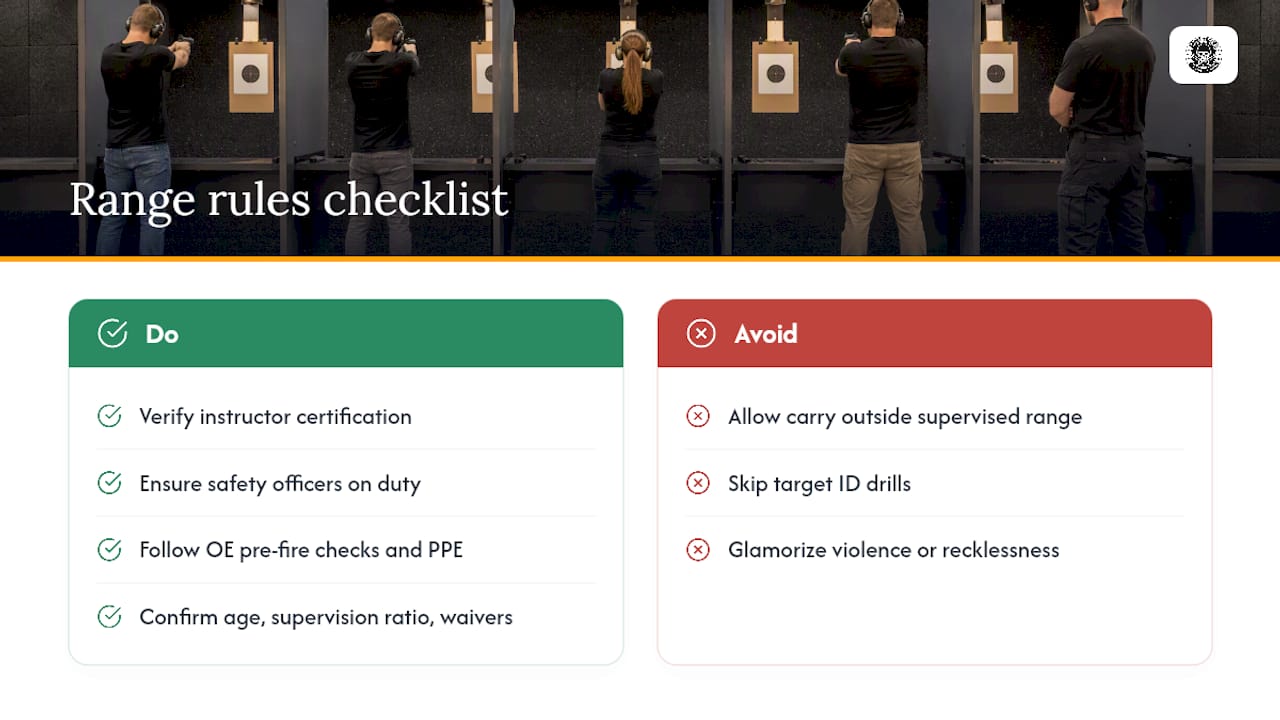
Firearms training in Estonia operates inside a defined regulatory structure, and a legitimate range makes that structure visible rather than treating it as fine print. Instructors must hold documented certification, safety officers must fill specific roles during live fire, and every session follows the OE safety framework covering pre-fire checks and PPE requirements.
The ethical dimension matters just as much as the legal one. Tactical shooting training exists to build competence and awareness, not to glamorize violence. Reputable instruction always frames firearm handling around responsibility: knowing when not to act is as important as knowing how. Target identification drills reinforce this directly, training participants to correctly distinguish a threat from a non-threat before making any decision.
Age requirements, supervision ratios, and waiver documentation are standard parts of any session, and a legitimate provider walks every participant through them before live fire begins. Groups booking a corporate or bachelor party event should confirm these details in advance, since expectations differ depending on group size and firearm selection.
Nothing in the training extends to carrying or using firearms outside the supervised range environment. The skills, awareness, decision discipline, and calm under pressure, are meant to transfer to daily life; the firearm itself stays exactly where it belongs, in a controlled, supervised setting with a certified instructor present.
Modern tactical training increasingly borrows tools from adjacent fields to sharpen the same core skills. Timing systems that measure reaction speed on a target-ID drill give instructors hard data instead of a gut impression of who’s improving. Video review of a movement-and-cover exercise lets a participant see their own tunnel vision in real time, which is often more convincing than any verbal correction.
Drone technology adds a different dimension entirely. Learning to operate and read a drone’s camera feed trains a distinct but related skill: scanning a wider field for movement and anomalies from an elevated perspective. Corporate groups that pair a shooting session with drone flight time often find the combination sharpens observational habits that carry over into the live-fire drills.
None of this replaces an instructor’s eye. Technology supplements the feedback loop; it doesn’t substitute for a certified professional watching your scan pattern and stance in real time. The tools that matter most stay simple: a stopwatch, a shot timer, and a stop command everyone in the room reacts to instantly.
Progress in this kind of training shows up in specific, observable markers rather than a single score. Instructors watch whether a stop command triggers an instant reflex or a half-second delay. They track whether target identification gets faster without sacrificing accuracy. They note whether movement drills happen with continuous scanning or with the tunnel vision that marks an early-stage participant.
Supervised practical assessments are the standard mechanism for this. Instructor courses typically conclude with a hands-on evaluation before a participant is cleared for more independent practice, and the same logic applies to shorter tactical courses: a final drill under time pressure reveals whether the earlier repetitions actually built a reflex.
For corporate teams, progress often gets measured less formally but just as clearly. Team leaders watch whether communication gets crisper across a session, whether commands get repeated back correctly, and whether the group coordinates faster on the final drill than the first one. Returning participants who book a follow-up session give instructors a direct before-and-after comparison, which is often the clearest evidence that the training worked.
If you’ve read this far, you already know that real situational awareness comes from repetition under proper supervision, not a single afternoon of theory. Tondi Shooting Range is the largest shooting range in the Baltic region, and it’s built specifically around that principle: documented IPSC Turvakoolitus sessions, certified instructors, and a facility designed to take someone from zero experience to confident, controlled decision-making.
No experience is required for any session, and every drill runs under direct instructor supervision from the safety briefing to the final shot. The range is fully indoors, so weather never cancels a booking, and the firearm selection covers everything from a first-timer’s introductory pistol to the setups used in tactical courses. Corporate groups get dedicated packages built around team communication and shared challenge, and the range’s drone flight experiences give event planners a second activity to pair with shooting for a full day of programming.
Whether you’re planning a bachelor party, a corporate offsite, or a solo session to build personal confidence, start with the general shooting session booking page to see available time slots, or head straight to the tactical shooting course page if situational-awareness training is specifically what you’re after. Corporate planners should check the team event pricing guide before booking to match group size and budget to the right package.
No. Every session at Tondi Shooting Range starts with a safety briefing and hands-on instruction designed for complete beginners, and instructors supervise every step before live fire begins.
Yes. Sessions follow Estonia’s OE safety framework, which mandates a dedicated range officer, PPE, pre-fire checks, and a rehearsed stop command that halts activity instantly if needed.
Session length varies by package, from a short introductory shoot to a full tactical course, and group size flexes to fit corporate events, bachelor parties, or private bookings.
Closed-toe shoes and clothing without loose, flowing fabric work best. Eye and ear protection is provided on-site along with all other required safety equipment.
Yes. Tondi Shooting Range pairs tactical shooting with drone flight experiences for corporate offsites and special occasions, giving groups two distinct activities in one booking.