Team Building in Tallinn: Why a Shooting Range Works
- Mo-Su 10.00 – 20.00
- +372 555 85 416
- sale@laskmine.ee




Movement in shooting training is the practice of integrating controlled footwork and body mechanics to maintain accuracy while engaging targets dynamically. Static range work builds a foundation, but it leaves a critical gap. Real shooting scenarios demand that you fire accurately while your body is in motion, and that skill requires dedicated, progressive training. The role of movement in shooting training goes far beyond simply walking and shooting at the same time. It reshapes your balance, your posture, and your ability to read and reset a threat.
Body position is the single biggest variable in shot placement. A 0.25-inch shift in foot placement can produce a 10-inch deviation at 25 yards. That number shows how much a small postural error compounds over distance.
The forward-leaning athletic stance is the standard starting point for dynamic shooting. Placing 60% of your body weight on the balls of your feet reduces muzzle rise by about 30%. Less muzzle rise means faster follow-up shots and better control during recoil.
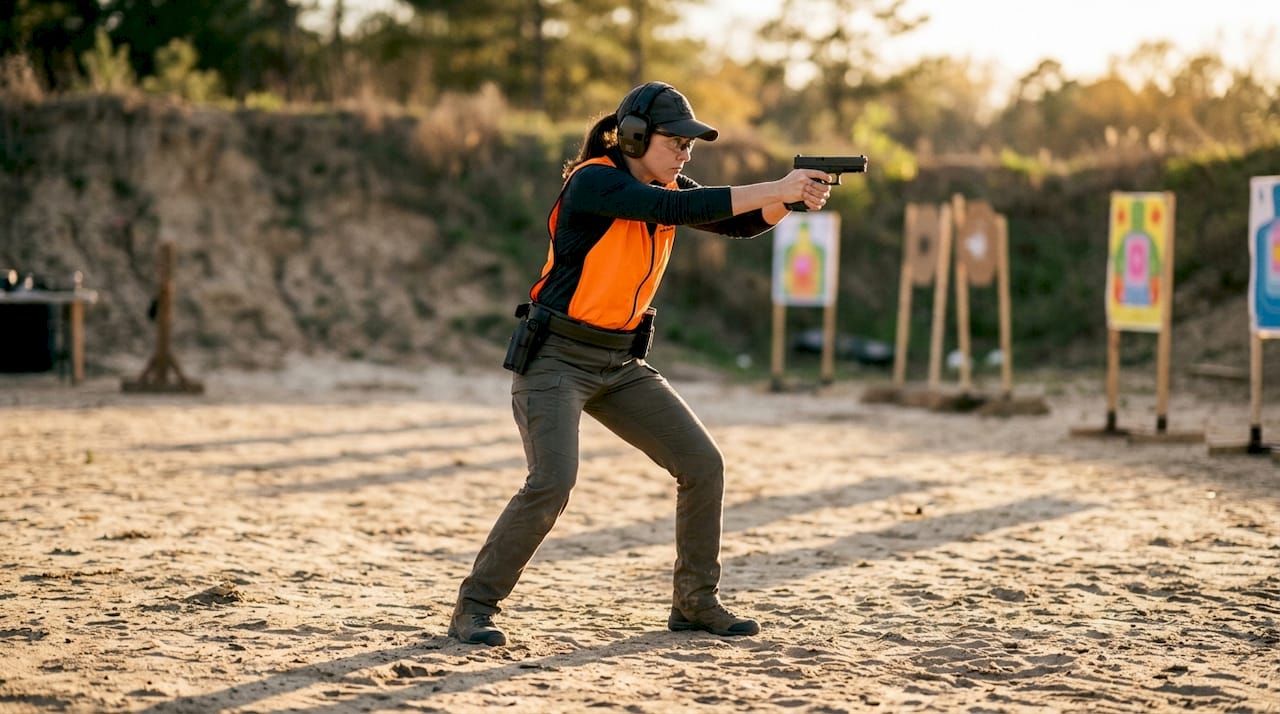
Foot placement also determines your ability to transition between static and moving positions. A staggered foot placement with your lead foot 12–15 inches ahead gives you 360-degree stability and prevents lateral sway during rapid target transitions. That stability is what lets you move without losing your shooting platform.
The impact of stance on accuracy becomes most visible under stress. When your base is weak, your whole upper body compensates. Shoulders tighten, elbows lock, and your grip pressure becomes uneven. All of those reactions degrade accuracy before you even pull the trigger.
Pro Tip: Practice your stance in front of a mirror before adding movement. If your weight shifts to your heels when you raise the firearm, your stance needs correction before you add footwork.
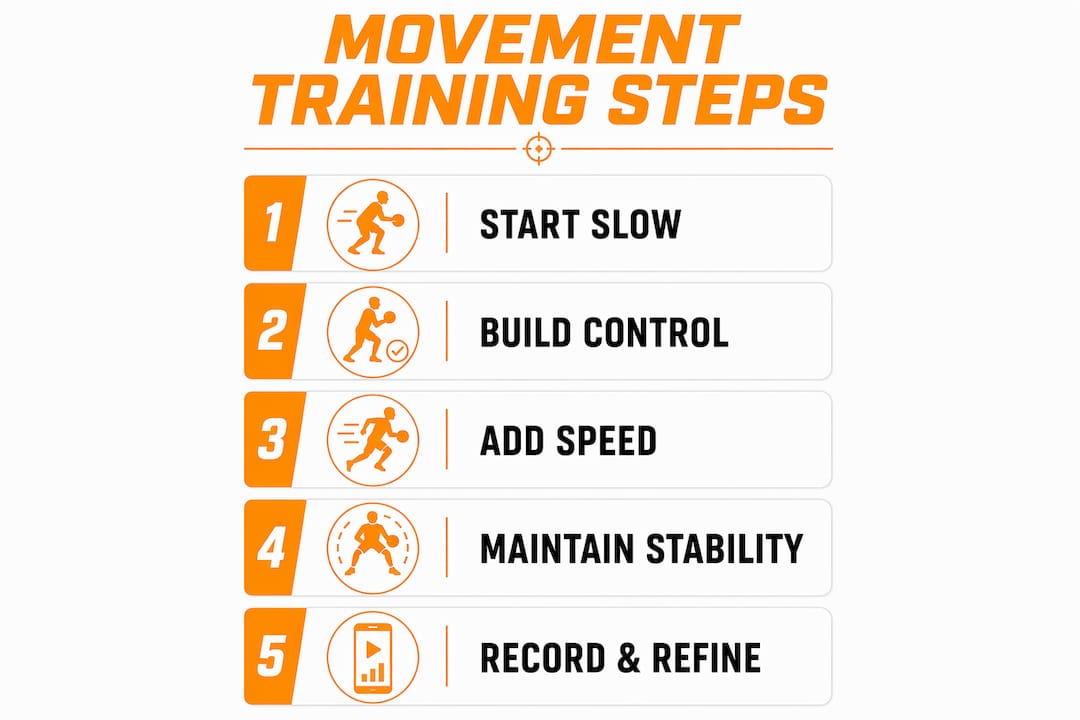
Movement techniques for shooting fall into a clear progression. You start slow, build control, and then add speed. Skipping steps in that sequence creates bad habits that are hard to break later.
The Groucho Walk is the foundational movement technique for shooters. It uses a low, bent-knee posture that keeps your center of gravity stable as you step. The Groucho Walk should progress from a slow shuffle to walking, then jogging, and eventually running to reflect real-world confrontation speeds. Each speed level demands more from your balance and timing.
Small, rhythmic steps outperform large, exaggerated strides every time. Large steps create vertical bounce, which throws off your sight picture. Short shuffle steps keep your head and upper body at a consistent height, which is exactly what you need to maintain sight alignment while moving.
Here is a practical progression for movement training:
Maintaining a smooth shooting platform from the hips up is the constant across all movement speeds. Your legs do the work of absorbing ground contact. Your upper body stays as still as possible.
Pro Tip: Record yourself from the side during movement drills. If your head bobs up and down, your steps are too large or your knees are not bent enough.
Dynamic movement training builds the muscle memory that static practice cannot. When you repeatedly fire while advancing, retreating, or moving laterally, your nervous system learns to coordinate trigger timing with your footwork. That coordination does not develop from standing drills alone.
Movement also creates a tactical advantage that goes beyond accuracy. Movement resets the opponent’s OODA loop, which stands for Observe, Orient, Decide, Act. Every time you change direction or speed, the threat must restart that decision cycle. That delay gives you time and space.
Dry fire practice is the most practical way to build cadence and timing for shooting on the move. Many ranges restrict live fire during movement drills. Dry fire removes that barrier and lets you practice the timing of trigger press relative to foot position hundreds of times per session.
The table below compares the core benefits of static versus dynamic shooting drills:
| Training type | Primary benefit | Limitation |
|---|---|---|
| Static standing drills | Builds trigger control and sight alignment | Does not prepare you for movement stress |
| Slow movement drills | Develops footwork and upper-body stability | Low speed does not replicate real conditions |
| Dynamic movement drills | Builds muscle memory for real-world scenarios | Requires more space and safety planning |
| Dry fire movement practice | Safe, high-volume cadence training | No recoil feedback |
Physical conditioning directly determines how well you can execute shooting footwork strategies. Tight hips, stiff shoulders, and a locked thoracic spine all force your body into compensated positions that degrade accuracy. Mobility in the shoulders, hips, and thoracic spine prevents unstable shooting positions and improves consistency across training sessions.
Shooters who neglect mobility training hit a ceiling. They can learn the correct technique, but their body cannot hold the position long enough to apply it under stress. Mobility work removes that ceiling.
Practical shooting movement skills rely on these specific areas:
Training volume and consistency matter as much as technique. Elite competitive shooters build to 2,000 rounds in a single month during peak preparation. That volume builds the stability and firing consistency that technique alone cannot create. You do not need to match that number to see results, but you do need regular, structured repetition.
The most common problem in movement-based shooting is firing low. Shots go low when you time the trigger press as your lead foot hits the ground. The vertical dip from that foot strike pulls the muzzle down at the moment of firing. Bent knees act as shock absorbers and reduce that dip significantly.
Lateral movement creates a different set of problems. Most shooters find it harder to engage targets while moving sideways than while advancing or retreating. Sliding the support hand back toward the magazine well during lateral movement reduces upper-body tension and improves target engagement. That small grip adjustment makes a measurable difference in control.
Pro Tip: During lateral movement drills, keep your feet from crossing. A crossover step destroys your balance and forces a pause before you can fire accurately. Use a lead-and-follow shuffle instead.
A balanced, stable stance also reduces the risk of muzzle misdirection under stress. Safety and accuracy share the same foundation in dynamic shooting.
Movement in shooting training builds accuracy, tactical advantage, and physical control that static drills alone cannot develop.
| Point | Details |
|---|---|
| Stance drives accuracy | A 0.25-inch foot shift causes a 10-inch deviation at 25 yards, making precise foot placement non-negotiable. |
| Weight forward reduces recoil | Placing 60% of body weight on the balls of your feet cuts muzzle rise by about 30%. |
| Progress speed gradually | Start with the Groucho Walk and build to jogging before adding live fire to movement drills. |
| Dry fire builds cadence | Dry fire practice is the safest and most accessible way to develop timing for shooting on the move. |
| Mobility enables technique | Shoulder, hip, and thoracic spine mobility prevents compensated positions that degrade accuracy under stress. |
Most shooters spend 90% of their range time standing still. I understand why. Static drills are measurable, comfortable, and easy to structure. But that comfort is exactly the problem.
The first time I added movement to a live fire session, my groups opened up dramatically. Not because my technique was wrong, but because I had never trained my body to hold a shooting platform while my feet were doing something else. Those are two separate skills, and they both need dedicated practice.
What changed my results was committing to dry fire movement work before touching live ammunition. I walked my apartment hallway in a Groucho Walk, pressing the trigger between steps, for weeks. By the time I brought that pattern to the range, the timing felt natural. The live fire results reflected that.
The other shift was treating mobility work as part of shooting training, not as something separate. Once my hip flexors and thoracic spine had real range of motion, my stance became more consistent and my transitions became faster. The physical and the technical are not separate categories. They feed each other.
If you are starting out, do not add speed until your slow movement is clean. A sloppy fast drill just reinforces bad habits at higher intensity. Slow is smooth, and smooth eventually becomes fast on its own.
— Tõnis
Laskmine’s Tondi Shooting Range in Tallinn is built for shooters who want to go beyond static target practice. The range offers structured programs and dynamic shooting challenges designed to put your movement skills to the test in a controlled, supervised environment.
Whether you are working on your Groucho Walk timing or ready to run full move-and-shoot courses, Laskmine provides the space, the targets, and the expert guidance to make that training count. The Zombie Weekend event at Laskmine’s Tondi range is one of the most engaging ways to apply dynamic shooting skills under pressure in a scenario-based format. Apply what you have learned here in a real training environment and see exactly where your movement skills stand.
Movement in shooting training develops your ability to fire accurately while your body is in motion. It builds muscle memory, improves tactical positioning, and forces you to coordinate footwork with trigger timing.
A forward-leaning stance with 60% of body weight on the balls of your feet reduces muzzle rise by about 30% and improves recoil control. Even a 0.25-inch shift in foot placement can cause a 10-inch deviation at 25 yards.
The Groucho Walk is a low, bent-knee movement technique that keeps your center of gravity stable while you advance or retreat. It progresses from a slow shuffle to walking, jogging, and running as your control improves.
Shots go low when you press the trigger as your lead foot strikes the ground. The vertical dip from that foot contact pulls the muzzle down. Bent knees act as shock absorbers and reduce this effect.
Dry fire practice lets you build timing and cadence for shooting on the move without live ammunition. It is especially useful when your range restricts live fire during movement drills, and it allows high-volume repetition at low cost.