How to Diagnose Shooting Errors and Fix Them Fast
- Mo-Su 10.00 – 20.00
- +372 555 85 416
- sale@laskmine.ee




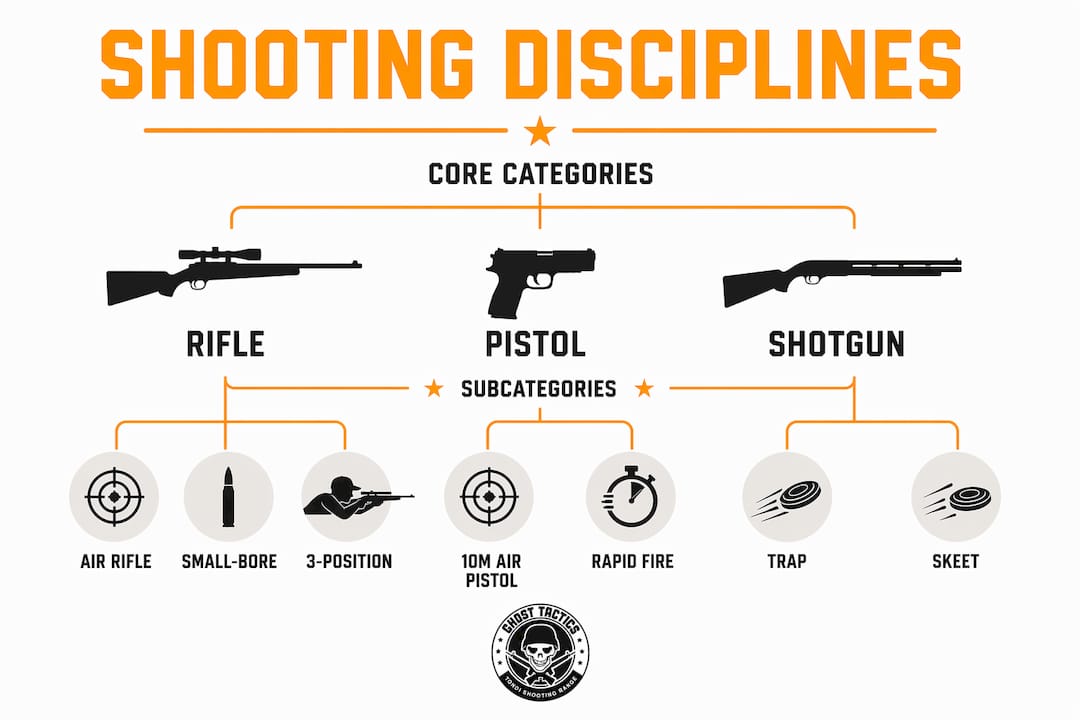
A shooting discipline is a distinct category of competitive shooting sport defined by its firearm type, target format, rules, and competition structure. The three primary categories recognized by the International Shooting Sport Federation (ISSF) and the Olympic program are rifle, pistol, and shotgun. Within those three categories sit 30+ distinct competitive formats, ranging from the stillness of 10m Air Rifle to the explosive speed of Trap shooting. Understanding what separates one discipline from another is the first step toward finding the format that fits your skills, goals, and access to equipment.
A shooting discipline is a formally defined competitive format within shooting sports, distinguished by its equipment specifications, shooting distance, target type, and scoring system. The ISSF, which governs Olympic shooting events, classifies disciplines under rifle, pistol, and shotgun. Each category contains multiple sub-disciplines with their own rules and physical demands.
The classification system exists because the skills required vary dramatically across formats. Holding a 5.5 kg air rifle steady for 60 shots over 75 minutes demands a completely different physical and mental profile than breaking clay targets flying at over 100 km/h. Grouping disciplines by category helps athletes, coaches, and facilities organize training and competition in a logical way.
Governing bodies like the ISSF set the standards that define each discipline. Those standards cover everything from firearm weight limits to target dimensions to time allowances. Without that structure, comparing performance across events or qualifying athletes for international competition would be impossible.
The three core categories cover the majority of competitive shooting worldwide. Each has its own equipment rules, scoring methods, and physical requirements.
Rifle shooting splits into air rifle (10m), small-bore (50m), and three-position events. The three-position format requires competitors to shoot from prone, standing, and kneeling positions, testing adaptability across all three stances. Rifles are weight-limited to 5.5 kg for air rifle and 8 kg for small-bore, keeping equipment advantages in check.
Scoring in precision rifle events uses a decimal system up to 10.9 per shot. A single tremor at the wrong moment can drop a score by a full point. That level of precision demands months of physical conditioning before a shooter can compete seriously.
Pistol events include 10m Air Pistol, 25m Pistol, and 25m Rapid Fire Pistol. The Rapid Fire format is one of the most demanding in all of shooting sports. Competitors fire at five targets within a time window as short as four seconds, requiring both accuracy and speed under pressure. Pistols are limited to 1.49 kg, which forces manufacturers and athletes to focus on balance and trigger quality rather than raw mass.
Shotgun events include Trap, Skeet, and Sporting Clays. Olympic shotgun targets travel at over 100 km/h and measure just 10 cm in diameter. Standard rounds consist of 25 targets per series, and competitors use 12-gauge cartridges. Equipment weight differs by event: skeet shotguns weigh approximately 2.9 kg, while trap shotguns reach around 4 kg to absorb recoil over long competition days.
The table below summarizes key attributes across the three core categories.
| Category | Distance | Target type | Key equipment spec |
|---|---|---|---|
| Air Rifle | 10m | Stationary paper | Max 5.5 kg |
| Small-Bore Rifle | 50m | Stationary paper | Max 8 kg |
| Air Pistol | 10m | Stationary paper | Max 1.49 kg |
| Rapid Fire Pistol | 25m | Multiple timed targets | Max 1.49 kg |
| Trap | Variable | Clay target, 100+ km/h | ~4 kg shotgun |
| Skeet | Variable | Clay target, 100+ km/h | ~2.9 kg shotgun |
Pro Tip: Before buying equipment, visit a range that offers multiple disciplines. Renting different firearms for a session costs far less than purchasing gear for a discipline you later decide is not the right fit.
The Olympic shooting program covers the most standardized formats, but a wide range of disciplines exist outside that framework. Many attract large participation numbers precisely because they emphasize speed, movement, and variety over strict precision.
Action shooting disciplines like USPSA (United States Practical Shooting Association) and IDPA (International Defensive Pistol Association) use a stage-based format. Competitors move through a course of fire, engaging multiple targets in a set sequence while being scored on both time and accuracy. USPSA and IDPA events blend speed with precision, often involving multiple firearms and requiring rapid decision-making that static precision events do not.
Multi-gun competitions, commonly called 3-Gun, add a rifle and a shotgun to the pistol, requiring competitors to transition between all three during a single stage. The skill set required is broad. A 3-Gun competitor needs to be competent with each firearm type and fast enough to switch between them without losing time.
Less common formats include Running Target and Target Sprint, both recognized by the ISSF but not included in the Olympic program. Target Sprint combines cross-country running with air rifle shooting, similar in concept to biathlon but using a different format and scoring system.
Key discipline examples outside the core Olympic categories:
Pro Tip: Action shooting disciplines like USPSA are excellent entry points for shooters who find static precision events too slow-paced. The stage-based format keeps sessions varied and mentally engaging from the first day.
Shooting requires significant muscle endurance and mental discipline, comparable in physical exertion to many recognized athletic events despite appearing sedentary from the outside. The specific demands vary sharply by discipline.
Precision rifle and pistol events test a shooter’s ability to maintain absolute stillness for extended periods. Mastering 10m air rifle demands muscle endurance strong enough to hold a steady aim through 60 shots, where minor tremors directly ruin scores. Athletes in these disciplines train their breathing, heart rate control, and postural stability as deliberately as any endurance athlete trains cardiovascular fitness.
Shotgun disciplines demand a completely different physical profile. Timing and movement define performance in Trap and Skeet. A competitor must track a fast-moving target, mount the gun smoothly, and fire in a fraction of a second. Shotgun shooting emphasizes timing and speed, while rifle and pistol events reward steadiness and precision.
“Shooting requires extreme stillness and physical conditioning, disproving stereotypes of it being non-athletic. Maintaining stillness over competition durations demands strength and control that most people underestimate until they try it themselves.”
Action shooting disciplines like USPSA add a cardiovascular component. Moving between positions, drawing from a holster, and engaging targets under time pressure elevates heart rate in ways that static events never do. Training for movement in shooting requires dedicated physical preparation that goes well beyond trigger time at the range.
Choosing the right discipline comes down to four practical factors: your interest in precision versus speed, your physical condition, your access to a suitable range, and your budget for equipment.
Competitive shooting improves firearm safety, handling skills, and personal performance across every format. The discipline you start with does not have to be the one you stay with. Many experienced shooters compete in two or three formats across different seasons.
A shooting discipline is a formally defined competitive format with its own equipment rules, target type, and scoring system, and choosing the right one depends on your interest in precision, speed, or both.
| Point | Details |
|---|---|
| Three core categories | Rifle, pistol, and shotgun cover the majority of competitive formats worldwide. |
| Precision demands conditioning | Air rifle and pistol events require muscle endurance and heart rate control, not just marksmanship. |
| Action shooting adds speed | USPSA and 3-Gun disciplines blend movement with accuracy, suiting shooters who prefer dynamic formats. |
| Range infrastructure matters | Not all ranges support every discipline; confirm facility capabilities before selecting equipment. |
| Start with instruction | A beginner course with a qualified instructor prevents technique errors from becoming permanent habits. |
Shooting sports attract a wider range of people than most outsiders expect. I have watched complete beginners walk into a range expecting a single, uniform activity and leave genuinely surprised by how different Trap feels from Air Pistol, or how much a USPSA stage resembles a physical puzzle more than a marksmanship test.
The variety is not just cosmetic. Each discipline genuinely develops a different skill set. Precision events build patience, body awareness, and mental focus that carry over into daily life in ways that are hard to quantify but easy to notice. Action shooting builds confidence under pressure and the ability to perform a complex physical task while managing stress. Both are worth pursuing.
My honest observation after years around shooting ranges is that most beginners pick a discipline based on what looks exciting in a video, then discover their real preference only after trying two or three formats in person. That process is not a mistake. It is exactly how the sport is supposed to work. The community around shooting sports is generally open and encouraging toward newcomers who show up willing to learn.
Safety and proper training are non-negotiable regardless of which format you choose. Every discipline has its own safety protocols, and learning them from a qualified instructor before developing independent habits is the single best decision any new shooter can make.
— Tõnis
Laskmine operates shooting ranges and courses designed to give you real experience across multiple disciplines, whether you are picking up a firearm for the first time or refining technique in a specific format.

At Laskmine’s Tondi Shooting Range, you can try rifle and pistol formats in a structured environment with professional instructors on hand. Beginner courses cover the fundamentals of safety, stance, and technique before you ever fire a shot. For shooters ready to go deeper, advanced sessions focus on the specific physical and technical demands of your chosen discipline. Shooting at the range at Laskmine gives you access to the facilities, guidance, and variety needed to find the format that genuinely suits you.
A shooting discipline is a specific category of competitive shooting sport defined by its firearm type, target format, and rules. Examples include 10m Air Rifle, Trap, Skeet, and USPSA pistol competition.
The ISSF and Olympic program alone cover 30+ distinct competitive formats across rifle, pistol, and shotgun categories. Additional disciplines like USPSA, IDPA, and 3-Gun exist outside the Olympic framework.
Shooting requires significant muscle endurance and mental discipline. Precision events demand postural control and heart rate management, while action shooting disciplines add movement and cardiovascular demands.
Start by identifying whether you prefer precision or speed, then check which disciplines your local range supports. Taking a beginner course before purchasing equipment is the most practical first step.
Both are shotgun disciplines using clay targets traveling at over 100 km/h, but they differ in target trajectory and shooting position. Trap and skeet vary by the angle and direction from which targets are launched, requiring different timing and gun-mount techniques.