No Experience Needed: Corporate Team Event at Tondi Shooting Range
- Mo-Su 10.00 – 20.00
- +372 555 85 416
- sale@laskmine.ee


A range safety officer (RSO) is the person who runs a shooting session safely. They brief everyone, check the range before any shot is fired, give the commands and stop the shooting the moment something looks wrong. In Estonia the same job is written into law as the “person conducting shooting”, and you can see how it works in practice at any well-run indoor range in Tallinn, including ours.
This guide explains the role in plain words. It covers what an RSO does, what authority they have, what Estonian rules require, how it differs from other range roles and what it means for you if you are a first-time visitor, a tourist or part of a group.
Most people picture an RSO standing behind the firing line and watching. The real job starts well before the first shot and covers the whole operation: people, equipment, commands and procedures.
The UK National Rifle Association’s RSO handbook says the primary duty is to run a safe range. It describes promoting safety, preparing and briefing range users, checking equipment and allocating duties. It also notes that the range operator defines the precise role. That last point matters: the title is the same everywhere, but the exact duties depend on the range and the rules it works under.
In day-to-day terms, a good RSO does five things:
The strongest idea behind the role is prevention. Brief well, inspect properly, keep commands clear and react instantly when conditions change. Emergency procedures exist, but they are the backup for when prevention fails.
Estonia does not leave this to custom. The regulation on shooting ranges, shooting sites and shooting competitions, published in Riigi Teataja, describes the person conducting shooting in detail. According to it, this person:
The regulation also covers the range itself. It requires rules on safe loading and safe direction, danger areas or backstops, warning signs, first-aid equipment and a means of communication. A later version of the regulation adds that a range’s visible notices must include the safety requirements, internal rules, first-aid equipment, communication means, initial firefighting equipment and the name of the person responsible for shooting.
So if you walk into a range in Estonia and see a notice board with the responsible person’s name, that is not decoration. It is a legal requirement.
The regulation sets out clear conditions. The person responsible for shooting must be a firearms instructor under § 86¹ of the Weapons Act, subject to stated exceptions for public authorities. The person conducting shooting must hold an Estonian firearms permit or a specified instructor, coach or sport-shooter licence, again with listed exceptions.
The range owner, possessor, organizing organization or responsible person appoints the person conducting shooting in a reproducible written form. Independent shooting at an Estonian range is permitted only for a person appointed to that role, subject to the licence or permit requirements in the regulation.
In short, this is not a role someone picks up by putting on a bright vest. It is an appointed, documented responsibility.
An RSO who cannot stop a session is not much use. In Estonia the person conducting shooting may order shooting stopped, and must stop it or order it stopped immediately when danger appears. Shooters must obey that person’s commands. There is no negotiation and no “just one more magazine.”
This is also why a good session feels calm. Everyone knows who is in charge, so nobody has to guess. When an instructor says stop, you stop, put the firearm down as directed and wait.
Shooting remains stopped until the dangerous conditions have ended. The decision to resume belongs to the person in charge, not to the shooter who was in the middle of a string of fire.
Three situations come up often enough that every RSO is trained for them.
Typical examples are a muzzle swinging off the safe direction, a finger on the trigger too early or a shooter turning around while holding a firearm. A good RSO corrects it at once, calmly and clearly. Often a quiet word is enough. If the behavior is dangerous, the session stops.
The UK NRA handbook’s emergency guidance uses an emphatic command, “STOP, STOP, STOP”, for an immediate hazard. The command is mandatory. The RSO then gives follow-up instructions such as putting firearms down, unloading and showing clear, or separating firearms from a casualty, depending on the danger.
The exact words differ between ranges, and each range sets its own. What does not change is the principle: one loud, unmistakable command that everyone obeys without thinking.
Under the Estonian regulation, if a shooting injury occurs, the person conducting shooting must arrange prompt medical assistance and notify the responsible person. That is why first-aid equipment and a communication method are compulsory at a range. If you want to know what good preparation looks like, read our guide to first aid at a shooting range in Estonia.
The terms get mixed up, especially in search results that mix American, British and competition language. A short map helps.
| Role | Where you meet it | What it covers |
|---|---|---|
| Range safety officer (RSO) | Club, public and commercial ranges | Runs safe range operations: briefing, inspection, commands, stoppages, emergencies |
| Range Officer | Practical shooting competitions | Manages the course briefing, commands, safe conduct and scoring |
| Chief Range Officer | Competitions | Oversees officials and activities in their area |
| Range Master | Competitions | Holds overall authority, including range safety and the application of the rules |
The competition roles come from IPSC’s safety and orientation guidance. The same page also requires designated safety areas for casing and uncasing firearms, bans ammunition handling in those areas and requires eye and hearing protection for competitors and spectators at competitions. That is a competition rule, but it shows how widely the same habits are shared: separate the places where firearms are handled, and protect eyes and ears.
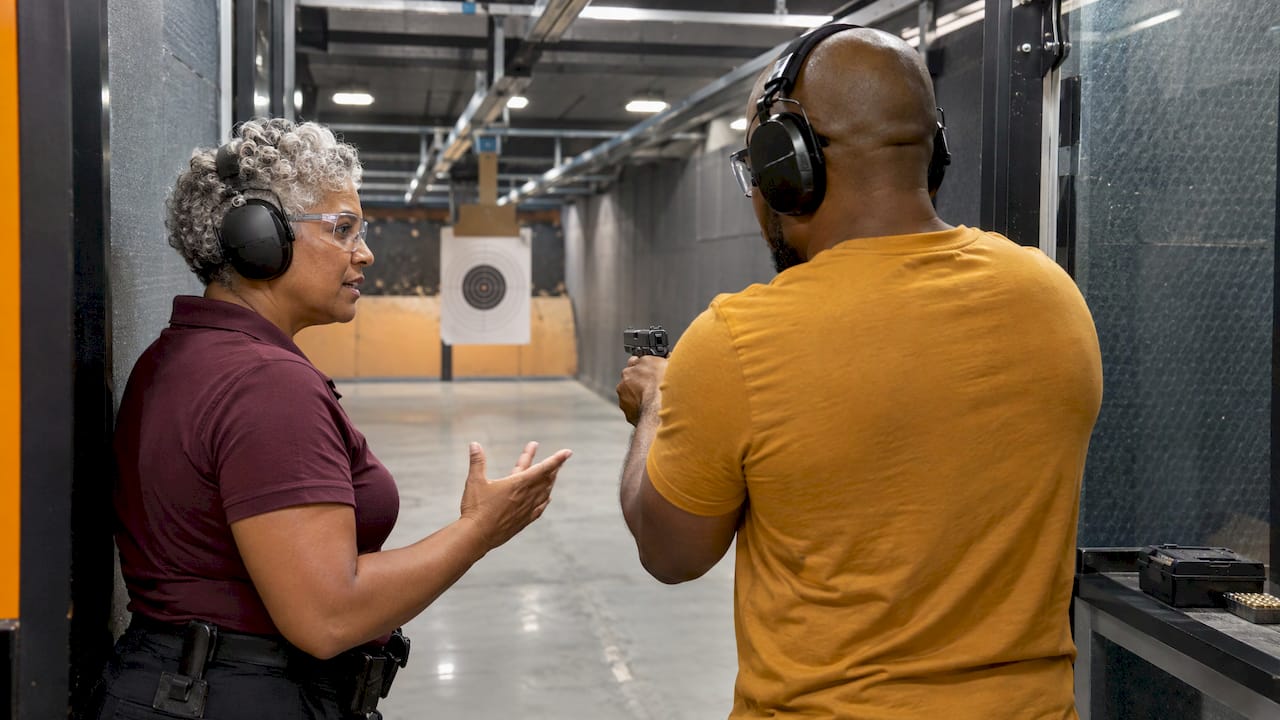
At a recreational range, the RSO and the instructor are often the same person. They teach you how to stand, hold and aim, and they also own the safety of the lane.
You do not need to know any of the above to shoot safely. That is the point of having an RSO. Still, understanding the role makes your visit smoother and more fun.
Expect a safety briefing. Listen to it fully, even if you have seen a hundred films with shooting. Ask questions if something is unclear. Nobody at a range expects a beginner to know the procedure, and a good instructor would much rather answer a question than correct a mistake.
Our short guides help you arrive prepared:
Three habits will make you the instructor’s favorite shooter:
If an instructor asks you to stop, stop. Do not finish the shot you were about to take. This is the single rule that makes the whole system work.
Groups benefit most from a clear structure, and that is where supervision matters. Planners can read our Estonia safety rules for shooting events at Tondi. Parents can find the basics in four shooting range rules for parents visiting Tallinn.
At our range, every session is supervised by professional instructors. Safety training is included in every experience, so you learn the essentials before you handle a firearm. The range is indoors, which means your visit does not depend on the weather, and there is a wide selection of firearms to choose from.
No experience is required. Our packages are designed for people who have never held a firearm: couples on a date, friends on a night out, tourists with an afternoon to fill, colleagues at a team event and birthday groups. The instructors explain each step, so you can enjoy the experience without feeling lost.
The RSO idea shows up in everything we do. You are briefed first. The lane is prepared. Commands are clear. Someone with the authority to stop the session is always present.
There is a package for most situations. Prices below are as published on our site.
| Experience | Price | Good for |
|---|---|---|
| Minu esimene pauk | €45 | A first-time introduction |
| Juunior ja seenior | €55 | A younger and an older shooter together |
| Shooting Foreplay | €76 | Couples and friends |
| Dünaamiline Duo | €105 | Two people who want more action |
| Eriüksuslane | €105 | Those who want a tactical feel |
| Adrenaliinilaks | €138 | Thrill seekers |
| VIP Duo | €168 | A premium experience for two |
These are available as gift cards too, which makes them an easy present for a birthday or a visitor’s farewell. Browse them on our shooting experiences and gift cards page.
For groups, our team event page lists Turvaline ettevõte from €80 per person, Vali ise kolleegidele pakett from €25 per person, and Poissmeesteõhtu from €25 per person. Corporate teams that also want something new can add drone operation training: Esmane droonikoolitus ettevõttele starts from €85 per person. If you are planning for a company, the guide to team building in Tallinn and the cost guide for corporate planners will help you decide.
If you already own a firearm, you can use the range directly. Laskeraja rent costs €125 per person, and Relvaomanik sõbraga tiiru is €15 per person. Frequent shooters can choose a 10x card for €150 or a 20x card for €200. Law enforcement staff have a dedicated option at €110. All of this is on our range page for firearm owners.
We also offer Relvakäsitsemise koolitus, a firearms handling course, for €175. If you are working toward your own permit, there is a permit applicant training gift card for €280.
Not the American one. In Estonia, the legal test is the one in the regulation above: the person responsible for shooting must be a firearms instructor under the Weapons Act, and the person conducting shooting must hold a permit or licence of the kind the regulation lists. Foreign courses can build knowledge, but they do not replace those requirements.
For reference, the US NRA says its instructor-led RSO course lasts nine hours and mixes classroom and range exercises. Its online route is limited to current NRA-certified instructors or coaches, requires six lessons and a 90% test score, and lists a price of US$125 (NRA RSO page). It is a useful picture of what RSO training contains in the United States. It is not an Estonian qualification.
A certificate also does not replace emergency preparation. Our article explains why shooting certificates cannot replace Estonia’s 16 hours of first aid.
If you want to try shooting for the first time, with instructors who handle the safety and a briefing built into every session, start with Minu esimene pauk at €45. Couples, bachelor and bachelorette groups, birthdays and colleagues can pick a package on our packages page or write to us at laskmine.ee and we will help you choose.
An RSO runs a shooting session safely. They brief shooters, check the range before firing, give commands, watch for unsafe behavior and stop the shooting if danger appears. In Estonia this role is called the person conducting shooting.
Yes. Under the Estonian regulation, the person conducting shooting may order shooting stopped, and shooters must obey that person’s commands. If you are asked to stop, put the firearm down as instructed and wait for the next command.
No. Our sessions are designed for first-timers, with safety training included and professional instructors supervising throughout. You will be briefed before you touch a firearm and guided at each step.
It does not replace the Estonian requirements. Estonian rules say the person responsible for shooting must be a firearms instructor under the Weapons Act, with limited exceptions. The NRA course is useful training but is a separate, US-based programme.
An RSO runs safe operations at a range in general. A Range Officer is a competition role under IPSC rules, where the officer manages the course briefing, commands, safe conduct and scoring for each shooter.