Alcohol and the Shooting Range: Why They Don’t Mix
- Mo-Su 10.00 – 20.00
- +372 555 85 416
- sale@laskmine.ee


Zeroing a red dot means making the bullet land where the dot sits. For a pistol, the most defensible starting point is 25 meters, with a rest, a three-shot group and a few small clicks at a time. If you own a pistol with an optic and want to do this properly in Tallinn, a supervised indoor range saves you the guesswork. Tondi Shooting Range offers range rental for gun owners, with professional instructors on site and no weather to fight.
This guide covers the distance to choose, the routine step by step, how to read your group, and how to confirm the zero afterwards.
On a pistol the optic sits above the barrel. The bullet leaves the barrel, rises across your line of sight, and then crosses it at your zero distance. Before that point the bullet prints low. Beyond it, the bullet prints high, until gravity drags it back down.
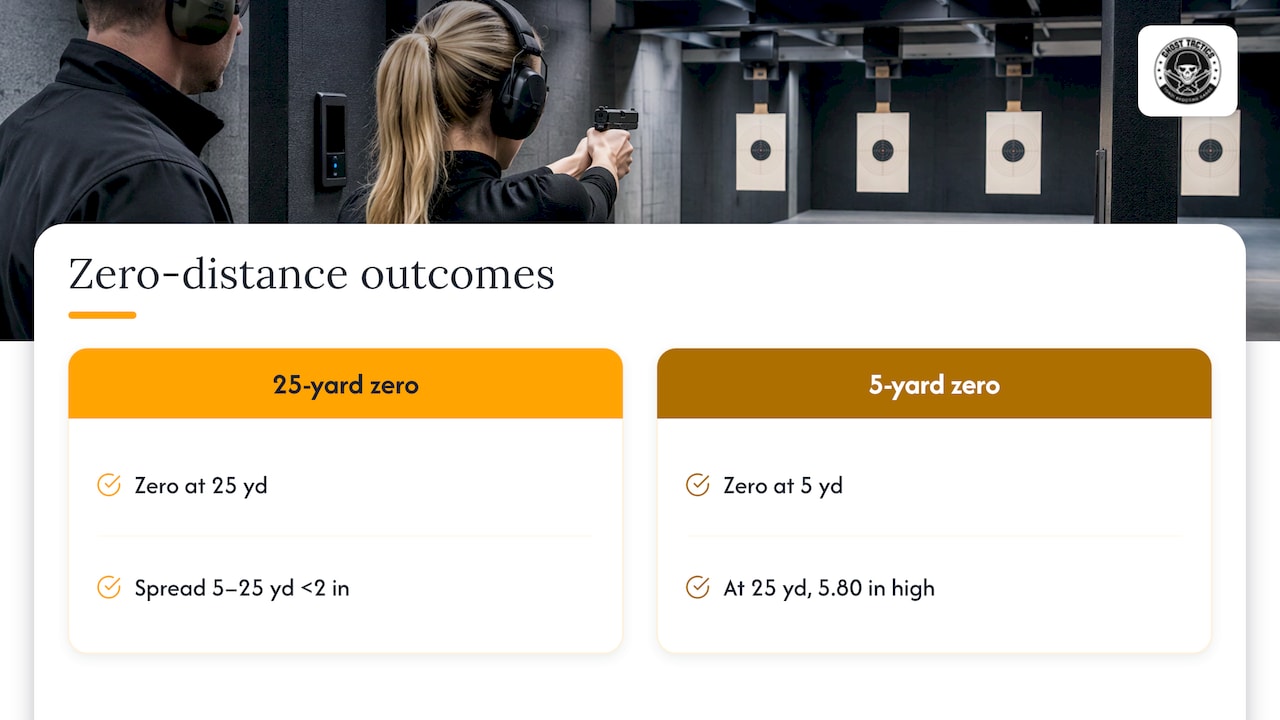
The author of a Shooting Illustrated sight-in test makes exactly this point from geometry. A longer sight-in distance makes the sight line cross the bullet’s path at a shallower angle, which keeps the miss small across the distances people actually shoot. In the same test, a 25-yard zero kept vertical spread under 2 inches across 5, 12 and 25 yards. A 5-yard zero put the 25-yard group 5.80 inches high.
For a beginner this is the key idea. You are not chasing a perfect dot. You are choosing where the bullet and the dot agree, and accepting a small, predictable difference elsewhere.
There is no single correct answer, but there is a sensible default.
25 meters or yards. Aimpoint recommends starting at 25 meters. Its sights are optically centered, so when the mount is properly aligned only minor adjustments should be needed. NRA Shooting Illustrated lists 7 to 10 yards, 15 yards and 25 yards as the common pistol choices, and says defensive pistol instructors generally favor 15 to 25 yards for red-dot pistols.
10 yards. A very short zero suits a gun that will never be used beyond a few steps. The catch is that it prints higher farther out. One published ballistic model of 124 grain 9 mm with the dot 1 inch above the bore puts a 10-yard zero about 1 inch high at 25 yards. A 25-yard zero in the same model prints about 0.4 inch low at 10 yards (rifleconfigurator.com).
Those differences are small. For most recreational shooting, the 25-yard zero gives you the most even result from close range out to the far end of the range, and it matches the starting point most optic makers document.
| Zero distance | Typical use | Behavior at other distances |
|---|---|---|
| 7 to 10 yards | Very close shooting only | Prints high farther out |
| 15 yards | Mid-range compromise | Small error both ways |
| 25 yards or meters | General pistol and range use | Under 2 inches of vertical spread from 5 to 25 yards in the test above |
If you are a visitor and have no particular plan, choose 25 and move on.
A good zero comes from boring preparation:
If you are new to handling a pistol, read our pistol shooting basics guide and the firearm safety rules first. Most of the gear a first-timer needs on the day is provided, as described in what to wear at the range.
Treat the pistol as loaded, check it, and put it in a safe condition before you handle it, as the Aimpoint guide says. Set the target at your chosen distance. At the range, the instructor on duty takes care of the safety side of the session, so you can focus on the sights.
Rest the pistol, keep the dot centered in the window of the optic, and aim at the same spot for every shot. Fire a slow control group of three to five rounds. Sig Sauer’s manual for its XRAY5 optic asks for a precise group of at least five rounds from a stable rest, aimed at exactly the same point. Three is enough for a first read, five if you want more confidence.
Look at where the center of the group sits compared with your aiming point. Do not chase the one stray shot. If the group is tight but off-center, the optic needs adjusting. If it is wide and scattered, the problem is grip or trigger press, and no amount of clicking will fix that. Our guide on trigger control is a good place to work on that, and the list of common handgun training mistakes covers the usual suspects.
Move the group toward the dot, not the dot toward the group. If the group prints high and right, you bring the point of impact down and left, using the elevation and windage turrets. Most red dots mark an arrow or a direction on each turret, so follow the marking rather than memory.
The clicks are small. One MOA (minute of angle) is roughly 1 inch at 100 yards, according to Sig Sauer. That scales down with distance, so at 25 yards a 1 MOA click moves the bullet about a quarter inch. A group 1 inch high at 25 yards therefore needs about four clicks down. At 15 yards the same click moves the bullet even less, so you need more clicks for the same inch.
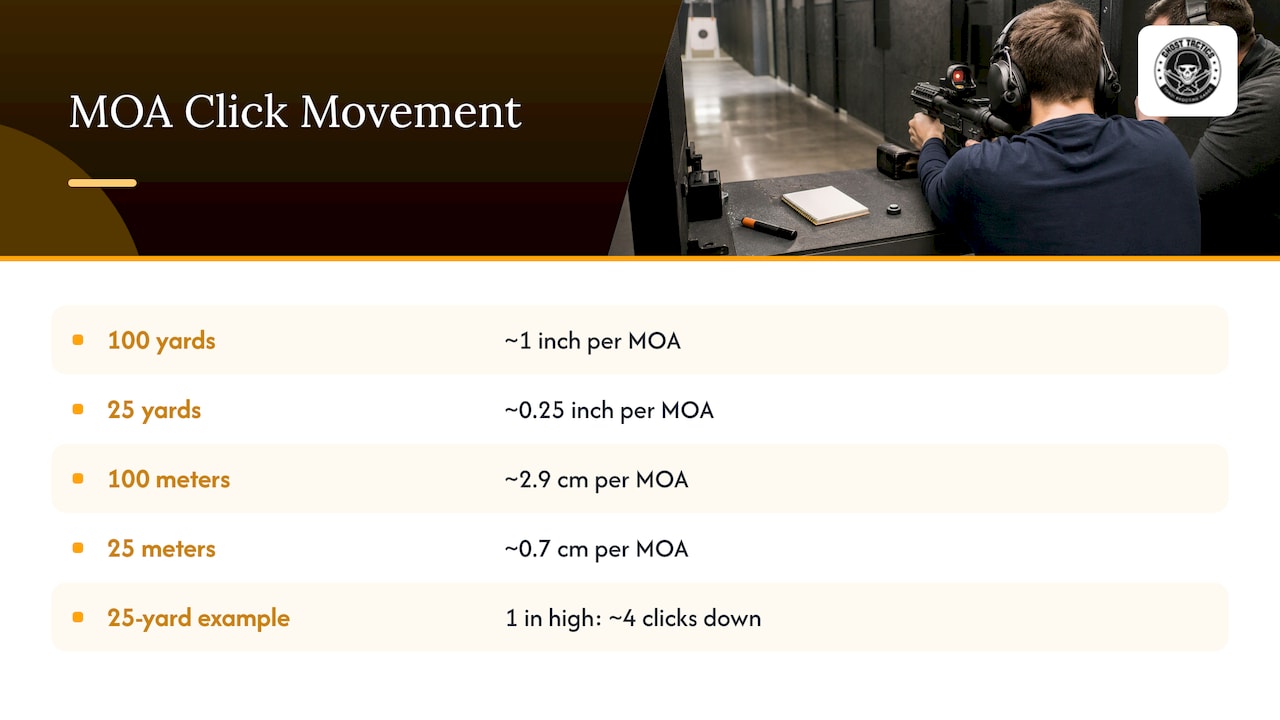
In metric terms, one 1 MOA click is about 2.9 cm at 100 meters and proportionally less on a shorter range, so about 0.7 cm at 25 meters.
After every adjustment, fire another three-round group. Repeat until the group sits where the dot sits. Resist the urge to make a big correction after a single bad group. Over-adjusting is the most common way to chase a zero that was nearly right.
Note the distance, the ammunition, the optic and the click settings. Bore sighting or a laser can get you on paper, but only live fire gives you the real zero, and the record lets you repeat it later.
You zero at 25 yards with a 1 MOA optic. Your first three shots form a tight group about 2 inches left of the dot and 1 inch low.
Make half of that first, say four clicks of windage and two of elevation, and shoot again. If the group has moved the right way, finish the job in the next round. Making the change in two steps costs you six more rounds and saves you from overshooting.
A zero that works at one distance is a promise, not a proof. Check it at a second distance. If you zeroed at 25 yards, your group at 10 yards should print slightly low, around the figure in the model above. If it is several inches off, the first zero probably rode on a bad group, a loose mount or a rest that pushed the slide.
There are two other things worth checking:
Zeroing is repetitive, and it rewards calm conditions. Wind, rain and cold hands are all enemies of a clean three-shot group, and the Estonian winter makes that a real issue for much of the year. At an indoor range, the lighting and distance stay the same shot after shot, which is exactly what you need to see small changes in the group. Our page on winter shooting prep explains how to stay ready for the cold months.
There is also the human side. All sessions at Tondi are supervised by professional instructors and safety training is included. Having someone watch your handling while you concentrate on the sights is a real advantage the first time you adjust an optic. If you want to know how that role works, read about the range safety officer.
If you own a pistol with a red dot, our offers for gun owners are built for this kind of work. Range rental is €125 per person. A 10x card costs €150 and a 20x card costs €200, which suits you if zeroing takes more than one visit or you want to keep practicing. Bringing a friend along is €15 per person under the “Relvaomanik sõbraga tiiru” offer. Details are on our page for gun owners.
If you want a stronger grounding in handling before you start adjusting optics, the firearm handling course is €175. And if you are new to shooting altogether, our packages start with My First Bang at €45. No experience is required, and we have a wide selection of firearms to try. For groups, couples and friends, the same range works for birthdays, bachelor parties and team events.
Estonia regulates range safety by government regulation. Under the current text of the range safety regulation, which was amended in 2026, the range must display its safety requirements, internal rules, first-aid equipment, means of communication, fire-extinguishing equipment and the name of the person responsible for shooting, all in a prominent place. Every shooter and person present at a training session must sign a confirmation that they will follow the internal rules, and the range keeps those records for six months from the visit.
In practice this means you will sign a short form on arrival and listen to a safety briefing. Our guides to range rules for Tallinn visitors, range etiquette and the 5 to 10 minute safety checklist walk through what to expect. For minor injuries or emergencies, see first aid at a shooting range.
The regulation also governs how ranges are built, including the height of the backstop behind the targets. It is the range’s job to meet those standards, not yours. Your job is to follow the instructions on the day and keep the muzzle pointed downrange.
For most shooters, 25 meters or yards is the best starting point. It is the distance Aimpoint recommends and the one many optic makers document. It keeps vertical error small from close range out to the end of a typical pistol range. A 10-yard zero is a fair choice if you only shoot very close.
Fire a group of three to five rounds from a rest and judge the center of the group, not a single shot. Make a small adjustment, then fire a confirmation group. This avoids the common mistake of over-adjusting after one stray round.
With a 1 MOA optic, one click moves the bullet about a quarter inch at 25 yards, because 1 MOA is roughly 1 inch at 100 yards. The effect shrinks as distance falls. If your optic has a different click value, check its manual and scale the numbers.
No experience is required for our sessions. Professional instructors supervise every session, safety training is included, and the range is indoors. Gun owners can book range rental or a multi-visit card on our page for gun owners.