Pistol Shooting Basics in Estonia: Beginner’s Guide
- Mo-Su 10.00 – 20.00
- +372 555 85 416
- sale@laskmine.ee





The Beretta 92 is a family of Italian-made 9x19mm semi-automatic pistols built around an open-slide design, a double-stack magazine, and a double-action/single-action trigger. It earned its reputation the hard way, through decades of military and police service, most famously as the U.S. military’s M9. For buyers and enthusiasts, the appeal comes down to three things: proven reliability, generous magazine capacity, and a shooting feel that’s stayed relevant for 50 years. The main tradeoffs are size and weight compared to modern compacts.
TL;DR:
- The Beretta 92’s open-slide design allows for easier clearance of debris and reduces jamming, making it highly reliable in tough conditions.
- Variants like the 92A1 and Vertec add modern features such as accessory rails and slimmer grips, catering to different hand sizes and accessory needs.
- Its long sight radius, mild recoil, and steel frame make it suitable for duty use, range training, and precision shooting, especially for larger hands.
- The platform’s reliability stems from decades of military service, with a proven track record and specific design fixes like a larger hammer pin to prevent slide separation.
- Testing the firearm firsthand at a shooting range is the best way to determine if its weight, grip, and trigger feel suit your shooting style before purchasing.
Beretta’s engineers sketched the original design in 1975, and full production started the following year. The company built on lessons from earlier Beretta pistols and borrowed a short-recoil locking system with roots in the Walther P38, but the result was distinctly its own: an open-top slide, a heel-mounted or later frame-mounted magazine release depending on the market, and a trigger system suited to both police and military users.
The line evolved fast. The original 92 gave way to the 92S, which added a frame-mounted safety and slide-mounted decocking lever for European law enforcement contracts. The 92SB followed with ambidextrous controls, and by the mid-1980s the 92FS arrived with a redesigned slide and a squared-off trigger guard. Each change responded to a specific complaint from real users, whether that meant faster reholstering, safer carry, or a stronger slide.
The biggest turning point came in 1985, when the U.S. Department of Defense selected the 92FS as the M9, replacing the M1911A1 after an extensive trial process. That contract forced Beretta to meet military endurance and parts-interchangeability standards that few commercial handguns ever face, and it pushed the pistol into decades of documented service across multiple branches.
Beretta has produced the 92 family continuously since 1976, with estimates ranging from roughly 3.5 to 4 million units built across variants, according to Wikipedia’s overview of the platform. That kind of volume, paired with adoption by multiple armed forces and a long run in film and television, turned the 92 into one of the most recognized handgun silhouettes on the planet. Few pistols carry that combination of military pedigree and pop-culture visibility.
Most modern service pistols use a fully enclosed slide. The 92 doesn’t. Its open-slide design leaves the top of the barrel exposed along a track cut into the frame rails, which lets spent casings eject more freely and reduces the odds of a stovepipe jam compared to closed-slide designs, according to Beretta 92 documentation. Debris has fewer places to get trapped, and shooters get a visual, at-a-glance check on chamber status that closed-slide guns don’t offer as easily.
Underneath that slide sits a falling locking block, a short-recoil system descended from the Walther P38’s wedge-lock concept. When the pistol fires, the barrel and slide travel rearward together for a short distance before a block beneath the barrel drops down, unlocking the slide to continue back on its own. Because the barrel doesn’t tilt the way it does on a Browning-style tilting-barrel gun, the 92 keeps the bore running in a straighter line through recoil. That inline movement also makes the platform friendlier to suppressor use, since there’s less barrel deviation to throw off a can’s alignment.
The trigger is where the 92 asks something of the shooter. Pull the trigger on a loaded chamber with the hammer down and you get a long, heavier double-action pull for the first shot. Every round after that fires single-action, with a short, light trigger break. Police and military buyers liked this setup because it offered a built-in safety margin for the first shot while keeping follow-up shots fast, a balance that shaped a lot of the platform’s early adoption according to historical retrospectives on the pistol.
Later variants added features the original lacked: a hard-chromed bore for corrosion resistance, accessory rails for lights and lasers on models like the 92A1, and dovetailed sights that make swapping to night sights or fiber-optic front sights straightforward.
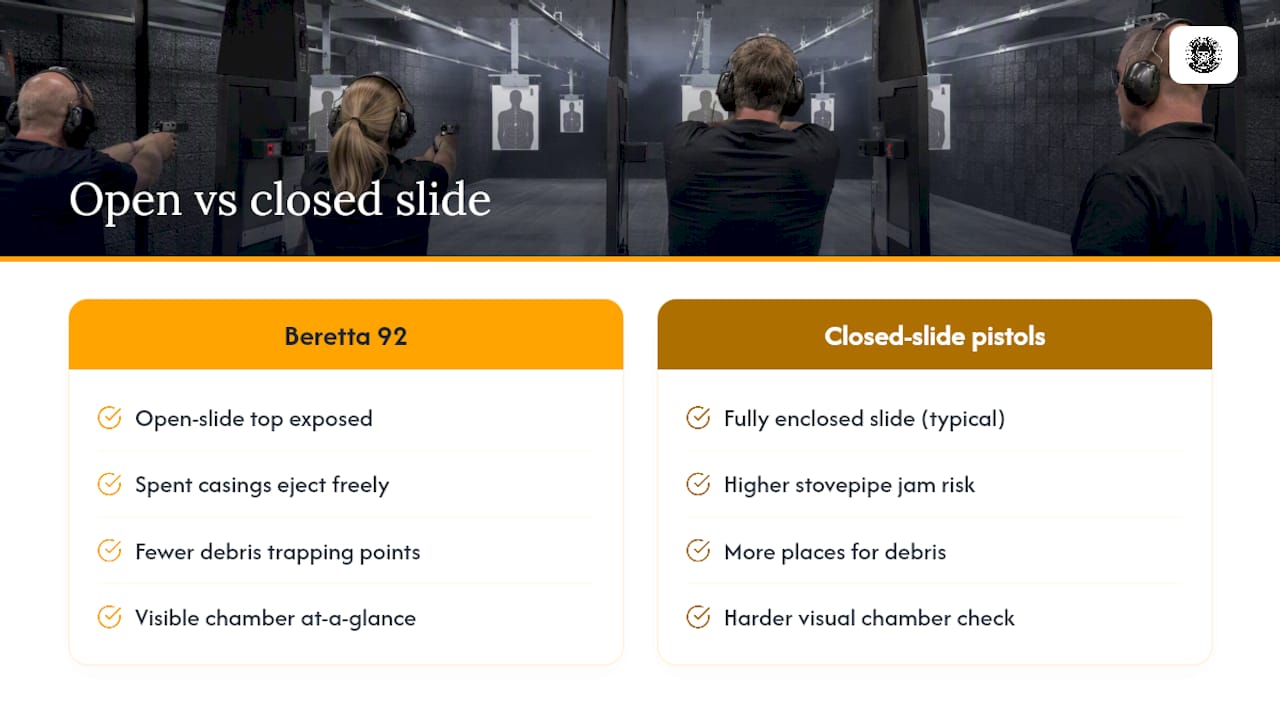
Here’s how the baseline 92FS measures up, along with what changes across the family’s most common variants.
| Spec | Beretta 92FS (baseline) |
|---|---|
| Weight (unloaded) | ~950 g |
| Overall length | ~217 mm |
| Barrel length | ~125 mm |
| Cartridge | 9x19mm Parabellum |
| Action | Double-action/single-action (DA/SA) |
| Standard magazine capacity | 15 rounds (flush-fit) |
| Extended magazine capacity | 17 to 18+ rounds |
Those figures come from Beretta 92FS specifications, and they apply to the full-size steel-framed guns that make up most of the lineup.
From there, the variants split by purpose. The 92A1, introduced in 2010, adds an accessory rail and borrows features from the M9A1 program, making it the pick for anyone who wants a modern light or laser mount on a classic platform, per Beretta’s own model history. The Vertec trades the original’s rounded, heel-release grip for a slimmer, straighter backstrap with a frame-mounted magazine release, aimed at shooters with smaller hands who found the standard grip too thick. The Compact and Centurion models shorten the barrel and slide (Centurion) or the grip and barrel together (Compact) for easier carry without dropping magazine capacity as much as a true subcompact would. The 96 and 98 designations swap the caliber entirely, chambering .40 S&W and .30 Luger respectively for shooters who want the same platform in a different cartridge.
Magazine capacity is one of the easiest upgrades on the platform. Factory-pattern 15-round magazines are standard, but 17 and 18-round extended magazines are widely available and drop into the same magazine well without modification.
Shooters consistently report mild recoil and a long sight radius on the 92 platform, a combination that supports steady accuracy at typical defensive and duty distances, according to range testing summarized by US Concealed Carry. The steel frame and moderate weight soak up recoil energy that a lighter polymer pistol would transmit more sharply to the shooter’s hand, which makes fast, accurate follow-up shots easier for most people.
The service record backs this up. Decades of military and police use across multiple conflicts and jurisdictions gave the platform a reliability reputation that few competitors can match on sheer duration of testing, a track record detailed in coverage of the pistol’s 50-year history. That doesn’t mean the design arrived perfect. During military testing, engineers identified a slide separation risk under certain conditions, and Beretta responded by enlarging the hammer pin on the M9 to keep the slide from separating from the frame if it cracked, a fix documented in the M9’s engineering history. It’s a good example of how military-grade testing catches failure modes that civilian use rarely surfaces, and how a manufacturer’s response to that testing becomes part of the gun’s long-term reliability story.
Barrel length and overall weight still matter for felt recoil. The Compact and Centurion variants, with their shorter barrels, kick a bit sharper than the full-size 92FS, and shooters moving between models often need a few magazines to recalibrate their grip and follow-through.
Most of the malfunctions attributed to the 92 platform don’t come from the gun itself. They come from magazines. Low-quality aftermarket magazines and inadequate lubrication account for the bulk of reported feeding issues, according to Beretta M9 service documentation, not some inherent flaw in the locking block or slide geometry. Factory-pattern magazines, including Mec-Gar OEM clones, are widely regarded by practitioners as the single most cost-effective reliability upgrade available for the platform.
A basic maintenance routine keeps a 92 running for decades:
Pro Tip: Keep at least two or three factory-pattern magazines in rotation instead of running one until it fails. Spreading wear across multiple magazines makes a failing spring or bent feed lip obvious before it turns into a jam mid-session.
Aftermarket sights and recoil springs are safe, useful upgrades that don’t touch the core mechanism. Cosmetic slide cuts, aggressive stippling, or unlicensed frame modifications are a different story. Since the 92’s reliability depends on tight tolerances between the slide, locking block, and frame rails, cutting into that geometry without factory-level precision can introduce the exact feeding problems a good magazine upgrade was supposed to prevent. If you’re storing or transporting a 92 across borders, it’s worth reviewing general firearm storage and transport guidelines that apply broadly across European jurisdictions.
Fit comes down to hand size and intended use more than anything else. Full-size 92FS and 92A1 models have a wider grip that suits larger hands well but can feel bulky for shooters with smaller palms, while the Vertec’s slimmer backstrap solves that problem without giving up capacity.
Before buying, it’s worth running a short DA/SA drill under supervision: five rounds starting from a double-action first shot, then five more in single-action, to feel how the transition affects your grip and trigger control. Pairing that with basic trigger control fundamentals gives you a clearer read on whether the 92’s trigger suits your shooting style before you commit to buying one.
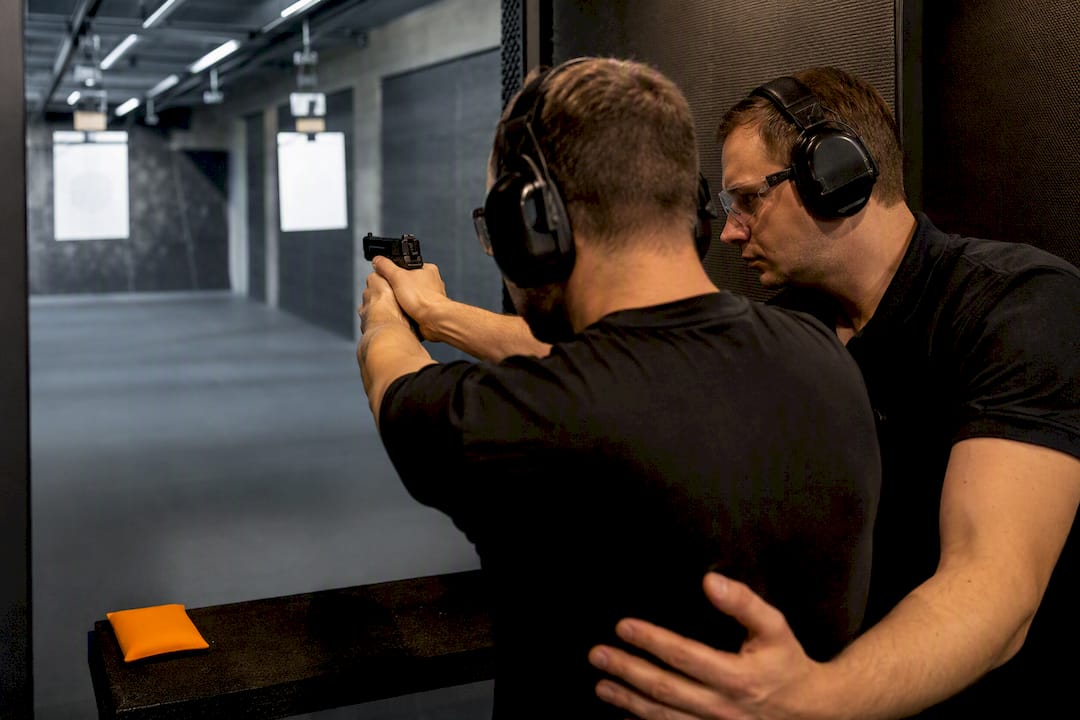
Reading specs only gets you so far. The real test is how the trigger, recoil, and grip feel in your own hands, and Tondi Shooting Range gives you exactly that chance at our indoor facility in Tallinn. No experience is required. Every session starts with a safety briefing and runs under the direct supervision of professional instructors who walk you through handling, stance, and the DA/SA transition before you fire a single round.
Testing a platform like the 92 at a professional range, rather than relying on reviews alone, is the only way to know if the grip, weight, and trigger actually suit you. Our indoor range gives you a controlled, weatherproof environment with a wide selection of firearms to compare side by side, so you’re not locking in a decision based on specs alone. Whether you’re a first-time shooter, planning a bachelor party, organizing a corporate team-building event, or just curious about historic service pistols, our instructors tailor the session to your experience level. Book a shooting session at our indoor range to try a Beretta 92 and other platforms firsthand, or check our guide for first-timers if this would be your first time holding a firearm. Groups planning something bigger can also look into our tactical shooting sessions for a more advanced, duty-style experience.
The standard Beretta 92 fires 9x19mm Parabellum. The 96 and 98 variants swap the caliber entirely, chambering different cartridges for shooters who want the same platform in a different caliber.
The M9 is the U.S. military designation for the 92FS, adopted in 1985 after the Department of Defense selected it to replace the M1911A1. Later M9 production included an enlarged hammer pin to address a slide separation risk found during testing.
The baseline 92FS weighs approximately 950 grams unloaded, with an overall length of about 217 millimeters and a barrel length near 125 millimeters.
The 92 uses a steel frame, an open-slide design, and a DA/SA trigger, while most Glock models use a polymer frame and a striker-fired action with a consistent trigger pull on every shot. The 92 tends to run heavier and offer a longer sight radius, while polymer striker-fired pistols are generally lighter and simpler to operate under stress.
A holster built specifically for the 92’s frame size, whether OWB or IWB, matters more than brand, since the pistol’s steel frame and longer grip need a holster molded to its exact dimensions for a secure retention fit.
No. At Tondi Shooting Range, all sessions include a safety briefing plus direct instructor supervision throughout your time on our indoor range.