Halloween Zombie Hunt in Tallinn
- Mo-Su 10.00 – 20.00
- +372 555 85 416
- sale@laskmine.ee





Book a supervised drone safety course and your group flies drones the same day, no experience required. These sessions include hands-on instruction for events: a safety briefing, simulator time, and real controlled flights under an instructor’s direct supervision. Tourists, bachelor parties, and corporate teams walk away with a genuine first-flight story instead of a stack of theory. Ready to see what a session looks like? Keep reading.
TL;DR:
- The session duration and structure can be tailored from 60 to 120 minutes, with longer times allowing more solo flight practice and basic maneuvers.
- Indoor setups with barriers and designated observer roles prevent accidents and ensure spectator safety during beginner drone flights.
- Preflight routines, battery checks, and emergency procedures are emphasized to minimize common mistakes and promote responsible flying habits.
- No prior experience is needed, and participants learn fundamental skills like takeoff, hovering, and controlled landing within a safe, supervised environment.
- Booking typically requires a few weeks for large groups and involves signing waivers, confirming group size, and considering the need for accessibility or insurance.
An event-focused drone safety course runs on a simple structure: brief it, simulate it, fly it. Nobody hands you a manual and walks away. Instructors stay next to participants for every phase, adjusting the pace depending on whether you have a group of nervous first-timers or a bachelor party ready to jump straight into the controls.
A typical session follows this order:
Shorter formats compress the simulator stage; longer ones add more solo flight time and basic maneuvers like gentle turns.
| Session length | Best for | Flight time per person |
|---|---|---|
| 60 minutes | Quick tourist add-on, small groups | a few minutes |
| 90 minutes | Standard corporate or party booking | several minutes |
| 120 minutes | Larger team-building days | longer flight time |
Pro Tip: If your group has never touched a drone controller, ask for extra simulator time upfront. Five minutes of simulated crashes beats one real one, and it makes the actual flight feel far less intimidating.
This format fits almost any group that wants a shared activity with a genuine adrenaline moment, not a lecture. It works particularly well for:
Groups usually run best at one instructor for every several participants, which keeps everyone flying rather than waiting. Minors typically need a parent or guardian present, and instructors adjust flight complexity based on age and comfort level. Small private groups get more one-on-one coaching time per person; larger corporate days rotate participants through stations so nobody stands around watching for twenty minutes straight.
By the end of the session, participants can perform the fundamentals independently: takeoff, stable hovering, controlled landing, and basic directional turns. That’s the visible part. The less visible part, and arguably the more important one, is the habit-building around preflight checks and emergency response.
Instructors walk participants through:
Local Estonian drone training providers that run practical “base” style courses emphasize the same preflight checklist habits: battery checks, flight planning, and risk assessment before a single takeoff. That consistency across providers isn’t a coincidence. It’s the backbone of safe recreational flying.
Pairing simulator time with real supervised flight time speeds up learning measurably. Research on instructor-led drone training formats shows that hands-on sessions combining short simulator drills with immediate supervised flight build confidence faster than either method alone, cutting down the fumbling that usually happens in someone’s first minute behind a controller. Drone racing safety guidance in Estonia follows a similar principle: clear spectator barriers and no-fly zones near people reduce risk regardless of skill level, and instructors apply the same rule at every event session.
Beginner drone sessions run on lightweight trainer drones, not the heavier rigs used for aerial filming. That distinction matters for safety: trainer models come with prop guards, are easier to recover from a tip-over, and simply do less damage if something goes wrong. Instructors also keep spare batteries on hand so downtime between flights stays short.
Indoors, the setup includes:
Outdoors introduces variables indoor sessions don’t have to deal with: wind, permissions for the airspace, and crowd control. That’s part of why the drone sessions are kept indoors. The environment is fully controlled, no wind gusts knocking a beginner’s first hover off balance, no weather delay on the day of a corporate event. University-run drone events in Estonia use the same logic for public demonstrations, running controlled indoor demos with mentoring and clear flight corridors specifically because it lets spectators watch safely while pilots practice.
Pro Tip: Leave the fancy footwear at home. Closed-toe shoes and clothing without loose straps or scarves make it easier to move quickly if an instructor calls for a position change mid-session.
Booking timelines depend on group type. Corporate events typically need two to three weeks of lead time to lock in a date, coordinate group size, and confirm any special requests. Tourists and smaller walk-in groups often have more flexibility, sometimes booking just days ahead depending on availability.
A few things shape the final price: session length, group size, the instructor-to-participant ratio you want, and whether you’re adding drone flights on top of a shooting range package. Indoor sessions also tend to be more predictable on pricing than outdoor bookings, since there’s no weather contingency to plan around.
Before the day, organizers should handle:
For anyone planning a full team-building day, pairing the drone session with a shooting activity fills out the itinerary well. Corporate team events at Tondi Shooting Range already run on this exact no-experience-needed model, so adding drone time follows the same booking flow.
None. That’s the entire point of an event-focused course. You don’t need to have flown a drone, read a manual, or watched a single tutorial video. Instructors assume zero prior knowledge and build the session around that assumption from the first minute.
What actually helps, though isn’t required, is basic hand-eye coordination comfort. If you’ve played video games with a controller, the drone controls will feel familiar faster. If you haven’t, the simulator stage exists specifically to close that gap before real flight time starts. Nervous first-timers often do better after five extra minutes on the simulator than after someone explaining the controls verbally.
There’s no age test, no written exam, and no prerequisite course. The only real “requirement” is a willingness to listen to the safety briefing and follow the instructor’s cues during flight. Groups with mixed experience levels, say, a corporate team where two people have flown drones recreationally and the rest never have, work fine. Instructors simply adjust pacing per person, giving more simulator time to beginners while letting the experienced flyers move to solo maneuvers faster.
One thing worth clarifying upfront: this isn’t a path toward an official drone pilot license or regulatory certification. It’s practical, supervised instruction built for a one-time event experience, not a multi-week licensing track.
There’s no formal certificate or regulatory credential issued at the end of an event-based session, and that’s by design. This course exists to give attendees a safe, memorable, hands-on experience, not to prepare them for an official pilot exam.
What participants do walk away with is practical competence: the ability to take off, hover, land, and handle basic maneuvers without hand-holding. For a lot of first-timers, that’s genuinely more useful than a certificate would be. You can’t frame confidence, but you can definitely use it the next time you’re handed a drone at a family gathering or a friend’s outdoor event.
Some participants use the session as a low-stakes way to test whether they want to pursue drone flying further, whether that means buying a personal trainer drone or eventually looking into formal certification paths elsewhere. For that group, the event session functions as an informed trial run. You get real stick time, direct feedback from an instructor, and a clear sense of whether the hobby actually appeals to you before spending money on your own equipment.
For corporate groups, the “outcome” looks a little different: it’s less about individual piloting skill and more about the shared experience. Watching a colleague nail a hover after struggling with it for ten minutes tends to generate the kind of genuine, unscripted encouragement that formal team-building exercises often try, and fail, to manufacture artificially.
Most beginner drone incidents come down to a small set of predictable mistakes, and the course is built specifically around preventing them. Overcorrection is the big one: new pilots tend to yank the controls too hard when a drone drifts, sending it further off course instead of back on track. Instructors coach small, deliberate stick movements from the first flight.
Battery and signal issues are the second common category. A drone losing GPS lock or running low on battery mid-flight can behave unpredictably if the pilot doesn’t know what to do. That’s why preflight checks aren’t treated as a formality. Participants actually run through battery and radio checks themselves, not just watch someone else do it.
Spectator proximity is the third major risk area, and it’s less about the pilot’s skill and more about crowd behavior. People instinctively want to get closer to watch, which is exactly the wrong instinct around an active flight. Drone racing safety guidance in Estonia addresses this directly, recommending designated spectator barriers and keeping observers away from active pilots at all times. Tondi Shooting Range applies the same principle indoors: netting, marked corridors, and an observer role separate from the pilot, so nobody wanders into a flight path by accident.
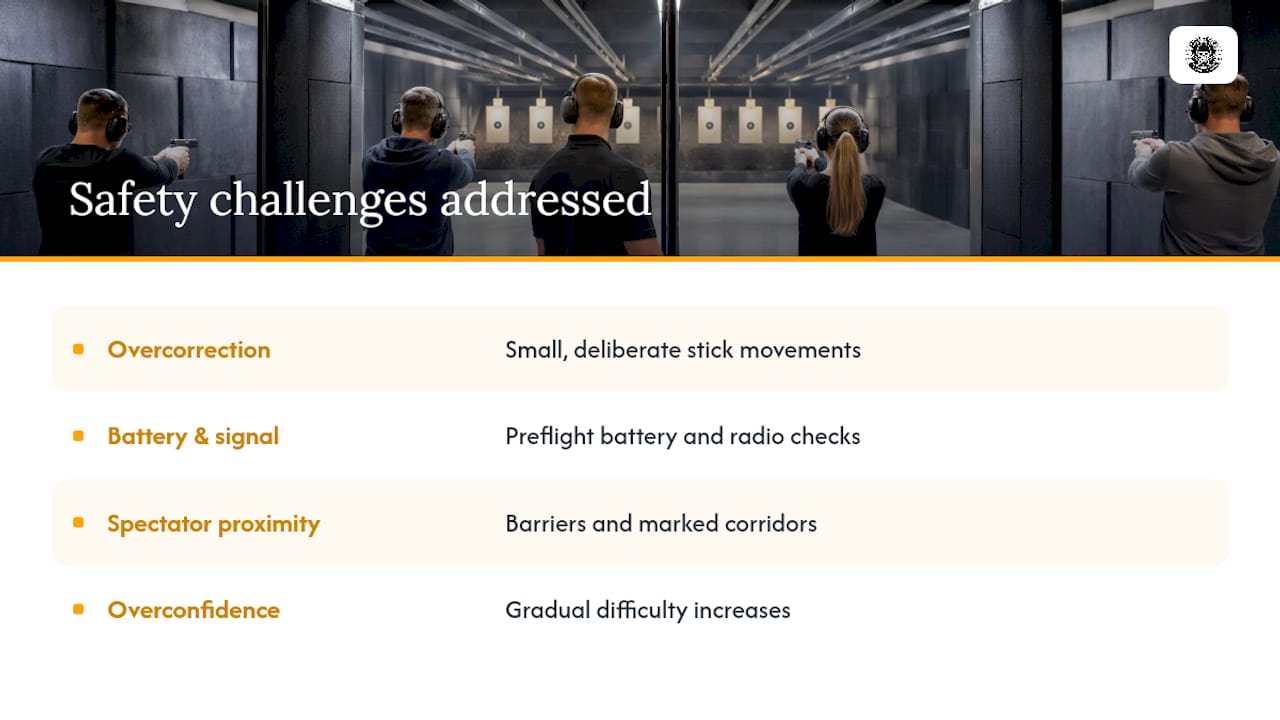
The last challenge is simply overconfidence after a good first flight. A smooth hover on attempt three can make someone feel ready to try something ambitious on attempt four. Instructors watch for this pattern specifically and dial the difficulty up gradually rather than letting enthusiasm outpace skill.
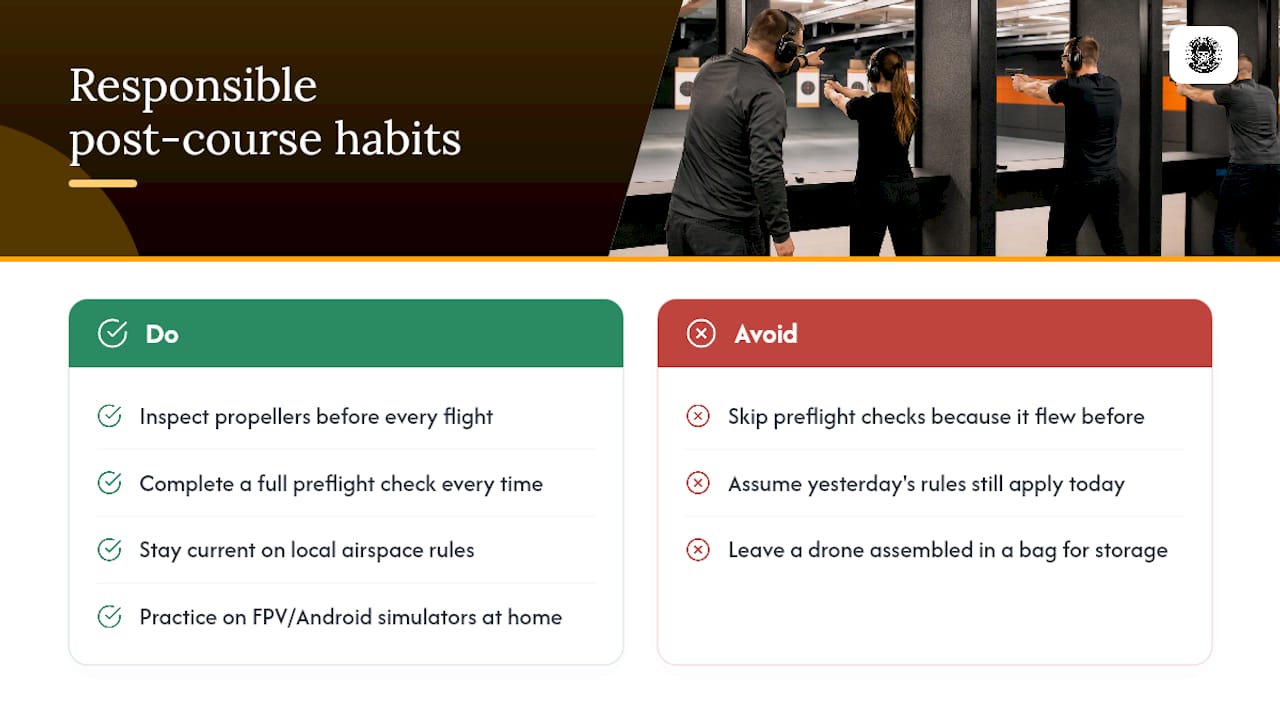
The habits that matter most after the session are the boring ones: charge batteries fully before storing them, inspect propellers for hairline cracks before every flight, and never skip a preflight check just because “it flew fine last time.” Trainer drones are forgiving, but the habits participants build during the course are meant to transfer to any drone they fly afterward, including a personal one bought later.
If you’re flying recreationally in Estonia going forward, staying current on local rules matters more than most people assume. Airspace restrictions, no-fly zones, and alert notices change, and what was fine to fly over last month might not be today. Tondi Shooting Range maintains current drone safety guidance and regulatory alerts specifically so past participants have somewhere reliable to check before their next flight.
Simulator practice doesn’t stop being useful after the course ends, either. Anyone who enjoyed the session and wants to keep building skill without buying equipment right away can keep practicing on FPV and Android drone simulators at home. It’s the same principle the course uses: build muscle memory somewhere low-risk before putting a real drone in the air.
Storage matters too, more than people expect. Batteries degrade faster when stored fully charged or fully drained, propellers warp in extreme heat, and a drone left assembled in a bag tends to accumulate small stress damage over time. None of this is complicated, but it’s the difference between a drone that lasts two years of casual flying and one that starts glitching after two months.
This course is designed around one idea: you shouldn’t need experience, gear, or a license to have a genuinely good first flight. Every session runs indoors, under direct instructor supervision, with simulator time built in before anyone touches the real controls. Whether it’s a bachelor party looking for something different, a corporate team filling out a team-building day, or a couple wanting a shared activity that isn’t dinner and a movie, the format scales to fit the group.
A popular option is pairing the drone session with firearms training and tactical shooting experiences, all with a no-experience-needed, fully supervised approach. If your group is already planning a corporate team event, adding drone time turns a good afternoon into a genuinely memorable one. First-timers nervous about either activity can check out what to expect at a shooting range built for beginners before the day arrives, so there are no surprises.
Reach out to book your date, confirm group size, and lock in indoor availability before your preferred slot fills up.
For rules that change with local airspace alerts, check Tondi Shooting Range’s drone safety and regulatory guidance before your session and again before any independent flight afterward. Want to practice controls before you arrive? The drone simulator recommendations page covers FPV and Android options worth trying at home. For a look at how controlled indoor demos work at scale, TalTech’s drone hackathon event page is a solid reference on supervised public flight formats.
No. Sessions at Tondi Shooting Range are built for complete beginners, with instructors guiding every step from the safety briefing through the first supervised flight.
Sessions usually run 60, 90, or 120 minutes, depending on group size and how much solo flight time you want built into the agenda.
Tondi Shooting Range runs its drone sessions indoors, which removes wind and weather as variables and keeps flight corridors fully controlled.
No formal certification is issued. The course is practical, supervised instruction for events, not a regulatory licensing program.
Yes, with a parent or guardian present. Instructors adjust flight complexity based on age and comfort level throughout the session.