The Great Halloween and Zombie Hunt at Tondi Shooting Range in Tallinn
- Mo-Su 10.00 – 20.00
- +372 555 85 416
- sale@laskmine.ee





Mikhail Kalashnikov was the Soviet small-arms designer who created the AK-47, the rifle family that would go on to arm more soldiers, militias, and revolutionaries than any firearm in history. Its reputation rests on three things: mechanical simplicity, ruggedness in brutal conditions, and a design cheap enough to mass-produce by the millions. What follows traces his life, how the rifle came together, and what separates its many variants technically and legally today.
TL;DR:
- The AK-47 was developed through a Soviet state-controlled competition, with Kalashnikov leading the design team rather than working alone in isolation.
- The rifle family has evolved into many variants like the AKM and AK-74, featuring major design changes such as stamped receivers and caliber shifts to 5.45mm.
- Its reliability stems from a long-stroke gas piston system and different receiver types, affecting maintenance procedures and part compatibility.
- Legal ownership varies globally, with fully automatic models heavily restricted, while semi-automatic civilian versions are accessible under different licensing regimes.
Kalashnikov grew up far from any weapons laboratory. Born into a peasant family in Siberia, he had no formal engineering education when the Soviet Union conscripted him into the Red Army in 1938. Nothing about his early life suggested he would become the most consequential weapons designer of the 20th century.
The war changed that trajectory. Kalashnikov served as a tank commander, and in 1941 he was seriously wounded in combat near Bryansk. The injury sidelined him during recovery, and it was in that hospital bed, listening to fellow soldiers complain about the poor performance of their standard-issue rifles against German firearms, that he began sketching his first weapon designs. A wound became the accidental starting point for a career.
His postwar path ran through the Soviet design establishment, culminating in a long career at the Izhevsk arms plant in the Ural region, where the rifle that bears his name would eventually be manufactured by the millions. He rose through Soviet engineering ranks over the following decades, earning a reputation as a practical, hands-on designer rather than a theoretical one.
A few career milestones stand out:
Late in life, Kalashnikov spoke openly about the weight of his invention. He maintained that he had designed a weapon for national defense, not for the atrocities later committed with copies of it, but he also expressed genuine ambivalence about the human cost tied to his name. That tension between engineering pride and moral reckoning defines how most historians now write about him.
The AK-47 did not appear overnight, and it wasn’t the product of one man working alone in a shed. It emerged from a structured, multi-year Soviet weapons trial that pitted several competing designs against each other.
It matters to get the collaborative context right. Historical analysis generally agrees that the AK-47’s final form resulted from state-directed competition and team engineering, not a lone genius working in isolation. Kalashnikov led the winning effort and gave the rifle his name, but Soviet ordnance bureaus, testing commissions, and other engineers all shaped the final product. That doesn’t diminish his role. It just means the popular “solitary inventor” story oversimplifies how Soviet weapons development actually worked.
“Kalashnikov” isn’t one rifle. It’s a family that spans more than seven decades of incremental redesign, and knowing the differences helps explain why the platform spread so widely and stayed relevant for so long.
Beyond these core models, the Kalashnikov design has been licensed, copied, and reverse-engineered in dozens of countries, producing an enormous range of regional variants with their own stock configurations, calibers, and furniture. That proliferation is a big part of why the platform is so hard to count accurately worldwide, and why used and surplus variants show up in conflicts far from where they were originally built.
The AK’s reputation for reliability comes down to one core mechanical choice: the long-stroke gas piston system. When a round fires, propellant gas is tapped from the barrel and pushed against a piston that is directly attached to the bolt carrier. That piston shoves the whole carrier group rearward with real force, cycling the action even when the rifle is caked in mud, sand, or carbon fouling. This design trades some precision for brute reliability, which is exactly the tradeoff Soviet engineers wanted for conscript armies fighting in harsh terrain.
Receiver construction is the other defining technical choice. Original AK-47s used milled steel receivers, machined from a solid block for maximum strength but at a high manufacturing cost. The AKM’s switch to a stamped receiver cut weight and production time, though it introduced tighter tolerances that make receiver-specific parts fitting more important. Knowing which receiver type a given rifle uses changes how you approach repairs and part compatibility.
For anyone learning to handle or maintain an AK-pattern rifle under proper supervision, a few basics apply every time:
Pro Tip: Professional instructors always run a function check, chamber inspection, and safety-selector test before handing any rifle to a shooter, even one they trust. That habit alone catches most equipment problems before they become dangerous ones. If you want to see this kind of routine in action, Tondi Shooting Range’s safety guidance walks through exactly what instructors check every time. Readers who want a deeper technical grounding in weapon construction and ammunition theory can also review shooting-license theory resources covering these fundamentals in more depth.
Global circulation estimates for Kalashnikov-pattern rifles commonly run into the tens of millions, with figures often cited between 72 and 100 million units worldwide. No other firearm platform comes close to that scale, and the reasons are more about economics and politics than pure engineering.
That last point explains one of the more surprising facts about Kalashnikov’s life: despite his rifle’s astronomical production numbers, he earned relatively little personal wealth from it. Soviet military designs were state property, not personal patents, and by the time licensed and unlicensed copies proliferated globally, there was no royalty structure to capture value from them.
The rifle’s image outgrew its military role entirely. It appears on national flags and emblems, in revolutionary iconography, and in film and music as shorthand for armed resistance or insurgency. That symbolism sits uneasily next to the platform’s darker record: use by state militaries and non-state militias alike, including documented use by child soldiers in multiple African conflicts. Kalashnikov himself grappled publicly with that legacy, insisting he built a defensive weapon while acknowledging discomfort with how it was ultimately used.
Kalashnikov received substantial state recognition during his lifetime, including the Stalin Prize and multiple Orders of Lenin, along with later honors and a promotion to senior military rank. He remained a public figure in Russia well into his nineties, occasionally addressing questions about the moral weight of his invention in interviews and published correspondence.
He died on December 23, 2013, and his death prompted renewed global reflection on his dual legacy. Engineers and historians tend to credit him with genuine industrial achievement: a rifle engineered for the realities of mass warfare and mass production rather than range performance alone. Ethicists and conflict researchers point to the same design as a driver of decades of proliferation and violence, arguing that ease of manufacture became its own kind of harm.
Both views are defensible, and most serious historical treatments hold them simultaneously rather than picking a side. Museums and military history exhibits around the world display AK variants alongside this dual narrative, treating the rifle as both an engineering case study and a case study in the unintended consequences of weapons design.
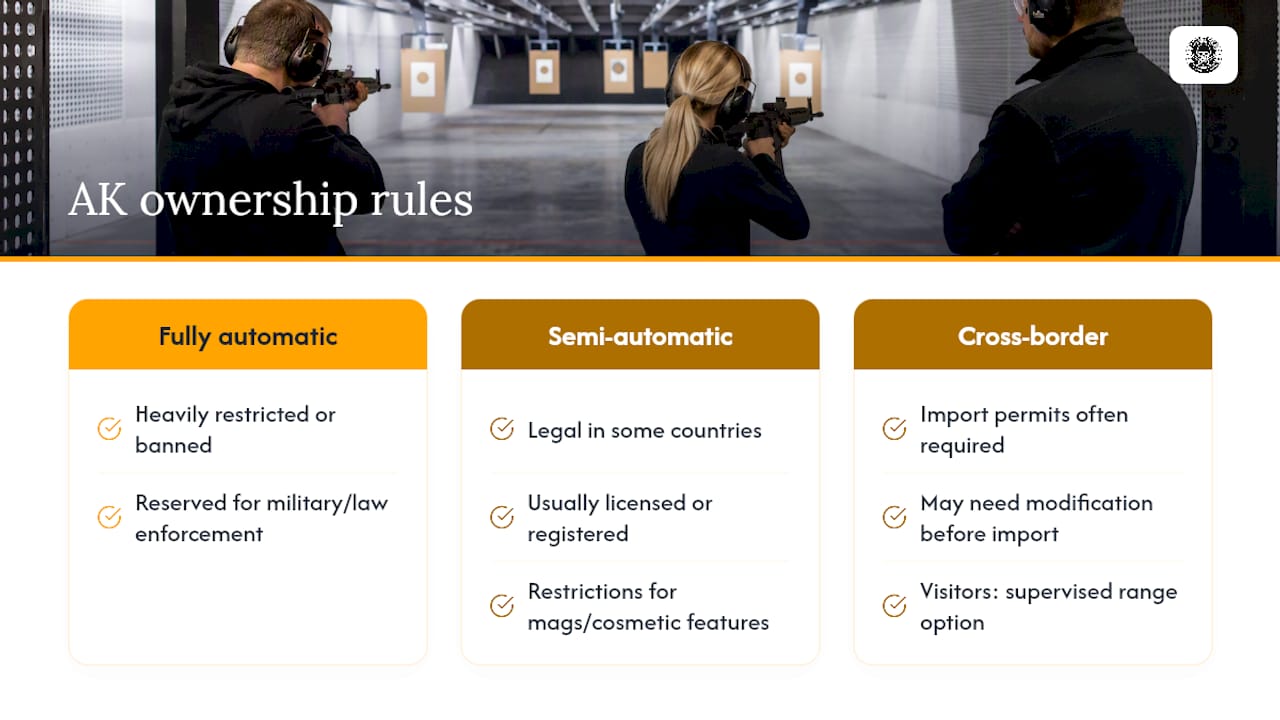
Legal access to AK-pattern rifles varies enormously by country, and the differences usually come down to whether the rifle is configured to fire fully automatic or semi-automatic only. Fully automatic AK variants are heavily restricted or banned outright for civilian ownership in nearly every country with modern firearms regulation, reserved for military and law enforcement use.
Semi-automatic AK-pattern rifles, built specifically for civilian sale, are legal to own in a number of countries, though usually under licensing, registration, or classification schemes that differ sharply by jurisdiction. Some countries treat them like any other semi-automatic hunting or sporting rifle. Others classify them separately due to magazine capacity or cosmetic features associated with military-style firearms, applying additional permits or outright restrictions on those features.
Cross-border rules add another layer of complexity. A configuration that’s perfectly legal to own in one country may require special import permits, be barred from import entirely, or need modification before it can be registered elsewhere. None of this is uniform, and rules change with political circumstances more often than most gun owners expect.
If you’re a resident firearms owner rather than a casual enthusiast, the only reliable approach is checking your own country’s current firearms authority guidance directly rather than relying on general summaries, since classification details shift and vary by exact configuration, barrel length, and magazine type. For visitors or first-time shooters curious about trying an AK-pattern rifle without navigating any of this, a supervised range session under professional instruction sidesteps the ownership question entirely. You get the hands-on experience without the licensing complexity.
Production of Kalashnikov-pattern rifles has never been centralized in one factory or even one country. The original manufacturing base sat at the Izhevsk arms plant in Russia, where Kalashnikov himself spent most of his career, and that facility remains a major producer of the modern Kalashnikov Concern’s rifles today.
But the design spread through licensing agreements and outright copying across the former Eastern Bloc and beyond. Manufacturing plants in Eastern Europe, China, the Middle East, and parts of Africa have all produced their own AK-pattern variants over the decades, often with local modifications to furniture, caliber compatibility, or receiver type. That decentralized manufacturing history is a major reason precise global production totals are difficult to pin down. Unlike a commercial product tracked by a single company’s sales ledger, Kalashnikov-pattern rifles were produced by dozens of state arsenals and private manufacturers with no unified reporting.
The tens of millions of units in circulation reflects this scattered production history rather than output from any single source. It also means the rifles in any given conflict zone or gun market could trace back to a Soviet-era factory, a licensed foreign producer, or an unlicensed copy built decades after the original design was finalized. That patchwork manufacturing legacy is part of why the AK platform remains so recognizable and so hard to fully account for at the same time.
Reading about the AK’s gas piston system and receiver design is one thing. Feeling how that long-stroke action actually cycles, understanding real recoil, and handling a rifle safely under trained eyes is a different kind of learning entirely. Tondi Shooting Range offers an indoor shooting range experience without requiring any prior firearms background.
Every session is led by supervised by professional instructors, who walk you through safe handling, mechanics, and shooting fundamentals before you ever fire a shot. The range is fully indoor, climate-controlled, and stocked with a wide selection of firearms, so you can see historically significant rifle designs up close and understand what made platforms like the Kalashnikov family so influential. No experience is required, and safety training is built into every booking.
Tondi Shooting Range regularly hosts tourists exploring Tallinn, bachelor and bachelorette parties looking for something memorable, birthday celebrations, couples on unusual dates, and groups of friends who just want a genuinely fun afternoon. It’s also become a favorite for corporate team-building events, where the shared focus and structure of a supervised shooting session builds collaboration in a way conference rooms rarely manage. Companies planning something more structured can look at tactical shooting sessions built specifically around group bookings.
First-time shooters can start with an introductory range experience designed for people who’ve never held a firearm before, while anyone wanting to sharpen their skills afterward can explore precision shooting techniques for their next visit. Ready to see how a rifle like the ones that shaped modern military history actually feels in your hands? Book a session at Tondi Shooting Range and find out under expert supervision, indoors, and without needing any prior experience.
Not exactly. The AK-47 is the original specific model designed by Mikhail Kalashnikov and adopted in 1949, while “Kalashnikov” refers to the entire rifle family descended from that design, including the AKM, AK-74, and numerous international variants.
Very little, relative to the rifle’s scale of production. Soviet weapons designs were state property rather than personal patents, so as licensed and unlicensed copies spread globally, Kalashnikov saw no meaningful royalty stream from the tens of millions of units eventually produced.
A Russian biographical film about the designer’s life was released as “Kalashnikov,” focusing on his early years and the invention of the rifle rather than using the weapon’s model name as the title.
Yes. The modern Kalashnikov Concern continues manufacturing firearms in Russia today, including updated rifle variants and other small arms, carrying the designer’s name forward as a commercial and military brand decades after his original design was adopted.
Yes, at a supervised indoor range like Tondi Shooting Range, where professional instructors handle safety training and firearm selection so first-time shooters and experienced enthusiasts alike can try historic rifle platforms legally and safely.