How to Diagnose Shooting Errors and Fix Them Fast
- Mo-Su 10.00 – 20.00
- +372 555 85 416
- sale@laskmine.ee





Shooting accuracy improvement drills are structured exercises designed to build precision by targeting the specific physical and mental habits that cause missed shots. Casual range time feels productive, but it rarely fixes the root problems. Trigger jerking alone accounts for accuracy loss in 65% of novice shooters, and 70% of beginners push shots left or right from front sight misalignment. The good news is that deliberate, repeatable drills fix these errors faster than any gear upgrade. Whether you shoot pistols, rifles, or shotguns, the fundamentals are the same, and the drills that sharpen them work at every skill level.
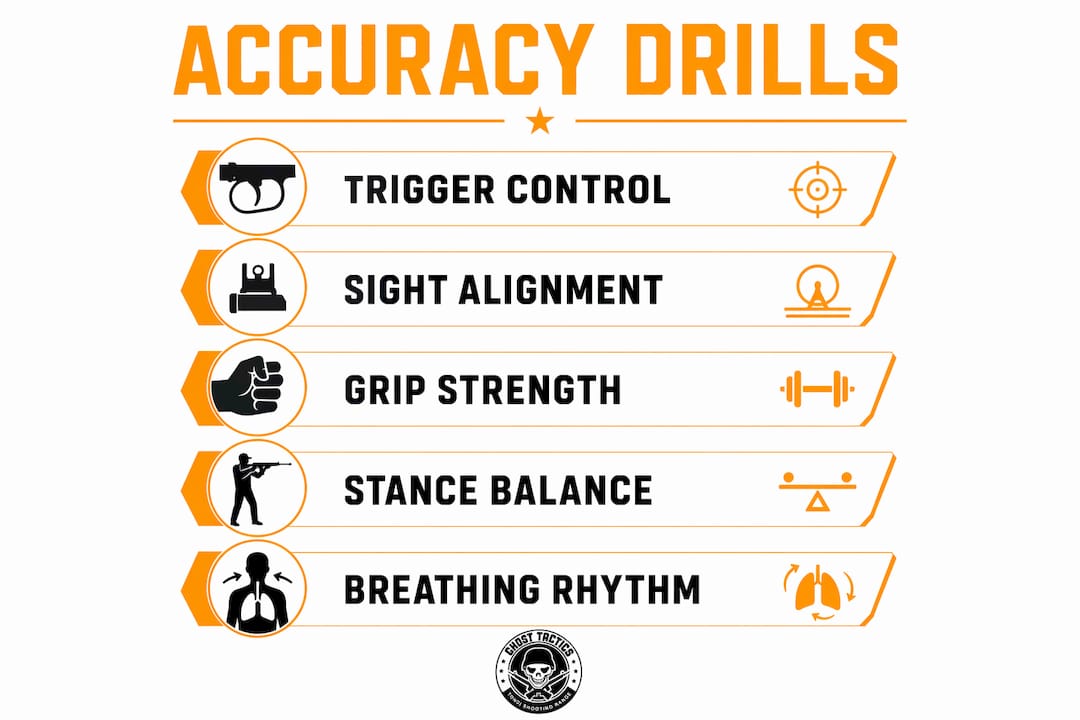
Every effective accuracy drill targets one or more of five physical fundamentals. Ignoring any one of them creates a ceiling on your progress.
Pro Tip: Fix fundamentals in order. Trigger control first, then sight alignment, then grip. Trying to fix all five at once produces no lasting improvement in any of them.
These are the drills that directly address the two most common accuracy killers. Each one isolates a specific error and trains the correct motor pattern.
Pro Tip: Ask a training partner to randomly load snap caps into your magazine. When the gun clicks instead of fires, watch what your hands do. A flinch is obvious and correctable once you can see it.
For shooters just starting out, the pistol shooting drills for beginners guide at Laskmine covers these foundational exercises in detail.
Grip and stance are physical skills. They respond to targeted exercise, not just more shooting.
The goal is not maximum grip strength. The goal is consistent grip pressure at or above 60% of your maximum, held through the entire shot cycle. Grip trainers and stress balls build baseline strength, but the real drill is the “crush and hold”: grip the unloaded firearm at full pressure for 30 seconds, relax to 60%, then press the trigger. This teaches your hand to maintain pressure without white-knuckling the gun, which causes its own accuracy problems.
Stand on one foot while dry-firing. It sounds unusual, but it exposes balance deficiencies immediately. If you sway on one foot, you sway on two feet as well. You just cannot feel it. The single-leg drill forces your core to stabilize your upper body, which is exactly what a good shooting stance requires. Once you can hold a clean dry-fire press on one foot, your two-footed stance will feel locked in by comparison.
The following table shows how different stance elements affect accuracy and what each drill targets:
| Stance element | Accuracy impact | Drill to fix it |
|---|---|---|
| Foot width and weight distribution | 15–20% inaccuracy increase from sway | Single-leg balance drill |
| Knee bend and forward lean | Reduces recoil recovery time | Isometric squat hold while aiming |
| Shoulder alignment | Controls muzzle rise direction | Wall-press drill for shoulder lock |
| Core engagement | Stabilizes upper body through recoil | Plank hold with dry-fire press |
Rifle shooters have one additional fundamental that pistol shooters do not: cheek weld. Consistent cheek weld pressure stabilizes the sight picture and prevents eye dominance shifts that cause flyers. The drill is simple. Close your eyes, mount the rifle naturally, then open your eyes. If the reticle is not centered, your mount is inconsistent. Repeat until the mount is automatic.
Follow-through is the habit of maintaining your sight picture and trigger position after the shot breaks. Tracking the front sight through recoil and into recovery is an advanced skill that speeds up follow-up shots and tightens groups. Practice it on every single shot, not just when you remember.
Breathing control is the most underrated accuracy skill. Most shooters know they should control their breathing. Very few practice it deliberately.
The correct technique is to fire during the natural respiratory pause, the brief moment between exhale and the next inhale when the body is still. This pause lasts roughly 2–4 seconds. If you cannot break the shot in that window, take another breath and reset. Forcing a shot outside the pause adds movement that no amount of trigger skill can compensate for.
Pro Tip: Practice breathing timing away from the range. Sit still, breathe normally, and notice the pause. Then pick a small object across the room and “aim” at it during the pause. You are training the timing without any firearm involved.
The NSSF’s “Hold, Settle, Hit” challenge addresses a related problem: the instinct to fight the wobble zone. NSSF experts recommend managing natural firearm movement rather than trying to hold the gun perfectly still. A gun held with white-knuckle tension shakes more, not less. The drill trains you to accept a small wobble, settle into it, and press the trigger when the sight is inside the acceptable zone.
Mental discipline drills include:
Most shooters plateau because they repeat the same errors without diagnosing them. These are the five mistakes that most reliably stall progress.
If you want a structured method for diagnosing shooting errors and fixing them quickly, Laskmine’s guide walks through the diagnostic process step by step.
Consistent accuracy improvement requires deliberate drills targeting trigger control, sight alignment, grip, breathing, and stance, not more casual range time.
| Point | Details |
|---|---|
| Trigger control is the top priority | 65% of novice accuracy loss comes from jerking; dry-fire coin drills fix this fastest. |
| Front sight focus beats target focus | Shifting your eye to the target during the press ruins alignment on every shot. |
| Grip must stay above 60% capacity | Grip below that threshold causes a 2–3 inch spread at 25 yards from muzzle flip. |
| Fire during the respiratory pause | Shooting during exhale widens groups by 25%; the pause gives you a still window. |
| Manage the wobble zone, do not fight it | Accepting natural movement and pressing within it produces tighter groups than forcing stillness. |
Knowing the drills is one thing. Having the right environment to practice them is another. Laskmine’s indoor shooting range at Tondi in Tallinn gives you a safe, supervised space to work through every fundamental covered here, whether you are picking up a firearm for the first time or refining a skill you have been building for years.
[IMAGE:cta_image]
Laskmine’s shooting range sessions are open to individuals, groups, and corporate teams. Instructors are on hand to watch your technique, call out errors you cannot see yourself, and guide you through drills that match your current level. If you want structured progression rather than open practice, Laskmine’s shooting courses cover fundamentals through advanced skills in a format that builds on each session. Book a session, bring a friend, and put these drills to work on a real range.
The dry-fire coin drill is the most direct method. Balance a coin on the slide and press the trigger without letting it fall. Repeat 20 times per session before live fire.
Firing during an exhale rather than the natural respiratory pause widens shot groups by 25%. Shooting during the brief pause between exhale and inhale gives you the stillest possible window.
Yes. Drills like dry-fire practice, the Dot Torture target, and the single-leg stance exercise require no advanced skill. They are most effective when started early, before bad habits become automatic.
Short, focused sessions three to four times per week produce faster results than one long session per week. Even 15 minutes of dry-fire at home builds trigger and sight discipline between range visits.
Grip below 60% of your maximum causes a measurable 2–3 inch spread at 25 yards from muzzle flip alone. Building and maintaining grip strength is one of the fastest ways to tighten groups without changing anything else.