Päästmisvead laskmisel
- Mo-Su 10.00 – 20.00
- +372 555 85 416
- sale@laskmine.ee





Drone-integrated security training teaches operators to deliver live, mission-relevant reconnaissance that improves response times and team safety. Instead of teaching hobbyist piloting, these courses embed drone operation directly into existing security and tactical procedures, so a drone feed drives real decisions during patrols, incident checks, and indoor movements. These sessions are run indoors, fully supervised, with no prior experience required.
TL;DR:
- Drone training for security focuses on operational integration, including threat verification, indoor navigation, and real-time reporting, not recreational flying.
- Courses emphasize safety protocols, tactical drills, and assessment methods that measure response times and report accuracy, often within simulated threat scenarios.
- Effective programs require thorough site audits, clear governance rules, and seamless integration with existing security systems to ensure long-term success.
- Selecting a provider involves verifying instructor experience, drone quality for indoor use, and whether the syllabus is tailored to specific operational needs.
- Refresher training every few months helps maintain skill levels, with certification validity and ongoing assessments ensuring consistent team readiness.
Most people picture drone training as learning to fly. That is not what this covers. Droonid turvakoolituses refers specifically to drone operation woven into security and tactical exercises, where the drone functions as an extra set of eyes for a team already running patrols, checks, or room clearances. The distinction matters because a pilot who can hover steadily but cannot report a threat clearly is not useful to a security team under pressure.
Professional programs built for corporate security and tactical teams emphasize this operational integration over recreational flying, focusing on drone-assisted patrol, rapid threat verification, indoor structure work, and real-time situational awareness, a pattern reflected in how the Estonian Defence Forces train reservists on unmanned systems ahead of large-scale exercises. The same logic applies at a smaller, corporate scale.
Core outcomes you should expect from a well-built course include:
Integration into existing standard operating procedures is what separates a real course from a novelty demo. Tactical training research shows that once a drone is added to a team, concealment habits, movement patterns, and communication tempo all have to shift, and Estonia’s growing drone-training ecosystem treats that adjustment as a core training objective, not an afterthought.
A serious syllabus follows a logical build: safety first, then fundamentals, then tactical application, then assessment. If a program skips straight to “fly the drone around the room,” that is a red flag.
Indoor tactical courses built around close-quarters battle (CQB) concepts typically split operators into two-person teams: one flies, one relays information, and both stay synced with the room-clearing element, an approach Project Gecko’s indoor tactical CQB drone course uses to keep the drone from becoming a distraction rather than an asset. Many programs also lean on flight simulators to build muscle memory for GPS-denied environments before live scenarios ever start, a method High Threat Training Group’s tactical drone course applies before moving students to real equipment. Estonia-based teams can review the best drone simulators for FPV practice as a way to arrive at in-person training already comfortable with the controls.
Pro Tip: Ask any provider for their sample AAR template before you book. If they cannot show you how they measure improvement session to session, they are probably not measuring it at all.
Reading a module list only tells you so much. The drills themselves are where the training either proves its worth or falls apart.
A typical perimeter patrol and rapid verification drill runs like this: a trigger event (a reported noise, a tripped sensor, a suspicious vehicle) prompts the team to deploy a drone instead of sending a person in blind. The operator confirms or denies the threat, escalates if needed, and the team decides how to move based on that feed, not on guesswork.
Indoor CQB and room-clearing FPV drills put an operator just outside a room, feeding a live view to the entry team before anyone crosses the threshold. Team roles matter here: one person flies, one calls the shots, and the entry team never moves on a hunch.
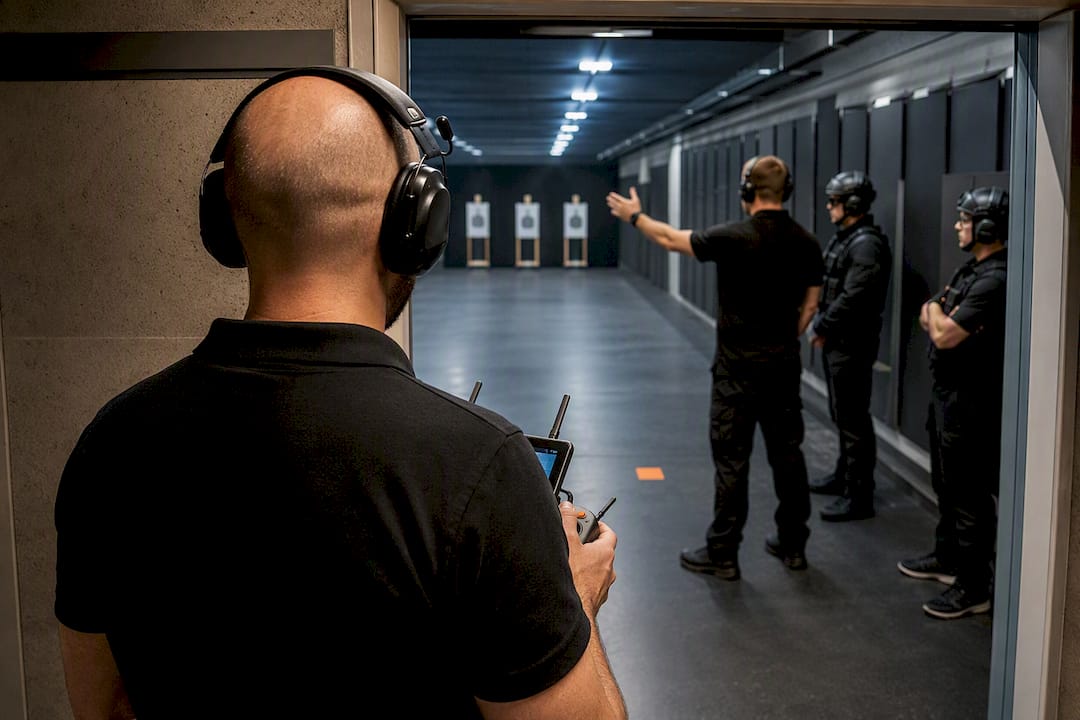
Coordinated overwatch drills go a step further, where the drone holds a static position over a courtyard or hallway junction while the ground team maneuvers based entirely on what the feed shows.
The outcome metrics that matter most:
Illustrative industry programs combining training with governance have reported measurable drops in manual patrol workload and faster incident triage, though results vary widely by deployment and team size, according to one professional drone training case study. The exact numbers will always depend on your baseline, but the direction of the improvement holds across most well-run programs.
Buying equipment and running one training day is the easy part. Building a program that keeps working six months later requires groundwork most organizations skip until something goes wrong.
A launch plan built only around new hardware, without matching governance and updated SOPs, tends to fail within the first few months regardless of how good the pilots are. Organizations that treat the drone as one more input into an existing security workflow, rather than a standalone gadget, get far more mileage out of the investment. Reviewing local drone safety rules before launch also keeps a program compliant from day one.
Not every provider offering “drone training” understands tactical integration. Ask three questions before signing a contract.
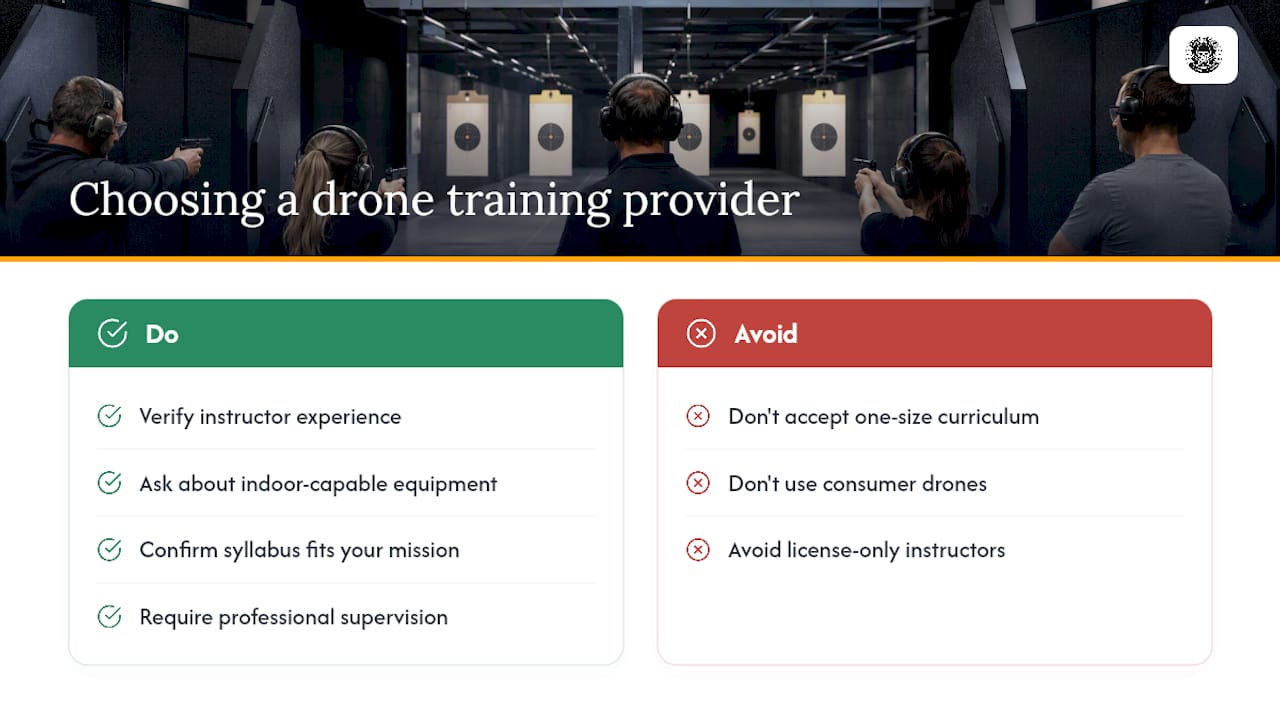
First, who is teaching? Instructor credentials should include hands-on operational experience, not just a piloting license. A provider who can explain how drone feeds change room-clearing tempo has actually run these drills, not just read about them.
Second, what is the equipment quality? Indoor FPV work demands drones built for tight spaces and low light, not consumer models designed for open-field hobby flying. Ask what platforms they use and why.
Third, does the syllabus map to your actual operational needs? A corporate security team clearing warehouse aisles needs different drills than an event security crew monitoring a crowd perimeter. A provider offering one fixed curriculum for every client is not customizing for your risk profile.
Estonia’s shooting and tactical training environment already leans heavily on professional supervision as a baseline expectation, and that same standard should apply to drone modules. Tondi Shooting Range folds drone technology experiences directly into its tactical and corporate training offerings, so teams get both firearms proficiency and reconnaissance skills under one roof, supervised by professional instructors throughout.
Pricing for drone-integrated tactical training varies more than most buyers expect, largely because the format changes so much between providers. A short introductory session focused on basic operation and one or two tactical drills sits at the lower end. A full corporate program with multiple modules, custom scenarios, and repeated sessions for skill retention costs considerably more.
Group size affects the per-person rate significantly. A single corporate team booking a half-day session typically pays a flat group rate that scales down per person as the group grows, which makes it a natural fit for corporate team-building events where the goal is shared experience as much as individual skill-building.
Equipment quality also factors into cost. Programs using purpose-built indoor FPV platforms with proper safety cages and low-light optics charge more than those relying on off-the-shelf consumer drones, but the training value difference is usually worth the gap. If you are budgeting for a corporate session, a detailed cost breakdown for shooting range team events gives a realistic sense of how group pricing scales for combined firearms and tactical formats.
No prior drone experience is required for these sessions, but a small amount of preparation makes the training day far more productive.
Physically, participants do not need special fitness, though indoor CQB drills involve movement, so comfortable clothing and closed-toe shoes matter more than people expect. Technically, reviewing basic drone terminology beforehand (line of sight, GPS-denied flight, FPV) saves instructor time that would otherwise go to vocabulary instead of practice.
The biggest readiness factor is mindset. Teams that arrive expecting a shooting-range-style skills day, rather than a lecture, get more out of the live drills. Corporate groups booking through Tondi Shooting Range’s company training checklist can typically schedule a session within two to three weeks, which also gives HR coordinators time to brief participants on what to expect.
One preparation step worth flagging: teams with zero firearms background sometimes worry the drone module requires shooting skill first. It does not. The drone and tactical modules can run as standalone sessions or combined with firearms training, depending on what the group wants out of the day.
A single training day builds familiarity, not mastery. Skill decay is real with any perishable skill, and drone operation under stress is no exception, so a certificate from one session should not be treated as a permanent qualification.
Refresher sessions every few months keep reporting formats and flight handling sharp, particularly for teams that do not deploy drones regularly in their actual jobs. Ongoing skill assessments, ideally tied to the same AAR structure used in the original course, give teams a way to track whether performance is holding steady or slipping.
Certification validity should be treated the same way a first-aid certification is treated: useful for a defined period, then due for renewal. Organizations running security operations year-round get the most value from building a refresher cadence into their annual training calendar rather than treating drone training as a one-time box to check.
Tondi Shooting Range is the most direct way to get drone-integrated tactical training without piecing together separate providers for firearms, tactical drills, and drone operation. Every session runs indoors, fully supervised by professional instructors, with safety training built into the start of the day and no prior experience required for any participant.
Sessions typically run as half-day or full-day formats, sized for anything from a small corporate team to a larger group event, and the range’s wide selection of firearms means groups can pair drone modules with live-fire tactical drills in the same booking. This setup works well for security teams building real operational skills, corporate groups looking for a team-building day that is more memorable than a conference room, and first-time visitors, including tourists, bachelor parties, and birthday groups, who want something more engaging than a standard activity.
Whether you are planning a corporate event, a stag weekend, or a team-building day, start with the tactical shooting sessions page to see current formats and book a date. Groups new to firearms entirely can also check the no-experience-required corporate event page to confirm exactly what a first visit looks like before committing.
No. Sessions at Tondi Shooting Range and similar tactical programs are built for first-time operators, with instructors covering flight basics before any tactical drills begin.
Hobbyist classes teach flight control. Security training integrates that control into team procedures, mission planning, and reporting formats used during real incident response.
Most corporate drone-integrated sessions run as a half-day or full-day format, depending on group size and whether firearms modules are included alongside drone drills.
Skill decay sets in within months without practice, so most security teams schedule refresher sessions every few months, paired with a scored assessment to track retention.
Yes. Tondi Shooting Range offers drone and tactical modules that can run standalone or combined with live-fire training in a single booking, making it efficient for corporate groups with limited scheduling time.