5 Checks Before Buying a Mosin Nagant — Collector Specs + Tondi
- Mo-Su 10.00 – 20.00
- +372 555 85 416
- sale@laskmine.ee





Keep the muzzle pointed downrange, your finger off the trigger until you are on target, load only on command, and treat every firearm as loaded. Bring photo ID, and know that minors need a parent or guardian’s consent. Our professional instructors supervise every session, and children shoot or observe only under explicit parental supervision and the range’s internal rules.
TL;DR:
- For the firearms license exam, the theory test has 10 questions; score at least eight, then complete the firing test within two months.
- Children need a parent or guardian’s consent and presence, plus hearing and eye protection; they may handle a firearm only beside an instructor.
- If a firearm misfires, keep it pointed downrange, remove your finger from the trigger, raise your free hand, and wait for the instructor.
- Bring your own firearm only if you hold a license; instructors inspect its condition, handling, and caliber, and unsafe weapons remain cased.
Every range runs on internal rules that you accept the moment you arrive, and the national safety regulation requires that a shooter knows the range’s internal rules and follows the commands of the person conducting the shooting. At our range that person is your instructor, and their word on the line is final. That is the whole contract in one sentence: listen, comply, ask when unsure.
Here is what to prepare before you come:
No experience is required. If you have never touched a firearm, tell the instructor at the start and we adjust the briefing. Our beginner page covers the first-timer basics in more detail.
Four universal rules apply to everyone, from a first-timer to a competition shooter. They are simple, and they are the reason ranges stay safe:
Loading and unloading happen only at the firing line and only on the instructor’s command. When you put a firearm down, it lies unloaded, with the action open where the design allows, pointing downrange.
Commands are short on purpose. “Load” means you may insert a magazine or rounds. “Fire” (in Estonian, “tuld”) means you may start shooting. “Cease fire” means you stop immediately, finger off the trigger, muzzle downrange. “Unload” means you remove the magazine and clear the chamber, then show the weapon to the instructor.
If a round does not fire or the gun stops working, keep the muzzle downrange, keep your finger off the trigger and raise your free hand. Do not look into the barrel and do not turn around with the gun. The instructor will clear it. A stoppage is never a reason to hurry.
Pro Tip: Say “I’m not sure” out loud. Our instructors would always rather repeat a command than watch you guess.
If you are applying for a firearms license, you take the relvaeksam. Police guidance says it includes a 10-question theory test. Check the official guidance for the current pass criteria and how long the theory result remains valid, then plan your firing test accordingly.
The process runs in a set order: you submit the application, pay the state fee, sit the theory test, then complete the firing test. The police explain why this is mandatory in their guidance on required exams: the process is standardized and checks both theoretical knowledge and practical skill.
For the practical part, examinees usually use their own weapon where possible, and for some parts a rifle must be chambered in .22 LR. Repeats and license extensions carry administrative fees, so a failed attempt costs real money.
Your test day checklist:
If you want to practice handling and safe habits before the exam, our relvakäsitsemise koolitus is priced at 175 EUR one-off.
Parents and the range share responsibility, but they are not equal shares. We control the line, the commands and the firearms. You control your child’s behavior, attention and readiness. A child who runs, shouts or reaches for equipment is a safety issue, and we will pause the session if that happens.
Hearing and eye protection are important considerations for everyone in the shooting area. Ask us about arrangements for children before your visit. Our Juunior ja seenior package is listed at 55 EUR one-off.
A short checklist for parents:
Pro Tip: Ask your child to repeat the safety rules back to you before you arrive. If they can say them, they will remember them on the line.
The safety regulation from the Ministry of the Interior sets requirements that all ranges must meet, including bulletproof structures and ventilation for indoor ranges and clearly marked warning signs that stop unauthorized people from entering danger zones. You can use it as a mental checklist when you walk into any venue.
The regulation defines open, semi-enclosed and closed ranges and the required areas of each, such as the firing line, target line and preparation area. Open ranges rely on backstops and side protection, while indoor ranges add enclosed, bullet-resistant structures. Danger zones must carry warning signs with defined dimensions and text, so a missing or hand-scribbled sign is a red flag.
What to look for:
Our range is indoors. More on that in our winter shooting guide.
Your instructor issues the load, fire, cease-fire and unload commands, checks every firearm and the ammunition you are about to use, and watches where each weapon is handled. Beginners get a briefing and a demonstration before they touch anything. Experienced shooters still get checked, because a clean record does not replace a second pair of eyes.
Instructors judge readiness by watching how you hold the firearm, where your finger sits and how you respond to commands. If something looks unsafe, they stop the line. That is not a punishment, it is the system working.
When you hear a stop command, freeze, take your finger off the trigger, keep the muzzle downrange and wait for instructions. Do not turn toward the instructor with the firearm in your hand. Arguing on the line helps nobody, and any discussion happens after the weapons are cleared and set down.
Some things are an instant stop. Alcohol or any intoxicating substance means you do not shoot, and we will not allow you onto the line. Horseplay, pointing a firearm at anyone, shouting commands over the instructor, ignoring a cease-fire call and aggressive conduct toward staff or other guests all end the session.
Why so strict? Firearms leave no room for second chances. One person who treats the line like a game puts everyone in the room at risk, and the regulation expects a shooter to follow the commands of the person conducting the shooting.
Safety comes first, and visitors must follow the instructor’s commands and the range rules.
Groups need to agree on one thing. At bachelor parties and birthdays, the mood is excited and everyone wants a good photo. Agree before you arrive that nobody drinks beforehand and that the instructor’s word is final. Our group events run smoothly when the group arrives sober and relaxed.
Firearms on our premises are either in the instructor’s control, on the firing line in use, or secured. There is no third state. You do not carry a firearm around the lobby, walk it to the car or leave it lying on a table between rounds.
If you bring your own firearm, ask us in advance about the applicable requirements. When you leave, unload, show clear, case it and go.
Follow your instructor’s directions for handling firearms between exercises.
A few simple habits cover most situations:
These steps cost nothing and prevent most accidents that happen away from the firing line.
Rental firearms can be a convenient option for visitors. We offer a wide selection, which suits tourists, couples, friends and first-time shooters.
Your own firearm is a different arrangement, and it is built for license holders. Our range rental, Laskeraja rent, is 125 EUR one-off per person, with a 10x card at 150 EUR and a 20x card at 200 EUR for regular shooters. Law enforcement staff can use a dedicated offer at 110 EUR one-off, and a gun owner can bring a friend along for 15 EUR one-off per person.
Personal firearms get checked, too. The instructor looks at the condition of the weapon, confirms that you know how to handle it and verifies that the caliber is allowed on the range. If the weapon looks unsafe, it stays in the case.
For the police shooting test, practice follows the same logic: your own weapon where possible, with .22 LR for certain rifle parts. If you are preparing, practice with the firearm you will use on the day.
Ammunition rules exist because bullets must stop where the range expects them to stop. The regulation limits allowed calibers and ammunition types for certain ranges and sets requirements for backstops, side protection and safe materials, all aimed at preventing dangerous ricochet.
In practice, use only ammunition that matches the firearm and the range, and follow your instructor’s directions about ammunition.
Some types stay off the line entirely: anything that is not intended for the range, handloads that no one can verify, and any round that looks corroded, dented or mismatched. If you are unsure, ask before opening the box.
Quantity depends on the package you book. Each package covers a defined amount of shooting, and you can add more at the desk if you want to continue. Cards for regulars work on visits, not on unlimited ammunition, so plan your session length the same way you plan your budget. For current options, see our price overview.
Shooting makes noise and releases combustion gases, and ranges have to manage both. That is the reason indoor ranges are required to have ventilation that extracts powder gases from the firing line toward the target area, keeping the air you breathe as clean as the setup allows.
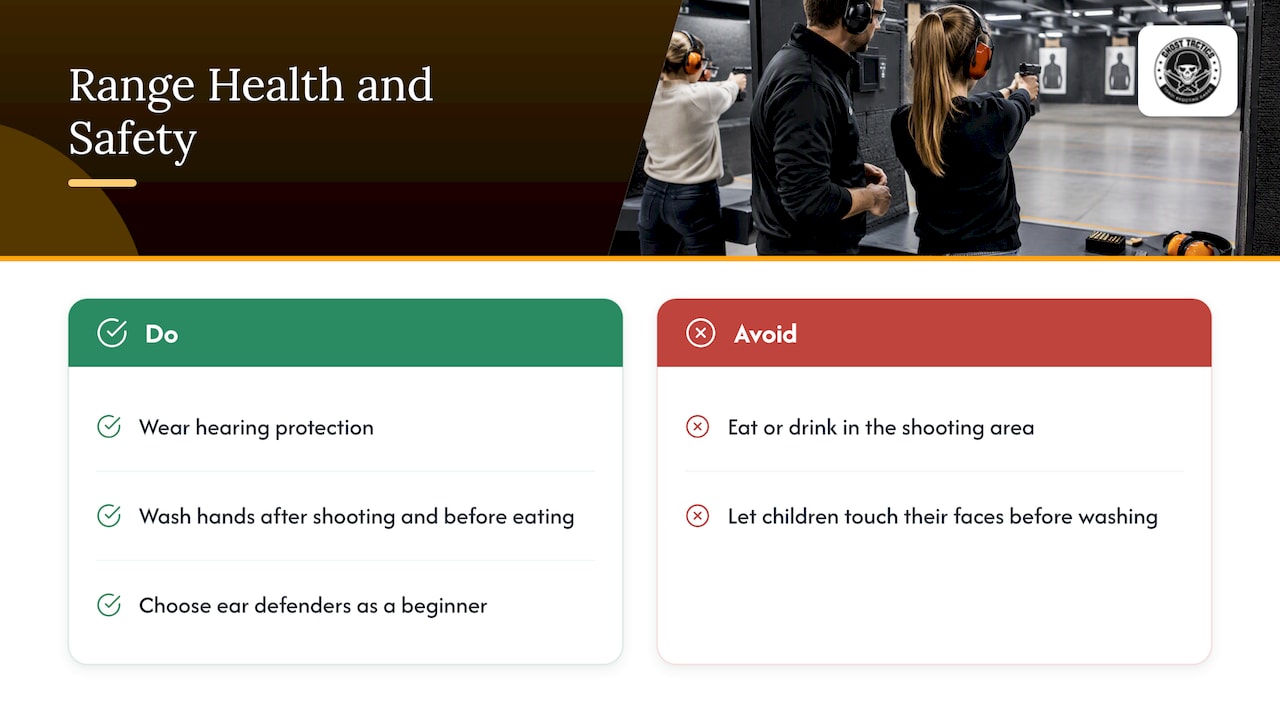
Noise is handled in two ways: the structure of the building and the protection you wear. An indoor range keeps the sound inside, which is easier on the neighborhood and the environment than a fully open field. Inside, hearing protection is mandatory for everyone, and for the shooter it is non-negotiable. We recommend ear defenders over foam plugs for beginners, since they are quick to put on and hard to put on wrong.
Lead and other residues are a real consideration as well. Good housekeeping matters: wash your hands after shooting and before eating, do not eat or drink in the shooting area and keep children’s hands away from their faces until they have washed. These habits are simple and are standard on any well-run range.
Being indoors also helps with weather and daylight. Rain, snow or a dark Tallinn afternoon do not change your session.
We built our range around one idea: anyone can shoot safely when the setup and the people are right. No experience is required, professional instructors supervise every session, and safety training is part of the visit. Our range is indoors, with a wide selection of firearms.
Read through the checklist above, then book a supervised session with us.
No, you do not need a license to shoot rental firearms under instructor supervision. You do need valid photo ID, and minors need parental consent. A license matters when you bring your own firearm.
Keep the muzzle downrange, keep your finger off the trigger until you are on target, treat every firearm as loaded and be sure of your target and what is beyond it. Load and unload only on the instructor’s command. Our beginner guide explains the commands in more detail.
The theory test has 10 questions, and you pass with at least eight correct answers. Police guidance says the theory result is valid for two months to complete the firing test, so plan your practical date early.
Yes, with a parent or guardian present, consent and mandatory hearing and eye protection. Children observe from the designated area and handle a firearm only with an instructor beside them.
Keep the muzzle downrange, keep your finger off the trigger and raise your free hand. Do not look into the barrel. Your instructor will clear the firearm safely.