NA 308 – new star at Tondi Shooting Range
- Mo-Su 10.00 – 20.00
- +372 555 85 416
- sale@laskmine.ee





The Mosin Nagant is a rugged, five-shot bolt-action rifle chambered in 7.62×54mmR that armed Russian and Soviet forces for over half a century. It remains one of the most affordable ways into military rifle collecting today, though buyers should expect dated ergonomics, a heavy trigger, and the maintenance demands of corrosive surplus ammunition.
TL;DR:
- The Mosin Nagant’s effective range with iron sights is around 400 to 500 yards, but sight calibration often uses obsolete Russian units, complicating aiming.
- Variants differ significantly in length, weight, and sighting, with the M91/30 being the most common, and Finnish refinements generally offer better accuracy and finish.
- Surplus rifles typically group about 2 MOA at 100 yards, but trigger weight and bore condition are the main factors that limit precision.
- Corrosive surplus ammo requires immediate, thorough cleaning to prevent salt residue from damaging the bore within days.
- Proper in-person inspection, including bore condition and matching serial numbers, is essential before purchasing a Mosin Nagant to avoid hidden damage or mismatched parts.
Every Mosin Nagant shares the same bones: a bolt-action rifle feeding from a 5-round internal magazine, chambered in the rimmed 7.62×54mmR cartridge, with a two-piece stock and right-hand rifling. What changes across variants is barrel length, overall length, weight, and sighting setup, and those differences matter a lot if you’re trying to identify what’s actually in your hands.
The table below compiles figures drawn from detailed variant specification data and the rifle’s general production record.
| Variant | Overall Length | Barrel Length | Weight | Sights | Notes |
|---|---|---|---|---|---|
| M91 | ~51.4 in | ~31.6 in | ~9.6 lb | Rear leaf, front blade | Original 1891 pattern, hexagonal receiver common |
| M91/30 | ~48.5 in | ~28.7 in | ~8.8 lb | Rear leaf (later tangent), front hood | Most common variant; basis for sniper builds |
| M38 | ~40 in | ~20 in | ~7.7 lb | Rear leaf, front blade | Carbine, no bayonet lug |
| M44 | ~40 in | ~20 in | ~8.9 lb | Rear leaf, front blade | Carbine with folding bayonet |
| M28/30 (Finnish) | ~44 in | ~27 in | ~9 lb | Adjustable rear sight | Finnish-refined barrels and finish |
A rimmed cartridge like the 7.62×54mmR feeds differently than a rimless design such as the .308. Rims can stack and lock inside the magazine if you load carelessly, which is why the Mosin’s magazine follower and cartridge guide were engineered specifically around loading rounds in the correct nose-up sequence. Handloaders should also know that rim thickness varies more across manufacturers than it does with rimless brass, so case sorting matters more here than with most modern calibers.
Effective range on iron sights runs out to roughly 400 to 500 yards for a trained shooter, though the rear sight graduations on many wartime examples are calibrated in arshins or old Russian units rather than meters, which throws off unfamiliar shooters at first. A few practical notes worth keeping in mind:
Russia’s Imperial Army ran rifle trials between 1882 and 1891 to replace its aging single-shot Berdan rifles, and two men ended up shaping the winning design. Sergei Mosin, a Russian artillery captain, developed the receiver and bolt system, while Léon Nagant, a Belgian arms designer, contributed a magazine and feed mechanism. The hybrid that emerged, officially adopted in 1891 as the “3-line rifle, Model 1891” (the “line” being an old Russian unit of measurement equal to roughly a tenth of an inch), became the standard infantry rifle of the Russian Empire and, later, the Soviet Union.
Production ramped up at the Tula and Izhevsk arsenals, with additional output from Sestroryetsk and, during World War I, contracted manufacturing from Remington and New England Westinghouse in the United States to meet wartime demand that Russian factories couldn’t handle alone. Over its production life, total output landed somewhere around 37 million units, making it one of the most mass-produced bolt-action rifle designs in history. That kind of volume is a big part of why surplus rifles remained cheap and plentiful for decades after their military careers ended.
The rifle’s service record covers nearly every major conflict Russia and the Soviet Union fought through the 20th century:
Finland took a different path. After capturing large numbers of Russian Mosins during the Winter War and Continuation War, Finnish arsenals reworked them into the M28, M28/30, and M39 variants with tighter tolerances, better barrels, and improved sights. Finnish-refinished rifles are widely regarded among collectors as the best-built Mosins ever produced, ironically better finished than most of the Soviet originals they were built from.
By the Cold War, the Mosin had largely been replaced in frontline Soviet service by semi-automatic and select-fire rifles, but it never fully disappeared. Warehouse stocks kept getting issued to reserve units, allied nations, and irregular forces well into the late 20th century, which is exactly why so many surplus examples flooded Western markets starting in the 1990s.
Telling one Mosin apart from another comes down to a handful of visual cues you can check in under a minute once you know what to look for.
A few other things separate a genuine collector piece from a common shooter-grade rifle:
Mixed-arsenal parts are common enough that they shouldn’t automatically scare off a buyer looking to shoot rather than collect. Wartime depots swapped bolts, stocks, and barrels between rifles constantly during repairs, so a rifle with a 1943 receiver and a 1938 stock isn’t necessarily a fake, just a working rifle that got fixed with whatever parts were on hand, as detailed variant records confirm.
With quality ammunition, most Mosin Nagants group around 2 MOA, meaning roughly 2 inches of spread at 100 yards. That’s a real number backed by field testing, not a marketing estimate, and it puts a well-maintained Mosin roughly in line with a lot of budget hunting rifles rather than in true precision territory.
Some well-preserved examples, especially Finnish-refinished rifles or original sniper builds, can approach 1 MOA under ideal conditions with handloaded ammunition matched to that specific barrel. That’s the exception, though, not the rule. Most surplus rifles that have passed through decades of arsenal rebuilds land closer to that 2 MOA baseline, and a rifle’s individual bore condition matters more than which model it is.
Trigger pull is the other half of the accuracy story. Mosin triggers commonly run 6 to 9 pounds, noticeably heavier and grittier than a modern hunting rifle’s trigger, which usually sits in the 3 to 5 pound range. That weight makes it harder to break a clean shot without disturbing your sight picture, and it’s one of the single biggest factors separating an average shooter’s groups from what the rifle is mechanically capable of.
A few things worth knowing about ballistics and realistic use cases:
If you want to close the gap between a 2 MOA rifle and something tighter, the most reliable path is trigger work, restocking or bedding the action, and, for serious shooters, a rebarrel job. None of that is required to enjoy the rifle. It’s just where the real gains live if you’re chasing smaller groups. For readers who want to understand what a “good group” actually looks like before chasing one, our guide on what grouping means in practical shooting terms breaks down how to measure your own results correctly.
Buying a Mosin sight-unseen from an online listing is a gamble. Buying one in person with a checklist in hand is a much smarter bet, and it takes only a few minutes to run through.
Pro Tip: Bring a bore light or borescope to any in-person inspection. A pitted or heavily eroded bore is invisible from the outside but will wreck accuracy no matter how clean the exterior looks.
Run through this before handing over any money:
Price bands vary widely by variant and condition. A standard M91/30 in shooter-grade condition typically sits at the lower end of the market, while a documented sniper-marked example with matching PU scope, mount, and correct case commands substantially more, sometimes several multiples of a base rifle’s price. Finnish M28/30 and M39 rifles, prized for their arsenal refinishing and tighter tolerances, also tend to price above standard Soviet-issue examples. Rare arsenal marks, early hexagonal receivers, and rifles with matching bayonets and accessories all push value upward too.
Before you finalize a purchase, especially for anything represented as a genuine sniper rifle or rare variant, get a second opinion from a gunsmith familiar with Mosins, and ask the seller for any documentation or provenance history. A rifle with a believable paper trail is worth more, and it’s a lot less likely to be a mismatched assembly dressed up as something rarer than it is.
Most surplus 7.62×54mmR ammunition uses corrosive primers, which leave behind salt residue that attracts moisture and eats away at your bore if you leave it uncleaned. This isn’t a minor maintenance suggestion. Skip cleaning after a range session with corrosive ammo and you can develop visible pitting within days, not months.
Here’s the cleaning sequence that actually works:
Pro Tip: If you can’t clean the rifle the same day you shoot it, at minimum run a wet patch down the bore before you leave the range. It buys you time and dramatically cuts the corrosion risk until you can do a full cleaning.
The Mosin’s safety mechanism deserves its own mention because it trips up a lot of new owners. To engage it, you pull the cocking piece at the rear of the bolt slightly rearward and rotate it to the left until it catches against the receiver. It’s stiff by design, fighting against firing pin spring tension, and many shooters find it genuinely difficult to operate smoothly without practice. Treat every Mosin as though the safety might not be reliably engaged, and always keep the muzzle pointed in a safe direction regardless of what position the safety appears to be in. Reviewing general firearm safety rules before handling any older military surplus rifle is a smart habit, since these designs predate a lot of the safety conventions built into modern firearms.
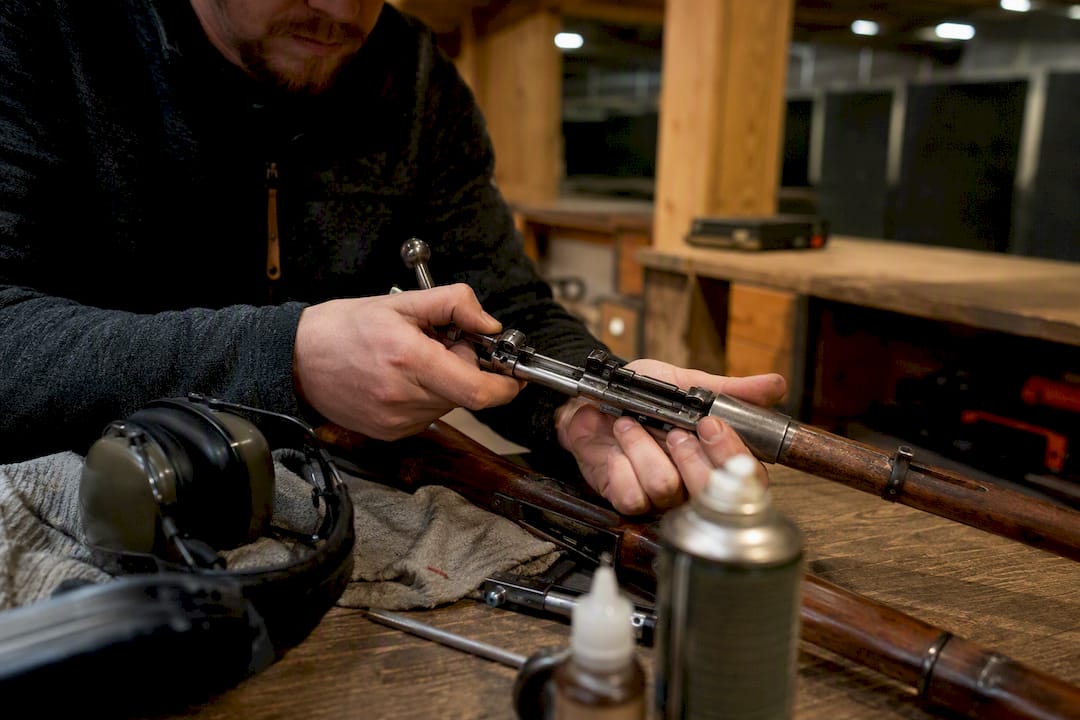
Store the rifle somewhere dry, check the bore periodically even when it’s not being fired, and if you ever spot pitting, cracked wood near the receiver, or a bolt that doesn’t lock up cleanly, get it looked at by a gunsmith before firing it again.
The Mosin’s long length and lack of a pistol grip make it feel different in the shoulder than most modern rifles, and that difference trips people up more than the recoil itself does. Get your cheek weld consistent against the comb first. Because the stock is a straight, dated profile without a raised cheekpiece, you have to find your own repeatable position rather than let the stock do it for you.

Recoil from the 7.62×54mmR cartridge is stout but manageable, comparable to a .308 in a similarly weighted rifle. A slip-on rubber buttpad is a cheap, non-permanent upgrade that noticeably softens the punch over a long session, and it’s one of the easiest wins available without touching the rifle’s originality.
A few habits make a real difference in your groups:
If you’re looking to sharpen fundamentals beyond the range session itself, our guides on common shooting mistakes worth fixing and breath control for tighter groups both apply directly to a rifle with a trigger this demanding. The fundamentals matter more on a Mosin than on a forgiving modern rifle, not less.
Reading specs and price guides only gets you so far. Shouldering the rifle, feeling that trigger break, and managing the recoil yourself is the only way to know if a Mosin Nagant actually fits how you want to shoot. Tondi Shooting Range gives you exactly that chance, in a fully supervised, indoor setting where no prior experience is required.
Every session starts with a safety briefing from a professional instructor, covering handling, the specific quirks of older military actions, and how to manage a heavier trigger safely before a single round gets fired. That matters even more with a rifle like the Mosin, whose safety mechanism and ergonomics differ so much from anything modern. Trying one under proper instruction before you buy is a smart way to find out if you actually enjoy shooting it, rather than discovering that after spending the money.
Tondi Shooting Range offers:
Groups looking for something more than a standard visit can build a full team-building event around the experience, and corporate organizers can check event pricing details ahead of booking. If you’re just starting to explore the sport, our main range page walks through what to expect from your first visit, and gift cards are available for anyone who wants to give the experience rather than book it themselves. Book a session with Tondi Shooting Range and find out firsthand what a piece of firearms history actually feels like in your hands.
For its era, yes. It was rugged, simple to manufacture in massive numbers, and reliable in harsh field conditions, though its heavy trigger and dated ergonomics make it feel rough by modern standards.
Firearm legality depends on classification and local regulation, and rules can change, so check current Canadian firearms law directly with an official source or licensed dealer before buying or importing one.
No, original military production ended decades ago; the roughly 37 million units built during the rifle’s service life represent total historical output, not ongoing manufacturing.
Complaints usually center on the heavy 6 to 9 pound trigger pull, an awkward safety mechanism, and a straight stock profile that feels less comfortable in the shoulder than modern designs, not on reliability or ruggedness.
Most rifles group around 2 MOA with good ammunition, meaning about 2 inches of spread at 100 yards, though some well-maintained examples can approach 1 MOA under ideal conditions.