How to Take a Friend to a Shooting Range Safely
- Mo-Su 10.00 – 20.00
- +372 555 85 416
- sale@laskmine.ee





Tactical shooting means firing a handgun or carbine under realistic conditions, movement, cover, target discrimination, and time pressure, rather than standing still at a paper target. No prior experience is required, and every session runs under direct instructor supervision. Tondi Shooting Range, with its Instructor TO leading sessions, is the recommended provider for individuals, tourists, and groups who want a safe, structured introduction to this kind of training.
TL;DR:
- Most sessions last between 60 and 90 minutes, with longer packages available for groups or corporate events, all under professional supervision.
- The standard safety protocol includes a mandatory briefing, dry-fire practice, and instructor oversight during live fire, ensuring safety for beginners.
- Equipment options primarily include semi-automatic pistols and carbines, with protective gear such as eye and ear protection required at all times.
- Bookings should be made at least a week in advance for large groups, with prices scaling based on ammunition, instructor ratio, and package complexity.
- The indoor range’s controlled environment, small instructor-to-participant ratios, and structured progression help newcomers build confidence and skills quickly.
Not every visitor wants the same thing out of a session, and that’s the point of having several formats instead of one fixed package. A solo tourist with an hour to kill wants something different from a twelve-person bachelor party or a company sending its sales team for an afternoon.
The typical breakdown looks like this:
Duration runs anywhere from a tight 45 minute intro slot to a two-hour team event, and most packages set an instructor-to-participant ratio that keeps every shooter within arm’s reach of professional supervision for the entire live-fire portion. Round counts vary by package, but a standard intro session usually includes enough ammunition to try more than one firearm without feeling rushed.
Tourists visiting Tallinn tend to gravitate toward the intro package, since it fits inside a half-day sightseeing schedule. Corporate groups and stag parties usually book the longer formats, since the value comes from shared experience as much as the shooting itself. If you’re planning a visit, the shooting experience booking page breaks down what’s included in each format.
Walking in without knowing the sequence of events is the biggest source of pre-session nerves, and it’s almost always unnecessary once you know the flow.
Training guides that study this kind of progression consistently recommend the same sequence: static marksmanship first, then movement, then scenario work, because skills build in that order or not at all. A 60 to 90 minute session typically allots 15 minutes to check-in and briefing, 15 to 20 minutes to dry fire, 30 to 45 minutes to live-fire drills, and a final 10 minutes to debrief.
Pro Tip: Ask your instructor to explain the “why” behind each correction, not just the fix. Understanding why your grip shifts under recoil sticks with you longer than a one-line reminder.
Multiple beginner course breakdowns confirm this pattern holds industry-wide: safety and dry practice come first, live fire comes second, and most first-timers find recoil far more manageable than they expected once they’ve been shown proper technique.
Every session at Tondi Shooting Range runs under the direct supervision of a professional instructor, and safety training is built into the package price rather than sold as an add-on. That’s not a marketing line, it’s the operating model. Nobody loads a firearm before completing the safety briefing, and nobody fires live rounds without an instructor positioned to intervene.
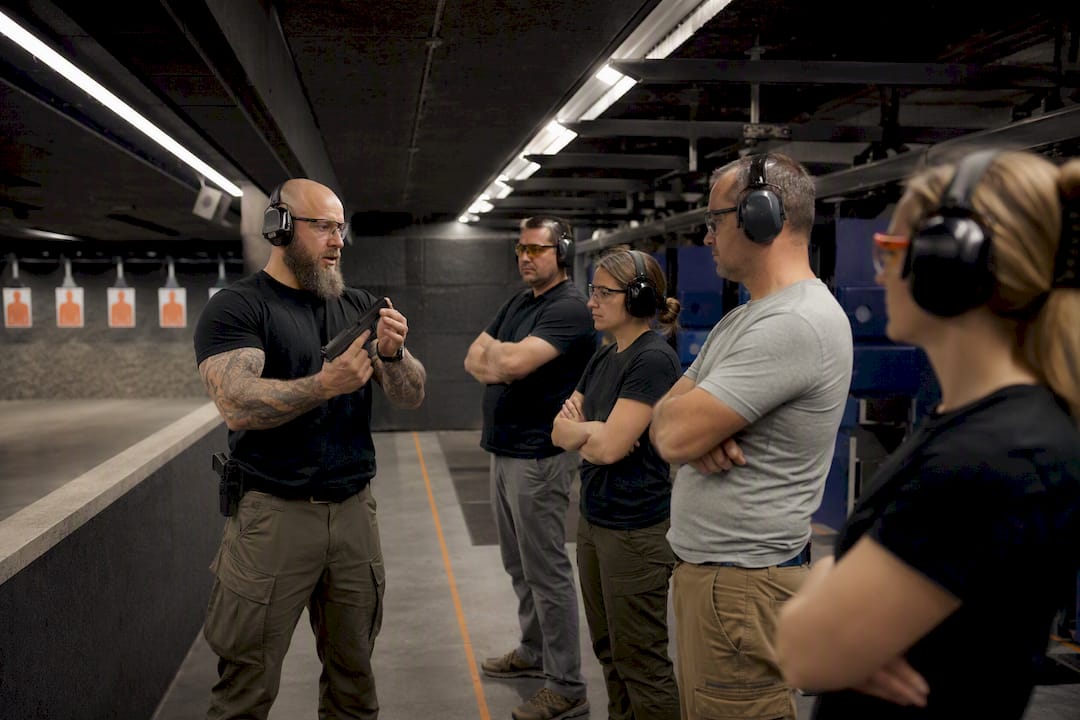
Tondi Shooting Range holds the distinction of being the largest shooting range in the Baltic region, which matters practically, not just as a bragging point. A larger indoor facility means more lanes running simultaneously, shorter wait times for group bookings, and enough instructor capacity to keep ratios tight even when a twelve-person corporate group and a couple booking a date-night session are on the range at the same time.
Instructor TO, who leads many of the tactical sessions, represents the kind of hands-on coaching that separates a supervised range visit from an unsupervised one. Feedback happens in real time, between shots, not after the fact.
A structured safety briefing followed by an instructor standing beside the shooter during live fire is consistently what turns first-timers from nervous to confident, and it’s often the deciding factor in whether someone books at all.
That pattern isn’t unique to one range. It shows up across first-lesson breakdowns for new shooters everywhere, and it’s why Tondi Shooting Range builds its entire session structure around instructor proximity rather than treating supervision as an optional upgrade. Visitor reviews of tactical shooting experiences in Tallinn repeatedly single out instructor professionalism and the adrenaline of the experience as the two things people remember most.
The indoor range setup at Tondi Shooting Range gives instructors control over lighting, distance, and target placement in a way an outdoor range can’t match, and it’s part of why sessions run reliably regardless of weather or season.
Firearms available typically fall into two broad categories:
Protective equipment is mandatory, not optional, for every participant regardless of experience level:
Some sessions include optional equipment demos, red-dot optics or weapon-mounted lights, so participants can see how these tools change target acquisition without needing to own the gear themselves. Instructors handle firearm selection based on hand size, grip strength, and comfort rather than letting a nervous first-timer pick blind. Indoor ranges of this type commonly run 25 and 50 meter lanes, which covers everything from close-range pistol work to longer carbine distances inside one facility.
The value extends well past the novelty of firing a gun for the first time, and it splits fairly cleanly between what an individual takes away and what a group takes away.
For individuals, the common outcomes are:
For groups, the payoff looks different:
Accessibility is broad but not unlimited. Most venues set a minimum age requirement, and every participant needs valid photo ID at check-in. Physical demands are modest, you’re standing and occasionally moving, not sprinting, so it suits a wide range of fitness levels. If you’re organizing a corporate outing, the team-building page covers group sizing and typical event formats in more detail.
Booking a session is straightforward, but a few timing details make a real difference for groups.
Most visitors book directly through the range’s booking page, by phone, or through gift card purchases for someone else. Groups of six or more should book at least a week ahead, since larger bookings need to be slotted around instructor availability and lane capacity. Local booking platforms also list tactical shooting packages and seasonal offers for anyone comparing options before committing.
Price generally scales with three factors:
Cancellation and rescheduling policies vary by package type, so it’s worth confirming the specific terms at the time of booking, particularly for larger group events where deposits are common. Operating hours generally accommodate both daytime tourist visits and evening corporate bookings, though exact hours should be confirmed when you book.
A little preparation goes a long way toward making your session smooth instead of rushed.
Bring these essentials:
Leave these at home or in the car:
Pro Tip: Arrive 15 minutes before your scheduled time. Check-in and paperwork eat into your session if you arrive right at the start time, and instructors can’t extend live-fire minutes to make up for a late arrival.
If you have any health conditions that might affect your ability to handle recoil or stand for the session length, mention it during booking so instructors can adjust the plan. For a deeper primer before you go, the beginner’s guide to pistol shooting basics covers grip, stance, and terminology you’ll hear during the briefing.
Tactical shooting isn’t one discipline, it’s a family of related skill sets that share a common foundation but branch depending on the scenario they’re built for.
Combat marksmanship focuses on accuracy under time pressure, hitting a target quickly and correctly rather than slowly and perfectly. It’s the base layer everything else builds on.
Close quarters battle (CQB) techniques deal with short-distance engagements, tight spaces, and rapid target discrimination, distinguishing a threat from a non-threat in a split second. This is typically introduced only after a shooter has solid fundamentals, since the pace leaves little room for correcting bad habits mid-drill.
Movement and cover work trains shooters to fire accurately while moving or using obstacles for protection, a skill set built on the idea that standing still in the open is rarely realistic outside a target range.
Explainers on the discipline consistently break it down into three pillars, mindset, marksmanship, and tactics, with drills progressing from static fire to movement to force-on-force scenarios as skill increases. Beginner sessions at most ranges, including Tondi Shooting Range, stay firmly in the marksmanship and light movement zone, building the fundamentals that make advanced disciplines possible later.
A handful of drills show up across nearly every tactical shooting curriculum because they isolate specific, learnable skills instead of testing everything at once.
The draw and presentation drill trains the motion from holster to sight picture, timed and repeated until it’s smooth rather than jerky. Slicing the pie teaches a shooter to clear a corner or doorway incrementally, exposing only as much of themselves as necessary at each step. Failure drills (sometimes called “failure to stop” drills) practice follow-up shots when a first hit doesn’t neutralize a threat, building the habit of assessing rather than assuming.
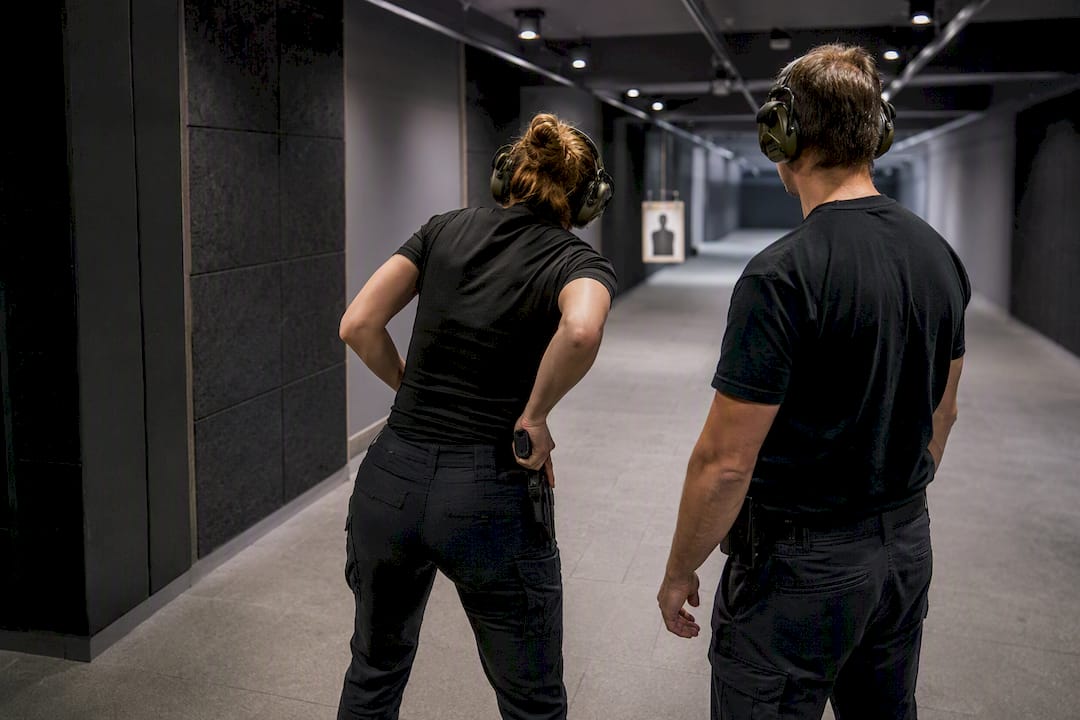
Reload under pressure drills combine a timer with a magazine change, since fumbling a reload in a real scenario costs more than seconds. Target discrimination exercises mix threat and non-threat targets in the same drill, forcing a shooter to identify before firing, a skill that separates tactical training from simple accuracy practice.
Instructors typically sequence these from slow and deliberate to fast and pressured, adding a timer only once the movement pattern is correct without one. This mirrors the broader industry consensus that skills should progress from dry-fire fundamentals to live, scenario-based variability rather than jumping straight to speed. If you want to build fundamentals between visits, dry-fire practice at home reinforces grip and trigger control without needing a range at all.
Most first-time participants hit the same handful of sticking points, and knowing them in advance takes the edge off.
Recoil anticipation is the biggest one. New shooters often flinch or push down on the trigger in anticipation of recoil, which throws shots low. Instructors catch this immediately during dry-fire practice, before it becomes a live-fire habit.
Grip fatigue shows up after extended strings of fire, especially for anyone who hasn’t held a firearm for a sustained period before. A proper grip reduces this, but it’s still common for hands to tire faster than expected.
Target fixation under time pressure is a challenge once movement or scenario elements enter the picture. Shooters focus so hard on the target that footwork and awareness of surroundings suffer. This is exactly why beginner sessions hold off on scenario work until marksmanship fundamentals are solid.
Stress response variability is real too. Some people handle the noise and adrenaline of live fire with total calm, others need a minute to adjust. Neither response is wrong, and instructors are trained to read it and adjust pacing rather than push everyone through the same script regardless of comfort level.
Participation in a supervised tactical shooting session at a licensed indoor range is a straightforward, legal recreational and training activity, but it does come with baseline requirements that every participant needs to meet.
Age verification and valid photo identification are checked at every session, and minimum age requirements apply regardless of whether you’re booking solo or as part of a group. Anyone showing signs of alcohol or drug impairment will not be permitted to handle a firearm, no exceptions.
Firearms handling at a licensed range is governed by the venue’s own safety rules and staff instructions, which participants agree to follow when they sign the standard waiver at check-in. This isn’t a formality, it’s the legal and practical basis for everyone’s safety on the range floor. Participants don’t need a firearms license or permit of their own to take part in a supervised session, since the range and its instructors hold the relevant licensing and the firearms remain under their control throughout.
If you have specific questions about eligibility, particularly around age or any legal restrictions that might apply to your situation, it’s worth confirming directly with the range before booking rather than assuming.
The session isn’t really over the moment the last shot is fired. The debrief is where the learning actually locks in.
A proper debrief covers what worked, grip, stance, follow-through, and what to adjust next time, delivered specifically rather than as vague encouragement. This is also when instructors answer lingering questions that participants were too focused to ask mid-session.
Physically, most participants notice mild hand or forearm fatigue after an active session, particularly if movement drills were involved. This fades within a day and isn’t a sign of doing anything wrong, it’s just muscle engagement you’re not used to.
Mentally, the adrenaline dip after a tactical session is real, and it’s part of why many participants describe the experience as unexpectedly calming afterward rather than just exciting during. Reviewing what you learned within a day or two, even mentally replaying the debrief notes, helps the technique stick far better than letting it fade. For anyone who wants to keep building skill between visits, structured pistol shooting drills designed for beginners offer a next step that doesn’t require another full session.
Tondi Shooting Range is the largest shooting range in the Baltic region, and that scale means more lanes, shorter waits for group bookings, and instructor capacity that keeps ratios tight even during busy weekends. Every session runs under professional supervision with safety training built into the price, the range is fully indoors so weather never cancels your booking, and the firearm selection covers everything from beginner-friendly pistols to carbines for those ready to progress. No experience is required, and that applies whether you’re a solo tourist, a couple looking for something different, or a twelve-person bachelor party.
Packages exist for every group type: corporate teams can check the team-building options for structured group events, bachelor and bachelorette parties will find tailored formats on the Tallinn group activity guide, and anyone wanting to lock in a date can head straight to the main booking page to check availability. Gift cards are also available for anyone who wants to give the experience rather than book it themselves.
Ready to see available time slots? Check current openings and book your session directly through the shooting experience page, or reach out ahead of time for group and corporate bookings.
No experience is required. Every session starts with a safety briefing and dry-fire practice before any live ammunition is used, and an instructor stays with you throughout.
Most intro sessions run 60 to 90 minutes, while team-building and group packages can extend to two hours depending on the number of stations and participants.
Yes. As the largest shooting range in the Baltic region, Tondi Shooting Range regularly hosts corporate team events, bachelor and bachelorette parties, and other large group bookings with dedicated instructor support.
Wear closed-toe shoes and avoid loose clothing that could interfere with your grip; long hair should be tied back away from ear protection and the firearm.
Sessions typically use the range’s own firearms, selected and supervised by instructors, so participants don’t need to own or bring any equipment.
Yes, when conducted under professional supervision with a mandatory safety briefing and progression from dry fire to live fire, which is standard practice at Tondi Shooting Range for every first-time participant.