Halloween Zombie Hunt in Tallinn
- Mo-Su 10.00 – 20.00
- +372 555 85 416
- sale@laskmine.ee





An AR-15 is a lightweight, semi-automatic rifle platform built for civilian use, and it’s the most customizable rifle design on the market today. It fires one round per trigger pull, unlike its select-fire military cousins, and it forms the basis for what most gun stores now call a “modern sporting rifle.” People use it for target shooting, competition, hunting varmint-sized game, and home defense, and prices for a basic build start in the several hundred dollar range, with custom setups running into the thousands.
Before you buy or even shoot one for the first time, a few things matter more than the brand stamped on the receiver:
Quick fact: The AR-15 traces its design back to ArmaLite, and Colt later built it into the civilian rifle most people recognize today, chambered originally in .223 Remington and 5.56×45mm NATO.
TL;DR:
- An AR-15 is a civilian semi-automatic rifle that cannot switch to automatic fire, unlike its military counterparts, the M16 and M4.
- Upgrades such as triggers, optics, and stocks generally improve shooting accuracy and handling more than barrel or gas system enhancements.
- In Estonia, firearm ownership requires passing a theory exam and practical shooting test before acquiring a permit, with supervised range training highly recommended.
- Beginners should try supervised range sessions before buying to understand how the rifle feels and ensure safety skills are properly developed.
AR does not stand for “assault rifle.” It stands for ArmaLite, the small California company that designed the original rifle back in the 1950s before selling the patent to Colt. That single fact clears up more confusion than anything else in this entire topic, and it’s worth knowing before you read another listing online.
Colt trademarked “AR-15” for its own semi-automatic version, which is why you’ll see the term “AR-15–style rifle” used for every other manufacturer’s version of the same general design. Dozens of companies now produce rifles built on this pattern, and none of them can legally call their product an “AR-15” unless it’s a genuine Colt. That’s why the market settled on alternate language:
The real distinction that matters, though, is the one between a civilian AR-15 and its military relatives, the M16 and M4. Those platforms are select-fire, meaning a soldier can switch between semi-automatic and fully automatic (or burst) fire. A civilian AR-15 cannot do that. It fires exactly one round per trigger pull, full stop, regardless of what internal parts you swap. That single mechanical difference is the entire legal and functional line between a rifle you can own for target shooting and a weapon restricted to military and law enforcement use. If you’ve read “AR 15 vs M16” comparisons that focus on cosmetics, ignore them. The trigger group and fire control mechanism are what separates the two, not the handguard or stock.
The AR-15’s defining trait is how easily it comes apart and goes back together. The rifle splits into two halves, an upper receiver and a lower receiver, connected by two pins. That modularity is why the platform has stayed relevant for seven decades and counting, and it’s also why new owners can spend a lot of money on upgrades that don’t actually improve their shooting.
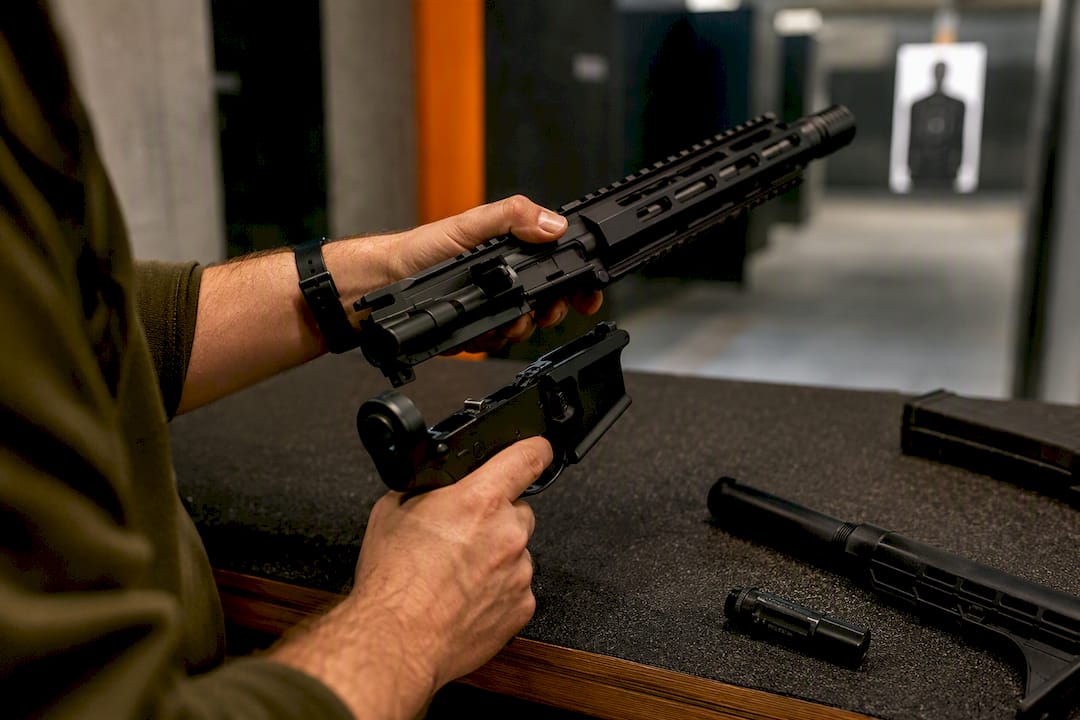
The lower receiver houses the trigger group, magazine well, and stock, and in most jurisdictions it’s the part legally classified as “the firearm” itself, meaning it’s the piece with the serial number and the piece that requires licensing paperwork. The upper receiver holds the barrel, bolt carrier group, and optic. Estonian buyers should treat any receiver swap or build project as a licensing question first. Check the legal section further down before assuming you can mix and match parts freely.
Here’s how upgrades actually rank in terms of real-world impact on your shooting:
Upgrades that improve shooter control, meaning the trigger, the stock, and the optic, tend to deliver more noticeable improvement for range regulars than an expensive match-grade barrel ever will.
Parts compatibility is where a lot of first-time builders run into trouble. Buffer systems, barrel extension specs, and gas-block positioning are the three most common points of mechanical incompatibility when mixing components from different manufacturers. A barrel rated for one buffer weight paired with the wrong spring can cause cycling issues that look like a defective rifle but are actually just a mismatched parts list.
Pro Tip: If you’re new to the platform, don’t buy upgrade parts before you’ve put at least a few range sessions behind the stock configuration. You’ll have a much better sense of what’s actually bothering you, whether it’s trigger weight, stock length, or sight picture, once you’ve felt it firsthand under supervision.
The standard chambering for most AR-15 rifles is .223 Remington or 5.56×45mm NATO, and for the vast majority of shooters, that’s still the right call. It offers manageable recoil, wide ammunition availability, and enough range and terminal performance for target work, varmint hunting, and home defense.
Two other calibers come up often enough to deserve a mention. .300 Blackout was designed to work well with suppressors and short barrels, trading some range for a heavier, quieter round that performs better at close distances. .224 Valkyrie pushes the opposite direction, favoring long-range flat trajectory over versatility, and it appeals mainly to shooters focused on distance competition rather than general-purpose use.
Then there’s the budget option almost nobody regrets: a .22 LR conversion upper or dedicated .22 LR AR-pattern rifle. Because ammo choice directly affects recoil, trajectory, and cost, training on .22 LR lets new shooters build fundamentals, trigger control, sight alignment, follow-through, without burning through expensive centerfire ammunition every session.
A few practical notes on barrel length and twist rate that most beginner guides skip entirely:
Quick fact: Because 5.56 NATO and .223 Remington chamber dimensions differ slightly, a rifle marked “5.56” can safely fire both, but a rifle marked only “.223 Remington” should not be fed 5.56 ammunition without checking the manufacturer’s specification.
Estonia treats firearm ownership as a licensed activity, not an automatic right, and an AR-15–style rifle falls under categories that require formal permitting before purchase. The process runs through the Estonian Police and Border Guard Board, and it follows a fairly predictable sequence.
Some rifle configurations and calibers fall into stricter permit categories than others, so it’s worth confirming exactly what your intended build or purchase requires before you commit money to it. Official guidance on the exam and testing process, including fee structures, is published directly by the Police and Border Guard Board rather than through third-party sources, and that’s the guidance you should follow over anything you read on a forum.
Here’s the part most articles miss: the practical shooting test isn’t just a bureaucratic hurdle, it’s genuinely useful preparation. Spending time at a supervised indoor range before your official test builds the muscle memory and comfort level that makes the actual exam far less stressful. Tondi Lasketiir’s supervised sessions are structured around exactly that kind of preparation, giving first-time applicants real trigger time with professional instructors watching every step.
Before you spend a dollar, answer four questions honestly. What will you actually use the rifle for, casual range days, competition, home defense, or hunting? What’s your realistic total budget, including ammo, optics, and a case, not just the rifle’s sticker price? How much ongoing maintenance and part support does the manufacturer offer? And does the platform you’re eyeing have a healthy aftermarket, so you’re not stuck if a part breaks or you want to upgrade later?
Price bands break down roughly into three tiers, and knowing where you land helps you avoid overpaying for features you won’t use.
When you’re talking to a dealer or instructor, ask direct questions: What’s included in registration support? Is parts and warranty service handled locally, or do you ship the rifle back to the manufacturer? What training packages are available for someone who’s never fired a rifle before?
That last question matters more than almost anything else on this list. If you’ve never shot before, do not start by buying a rifle. Start by renting one at a supervised range and running through a guided introductory package. It costs a fraction of what a first-time buyer typically spends on a rifle they end up not liking, and it teaches you what actually matters, grip, stance, trigger control, before you commit real money to a purchase.
Pro Tip: Ask any dealer or range whether they offer a “try before you buy” style session. If they can’t answer that clearly, that’s useful information in itself.
Regular cleaning keeps an AR-15 running reliably, and the platform’s gas-operated system means carbon buildup in the bolt carrier group and chamber is the main thing you’re fighting after every session. A basic cleaning kit, solvent, a bore brush, patches, and a quality lubricant covers most of what you need.
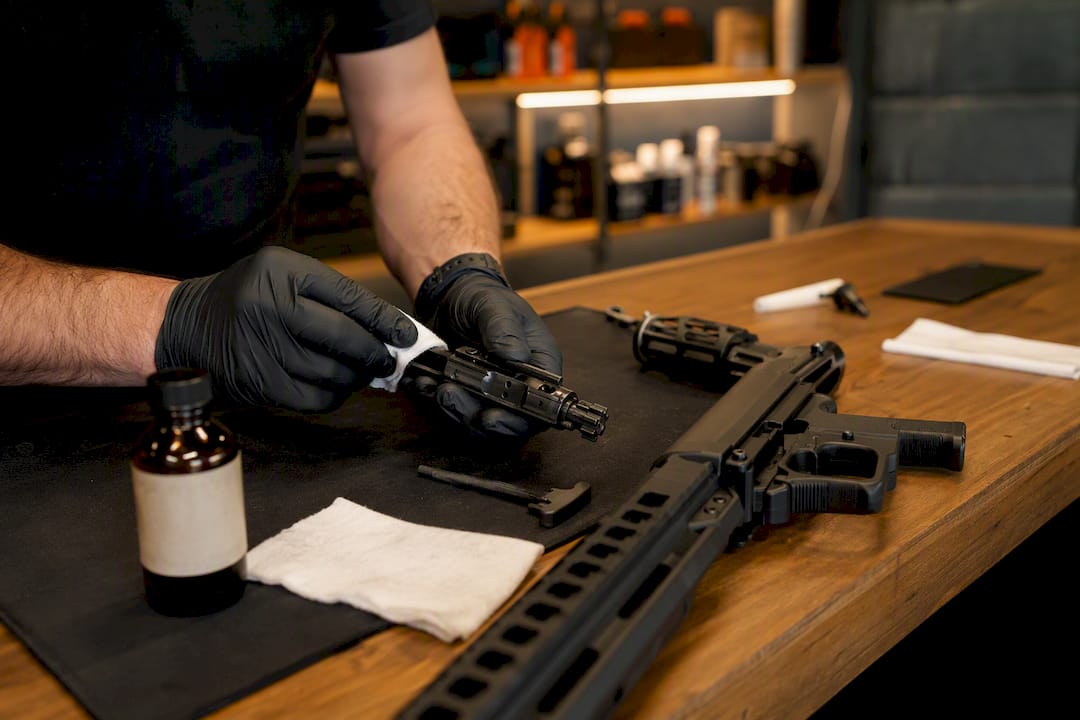
After each range trip, field-strip the upper and lower, run a bore brush through the barrel, scrub the bolt carrier group and firing pin channel, and wipe down the buffer tube and springs. Reapply lubricant to the bolt carrier rails and cam pin, since a dry AR-15 is far more likely to experience malfunctions than an over-lubricated one. Check the gas rings on the bolt periodically, since worn rings are a common, often overlooked cause of cycling problems.
Store the rifle in a dry environment, since humidity is the leading cause of corrosion on internal steel components. A quick monthly inspection, even if you haven’t shot the rifle, catches surface rust or loosening screws before they become bigger problems. None of this requires special tools or gunsmith-level skill. It requires consistency, and a five-minute post-session habit will save you far more time than an occasional deep clean after months of neglect.
Against bolt-action hunting rifles, the AR-15 loses on raw long-range accuracy out of the box but wins decisively on follow-up shot speed, modularity, and ergonomics. A bolt gun still has a place for dedicated long-range hunting, but for range training, home defense, or general recreational shooting, the semi-automatic action and adjustable configuration give the AR-15 a practical edge most bolt guns can’t match.
Against other semi-automatic sporting rifle patterns, like AK-pattern rifles, the comparison comes down to philosophy. AK-style rifles are famous for mechanical simplicity and tolerance for neglect, running reliably with minimal cleaning. The AR-15 trades some of that low-maintenance toughness for tighter tolerances, generally better factory accuracy, and, most importantly for buyers, a much deeper aftermarket. You can find replacement parts, upgrades, and accessories for an AR-15 far more easily than for most competing patterns, which matters enormously if you ever want to upgrade a trigger or swap a stock down the road.
For pure hunting-only decisions, a purpose-built bolt-action rifle in a hunting caliber often makes more sense. For a rifle that serves multiple roles, training, sport, defense, and long-term customization, the AR-15’s flexibility is hard to match.
Reading about trigger weight and gas systems only gets you so far. At some point you need to actually put rounds through a rifle, and that’s exactly where Tondi Shooting Range comes in. As the largest indoor shooting range in the Baltic region, Tondi Shooting Range gives you hands-on access to a wide selection of firearms, including AR-15–style rifles, without the upfront cost or licensing wait of buying one yourself first.
No experience is required to book a session. Every visit is supervised by professional instructors who walk you through safety fundamentals before you fire a single round, and because the range is indoors, weather is never a factor in whether your session happens. That setup works whether you’re a first-time shooter figuring out if the platform is even for you, a couple looking for something different on a date, a group of friends killing an afternoon, or a company running a team-building event that actually gets people talking to each other.
Bachelor and bachelorette parties, birthdays, and corporate groups all book regularly, and every session includes safety training as standard, not an upsell. If you want to feel a trigger pull before spending money on a rifle, book a supervised range session and find out firsthand what all that upgrade talk actually feels like in your hands.
The AR-15’s modular design, combined with supervised training and a clear understanding of caliber and legal requirements, gives first-time buyers the fastest path to a confident, safe purchase decision.
| Point | Details |
|---|---|
| AR-15 is semi-automatic only | Unlike military M16/M4 rifles, a civilian AR-15 fires one round per trigger pull with no select-fire option. |
| Modularity drives upgrade value | Triggers, optics, and stocks typically improve shooting more than expensive barrels for casual range use. |
| Caliber choice affects cost long-term | .223/5.56 suits most uses, while .22 LR conversions cut training costs significantly. |
| Estonian licensing requires two tests | Applicants must pass a theory exam and a practical shooting test before a permit is issued. |
| Tondi Shooting Range offers a no-commitment start | Supervised, indoor sessions with instructors and a wide firearm selection let beginners try before buying. |
An AR-15 is a semi-automatic rifle platform originally developed from ArmaLite designs and later produced by Colt, and it fires one round per trigger pull unlike military select-fire versions.
No. The M16 is a select-fire military rifle capable of automatic or burst fire, while a civilian AR-15 can only fire semi-automatically, one shot per trigger pull.
Most AR-15 rifles use a standard civilian chambering suitable for a wide range of uses, though other calibers and conversion options exist for specialized purposes.
Basic AR-15–style rifles start in the several hundred dollar range, while mid-tier and custom builds with upgraded parts can run into the low thousands or beyond.
Formal training isn’t always legally required everywhere, but supervised range sessions dramatically shorten the learning curve and are the safest way to test the platform before purchasing, which is exactly what Tondi Shooting Range’s supervised sessions are built for.
Yes. Renting a rifle at a supervised indoor range, like Tondi Shooting Range, lets first-time shooters experience the platform with full instructor guidance and no ownership commitment.