Tondi Shooting Range recommends: An adrenaline rush for yourself and a surprise for a friend!
- Mo-Su 10.00 – 20.00
- +372 555 85 416
- sale@laskmine.ee





The MP5 is a roller-delayed, closed-bolt 9×19mm submachine gun built by Heckler & Koch, and it remains one of the most recognized close-quarters weapons in the world. Its reputation rests on one mechanical trait: it fires from a closed bolt, which gives it pistol-caliber accuracy that most submachine guns of its era couldn’t match. That precision is why police and special operations units across the globe adopted it, and why it still shows up in training rooms and on movie screens decades after its debut.
TL;DR:
- The MP5’s closed-bolt design and roller-delayed blowback system provide unmatched accuracy and manageable recoil for a pistol-caliber submachine gun.
- Variants include fixed-stock, retractable-stock, suppressed, and compact models, with most designed for specific roles like close-quarters, covert operations, or training.
- Civilian ownership is limited to semi-automatic clones like the HK SP5, as true select-fire MP5s are highly regulated and rare in the United States.
- Regular maintenance requires careful cleaning and inspection of delicate roller and cam components to ensure reliable operation and safety.
- The MP5’s global reputation owes to its operational effectiveness, iconic design, and prominent appearances in high-profile police and military actions.
Heckler & Koch didn’t set out to build a legend. In 1964, the company began work on a project internally labeled HK54, developing a compact automatic weapon built around the same roller-delayed blowback system it had already proven in the G3 battle rifle. The engineering logic was straightforward: take a mechanism that worked reliably at rifle pressures and scale it down for a pistol cartridge. Two years later, in 1966, the German federal police (Bundesgrenzschutz) and border patrol adopted the finished design under a new name: MP5, short for Maschinenpistole 5.
That 1964 to 1966 development window is one of the more compressed design-to-adoption timelines in modern firearms history. Most submachine guns of the postwar period, including many open-bolt designs from the 1940s and 1950s, were simpler and cheaper to produce. Heckler & Koch went the opposite direction, betting that precision engineering would win out over rock-bottom manufacturing cost. West German police agencies bought that bet almost immediately, and other European forces followed within a few years.
The 1970s and 1980s turned the MP5 from a well-regarded police tool into an international standard. Key milestones during this stretch:
Operation Nimrod deserves particular attention, because it did something no marketing campaign could. Millions of viewers watched black-clad operators breach a London townhouse carrying a compact, oddly futuristic-looking weapon, and within days the MP5 had a public identity separate from its military and police customers. Firearms writers still point to that broadcast as the moment the MP5 crossed from professional tool to cultural icon.
By the end of the 1980s, the MP5 had been licensed or exported to dozens of countries, and law enforcement agencies from the FBI’s Hostage Rescue Team to various Asian and Latin American special units had standardized on it. Few submachine guns have matched that adoption curve, and fewer still have stayed in front-line service as long.
The MP5 uses a roller-delayed blowback system, a mechanism borrowed and scaled down from the G3 rifle. Understanding it doesn’t require an engineering degree. When the round fires, pressure pushes the bolt head backward, but two small rollers seated in recesses temporarily resist that movement by camming against an angled locking piece. The rollers don’t lock the action shut the way a rotating bolt does. They delay it, bleeding off just enough time for chamber pressure to drop to a safe level before the bolt carrier fully cycles back.
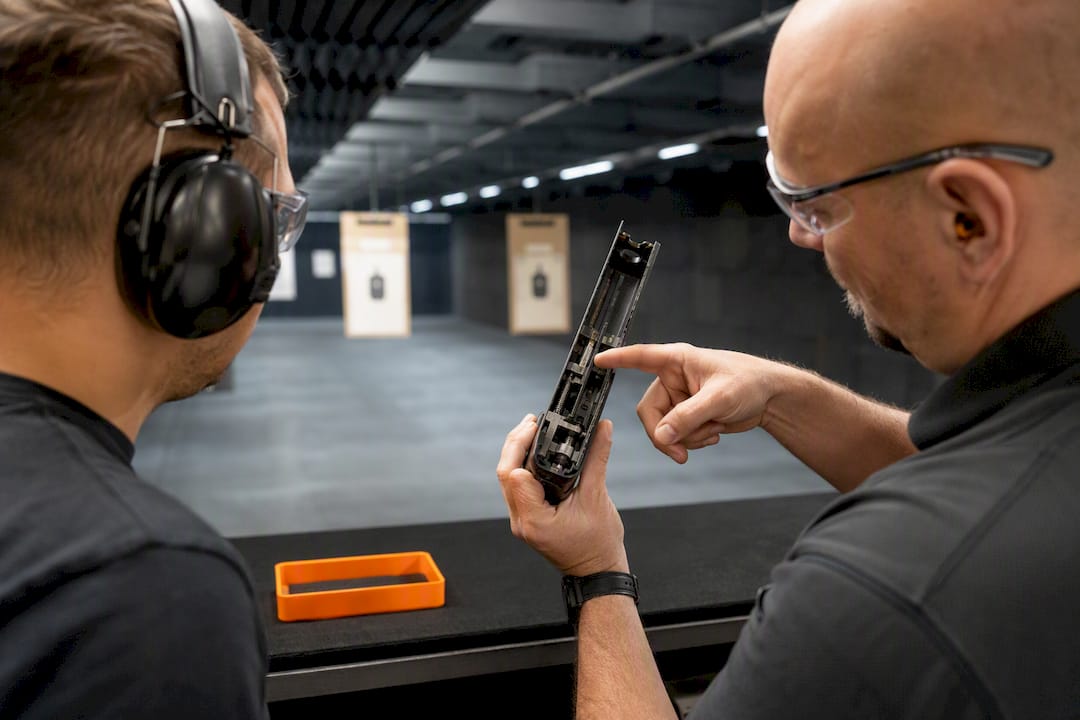
That half-second of mechanical hesitation is the entire trick. It lets Heckler & Koch build a blowback gun, which is inherently simpler and lighter than a locked-breech design, without the harsh recoil impulse that plain blowback actions produce. The rollers essentially borrow time from the physics of the cartridge itself.
The second defining trait is that the MP5 fires from a closed bolt. On most open-bolt submachine guns of the mid-20th century, the bolt sits fully rearward until the trigger is pulled, then slams forward, chambers a round, and fires almost in the same motion. That forward-moving mass shifts the point of aim right as the round goes off, which is part of why so many classic submachine guns spray wide on full auto. The MP5 chambers its round first and holds the bolt closed and still. Pulling the trigger only releases the firing pin. Nothing large is moving when the shot actually breaks, and that stillness is the primary technical reason the MP5 held onto rifle-like accuracy in an era when submachine guns were considered close-range spray weapons at best.
Heckler & Koch built the MP5’s controls around a paddle magazine release, a rotating safety/selector on the left side of the receiver above the pistol grip, and a cocking handle mounted on the left as well, which stays stationary during firing on most variants because it doesn’t reciprocate with the bolt carrier the way an AR-pattern charging handle does. That layout keeps the weapon’s silhouette narrow and lets a shooter reach every control without breaking their firing grip, a detail that matters enormously when seconds count in a room-clearing scenario.
Sustained automatic fire is where the roller-delayed system earns its keep. Because the bolt carrier’s rearward travel is metered rather than instant, the impulse transmitted to the shooter’s shoulder and hands arrives more gradually than in a straight blowback gun firing the same 9×19mm cartridge. Combine that with the weapon’s modest overall weight and a stock designed to sit in line with the bore, and full-auto strings stay flatter and easier to keep on target than most contemporaries firing the same pistol caliber. That combination, closed-bolt ignition plus a metered action, is why instructors still use the MP5 as a benchmark for what controllable automatic fire feels like.
Specifications vary slightly by production era and market, but the figures below reflect the commonly cited ranges from Heckler & Koch’s own documentation and independent identification references.
The 800-round-per-minute cyclic rate sits in the middle of the submachine gun field, fast enough for effective close-range suppression but slow enough that trained shooters can control short bursts. The Small Arms Survey’s weapons identification sheet breaks these figures down further across variant families, which matters if you’re trying to identify a specific configuration rather than just the platform in general.
Note that the 200-meter effective range figure describes realistic hit probability against a man-sized target under good conditions, not the distance the round physically travels. Pistol-caliber ammunition drops fast, and most MP5 use cases involve engagement distances well under 50 meters.
Heckler & Koch never built one MP5. It built a family, and depending on how loosely you count clones and licensed copies, more than 100 distinct variants have existed since 1966. Most of that variation comes down to four axes: stock type, trigger group, barrel configuration, and suppressor integration.
The A-series (A1 through A5) covers stock and trigger differences. The MP5A1 has no stock at all, just a rear cap, built for concealment or vehicle crews. The MP5A2 uses a fixed polymer stock for maximum stability. The MP5A3 swaps that for a retractable metal stock, trading a little rigidity for a smaller footprint. Later A4 and A5 designations layered in ambidextrous controls and updated trigger groups, including three-round burst options that some agencies preferred over full-auto for fire discipline.
The MP5SD is the integrally suppressed variant, and it’s one of the more technically interesting members of the family. Rather than bolting a suppressor onto a standard barrel, Heckler & Koch built the SD with a shorter barrel drilled with venting ports that bleed gas into an integral expansion chamber before the bullet exits. That design keeps the bullet subsonic on standard-velocity 9mm loads and suppresses both the muzzle blast and the sonic crack in one integrated package, rather than relying on a bolt-on can. The trade-off is a slightly reduced muzzle velocity and a weapon that’s permanently configured as suppressed. You can’t remove the “suppressor” because it’s not a separate part.
The MP5K is the compact variant, with “K” standing for kurz, the German word for short. Barrel length drops to roughly 115mm, and the whole weapon can be small enough to conceal under a jacket. That size comes at a cost: shorter barrels mean more muzzle blast and flash, and the compact dimensions make the weapon harder to control in extended full-auto fire. Agencies running plainclothes protective details or vehicle-based units have favored the MP5K specifically because concealability matters more than range performance in that role.
Modern semi-auto and refreshed configurations round out the current lineup. The MP5SF designation covers semi-auto-only trigger groups built for training and markets where select-fire weapons face heavier restriction. In 2015, Heckler & Koch released a Mid-Life Improvement package (MLI) that modernized the platform with a new lower receiver, ambidextrous controls, and an accessory rail system, keeping a fundamentally 1960s design compatible with modern optics and lights.
A few practical notes on how these variants get chosen in the field:
Roughly 100 countries have fielded the MP5 in police, military, or paramilitary service at some point since its introduction, according to compiled tracking from Small Arms Survey’s identification resources. Very few small arms of any category reach that kind of geographic spread, and almost none do it while remaining in continuous production for close to six decades.
Part of that story is operational performance. Closed-bolt accuracy at typical room-clearing distances, manageable recoil, and a compact footprint made the MP5 genuinely well suited to the hostage-rescue and counterterror mission that expanded rapidly through the 1970s and 1980s. Agencies weren’t just buying a weapon; they were buying a documented track record. GSG-9’s use in the 1977 Mogadishu rescue and the SAS’s role in Operation Nimrod in 1980 gave the MP5 two headline-grabbing proof points within three years of each other, at exactly the moment global media coverage of terrorism and counterterror response was expanding.
The other part of the story is limitation, and it’s worth being honest about it. Pistol-caliber ammunition means the MP5 was never a long-range or hard-cover-penetrating weapon, and that’s precisely why many military units have shifted toward rifle-caliber personal defense weapons and compact carbines for roles that used to belong to submachine guns. The MP5 hasn’t disappeared from service by any means, but it has settled into the roles it’s genuinely best at: indoor close-quarters work, vehicle and dignitary protection, and training environments where controllability matters more than penetration.
Cultural exposure did the rest. Film and television armorers gravitated toward the MP5’s distinctive silhouette for decades, and that repeated on-screen presence built public familiarity that outpaced most other service weapons of its generation. Ask a room of non-shooters to sketch a submachine gun, and a surprising number will draw something that looks like an MP5, whether they know the name or not.
Civilians in the United States and most other countries cannot legally buy a select-fire (fully automatic) MP5 without navigating extremely narrow and expensive regulatory pathways, and in many cases the purchase isn’t available to civilians at all. What’s actually available on the civilian market is a different animal: semi-automatic firearms built on the same roller-delayed platform, most notably the HK SP5, which Heckler & Koch produces specifically as a semi-automatic civilian-legal version of the MP5 pattern.
The distinction matters because it’s not a technicality. A select-fire MP5 fires multiple rounds per trigger pull; the SP5 and comparable clones fire one round per pull, full stop. Original transferable select-fire MP5s that exist in the US civilian market are pre-1986 registered machine guns, a fixed and shrinking supply under federal law, and they routinely sell for tens of thousands of dollars specifically because no new ones can be added to that registry.
A few practical points worth knowing if you’re researching civilian ownership:
None of this is legal advice, and firearms law changes by jurisdiction more than almost any other consumer category. If you’re genuinely considering ownership of an MP5-pattern firearm, talk to a licensed dealer in your area and read the firearm safety rules that apply to responsible owners before you assume anything about what’s permitted where you live. Cross-border assumptions get people in serious legal trouble, and “I saw it online” has never held up as a defense anywhere.
Roller-delayed actions reward careful maintenance and punish neglect faster than a simple blowback design does. The rollers, camming surfaces, and locking piece all need to move against each other with very specific tolerances, and grit or the wrong lubricant in that interface causes function issues that don’t show up on a simpler firearm.
A basic maintenance routine looks like this:
Pro Tip: Don’t over-oil the roller and camming surfaces. A thin film is enough; excess lubricant on a roller-delayed action just becomes a magnet for carbon and dust, and that buildup is one of the most common causes of sluggish cycling in these systems.
Safe handling around any MP5-pattern firearm follows the same universal rules that apply to every firearm: treat it as loaded until you’ve personally verified otherwise, keep the muzzle pointed in a safe direction, keep your finger off the trigger until you’re on target, and know exactly what’s beyond your target before you press the trigger. A supervised range session typically walks a newcomer through these fundamentals on a low-recoil platform before ever loading a magazine into something firing on full auto, which is exactly the sequencing that reduces both risk and anxiety for a first-time shooter.
If you ever notice unusual wear on the rollers, a locking piece that doesn’t seat cleanly, or inconsistent cycling that basic cleaning doesn’t fix, that’s a job for a qualified gunsmith familiar with roller-delayed systems, not a home fix. The tolerances involved are tight enough that guesswork tends to make things worse.
Reading about a roller-delayed system is one thing. Feeling how a closed-bolt gun tracks under recoil is another, and that gap is exactly what a supervised range visit closes. Tondi Lasketiir is the largest shooting range in the Baltic region, and it was built around exactly this kind of hands-on, professionally guided introduction to firearms that most people only ever read about.
You don’t need any prior shooting experience to book a session. Visits typically include safety training and supervision as standard parts of the experience, often at an indoor range where weather does not cancel bookings and conditions stay consistent year-round. That structure matters especially for automatic-capable platforms in the MP5’s family, since instructors can introduce recoil management and trigger discipline step by step rather than handing someone a loaded weapon and hoping for the best.
The firearm selection goes well beyond a single platform. Sessions include hands-on time with weapons such as the Heckler & Koch MR 308, the Sniper Tikka T3X A1, the Glock 19, and the AR-15, giving visitors a genuine feel for how different actions, calibers, and ergonomics compare in the same afternoon. For tourists visiting Tallinn, bachelor and bachelorette parties, birthday groups, corporate teams looking for a genuinely memorable team-building exercise, or couples wanting to try something neither has done before, that variety turns a single booking into a real comparison of what firearms actually feel like, not just what they look like on screen.
If you’re curious how a closed-bolt roller-delayed system actually behaves in your hands, versus reading about it, book a tactical shooting session at Tondi Shooting Range and find out under professional supervision, indoors, with zero experience required to get started.
Most of the historical and technical claims in this article draw on the Heckler & Koch MP5 Wikipedia entry, which consolidates development dates, variant lists, and adoption history in one place. Manufacturer specifications, including caliber, action type, and cyclic rate, come directly from the Heckler & Koch MP5 product page. For variant identification and field measurements, the Small Arms Survey weapons identification sheet offers the kind of granular detail used by researchers and collectors. Historical and operational narrative context, including the story behind the MP5’s rise to global recognition, is drawn from Breach-Bang-Clear’s retrospective on the platform’s Cold War origins.
Civilians can generally buy semi-automatic versions such as the HK SP5 or comparable semi-auto clones. Original select-fire MP5s are restricted, rare, and often limited to pre-1986 registered transferable units where that category exists.
Neither is “better” in an absolute sense because they solve different problems. The AK-47 is a rifle-caliber weapon built for range and penetration, while the MP5 is a pistol-caliber platform optimized for close-quarters accuracy and control, so the comparison depends entirely on the intended use case.
Select-fire MP5s are heavily regulated under federal machine gun law and are not something the general public can freely purchase new. Semi-automatic variants like the HK SP5 are legal to own in most states, subject to standard federal and state firearm purchase requirements.
Its fame comes from a mix of genuine performance and high-visibility exposure: closed-bolt accuracy that outperformed most submachine guns of its era, adoption by units like GSG-9 and the SAS, and televised operations such as the 1980 Iranian Embassy Siege that put the weapon in front of a global audience.
No prior shooting experience is required. At Tondi Shooting Range, every session includes professional instruction, safety training, and takes place indoors, making it accessible for total first-timers as well as experienced shooters.