Terms and conditions

Tondi Shooting Range user and customer conditions

Purpose:
1.1. The purpose of these User and Client Terms and Conditions is to provide the principles of the Shooting Range User Agreement with respect to the Client using the Shooting Range services.
1.2. The user and customer conditions apply to the contract entered into upon purchase of the Visiting Card and the one-time service.

Key terms:
2.1. In the Terms of Use and Customer, the following terms are used with the following meanings:
2.1.1. "Booking Rules" - the part of the user and customer conditions that stipulates the procedure and conditions of pre-registration when purchasing the service;
2.1.2. „Lasketiir“ - service provider Tondi Lasketiir OÜ;
2.1.3. "Customer" - a person using the services of the Shooting Range on the basis of purchasing a Visiting Card or a one-time service;
2.1.4. "Visiting Card" - a multiple card of the shooting range for a regular customer;
2.1.5. "Shooting Package" - the service offered by the Shooting Range, the rights of which are defined in the Price List and provided on the Shooting Range website.
2.1.6. "User and Customer Terms and Conditions" - these User and Customer Terms and Conditions, which apply to the Customer using the services of the Shooting Range in case of purchasing a Visitor Card or a one-time service.

Use of a shooting range
3.1. The Client has the right to use the Shooting Range and the services offered therein in accordance with the conditions set out in his Shooting Package or in accordance with the conditions valid for the Visiting Card. When using the Shooting Range, the Client follows the instructions of the Shooting Range staff.
3.2. The shooting range services are provided only by persons authorized by the shooting range. The Client is prohibited from providing any services to the Shooting Range to third parties without the written consent of the Shooting Range.
3.3. The shooting range can be used by persons from the age of 16. Persons aged 12-15 (incl.) Use the Shooting Range only with an adult and / or consent (eg Shooting Packs "Junior and Senior", "Children's Birthday" or "Youth Birthday"). Persons under the age of 12 are not allowed to use the Shooting Range.
3.4. The client can access the Shooting Range on the basis of a previous reservation. The shooting range has the right to demand the presentation of an identity document to confirm a previous reservation and / or to confirm the age of the Customer.
3.5. If the Customer is not able to use the service offered by the Shooting Range at the time previously booked, he must cancel his reservation in accordance with the procedure provided in the "Booking Rules".
3.6. The Client who does not have a reservation can use the services offered by the Shooting Range only if there are free times.
3.7. The shooting range has the right to make changes in the Shooting Packages and other services offered at any time.
3.8. For extraordinary or reasons beyond the control of the Shooting Range (eg in case of an instructor's illness, bomb threat, fire, accident, their danger, etc.), the Shooting Range has the right to cancel the times previously reserved for the use of the service or restrict the use of the service. The Client will be notified as soon as possible.
3.9. The staff of the shooting range advises and instructs the Client on issues related to the use of the services provided, including the equipment, and keeps the used equipment in working order. The client uses the equipment according to its intended use and instructions received from the shooting range staff.
3.10. The Client behaves in accordance with good manners in the Shooting Range and treats the property in the Shooting Range prudently. Smoking and the consumption of alcohol or stimulants are not allowed in the shooting range. Pets are not allowed on the shooting range. The personnel of the Shooting Range have the right to temporarily remove the Shooting Range from the Shooting Range or to file a claim for damages in violation of any previous obligation or rule.

Terms of purchase and sale
4.1. The Client of the Shooting Range pays the Shooting Range for the service on the basis of an invoice according to the amount of fees provided in the price list. It is possible to pay for the service in cash or by bank card at the shooting range on site. On the website of the shooting range, it is possible to pay for the time via a bank link.
4.2. In the event of a delay in the payment of any fee under the Agreement, the Shooting Range has the right to demand late payment interest of 0.15% of the amount payable per day for each day of delay in payment until full payment of the amount due.
4.3. The shooting range has the right to withdraw from the sales contract entered into via the e-store and not to deliver the ordered goods or provide the service in the following cases:
- the goods have run out of stock;
- the price or features of the goods have been displayed incorrectly in the e-shop due to a system error;
- if the Client does not meet the conditions established by the Shooting Range.
4.4. If it is not possible for the Shooting Range to fulfill the order, the Shooting Range will contact the Customer and return the paid amount when the Customer has managed to make an advance payment for the goods.
4.5. The delivery partner of the shooting range is Itella Estonia OÜ (Itella SmartPost). The maximum delivery time is 8 working days. The ordered product is delivered via the parcel machine service.


Payment
5.1. The prices of the products sold in the shooting range online store are given in Euros without transport costs. VAT will not be added. Prices in the online store and sales showroom in Tallinn may differ.
5.2. Payment can be made via Swedbank, SEB Pank, LHV Bank, Luminor, Pocopay and Coop Pank Internet Bank. Also Paypal
CLOSE

Frequently Asked Questions

With which public transport are it possible to come from the center of Tallinn to the Weapons and Tactics Training Center?

Trams no. 3 and 4, stop “Tondi”
b. Buses no. 5, 18, 36, stop “Kalev”
c. Taxi – Be sure to add an approximate cost.


What is SLICE?

The SLICE payment method allows you to pay interest and service fees in three equal installments for purchases of € 75-800. You don’t pay a cent more than the actual cost of the product! You can choose the SLICE payment method in the last stage of the purchase, ie on the checkout page, if the purchase amount is between 75-800 euros. You will make the first installment only one month after the purchase and the second and third installments in the following months. Paying with SLICE is quick and easy. The purchase is confirmed in a few moments and there is no need to sign a credit agreement. The option to pay with the SLICE payment method is marked with the SLICE logo on each product!

The service is provided by Inbank AS

CLOSE
en
Desert Eagle Specs: 1,998 g, Estonia Permit Steps

Desert Eagle Specs: 1,998 g, Estonia Permit Steps

16.09.2026

The Desert Eagle is a gas-operated, large-caliber semi-automatic pistol built by Magnum Research, best known through the current Mark XIX model chambered in .50 AE, .44 Magnum, and .357 Magnum. It’s a range gun, a hunting handgun where local law permits it, and a collector’s piece, using polygonal rifling borrowed from rifle design. It is not a practical carry gun. If you want to feel the recoil before you commit to buying one, An indoor shooting range lets you fire one under instructor supervision, no experience required.


TL;DR:

  • The gas-operated system, borrowed from rifles, requires frequent cleaning of the gas piston and bolt face to prevent cycling issues caused by carbon buildup.
  • Most buyers are collectors, range enthusiasts, or hunters, not those seeking a concealed carry gun due to its weight and high ammunition cost.
  • To legally own a Desert Eagle in Estonia, one must obtain a weapons permit, register the purchase within seven days, and follow strict storage and transportation rules.

Tondi Shooting Range
Experience Tondi Shooting Range
Explore firearms training and tactical experiences at Estonia’s largest shooting range, with professional training and practical security awareness.

Table of Contents

Desert Eagle Specifications: Calibers, Dimensions, and Weight

Before you compare a Desert Eagle against anything else in a gun shop, the numbers matter more than the reputation. The Mark XIX, the model currently in production, comes chambered in three calibers, each with its own magazine capacity and bore geometry, with capacities varying depending on the caliber.

With the standard 6-inch barrel, the pistol runs about 10.75 inches long. There is also an option for a longer barrel to offer a longer sight radius and flatter trajectory. Height and width vary slightly by finish and grip panel, but the frame geometry stays consistent across calibers, since the same receiver accepts different barrel and bolt assemblies.

The number that surprises most first-time shooters: an empty Mark XIX with a 6-inch barrel weighs roughly 1,998 grams, or about 71.4 ounces. That’s nearly double the weight of a full-size service pistol, and it’s the main reason recoil feels more like a shove than a snap.

All Mark XIX barrels use polygonal rifling rather than traditional lands and grooves, which reduces bullet deformation and tends to extend barrel life. Accessory rails on current production models accept standard optics and light mounts, a feature older Mark I and Mark VII pistols didn’t offer from the factory.

Which Desert Eagle Model Should You Look For?

Not every Desert Eagle on the market is the same gun wearing a different label. The lineup has changed enough over the decades that knowing which generation you’re looking at matters just as much as knowing the caliber.

  • Mark XIX: The current production model and the one you’ll find at most dealers today, with the widest caliber and finish selection.
  • Mark I and Mark VII: Earlier generations with different trigger mechanisms and a narrower range of factory chamberings; increasingly collector items rather than shooters.
  • Finish options: Brushed chrome, titanium gold, and case-hardened finishes are common on the Mark XIX, along with 6-inch and 10-inch barrel lengths.
  • Micro Desert Eagle: A compact .380 pistol that shares the name but not the platform. It’s a small blowback-operated carry gun, not a gas-operated magnum pistol, and buyers sometimes confuse the two.

If a listing simply says “Desert Eagle” with no model number, ask which mark it is. Parts, magazines, and even holsters aren’t always interchangeable across generations.

How Does the Desert Eagle’s Gas System Actually Work?

Most semi-auto pistols cycle through simple recoil operation. The Desert Eagle doesn’t. It uses a gas-operated, rotating-bolt system borrowed from rifle engineering, which is exactly why it can handle magnum pressures that would batter a straight blowback design. When you fire a round, gas is tapped from the barrel to drive a piston rearward, which rotates and unlocks the bolt so it can cycle the action.

That mechanical borrowing from rifles is also why the gun runs cleaner-feeling under recoil but dirtier internally. Gas fouling builds up around the piston and bolt face faster than on a typical striker-fired handgun, so cleaning frequency matters more here than on most pistols in your safe.
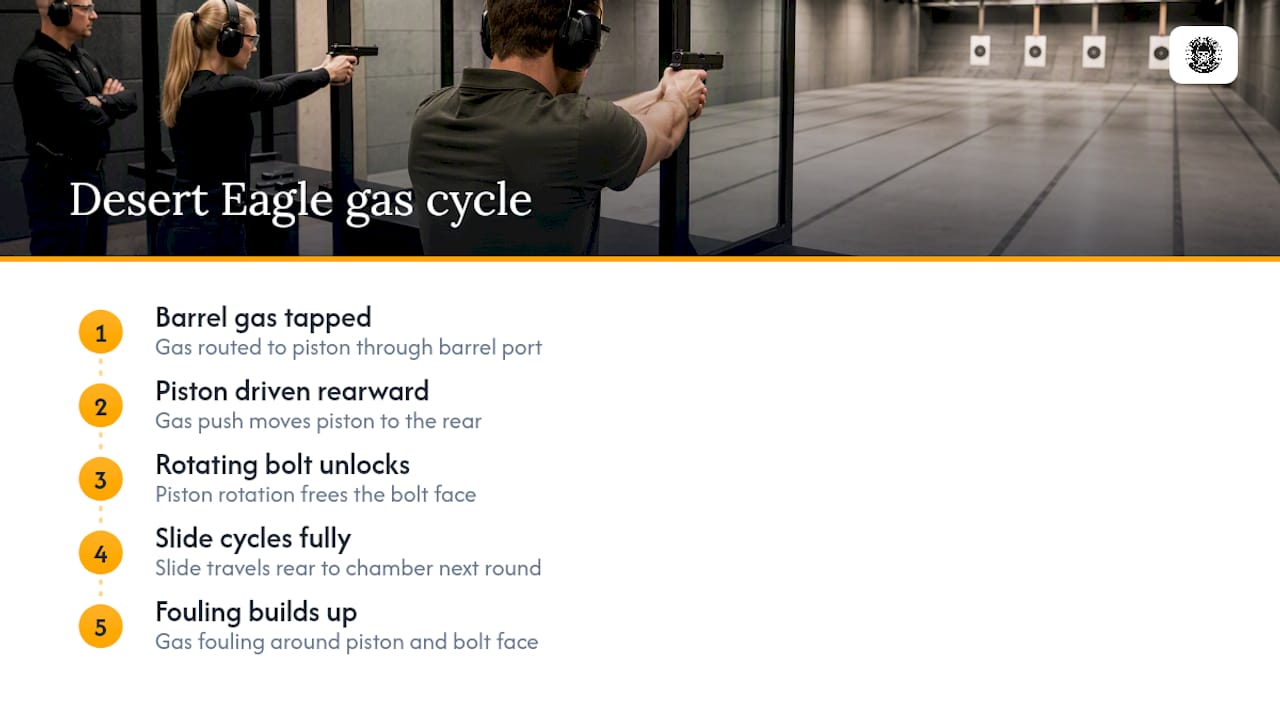
Desert Eagle gas operation and fouling cycle

Grip technique changes too. Because the frame is heavy but the action still needs full slide travel to cycle, a loose or bent-elbow grip can cause short-stroking, a failure where the slide doesn’t travel far enough to pick up the next round.

Pro Tip: Use a firm two-handed push-pull grip, push forward with your shooting hand, pull back with your support hand, and keep your elbows locked. A bent elbow absorbs recoil energy that the gas system needs to cycle the action fully.

Who Actually Buys a Desert Eagle, and Why?

Movies sold the Desert Eagle as an all-purpose intimidation machine. Real-world buyers use it very differently.

  • Collectors drawn to the engineering and the finish options, often buying one they’ll shoot occasionally rather than regularly.
  • Range enthusiasts who want to experience heavy recoil and a mechanically distinct action in a controlled setting.
  • Hunters, where local law and game regulations permit handgun hunting, particularly in .44 Magnum or .50 AE for larger game.

What it’s not built for is concealed carry. At nearly two kilograms unloaded plus a full magazine, with a slide profile that doesn’t hide under clothing, it fails the basic tests of a defensive carry gun. Ammunition cost adds to that: .50 AE rounds routinely cost several times what common defensive calibers run. Effective range and accuracy are genuinely good for a pistol platform, but the shooters who get the most from a Desert Eagle are experienced enough to manage the recoil and grip discipline consistently, not first-time shooters chasing a movie moment on their own.

Buying a Desert Eagle in Estonia follows the same permit process as any handgun purchase, and skipping a step here isn’t a minor paperwork issue, it’s a legal one.

  • Get your weapons permit first. You need a valid permit issued under the requirements set out in the Estonian Weapons Act before you can legally acquire a handgun.
  • Register within seven business days. Once you’ve purchased the pistol, Estonian law requires you to register the weapon with your local Police prefecture within seven business days of acquisition.
  • Keep your documentation. Purchase receipts, permit paperwork, and registration confirmation should stay together, both for future transfers and for routine checks.
  • Store and transport it properly. Secure storage and safe transport aren’t optional extras, they’re part of the same legal framework that governs the permit itself.

If you’re still deciding whether a large-caliber semi-auto fits your needs before committing to the permit process, our beginner’s guide to pistol shooting basics in Estonia walks through what new shooters should expect at that stage.

How Do You Clean and Maintain a Desert Eagle Safely?

The Desert Eagle operating manual is specific about handling and cleaning steps, and skipping them is the fastest way to end up with a jammed gas system.

  1. Confirm the pistol is unloaded using the manual’s checklist before any cleaning or disassembly.
  2. Field-strip according to the manufacturer’s sequence, paying particular attention to the gas piston and bolt assembly.
  3. Clean the gas port and piston thoroughly, since carbon buildup here is a common cause of cycling failures, more often than any mechanical defect.
  4. Avoid unjacketed lead bullets, which can foul the gas system faster than jacketed ammunition.
  5. Inspect the barrel, bolt, and magazine feed lips for wear each time you clean, especially on a used gun with unknown round count.

Pro Tip: If a Desert Eagle you’re inspecting fails to cycle reliably at a test range, don’t assume it’s broken. Weak grip technique and a fouled gas port cause more cycling issues than actual parts failure, according to the manufacturer’s own operating instructions. Check technique and cleanliness before you check for a gunsmith.

For sharper follow-up shots once the action is running clean, our guide to precision shooting techniques covers grip and stance adjustments specifically for heavy-recoil pistols.

What Should You Check Before Buying One?

Price on a Desert Eagle swings hard based on finish, barrel length, caliber, and condition. New guns in standard finishes sit at one price point, while titanium gold or case-hardened finishes command a premium. Used guns vary even more depending on round count and how well the previous owner maintained the gas system.

Caliber choice is really a cost-and-recoil decision. .357 Magnum is the gentlest to shoot and cheapest to feed, .44 Magnum lands in the middle as the most commonly recommended all-around choice, and .50 AE delivers the most energy at the highest per-round cost.

If you’re looking at a used pistol, check these before you hand over money:

  • Bolt, barrel, and magazine are factory-matched to the frame, not mixed from different guns.
  • Headspace checks out correctly for the chambered caliber.
  • The gas system is clean, with no heavy carbon buildup around the piston.
  • Paperwork for legal transfer and prior registration is complete and matches the seller’s identity.

Our ammunition types guide breaks down what’s legally available in Estonia if you’re narrowing down caliber choice before you buy.

Not Sure Yet If It’s For You? Try Shooting Safely at Tondi Shooting Range

Tondi offers a wide range of pistols and calibers for anyone to try. No experience is required. Every session is supervised by professional instructors, and safety training is built into the visit before you touch a firearm. The range itself is indoor, so weather is never a factor, and the firearm selection is wide enough that you can compare the Desert Eagle against other calibers in the same afternoon.
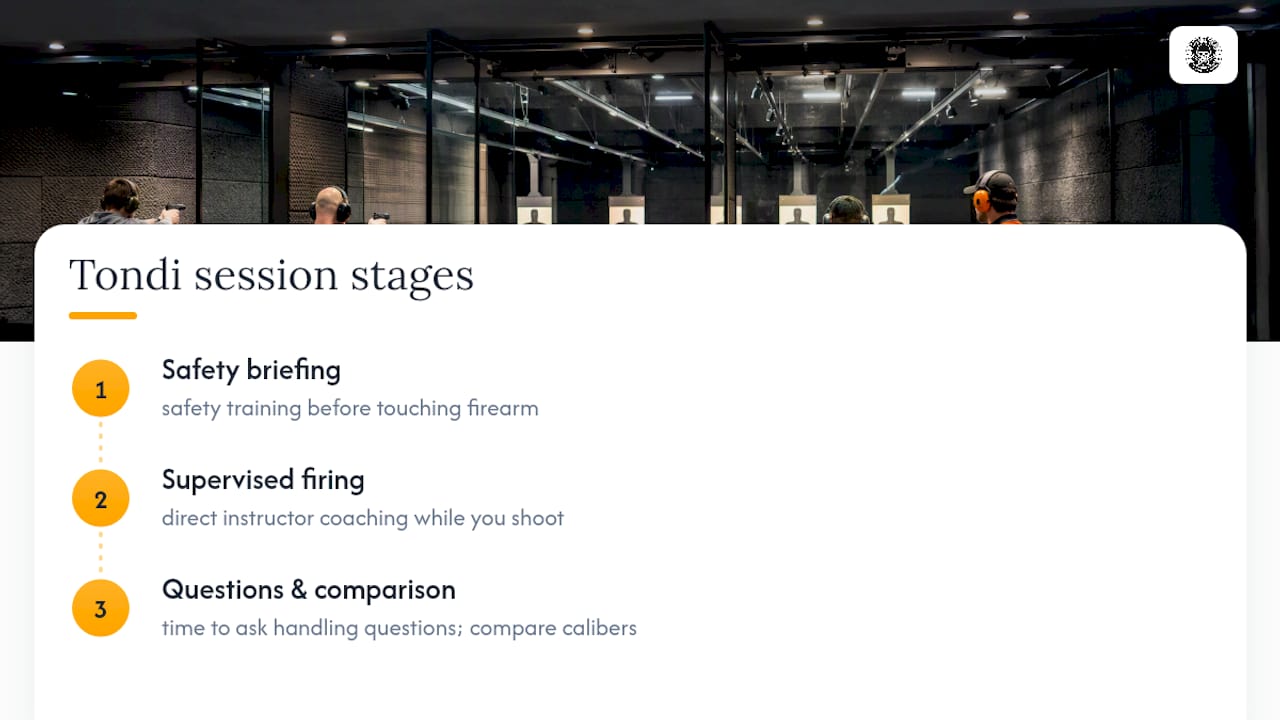
Try One Safely at Tondi Shooting Range — overview diagram

Sessions include a safety briefing, supervised firing under direct instructor coaching, and time to ask questions about handling a pistol this heavy and this loud. Whether you’re a tourist looking for a memorable Tallinn experience, planning a bachelor party, organizing a corporate team-building event, or just curious after reading this guide, book a tactical shooting session and find out what that recoil actually feels like before you decide whether to buy one.

Sources

FAQ

Is a Desert Eagle really a .50 caliber?

Yes, the .50 AE chambering is a genuine large caliber round, and it’s the largest of the three calibers offered in the current Mark XIX, alongside .44 Magnum and .357 Magnum.

Is the Desert Eagle the most powerful handgun?

No. It’s a powerful semi-automatic pistol, but several revolver cartridges exceed its energy output. Its reputation for power comes more from cultural presence in films and video games than from topping actual ballistic charts.

Can you own a Desert Eagle in Estonia?

You can own one legally by obtaining a valid weapons permit under the Estonian Weapons Act and registering the firearm with your local Police prefecture within seven business days of purchase.

Why is a Desert Eagle so expensive?

Manufacturing costs run higher because of the gas-operated action, machined components, and finish options like titanium gold, and ammunition costs significantly more per round than common defensive calibers.

Do I need experience to try a Desert Eagle at a shooting range?

No prior experience is needed. Every session includes safety training and direct supervision from professional instructors before you fire a shot.