Valentine’s Day Special in Tondi Shooting Range
- Mo-Su 10.00 – 20.00
- +372 555 85 416
- sale@laskmine.ee


Good shooting range ventilation moves air in one direction, from behind the shooter toward the bullet trap. It then filters that air before it leaves the building. Fresh air comes in behind the firing line, passes the shooter’s breathing zone, carries fumes and dust downrange, and is exhausted through filters. Everything else in range ventilation (fan sizing, filter grades, monitoring) supports that one-way flow.
This guide explains how the system works, what the published standards say, how operators handle cost and maintenance, and what it means if you are planning a first visit to an indoor range in Tallinn.
Firing a gun releases more than noise. Lead particles come from primer compounds and from bullet friction, and propellant adds smoke, gases and unburned powder. The body takes up lead through both swallowing and breathing. The EU’s 2024 amendment to its carcinogens directive says that oral and inhalation exposure are both relevant routes for lead, which is why dust control and good hygiene go together.
What happens when the design is wrong is documented. A peer-reviewed case report from an indoor firing range in South Korea found airborne lead well above the acceptable standard. The causes were the wrong filter type (a charcoal filter instead of a dust filter) and an airflow layout that created a swirl instead of carrying dust out of the range. The lesson is practical: the filter grade and the airflow pattern matter as much as the size of the fan.
So a well-designed system has three jobs:
OSHA recommends a separate push/pull system for indoor ranges, not connected to the building’s general HVAC. Supplied and exhausted air is designed to move lead emissions downrange, away from the firearm and toward the filtered exhaust at or behind the bullet trap. The supply and exhaust fans are electrically interlocked, so one cannot run without the other.
The New York State Education Department’s guidance adds a layout detail: supply inlets about 15 feet behind the shooter, with the whole range kept at negative pressure relative to surrounding rooms. Air is pulled into the range from outside it, never pushed out into the lobby or corridors.
Negative pressure simply means the range exhausts a little more air than it receives. The UK Ministry of Defence’s range chapter asks for extraction at least 10% greater than the air input. New Jersey’s standard requires the same 10% margin. The Whole Building Design Guide puts the typical figure at 3 to 7 percent more air exhausted than supplied.
Too little airflow leaves fumes hanging around the shooter. Too much creates turbulence and drafts. The benchmarks from official sources:
| Source | Airflow at the firing line | Other notes |
|---|---|---|
| US Navy industrial hygiene guide (2022) | At least 50 fpm, 75 fpm preferred | At least 30 fpm downrange; 100% outside air, no recirculation |
| New Jersey Administrative Code | 50 fpm minimum, 75 fpm optimum | Filtered air introduced behind the firing line |
| UK MoD JSP 403 | 0.15 to 0.2 m/s | 0.1 m/s or less is not enough fresh air; above 0.3 m/s may need heating |
For orientation, 50 fpm is roughly 0.25 m/s and 75 fpm is roughly 0.38 m/s. The UK guidance also calls for 6 to 10 air changes per hour in most indoor ranges.
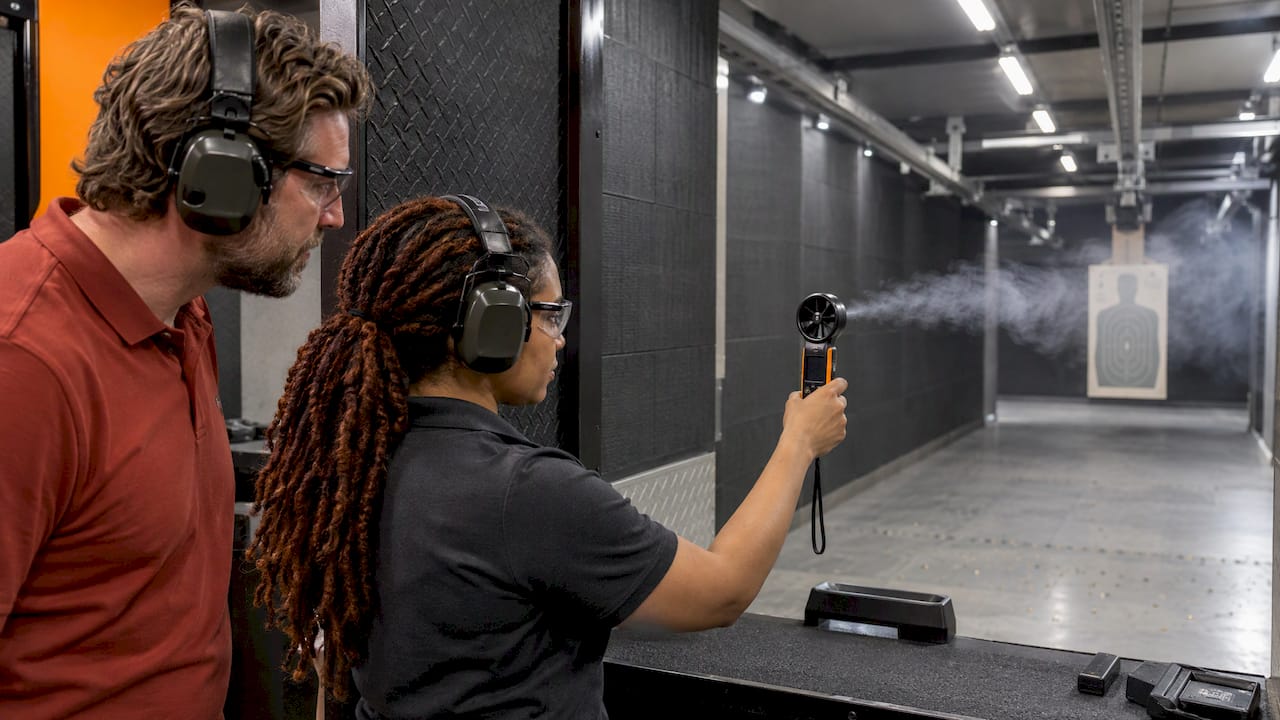
The Navy guide describes how to check this: an anemometer held perpendicular to the floor, three readings at each of three heights (about 1, 3 and 5 feet), plus smoke testing to reveal eddies and dead spots. Smoke tests are the easiest way to see a layout working: a good one shows a smooth, slow curtain of air drifting toward the bullet trap.
A real-world example is a NIOSH follow-up evaluation of a push-pull range. Four systems served the firing bays, each designed to supply about 21,000 cfm and exhaust about 24,000 cfm, with HEPA-filtered exhaust discharged outdoors. Instructors’ full-shift lead exposures were below 8% of the NIOSH and OSHA limits. That is what a well-run system is expected to deliver.
Filtration is staged because dust loads the first filter fastest. The Navy guide calls for a MERV 15 bag filter followed by a HEPA filter rated 99.95% efficient. The 2023 industry best-practice guidelines say exhaust or recirculated air should be filtered at the point of removal with a minimum 99.97% HEPA filter, which corresponds to the EN 1822 H13 class used in Europe.
If you read a ranking technical page and see “HEPA at the point of removal”, that is the idea: capture the lead where it is carried out of the range, not somewhere further down a duct.
Operators generally choose between two designs.
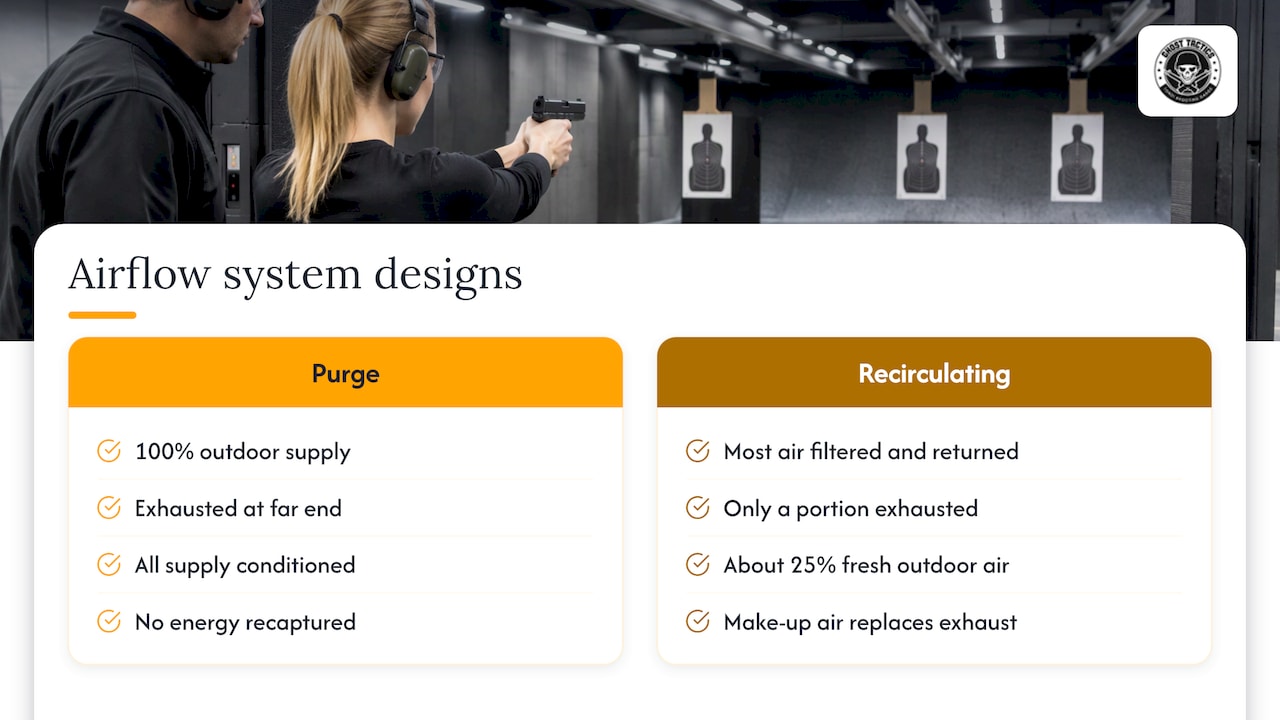
Purge (single-pass) systems draw 100% outside air in behind the shooting stations, pass it through the range and exhaust it at the far end. They are simple. The trade-off is energy: in a purge system all of the supply air must be conditioned from outdoor conditions, and none of that energy is recaptured.
Recirculating systems filter most of the range air and return it, exhausting only a portion to maintain negative pressure. Make-up air comes in to replace that portion. In standard designs, about 25% of the supply is fresh outside air, which is needed to keep carbon monoxide under control. The UK Health and Safety Executive’s 2025 review notes that recirculating systems can reduce heating costs and avoid ducting through walls or roofs, and that they depend on the right filter type working properly.
Neither is “the” correct answer. The choice depends on climate, building and budget, and the purge design is what the US Navy specifies for its own facilities.
An ASHRAE Journal case study of an Alaskan range is a vivid example. At an outdoor design temperature of about -48°C, a 100% outside air system would burn about 75,000 liters of heating fuel annually. The designers instead used dilution ventilation with HEPA filtration, carbon monoxide monitoring and variable-speed fans. Estonian winters are far milder than Fairbanks, but the same trade-off between heating energy and filtration explains why different ranges choose different systems.
Ventilation that is not checked drifts out of specification. The common elements in official guidance:
Housekeeping on the floor matters as much as hardware in the ceiling. For a visitor, that is one more reason the basic range rules (listen to the instructor, wash your hands, no eating in the shooting area) exist. Our visitor checklist of safety rules for Estonian ranges covers them in five to ten minutes.
Estonia’s Occupational Health and Safety Act sets the principle. Where harmful smoke, dust, gases or vapors arise in the work process, they must be removed at the source and rendered harmless rather than allowed to spread through the working environment. Chemical hazard levels must also stay within the maximum limits set by the government.
For lead specifically, the EU is tightening the numbers. Directive (EU) 2024/869 reduces the occupational exposure limit for lead to 0.03 mg/m³ as an 8-hour time-weighted average, and sets a biological limit of 15 µg Pb per 100 ml blood, with a transitional limit of 30 µg until 31 December 2028. Before that change, the binding EU value was 0.15 mg/m³. The directive treats lead as a non-threshold reprotoxic substance, so the aim is to keep exposure as low as is technically possible, not merely under the number.
That is the regulatory direction for anyone operating a range in Estonia: capture at the source, filter, measure and keep records.
Ventilation is one of the largest running costs for an indoor range, which is why designs differ. A US range-equipment supplier recommends budgeting about $2.00 per lane-hour for direct costs on full-HVAC lanes and about $1.00 for purge systems with heating or evaporative cooling. Direct costs there include fan and air-conditioning electricity, heating gas, and filter replacement and disposal; indirect costs include maintenance and staff time.
The Alaska study shows that the cheaper-looking design is not always the cheaper one over time. The dilution system cost about $2,000 more to install and just under $4,000 a year more to operate and maintain, yet saved roughly $14,000 per year in energy. The key cost drivers are climate, lane count, how much air is conditioned, and how often filters are changed.
You do not need to understand fan curves to enjoy a session. You do need a range that treats air quality as part of safety. A few practical points for first-timers:
If you are expecting a child, are pregnant, or have a health condition you are concerned about, ask your doctor before booking any range activity. Parents bringing children should read our four rules for parents visiting a Tallinn range. If something does go wrong, our guide to first aid at a shooting range in Estonia explains what to do.
Being indoors means weather never cancels your plans, and that suits Estonia’s dark, wet months. Our page on indoor winter shooting at Tondi Lasketiir explains rentals, safety and the fact that no license is needed to try it. For a general overview of what a session involves, see shooting at the range.
Tondi Lasketiir in Tallinn is an indoor range, and we describe ourselves as the largest shooting range in the Baltic region. No experience is required. Every session is supervised by professional instructors, safety training is included, and there is a wide selection of firearms to choose from.
If you want a simple first step, our “Minu esimene pauk” package (“My first shot”) costs €45, and gift cards for couples, friends and birthdays start from there. Browse the gift card and experience packages to pick one. Groups, bachelor parties and colleagues can look at event options for teams, where “Vali ise kolleegidele pakett” and the bachelor party package both start from €25 per person. Companies planning an outing can also read about team building in Tallinn.
A range with a correctly designed and maintained ventilation system is built to move fumes and dust away from the shooter and capture them on filters. The measured results can be good: in one NIOSH evaluation of a push-pull range, instructors’ lead exposures were below 8% of the exposure limits. Follow your instructor’s directions and wash your hands afterward as a standard precaution. If you have a medical concern, ask your doctor first.
No. First-time shooters are welcome, no experience is required, and sessions are supervised by professional instructors with safety training included. Our no-experience team event page shows how a group session is structured.
A purge system brings in 100% outside air and exhausts it after one pass, which is simple but expensive to heat or cool. A recirculating system filters most of the air and returns it, adding some fresh air and exhausting enough to keep the range at negative pressure. Both depend on proper filtration and regular checks.
US guidance such as the Navy guide sets at least 50 fpm (about 0.25 m/s) at the firing line, with 75 fpm preferred. UK MoD guidance recommends 0.15 to 0.2 m/s to limit turbulence at the shooter’s breathing zone. Operators measure this with an anemometer and confirm the pattern with smoke tests.
Directive (EU) 2024/869 sets an occupational exposure limit of 0.03 mg/m³ as an 8-hour average, down from the earlier 0.15 mg/m³ binding value. It applies to workers such as range staff, and member states, including Estonia, apply it through their own occupational health rules.