Your First Time at a Shooting Range in Tallinn: What to Expect
- Mo-Su 10.00 – 20.00
- +372 555 85 416
- sale@laskmine.ee


Yes, you can shoot while wearing prescription glasses, and you do not need perfect eyesight to enjoy a range. The catch is that ordinary glasses are not eye protection. What matters is the protective eyewear you wear with them, how it fits under ear muffs, and where you look through the lens. At Tondi Shooting Range in Tallinn, no experience is required and every session is supervised by professional instructors, so you can sort out the glasses question with a person standing next to you rather than guessing alone.
This guide is for first-time shooters, tourists, couples and groups of friends who wear glasses and want to know what to expect. It covers what to wear, what to avoid and a few tricks that make the sights look sharper.
Your everyday glasses are made to correct vision, not to stop a fragment. According to the American Academy of Ophthalmology guidance reported by a shooting-eyewear publisher, regular eyeglasses do not offer proper eye protection and can make an injury worse if they shatter. Another guide notes that typical lens material is not designed for ricochets, spent casings or debris.
The gap is not only about the lens. A common complaint is that a normal frame leaves open space above the brow and at the sides. Casings are ejected hot, and debris does not travel in a straight line, so coverage matters as much as lens strength.
You will see these marks on the frame or lens of protective eyewear. They come from the US ANSI Z87.1 standard, which tests the assembled frame and lens together. According to a range-safety guide, the basic Z87 test drops a one-inch steel ball from 50 inches. The Z87+ high-velocity test fires a quarter-inch steel ball at the glasses, and the plus sign means the pair passed those high-impact tests.
The same guide points out that some ranges accept plain prescription glasses as their own policy, which is not the same as a safety standard. For your own comfort, treat the Z87+ mark as the sign of real protection.
You do not have to buy anything for a first visit. Still, it helps to know the options, because they explain what an instructor will talk to you about.
| Option | How it works | Good to know |
|---|---|---|
| Protective glasses worn over your own (OTG, “over the glasses”) | A larger wraparound frame sits over your regular glasses | Must be made to fit over an existing prescription, with room for your frame |
| Prescription insert | A small lens carrier clips inside protective eyewear | Your prescription sits close to the eye, the outer shield does the protecting |
| Prescription shooting glasses | Protective frame with your lenses built in | Best for regular shooters, needs an eye exam and an order |
| Contact lenses plus protective eyewear | Contacts correct vision, clear protective glasses protect | Wider field of view, but you still need protection in front of the eye |
As one eyewear guide explains, protective eyewear worn over prescription glasses must still fit well over them. Look for adjustable nose pads, a sweat bar for stability, padding and rounded edges. The same page makes a point many people miss: if safety glasses are uncomfortable you are less likely to keep them on, so comfort features are safety features.
Polycarbonate with a scratch-resistant coating has long been the standard lens choice for shooting glasses because of its impact resistance against blow-back and bounce-back. That page also notes that plain nonprescription sports goggles are fine if you do not need vision correction or if you wear contacts.
A few small habits make the difference between a sight picture that looks soft and one that looks crisp.
Put on your protective eyewear, then the ear muffs. Temple arms matter more than lens colour. A shooting-glasses guide recommends thin, low-profile arms that do not create a hard ridge under the ear cups, slightly flexible arms that do not pinch, and a nose fit that feels secure without being tight. It also suggests checking that the top edge does not intrude when you look up and the lower edge does not block your view when you glance down.
Shake your head side to side and up and down. If the glasses slide, say so. A fit problem is easier to fix before the first shot than during it.
Bring the firearm up into your normal shooting position and see what the sights look like. In a stance, your eye is a different distance from the sights than when you read a book, so your glasses may feel “off”. Beginners often think the problem is their aim when it is really the optics of the lens.
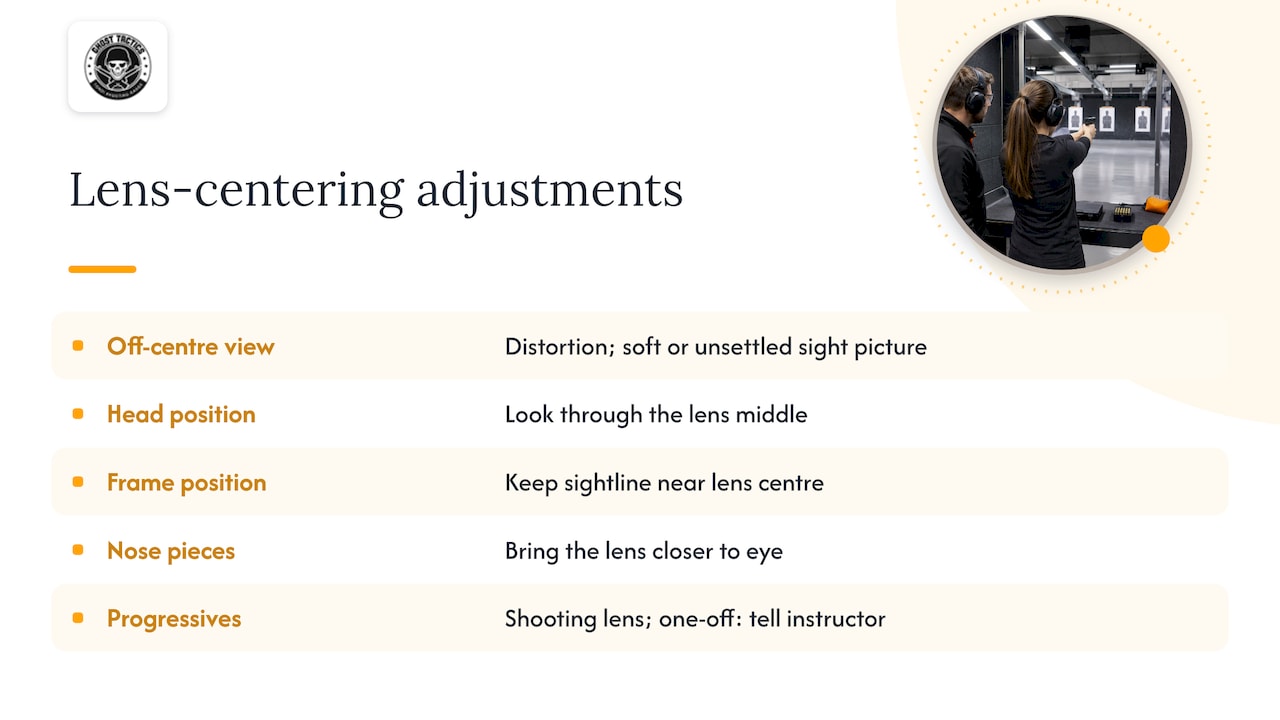
Every prescription lens has an optical centre ground for looking straight ahead. According to an eyewear guide, looking through the lens off-centre adds distortion, and the symptom is a sight picture that will not settle or a slightly soft front sight. The simple fixes are to turn your head so you look through the middle of the lens, to keep the frame positioned so your line of sight stays near that centre, and to bring the lens closer to your eye with adjustable nose pieces.
If you wear progressive (varifocal) lenses, the same guide suggests a dedicated single-vision or top-focal lens for shooting, because the reading zone sits low in the lens and the sights may fall in a blurry band. For a one-off visit you can simply tell your instructor and adjust your head position.
Indoor ranges are warm, and ear muffs and a mask-like frame trap heat around your eyes. Anti-fog coatings on over-glasses help, and so does keeping a clean microfibre cloth in your pocket. Wipe lenses before you step up, not while a firearm is in your hand.
For a handgun, the sharpest thing in your view should be the front sight, with the target slightly soft. An NRA magazine article on corrective lenses explains that the correction needed varies with the eye-to-sight distance: enough correction to read a book is too much for pistol shooting. For a first visit you do not need to change your prescription. If you become a regular, an eye doctor can measure your correction with the pistol held in shooting position.
If you have astigmatism, a red dot can look smeared, starred or doubled instead of a clean point. This is common and not a sign that you cannot shoot. A few adjustments usually help, though they are general advice and not a medical treatment:
If the dot stays distorted even with your correction, an eye doctor or optometrist is the right person to ask, since they can check your prescription and whether it suits the sight distance you shoot at.
Both work. Glasses are simple and add a layer of physical protection around the eye, while contacts give a wider field of view and nothing sits between your face and the muffs. A shooting-vision practitioner writes that well-fitted contacts can improve peripheral vision compared with glasses alone, but poorly fitted or badly maintained lenses can cause irritation and infections. Whichever you choose, you still wear protective eyewear over or in front of them.
Practical tips for a day trip:
The visual point also sits higher in the frame when a long gun is at the shoulder, so the “sweet spot” of your lens is slightly above where you would normally look. That is one more reason to move your head and not just your eyes.
Estonia regulates ranges through the Weapons Act. Under section 84 of the Weapons Act, ranges must be arranged for user safety and must display safety requirements and internal rules, with detailed requirements set by ministerial regulation. Sport ranges must follow the requirements of the recognised international sport organisation. The ISSF technical rules, which govern Olympic-style shooting, call for shatter-proof shooting glasses or similar eye protection.
In practice, that means the safety briefing and the range rules are part of your visit. Our guides on shooting range rules in Tallinn and the visitor safety checklist walk through what to expect, and range etiquette for first-timers covers how to behave at the firing line.
Keep it light. Bring your glasses or contacts, a lens cloth, and a spare pair if you have one. Our page on what to wear at a range explains that most range gear is provided in Estonia, and the packing list covers the rest. Winter visitors will find a few extras in our winter range prep guide, since cold air to warm indoor air is a classic cause of fogged lenses.
When you arrive, mention your glasses to the instructor at the start. It takes ten seconds and lets them look at your fit with you before the session begins.
Tondi Shooting Range is the largest shooting range in the Baltic region, and our range is indoors, so weather never changes your plans. Sessions are supervised by professional instructors, safety training is included, and no experience is required. A wide selection of firearms is available, which helps when you want to find a gun that feels comfortable and a sight picture that works with your glasses.
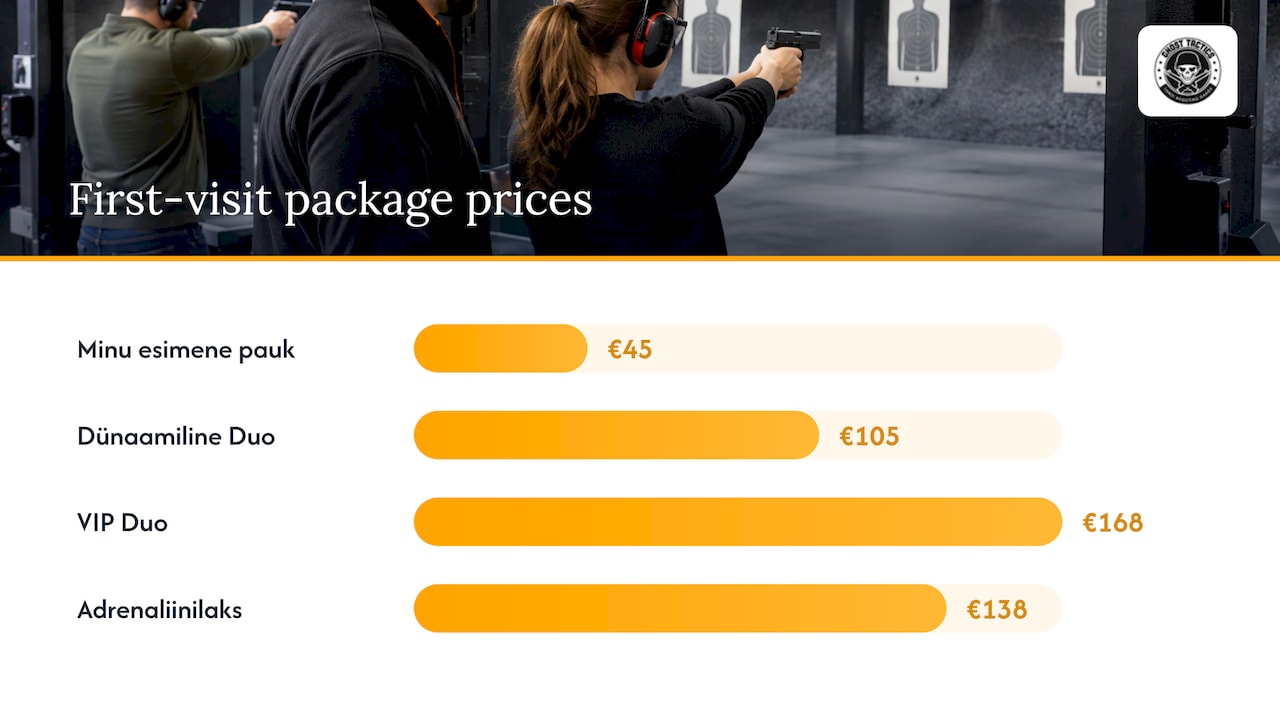
If you wear glasses, the easiest first booking is a short one. Minu esimene pauk costs €45 and is designed for first-timers. Couples and friends can look at the Dünaamiline Duo at €105 or the VIP Duo at €168, and for something more adrenaline-driven the Adrenaliinilaks is €138. All of them are listed on our booking and gift card page, which also works if you are buying for someone else.
Groups have more choice. Bachelor parties, birthdays and company outings can start with the packages on our events page: Poissmeesteõhtu and Vali ise kolleegidele pakett start from €25 per person, and Turvaline ettevõte starts from €80 per person. If you are planning a team day, team building in Tallinn and the no-experience team event pages show how a session works. Parents travelling with family can read our rules for parents.
Gun owners who already shoot regularly can use the range through the range rental and card options: the 10x card is €150 and the 20x card is €200.
If you want to practise your stance and sight picture before you travel, our dry fire practice guide and pistol drills for beginners are a good start. Safety questions, including what happens if something goes wrong, are covered in first aid at a shooting range.
If you notice persistent blur, double images or eye discomfort in daily life, not just at the range, see an optometrist or eye doctor. That is a medical question and not something a range can answer.
Ordinary prescription glasses are not rated as shooting eye protection, and they leave gaps at the brow and sides. The safe approach is protective eyewear that fits over them or has your prescription built into a protective frame. Look for the Z87+ mark if you buy your own.
Yes. Many first-time visitors wear glasses, and no experience is needed to book at Tondi. Tell your instructor at the start so the eyewear and fit can be checked with you before the session.
Yes, as long as the protective glasses are made to fit over an existing prescription. Check that your frame sits comfortably inside, that the arms do not clash with ear muffs, and that the lenses do not press on your face.
Usually, yes. Wear your correction, turn the dot’s brightness down and try a larger or green dot if available. If the dot still looks smeared, ask an eye doctor to check your prescription.
Either works. Contacts give a wider field of view, glasses are simpler and add a layer around the eye. Bring both if you can, and wear protective eyewear over whichever you choose.