Terms and conditions

Tondi Shooting Range user and customer conditions

Purpose:
1.1. The purpose of these User and Client Terms and Conditions is to provide the principles of the Shooting Range User Agreement with respect to the Client using the Shooting Range services.
1.2. The user and customer conditions apply to the contract entered into upon purchase of the Visiting Card and the one-time service.

Key terms:
2.1. In the Terms of Use and Customer, the following terms are used with the following meanings:
2.1.1. "Booking Rules" - the part of the user and customer conditions that stipulates the procedure and conditions of pre-registration when purchasing the service;
2.1.2. „Lasketiir“ - service provider Tondi Lasketiir OÜ;
2.1.3. "Customer" - a person using the services of the Shooting Range on the basis of purchasing a Visiting Card or a one-time service;
2.1.4. "Visiting Card" - a multiple card of the shooting range for a regular customer;
2.1.5. "Shooting Package" - the service offered by the Shooting Range, the rights of which are defined in the Price List and provided on the Shooting Range website.
2.1.6. "User and Customer Terms and Conditions" - these User and Customer Terms and Conditions, which apply to the Customer using the services of the Shooting Range in case of purchasing a Visitor Card or a one-time service.

Use of a shooting range
3.1. The Client has the right to use the Shooting Range and the services offered therein in accordance with the conditions set out in his Shooting Package or in accordance with the conditions valid for the Visiting Card. When using the Shooting Range, the Client follows the instructions of the Shooting Range staff.
3.2. The shooting range services are provided only by persons authorized by the shooting range. The Client is prohibited from providing any services to the Shooting Range to third parties without the written consent of the Shooting Range.
3.3. The shooting range can be used by persons from the age of 16. Persons aged 12-15 (incl.) Use the Shooting Range only with an adult and / or consent (eg Shooting Packs "Junior and Senior", "Children's Birthday" or "Youth Birthday"). Persons under the age of 12 are not allowed to use the Shooting Range.
3.4. The client can access the Shooting Range on the basis of a previous reservation. The shooting range has the right to demand the presentation of an identity document to confirm a previous reservation and / or to confirm the age of the Customer.
3.5. If the Customer is not able to use the service offered by the Shooting Range at the time previously booked, he must cancel his reservation in accordance with the procedure provided in the "Booking Rules".
3.6. The Client who does not have a reservation can use the services offered by the Shooting Range only if there are free times.
3.7. The shooting range has the right to make changes in the Shooting Packages and other services offered at any time.
3.8. For extraordinary or reasons beyond the control of the Shooting Range (eg in case of an instructor's illness, bomb threat, fire, accident, their danger, etc.), the Shooting Range has the right to cancel the times previously reserved for the use of the service or restrict the use of the service. The Client will be notified as soon as possible.
3.9. The staff of the shooting range advises and instructs the Client on issues related to the use of the services provided, including the equipment, and keeps the used equipment in working order. The client uses the equipment according to its intended use and instructions received from the shooting range staff.
3.10. The Client behaves in accordance with good manners in the Shooting Range and treats the property in the Shooting Range prudently. Smoking and the consumption of alcohol or stimulants are not allowed in the shooting range. Pets are not allowed on the shooting range. The personnel of the Shooting Range have the right to temporarily remove the Shooting Range from the Shooting Range or to file a claim for damages in violation of any previous obligation or rule.

Terms of purchase and sale
4.1. The Client of the Shooting Range pays the Shooting Range for the service on the basis of an invoice according to the amount of fees provided in the price list. It is possible to pay for the service in cash or by bank card at the shooting range on site. On the website of the shooting range, it is possible to pay for the time via a bank link.
4.2. In the event of a delay in the payment of any fee under the Agreement, the Shooting Range has the right to demand late payment interest of 0.15% of the amount payable per day for each day of delay in payment until full payment of the amount due.
4.3. The shooting range has the right to withdraw from the sales contract entered into via the e-store and not to deliver the ordered goods or provide the service in the following cases:
- the goods have run out of stock;
- the price or features of the goods have been displayed incorrectly in the e-shop due to a system error;
- if the Client does not meet the conditions established by the Shooting Range.
4.4. If it is not possible for the Shooting Range to fulfill the order, the Shooting Range will contact the Customer and return the paid amount when the Customer has managed to make an advance payment for the goods.
4.5. The delivery partner of the shooting range is Itella Estonia OÜ (Itella SmartPost). The maximum delivery time is 8 working days. The ordered product is delivered via the parcel machine service.


Payment
5.1. The prices of the products sold in the shooting range online store are given in Euros without transport costs. VAT will not be added. Prices in the online store and sales showroom in Tallinn may differ.
5.2. Payment can be made via Swedbank, SEB Pank, LHV Bank, Luminor, Pocopay and Coop Pank Internet Bank. Also Paypal
CLOSE

Frequently Asked Questions

With which public transport are it possible to come from the center of Tallinn to the Weapons and Tactics Training Center?

Trams no. 3 and 4, stop “Tondi”
b. Buses no. 5, 18, 36, stop “Kalev”
c. Taxi – Be sure to add an approximate cost.


What is SLICE?

The SLICE payment method allows you to pay interest and service fees in three equal installments for purchases of € 75-800. You don’t pay a cent more than the actual cost of the product! You can choose the SLICE payment method in the last stage of the purchase, ie on the checkout page, if the purchase amount is between 75-800 euros. You will make the first installment only one month after the purchase and the second and third installments in the following months. Paying with SLICE is quick and easy. The purchase is confirmed in a few moments and there is no need to sign a credit agreement. The option to pay with the SLICE payment method is marked with the SLICE logo on each product!

The service is provided by Inbank AS

CLOSE
en
Why Shooting Courses Build Confidence That Lasts

Why Shooting Courses Build Confidence That Lasts

23.07.2026

Shooting courses build lasting confidence by combining progressive skill mastery, mental conditioning, and structured exposure to manageable stress, all guided by expert instructors in a safe environment. The mechanism is not mysterious. When you learn to control your grip, breathing, and trigger pull under calm, supportive conditions, you accumulate small wins that stack into genuine self-assurance. That confidence does not stay on the range. It transfers to how you handle pressure, make decisions, and trust yourself in everyday life.

Here is what that process actually looks like:

  • You start with the mechanical fundamentals: grip, stance, sight alignment, and trigger control.
  • Instructors provide immediate, specific feedback that replaces guesswork with clarity.
  • Controlled exposure to shooting stressors teaches composure, not just accuracy.
  • Safety training anchors the whole experience, turning awareness into a source of calm rather than anxiety.
  • Each skill layer you add reinforces the one before it, creating a confidence-competence loop that grows with every session.

If you are in Tallinn and want to experience this firsthand, Tondi Lasketiir offers beginner shooting packages in a professional indoor environment designed exactly for this kind of progression.


Why shooting courses build confidence at the psychological and physiological level

The confidence you gain from shooting is not a side effect. It is a direct product of what the sport demands from your mind and body simultaneously.
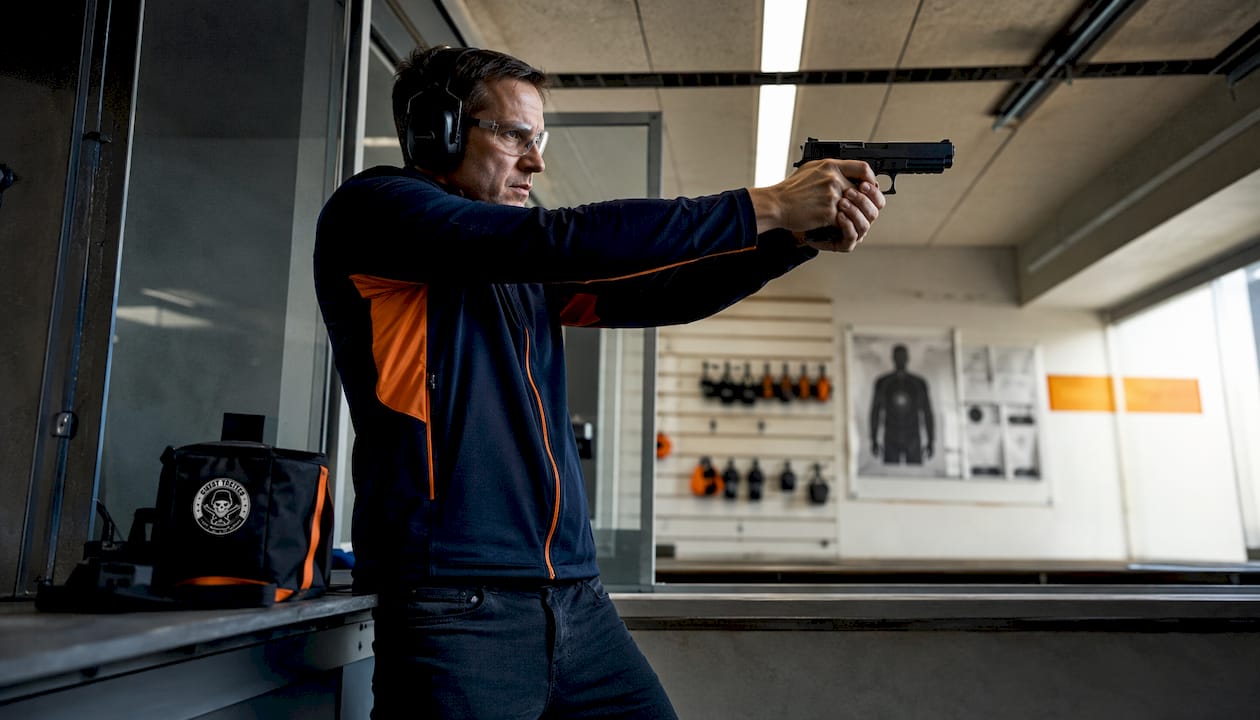
Focused man aiming pistol with concentration

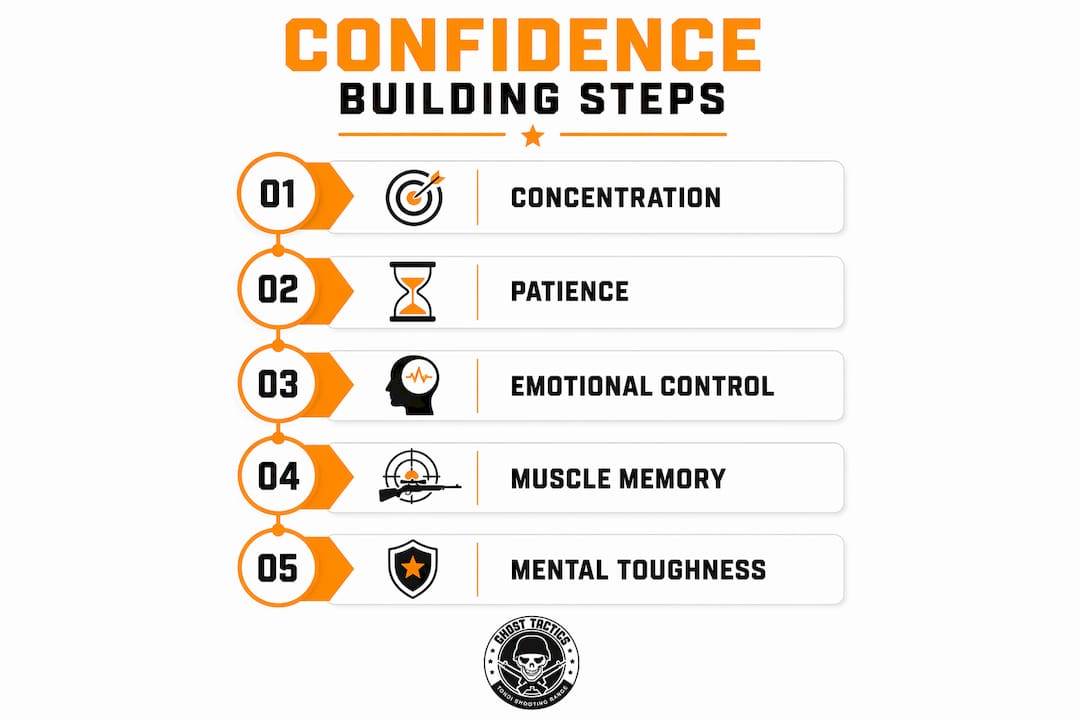
Shooting sport develops concentration, patience, emotional control, and self-discipline, and students report using these qualities in their educational and daily activities. A survey of 50 student athletes found that 96% believed shooting sport helps develop specific psychophysical qualities, with many reporting direct personal improvement. The qualities they named most often were calmness, mental balance, stress resistance, and perseverance.

Physiologically, the sport demands muscle memory, fine motor control, and body steadiness. You cannot fake a clean shot. Your hands, breath, and focus all have to arrive at the same place at the same time. Practicing that coordination repeatedly builds what coaches call a physical confidence anchor: a felt sense in your body that you know what you are doing.

Mental toughness, including emotional regulation and stress resistance, is the foundation coaches at programs like the University of North Georgia shooting team point to when explaining why their athletes perform under pressure. The discipline of holding still, waiting for the right moment, and executing cleanly translates directly into the kind of composure that serves you far outside the range.

Quality developed Psychological benefit Physiological benefit
Concentration Sustained attention under pressure Fine motor coordination
Patience Delayed gratification and impulse control Breath and body steadiness
Emotional control Stress regulation and composure Reduced physical tension
Self-discipline Goal persistence and follow-through Consistent muscle memory
Stress resistance Confidence under uncertainty Stable heart rate and grip

Infographic showing steps of building shooting confidence

Navy SEAL training concepts reinforce this model. Mental conditioning in high-performance programs centers on the same loop shooting courses use: introduce a controlled stressor, practice the response, debrief, and repeat. The stressor does not need to be extreme to be effective. For most beginners, the first live-fire session is stressor enough, and working through it calmly is the first real confidence deposit.


Practical methods shooting courses use to develop your confidence

Good courses do not throw you into the deep end. They build you up deliberately, and that structure is exactly why they work.

The sequence typically starts with dry-fire practice and mechanical fundamentals before any live ammunition is involved. This approach removes the noise and recoil variables so you can focus entirely on grip, stance, and trigger discipline. Mastering these fundamentals in a no-pressure environment forms the confidence-competence loop that carries forward into every subsequent session.

  • Stepwise progression: Each session adds one new variable, so you are never overwhelmed and always building on solid ground.
  • Safe, structured environments: Professional shooting courses reduce fear through structured practice, replacing anxiety with competence.
  • Positive self-talk and affirmation: Instructors actively coach mental framing, helping you replace “I missed” with “I know what to adjust.”
  • Scenario exposure: Varied shooting scenarios simulate mild stress under controlled conditions, training composure rather than just accuracy.
  • Instructor feedback: Specific, non-judgmental correction after each shot gives you a clear path forward instead of vague frustration.
  • Peer encouragement: Group courses create a social dynamic where progress is shared, which sustains motivation between sessions.

Pro Tip: Focus on mastering the process, not the score. Shooters who track their technique improve faster and stay motivated longer than those who fixate on hitting the target every time.

The same principle applies in wilderness survival training, where supportive environments and graduated stress exposure build the same kind of durable confidence. The pattern holds across disciplines: controlled challenge plus expert guidance equals real growth.


Common misconceptions about shooting confidence and how to avoid them

A few persistent myths about shooting confidence actually slow people down, and knowing them upfront saves you a lot of frustration.

  • Confidence is not instant. It builds gradually through practice and honest reflection. Anyone who tells you a single session will transform your self-assurance is selling something.
  • Perfect accuracy is not the goal, especially early on. Experienced shooters focus on perfecting their sight picture and treat mistakes as corrections, not failures. That mindset shift is what prevents discouragement.
  • Fear of firearms decreases with structured training, not avoidance. Skipping the fundamentals or rushing past safety training does not reduce anxiety. It amplifies it. A proper course addresses fear directly by replacing the unknown with knowledge.
  • Confidence comes from process mastery, not external validation. Shooting well because an instructor praised you is not the same as knowing you can replicate the shot on your own. Real confidence is internal.
  • Comparing yourself to experienced shooters too early is counterproductive. A competitive marksman with years of practice is not your benchmark in week two. Your benchmark is last session’s you.
  • Overconfidence is a safety risk. Mistaking early enthusiasm for mastery leads to shortcuts around safety protocols. Safety training is not a formality. It is what grounds genuine confidence in reality.

The shooters who progress fastest are the ones who stay curious about their errors rather than defensive about them. That orientation, treating every missed shot as a data point, is a learnable habit.


How the confidence you build on the range carries into the rest of your life

The skills shooting develops do not clock out when you leave the range. They show up in your work, your relationships, and your ability to handle whatever comes at you.
Friends socializing in shooting range lobby

Competitive marksmen report that mastering themselves on the range creates a stepping stone to confidence in other areas entirely. After learning to shoot offhand, algebra and term papers feel less intimidating, because both require a positive attitude and a basic structure you can adapt to your own style. That transfer is not metaphorical. It is a documented pattern.

Target shooting improves focus, self-discipline, mental clarity, and time management, all of which benefit everyday tasks. The concentration you train to hold a steady sight picture is the same concentration you bring to a difficult work problem or a high-stakes conversation.

  • Enhanced focus and patience carry directly into professional and academic performance.
  • Improved stress regulation means you stay calmer in situations that used to rattle you.
  • Self-discipline developed through shooting supports goal setting and follow-through in any domain.
  • Increased self-esteem influences how you present yourself socially and professionally.
  • Responsibility and accountability learned through safe firearm handling build leadership qualities over time.
  • Optimism and problem-solving grow from the habit of analyzing errors rather than dwelling on them.

Youth shooting programs like Illinois 4-H report that participants develop decision-making, teamwork, self-discipline, self-confidence, and problem-solving skills. The same developmental arc applies to adults who come to the sport later. The range is just the classroom.


What experts and research say about building shooting confidence effectively

The most consistent message from instructors and researchers is this: build confidence before you evaluate performance.

Instructor-led training in a non-judgmental environment primes mental preparedness in a way that self-directed practice rarely achieves. The feedback loop between coach and student accelerates the confidence-competence cycle because errors get named and corrected before they become habits.

Competitive shooting coaches consistently emphasize that analyzing errors as data rather than failures is the single most important mindset shift a new shooter can make. Coaches who focus on performance over score produce athletes who are harder to rattle, because a missed shot becomes a problem to solve rather than a reason to spiral.

The discipline of multiple “holds,” waiting for the perfect moment to execute a shot, comprises a large portion of what shooting actually teaches. Patience, body control, and the ability to reset after a poor shot are not personality traits. They are trained responses.

Student athletes in shooting programs develop mental stability, responsibility, and goal-setting habits that coaches and parents observe directly. The sport’s individual nature means every shooter owns their results, which builds accountability faster than most team sports.

At Laskmine, instructors at Tondi Lasketiir apply these same principles: fundamentals first, feedback always, and no pressure to perform before you are ready. The result is a learning environment where confidence grows naturally from competence, not from being told you did well.


Key Takeaways

Shooting courses build lasting confidence by training mental discipline, physical control, and composure under pressure, all of which transfer directly to everyday life.

Point Details
Fundamentals anchor confidence Mastering grip, stance, and trigger control creates a physical foundation that holds under stress.
Many student athletes improve A survey found that shooting sport participants develop key psychophysical qualities like calmness and self-discipline.
Mistakes are data, not failures Treating errors as corrections rather than setbacks is the mindset shift that sustains long-term progress.
Confidence transfers beyond the range Focus, patience, and stress regulation built through shooting improve performance in work, education, and daily challenges.
Safety training grounds real confidence Understanding firearm safety replaces fear with knowledge, making confidence stable rather than fragile.

FAQ

What are the main benefits of taking a gun safety course?

Gun safety courses build firearm handling knowledge, reduce fear through structured practice, and develop the self-discipline and focus that improve daily performance. Participants consistently report gains in concentration, patience, and emotional control.

Does shooting sport actually improve self-confidence?

Yes. Research on student athletes shows that shooting sport develops calmness, mental balance, stress resistance, and self-discipline, with many participants reporting direct personal improvement in these qualities.

What is the 3-3-3 rule in self-defense?

The 3-3-3 rule is a common self-defense heuristic used in training to frame realistic scenario preparation, though actual situations vary widely.

Why does shooting feel so satisfying?

Shooting combines physical precision with mental focus in a way few activities match. Successfully executing a clean shot delivers immediate, concrete feedback that you controlled your body and mind simultaneously, which is a direct trigger for the kind of confidence that builds on itself over time.

How do beginners start building shooting confidence?

Start with a structured course that prioritizes fundamentals before live fire. Dry-fire practice, instructor feedback, and a no-pressure environment let you build competence without anxiety, which is the fastest path to genuine confidence.


Ready to experience this for yourself? Tondi Lasketiir in Tallinn offers shooting experiences for all levels, from first-timers to groups looking for a memorable activity. Book a session and find out what it feels like to walk off the range with something you actually earned.
https://laskmine.ee/en