Terms and conditions

Tondi Shooting Range user and customer conditions

Purpose:
1.1. The purpose of these User and Client Terms and Conditions is to provide the principles of the Shooting Range User Agreement with respect to the Client using the Shooting Range services.
1.2. The user and customer conditions apply to the contract entered into upon purchase of the Visiting Card and the one-time service.

Key terms:
2.1. In the Terms of Use and Customer, the following terms are used with the following meanings:
2.1.1. "Booking Rules" - the part of the user and customer conditions that stipulates the procedure and conditions of pre-registration when purchasing the service;
2.1.2. „Lasketiir“ - service provider Tondi Lasketiir OÜ;
2.1.3. "Customer" - a person using the services of the Shooting Range on the basis of purchasing a Visiting Card or a one-time service;
2.1.4. "Visiting Card" - a multiple card of the shooting range for a regular customer;
2.1.5. "Shooting Package" - the service offered by the Shooting Range, the rights of which are defined in the Price List and provided on the Shooting Range website.
2.1.6. "User and Customer Terms and Conditions" - these User and Customer Terms and Conditions, which apply to the Customer using the services of the Shooting Range in case of purchasing a Visitor Card or a one-time service.

Use of a shooting range
3.1. The Client has the right to use the Shooting Range and the services offered therein in accordance with the conditions set out in his Shooting Package or in accordance with the conditions valid for the Visiting Card. When using the Shooting Range, the Client follows the instructions of the Shooting Range staff.
3.2. The shooting range services are provided only by persons authorized by the shooting range. The Client is prohibited from providing any services to the Shooting Range to third parties without the written consent of the Shooting Range.
3.3. The shooting range can be used by persons from the age of 16. Persons aged 12-15 (incl.) Use the Shooting Range only with an adult and / or consent (eg Shooting Packs "Junior and Senior", "Children's Birthday" or "Youth Birthday"). Persons under the age of 12 are not allowed to use the Shooting Range.
3.4. The client can access the Shooting Range on the basis of a previous reservation. The shooting range has the right to demand the presentation of an identity document to confirm a previous reservation and / or to confirm the age of the Customer.
3.5. If the Customer is not able to use the service offered by the Shooting Range at the time previously booked, he must cancel his reservation in accordance with the procedure provided in the "Booking Rules".
3.6. The Client who does not have a reservation can use the services offered by the Shooting Range only if there are free times.
3.7. The shooting range has the right to make changes in the Shooting Packages and other services offered at any time.
3.8. For extraordinary or reasons beyond the control of the Shooting Range (eg in case of an instructor's illness, bomb threat, fire, accident, their danger, etc.), the Shooting Range has the right to cancel the times previously reserved for the use of the service or restrict the use of the service. The Client will be notified as soon as possible.
3.9. The staff of the shooting range advises and instructs the Client on issues related to the use of the services provided, including the equipment, and keeps the used equipment in working order. The client uses the equipment according to its intended use and instructions received from the shooting range staff.
3.10. The Client behaves in accordance with good manners in the Shooting Range and treats the property in the Shooting Range prudently. Smoking and the consumption of alcohol or stimulants are not allowed in the shooting range. Pets are not allowed on the shooting range. The personnel of the Shooting Range have the right to temporarily remove the Shooting Range from the Shooting Range or to file a claim for damages in violation of any previous obligation or rule.

Terms of purchase and sale
4.1. The Client of the Shooting Range pays the Shooting Range for the service on the basis of an invoice according to the amount of fees provided in the price list. It is possible to pay for the service in cash or by bank card at the shooting range on site. On the website of the shooting range, it is possible to pay for the time via a bank link.
4.2. In the event of a delay in the payment of any fee under the Agreement, the Shooting Range has the right to demand late payment interest of 0.15% of the amount payable per day for each day of delay in payment until full payment of the amount due.
4.3. The shooting range has the right to withdraw from the sales contract entered into via the e-store and not to deliver the ordered goods or provide the service in the following cases:
- the goods have run out of stock;
- the price or features of the goods have been displayed incorrectly in the e-shop due to a system error;
- if the Client does not meet the conditions established by the Shooting Range.
4.4. If it is not possible for the Shooting Range to fulfill the order, the Shooting Range will contact the Customer and return the paid amount when the Customer has managed to make an advance payment for the goods.
4.5. The delivery partner of the shooting range is Itella Estonia OÜ (Itella SmartPost). The maximum delivery time is 8 working days. The ordered product is delivered via the parcel machine service.


Payment
5.1. The prices of the products sold in the shooting range online store are given in Euros without transport costs. VAT will not be added. Prices in the online store and sales showroom in Tallinn may differ.
5.2. Payment can be made via Swedbank, SEB Pank, LHV Bank, Luminor, Pocopay and Coop Pank Internet Bank. Also Paypal
CLOSE

Frequently Asked Questions

With which public transport are it possible to come from the center of Tallinn to the Weapons and Tactics Training Center?

Trams no. 3 and 4, stop “Tondi”
b. Buses no. 5, 18, 36, stop “Kalev”
c. Taxi – Be sure to add an approximate cost.


What is SLICE?

The SLICE payment method allows you to pay interest and service fees in three equal installments for purchases of € 75-800. You don’t pay a cent more than the actual cost of the product! You can choose the SLICE payment method in the last stage of the purchase, ie on the checkout page, if the purchase amount is between 75-800 euros. You will make the first installment only one month after the purchase and the second and third installments in the following months. Paying with SLICE is quick and easy. The purchase is confirmed in a few moments and there is no need to sign a credit agreement. The option to pay with the SLICE payment method is marked with the SLICE logo on each product!

The service is provided by Inbank AS

CLOSE
en
Common Rifle Shooting Mistakes to Fix in 2026

Common Rifle Shooting Mistakes to Fix in 2026

22.07.2026

Most rifle shots go wide for the same handful of reasons. Whether you’re a first-timer at an indoor range or a hunter who’s been at it for years, the errors that hurt your accuracy tend to cluster around grip, trigger control, sight alignment, and recoil anticipation. Here’s a quick map of what this guide covers:

  • Poor grip pressure and unstable stance
  • Improper sight alignment and wrong focus point
  • Jerking or anticipating the trigger
  • Skipping follow-through after the shot
  • Flinching in response to recoil
  • Loose screws, dirty bores, and scope mounting errors
  • Breathing at the wrong moment
  • Ignoring range safety rules
  • Failing to account for wind and conditions

Fix these, and your groups tighten. Miss one, and the others barely matter.

1. How grip and stance errors wreck your shot consistency

Excessive or inconsistent grip pressure reduces shot consistency and increases muzzle flip. That’s the short version. The longer version is that most beginners either death-grip the rifle or hold it so loosely that it shifts between shots, and neither approach gives the rifle a repeatable platform to recoil from.
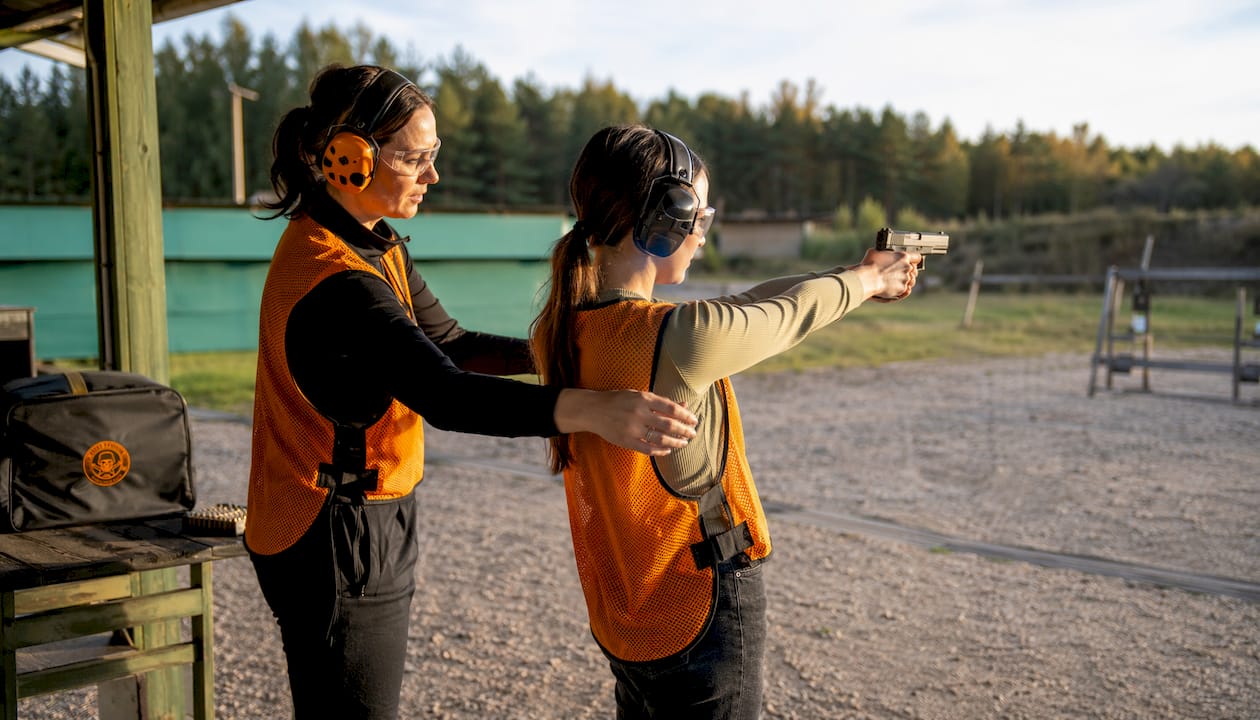
Instructor correcting female shooter's grip and stance

Stance compounds the problem. Leaning back, standing square to the target, or letting your weight drift to your heels all reduce your ability to absorb recoil and recover for a follow-up shot.

Common grip and stance errors:

  • Gripping the forend too tightly, which torques the barrel
  • Inconsistent cheek weld, changing your eye-to-scope distance shot to shot
  • Standing upright or leaning back instead of slightly forward into the rifle
  • Feet too close together, reducing lateral stability
  • Poor shoulder pocket placement that lets the stock shift under recoil

Pro Tip: Grip the rifle firmly enough that it won’t move, but not so hard that your forearm muscles tremble. Think of it as a confident handshake, not a wrestling match. Relax your support hand and let it guide rather than clamp.

2. Sight alignment and sight picture mistakes that cost you accuracy

The most common error here is focusing on the target instead of the front sight or reticle. Your eye can only focus sharply at one distance at a time. If you’re staring at the deer or the bullseye, your sight picture blurs, and your brain fills in the gap with guesswork.
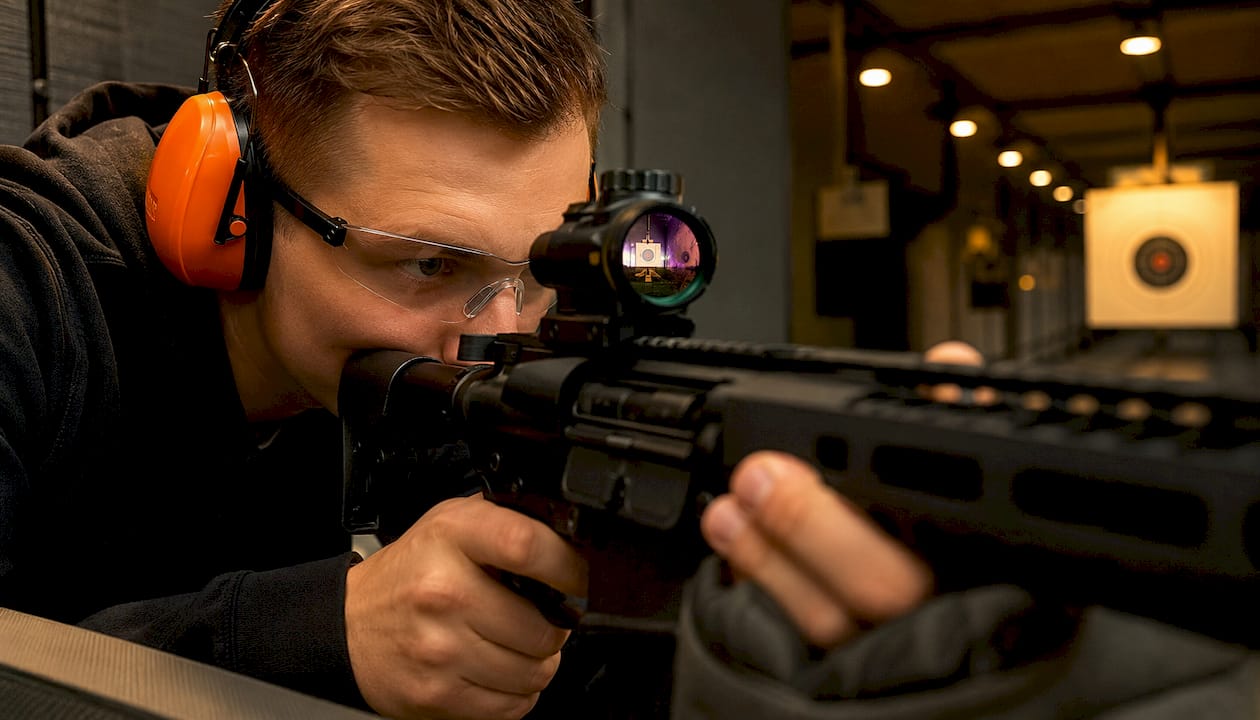
Rear view of male shooter practicing sight alignment indoors

Canting the rifle even a few degrees shifts shot placement laterally, and the effect gets worse at distance. A rifle that looks level to you but is actually tilted five degrees will send shots noticeably off-center at 100 yards.

Errors to watch for:

  • Focusing on the target instead of the reticle or front sight post
  • Allowing the rifle to cant left or right without a level reference
  • Inconsistent eye relief, causing scope shadow or parallax error
  • Rushing target acquisition before the sight picture is settled

Pro Tip: For iron sights, focus on the front sight and let the target go slightly soft. For scopes, dial out parallax at your shooting distance and confirm your eye is centered behind the ocular lens before every shot.

3. Trigger control errors: jerking and anticipating the shot

Many shooters jerk the trigger out of impatience, and the result is a shot that breaks before the rifle is settled. The trigger should surprise you slightly. If you know exactly when it’s going to fire, you’re probably tensing up in anticipation.

Think of the trigger like a camera shutter. You press it slowly and steadily until the shot breaks on its own. The moment you start “helping” it along with a quick squeeze, the muzzle moves before the bullet leaves the barrel.

Experienced shooters learn to trust the wobble, letting the reticle move naturally within the target zone rather than timing a perfect moment to fire. Chasing that perfect moment is what causes the jerk.

  • Place the pad of your index finger on the trigger, not the joint
  • Apply pressure straight back, not to the side
  • Maintain consistent trigger finger placement across every shot
  • Practice dry firing to build the muscle memory without burning ammo

Pro Tip: Dry fire practice is one of the most effective ways to eliminate trigger jerk. With an unloaded and verified-safe rifle, practice pressing the trigger until the firing pin drops, watching for any muzzle movement. If the barrel dips or swings, you’re anticipating.

4. Why follow-through matters more than most beginners realize

Follow-through is what you do in the half-second after the trigger breaks. Most beginners immediately drop the rifle to check where they hit. That movement starts before the bullet clears the barrel, and it pulls the shot.

Proper follow-through means holding your cheek weld, keeping your eye on the reticle, and maintaining your grip through the recoil cycle. It also gives you a chance to call your shot, meaning you can tell where the crosshairs were sitting when the rifle fired, which tells you where to look for impact.

Follow-through best practices:

  • Keep your cheek on the stock until the rifle fully settles from recoil
  • Stay behind the scope and watch for the reticle to return to the target
  • Mentally note where the crosshairs were at the moment of the shot
  • Resist the urge to look over the rifle or lower it immediately after firing
  • Breathe out slowly and reset before cycling the bolt or moving

5. Recoil anticipation: the mistake that causes the most missed shots

Anticipating recoil causes vertical shot stringing and shifts the muzzle several inches off target at longer distances. It’s the single most common reason hunters miss at ranges well within their rifle’s capability.

The flinch is involuntary. Your brain knows the rifle is about to be loud and push back hard, so it fires a pre-emptive muscle contraction. The result is a dip or push of the muzzle just as the trigger breaks.

Recoil management is about mechanics, timing, and consistency, not raw strength. Tensing up actually makes it worse. Proper grip angle, wrist lock, and hand placement create a repeatable recoil path that your body can absorb without fighting. Good recoil management also lets you stay in the scope and observe where the bullet hit, so you can correct instantly.

Key insight: Flinching and recoil anticipation are the leading causes of vertical shot dispersion at distance. Technique and structure fix this. Strength does not.

Pro Tip: Dry fire practice and slow, controlled breathing before the shot both reduce anticipation. If you’re shooting a hard-kicking caliber, intersperse a few rounds of .22 LR between groups to reset your fundamentals and confirm you’re not developing a flinch.

6. Common rifle setup and equipment care mistakes

A rifle that isn’t properly maintained or set up will fight you regardless of your technique. These errors are easy to overlook because they happen before you even get to the range.

Common equipment mistakes:

  • Loose action screws that shift the barreled action in the stock
  • DIY scope mounting with incorrect torque or misaligned rings, causing cant and zero loss
  • Bore fouling from skipped cleanings, which degrades accuracy over time
  • Scope rings that don’t match the tube diameter, requiring improvised fixes
  • Mounting the scope too far forward or back, causing eye relief problems

Loose hardware is the sneakiest culprit. A scope that loses zero after every session often has a mounting screw that’s just slightly under-torqued. Use a proper torque driver and follow the manufacturer’s spec, typically 15–25 inch-pounds for most ring screws.

At Tondi Lasketiir, the range’s indoor shooting experience includes properly maintained equipment and staff who can spot setup issues before they cost you a session’s worth of shots.

7. Breathing control errors during shooting

Breathing moves your chest, which moves the rifle. Fire at the wrong point in your breath cycle and you’ve introduced movement that no amount of trigger technique can fix.

The standard method is to fire during the respiratory pause, the natural 2–3 second window between exhaling and inhaling again. Your body is still, your muscles are relaxed, and the rifle sits naturally on target. Holding your breath too long causes muscle tremor and lightheadedness, both of which move the rifle.

The fix is straightforward: take a normal breath, exhale about half of it, and let the pause happen naturally. Don’t force it. If the shot isn’t ready within that window, breathe normally and start again rather than rushing. For a deeper breakdown of this technique, Laskmine’s breath control guide covers the full respiratory cycle and how to time your shots around it.

8. Incorrect shooting range safety practices

Safety errors at the range aren’t just rule violations. They put people at risk and get shooters removed from facilities. The most frequent mistakes are also the most preventable.

Treating every firearm as loaded is the baseline rule, and yet beginners routinely handle rifles carelessly when they believe the chamber is empty. Muzzle discipline, keeping the barrel pointed downrange or in a safe direction at all times, is the second habit that separates careful shooters from careless ones.

Other common safety mistakes:

  • Finger inside the trigger guard before the shooter is on target and ready to fire
  • Crossing the firing line while others are shooting
  • Failing to wait for a ceasefire before going downrange to check targets
  • Not wearing eye and ear protection consistently
  • Handling a rifle while others are downrange

Range safety rules exist because the consequences of ignoring them are severe and irreversible. If you’re new to range protocol, a structured shooting course with a qualified instructor is the fastest way to build safe habits from the start.

9. Failing to adjust for wind and environmental factors

Wind is the most misunderstood variable in field shooting. Hunters frequently misjudge range and shooting conditions, and wind is a major contributor to missed shots even at distances most hunters consider routine.

A 10 mph crosswind moves a typical hunting bullet several inches at 200 yards. At 300 yards, that same wind can push the shot outside the vital zone of a deer-sized target. The error isn’t the wind itself; it’s the failure to account for it before pulling the trigger.

Practical adjustments:

  • Read wind direction from grass movement, mirage, or a wind indicator
  • Learn your cartridge’s wind drift at common hunting distances
  • Aim into the wind to compensate, or wait for a lull if conditions are gusty
  • Factor in temperature and altitude, both of which affect bullet velocity and drop
  • At indoor ranges, environmental factors are controlled, making them ideal for building baseline fundamentals before moving to field conditions

Try it yourself at Tondi Lasketiir

https://laskmine.ee/en

Reading about these errors is one thing, but you can also try Combat d’Archers’ supervised indoor shooting activities that blend fitness and precision skills. Feeling them corrected in real time is another. Tondi Lasketiir in Tallinn offers a supervised indoor shooting experience where beginners and experienced shooters alike can work through these exact fundamentals with properly maintained equipment and knowledgeable staff on hand. Whether you’re booking a solo session, a group outing, or a corporate event, the range is set up to make the experience safe, enjoyable, and genuinely useful for your accuracy. Book a shooting session and find out which of these mistakes you’re actually making.


Key Takeaways

Correcting common rifle shooting mistakes requires fixing technique, equipment, and habits together, not just one at a time.

Point Details
Grip and stance first Inconsistent grip pressure and poor stance reduce shot consistency and increase muzzle flip.
Trigger patience pays off Pressing the trigger slowly and letting the shot break unexpectedly eliminates most jerking errors.
Follow-through is part of the shot Holding cheek weld and watching the reticle after firing helps you call the shot and correct faster.
Recoil anticipation causes vertical stringing Flinching shifts the muzzle off target at distance; mechanics and dry fire practice fix it, not strength.
Equipment setup matters Loose screws and DIY scope mounting with incorrect torque cause zero loss and erratic shot placement.

FAQ

What is the most common reloading mistake for rifle shooters?

The most frequent error is inconsistent primer seating depth, which affects ignition reliability and pressure consistency. For shooters who don’t reload, the equivalent mistake is using ammunition that doesn’t match the rifle’s chamber specifications.

What are the five fundamentals of shooting a rifle safely?

The core fundamentals are: treat every firearm as loaded, keep the muzzle pointed in a safe direction, keep your finger off the trigger until ready to fire, know your target and what’s beyond it, and store firearms safely when not in use.

What causes a rifle to be inaccurate?

Inaccuracy usually comes from a combination of technique errors (grip, trigger control, breathing) and equipment issues (loose action screws, scope cant, bore fouling). Fixing fundamentals first almost always produces a bigger improvement than changing equipment.

What are the three most common firearm malfunctions?

The three most frequent malfunctions are failure to feed (a round doesn’t chamber), failure to fire (the primer doesn’t ignite), and failure to eject (the spent case stays in the chamber). All three are usually caused by dirty components, weak ammunition, or worn parts.