Shooting in Tallinn: Safe, Guided Experiences for Tourists
- Mo-Su 10.00 – 20.00
- +372 555 85 416
- sale@laskmine.ee


Mental focus in shooting means keeping your attention on the few things you control during a shot: your stance, your sight picture, your breathing and your trigger press. It does not mean emptying your mind or trying harder. The International Shooting Sport Federation (ISSF) advises shooters to concentrate on skill and execution and to stop distracting thoughts from impairing performance. This guide shows you how to do that, whether you are a first-timer or a gun owner who wants tighter groups.
New shooters often think focus means staring harder at the target. In practice it is closer to attention management. You choose what gets your attention, in what order, and you let everything else go.
The ISSF takes a process-oriented view. In its guidance, the shooter regulates attention toward execution rather than outcome, equipment worries, competitors or negative predictions about performance. That is useful for a beginner too. Thinking “I must hit the center” pulls your attention to the result, which you cannot control in that moment. Thinking “front sight, steady breath, smooth press” pulls it to actions you can control.
A simple way to picture it is a funnel. At the wide end are all the things around you: other people, noise, the number on the target, the memory of your last bad shot. At the narrow end is one thing at a time. Good shooters narrow the funnel on purpose, shot after shot.
A pistol or rifle shows you your mental state very honestly. A flinch before the shot, a jerked trigger or a drifting sight picture often starts as a thought, not a muscle problem. When your mind jumps ahead to the result, your hands follow. That is why two shooters with identical equipment and similar strength can produce very different groups.
Consistency is the real prize. Anyone can fire one good shot. Focus is what lets you repeat the same process ten times in a row, so your group shrinks instead of scattering.
Research cited by the ISSF points to a mix of mental and physical factors. Anxiety and poor emotional management can impair shooting performance. Higher heart loads in competition can affect breathing, body and hand tremors. Negative thoughts and distractions about equipment, competitors and the target also play a role.
Translated into range life, the usual culprits look like this:
Notice that most of these are about attention, not talent. That is good news: attention can be trained.
Breathing is the one body function you can control and also the one that most directly affects your nerves. The ISSF Athlete’s Handbook states that breathing can reduce stress and muscle tension, calm nerves, sharpen focus and minimize negative thoughts.
Breathe calmly before you raise the firearm. Two or three slow breaths, with a longer exhale than inhale, give your pulse a chance to settle. Treat this as an anchor you repeat every single time, so your body learns that this breathing means “time to shoot.”
The goal is a brief natural pause or slow exhale, not a long breath hold. The ISSF warns against prolonged holds, because oxygen starvation makes your sight picture swim and your muscles tense. A 1992 study record in the International Journal of Sport Psychology reports that skilled rifle shooters commonly showed heart-rate deceleration before trigger release, along with breath holding combined with slow expiration just before the shot. In plain words: experienced shooters tend to get calmer and slower right as they fire.
Want the mechanics in more depth? Our breath control shooting technique guide walks through the breathing cycle step by step.
A doctoral thesis reviewing slow breathing found limited evidence that a single session improves stress responses or pistol accuracy in novices, while repeated sessions looked more promising, though not conclusively. The practical lesson is honest and simple: make breathing a habit you rehearse often, not a trick you try once when you are already shaking.
A routine gives your mind a track to run on. When the track is familiar, there is less room for doubt. Here is a simple five-step version that works for most beginners. It is a practical coaching template, not a rule from any federation, so adjust it with your instructor.
If your mind wanders mid-routine, do not fire. Lower the firearm safely, reset and start again. Resetting is a sign of discipline, not failure.
Trigger work is where focus most visibly turns into accuracy, so it pairs well with our article on trigger control best practices.
The ISSF recommends psychological monitoring together with relaxation and attentional strategies to improve shooting performance. For a recreational shooter, that boils down to three habits: notice your mental state, calm it down, and aim your attention deliberately.
Dry fire means practicing the routine with an unloaded firearm, following the safety rules you were taught. Ten minutes at a time is enough. Without recoil and noise, you can watch your sights during the trigger press and spot where your attention slips. Our dry fire practice guide explains how to set it up safely at home.
Give every range session one mental goal. Today it might be “I follow my five-step routine on every shot.” Next time it might be “I call every shot before checking.” Fewer shots with full attention teach more than a hundred rushed ones. If you are starting with a pistol, the drills in our pistol shooting drills for beginners give structure to that kind of practice.
There is academic support for training your inner attention. A peer-reviewed study found that elite shooting and archery athletes were better than non-elite athletes at detecting and discriminating internal bodily signals, and that 5 to 8 weeks of mindfulness training improved interoceptive attention. That means sensing your own heartbeat, breath and muscle tension. You can start small: before each string of shots, spend ten seconds noticing your breathing, your grip pressure and your shoulders.
Once your routine feels natural, add mild pressure: a timer, a friend watching, a score you write down. The point is to practice your routine when your pulse is a bit elevated, since that is what a real match or a new group environment feels like. If you are heading toward a match, our competition preparation guide for Estonia covers how to build that up.
| Mistake | What it looks like | Quick fix |
|---|---|---|
| Chasing the result | Looking at the target after every shot, tensing up | Call the shot first, then check |
| Holding your breath too long | Blurry sights, trembling | Use a natural pause or slow exhale |
| Too many thoughts | Trying to remember stance, grip, sights and trigger at once | Pick one cue per shot |
| Rushing | Fast, sloppy trigger presses | Reset and restart the routine |
| Staying too long | Groups opening up late in the session | Stop while you are still sharp |
| Silent frustration | Getting angry after a miss | Take a breath, name one thing to fix, move on |
Many of these overlap with technical faults. If your group is scattered even when you feel calm, check the common rifle shooting mistakes list, and for deeper accuracy work see precision shooting techniques.
Focus is hard when you are worried about doing something wrong. That is why the environment matters. At Tondi Shooting Range in Tallinn, the range is indoors, so weather and outside distractions are not part of the equation. No experience is required, every session is supervised by professional instructors, and safety training is included before you handle anything. A wide selection of firearms means you can try different options instead of fighting with one that does not suit you.
When you do not have to worry about safety rules or what to do next, your attention is free for the thing that matters: the shot in front of you. An instructor can also see your habits from the side, such as a held breath or a tense shoulder, and fix them in seconds.
If you like the idea of building awareness and calm under pressure through practical exercises, read about tactical shooting sessions and about building awareness through tactical training.
Here is how our published offers fit different goals. Prices are as listed on our site.
If you are planning a company outing, our guide to team building at a shooting range explains why shooting works for communication and confidence. For colder months, see indoor winter team events in Tallinn, and for groups with no background, the page on a corporate team event with no experience needed.
Pick the package, bring your curiosity, and let the instructors handle the rest.
This is a practical example you can adapt. It assumes one supervised range visit per week and short home sessions.
Week 1: Learn the routine. At the range, work on the five-step routine with your instructor. At home, practice breathing for two minutes a day: slow inhale, longer exhale.
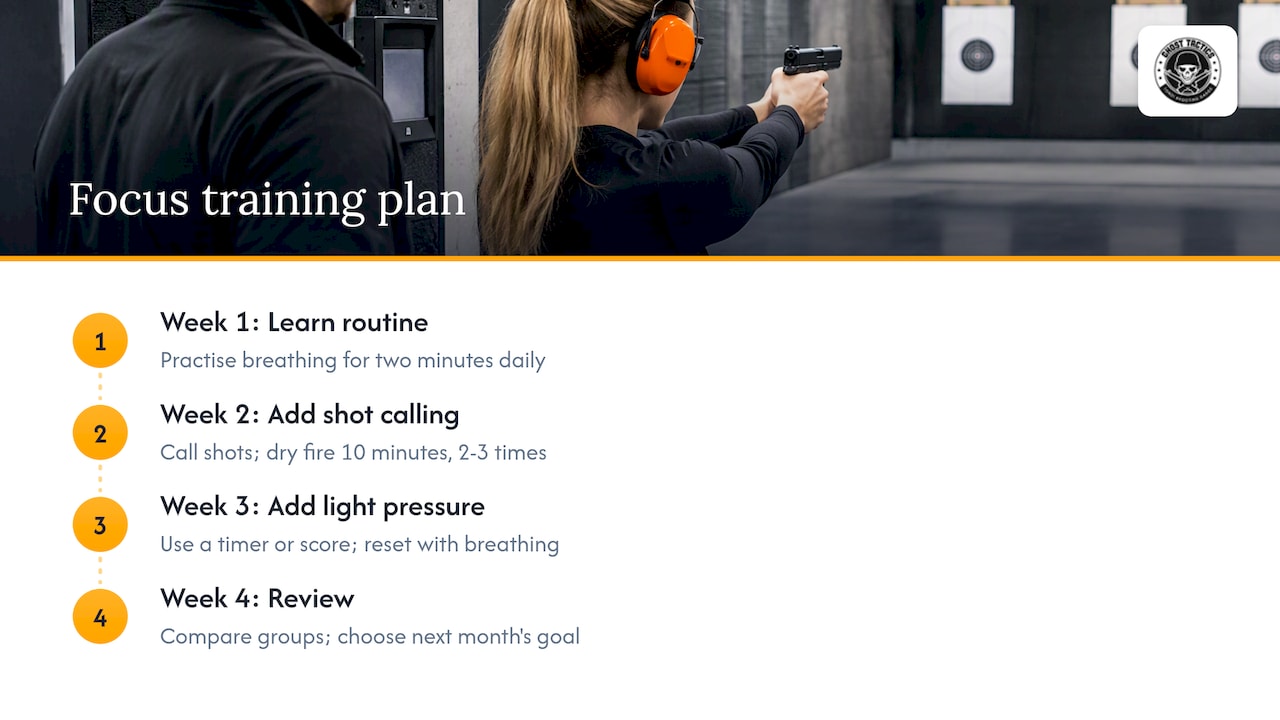
Week 2: Add shot calling. Call every shot before looking at the target. Do ten minutes of dry fire two or three times this week, watching the front sight through the whole trigger press.
Week 3: Add light pressure. Use a timer or keep score for a few strings. Notice what your body does when you feel pressure, and use your breathing anchor to reset.
Week 4: Review. Compare your groups from week 1 and week 4. Ask your instructor which habit still disturbs your focus most, and make that next month’s goal.
Keep your expectations realistic. Research on slow breathing suggests repeated practice is more promising than a single session, and mindfulness studies in shooters ran for 5 to 8 weeks. Steady habits beat dramatic breakthroughs.
If pistol is your starting point, the pistol shooting basics in Estonia guide fits well alongside this plan.
No. Focus is a skill you build, and beginners often progress quickly because they have no bad habits to unlearn. At Tondi, no experience is required, safety training is included and instructors supervise every session. You only need to bring your attention.
Nerves, a fast pulse and tension are common causes, and ISSF guidance notes that heart load can affect breathing and hand tremors. Take a few slow breaths before raising the firearm, relax your shoulders and shoot fewer rounds with more attention. If shaking persists, tell your instructor so they can check your stance and grip.
Not for long. A brief natural pause or a slow exhale during the trigger press is the aim, and the ISSF warns against prolonged breath holds. If your sights start to blur, lower the firearm safely, breathe normally and begin again.
Many people find the need for calm, steady attention a welcome break from daily noise, and group sessions give teams a shared challenge where communication matters. We do not promise a particular outcome, since results differ from person to person. A supervised session is the easiest way to find out how it works for you or your team.
Choose a package on our experience and gift card page, or see the group events page for bachelor parties and company outings. Visit Tondi Shooting Range for current booking options and opening times.