What Is an AR 15 and What Should Buyers Know Before Purchasing?
- Mo-Su 10.00 – 20.00
- +372 555 85 416
- sale@laskmine.ee


A security scenario in team training is a short, controlled situation in which a group practises how it would act under pressure: who decides, who speaks, what gets reported and what gets missed. It works best when it has one clear learning objective, roles that match real jobs, a calm facilitator and a proper debrief. At Tondi Shooting Range in Tallinn we build team sessions on exactly this logic, indoors, with professional instructors and no experience required.
This guide is for HR managers, team leads and event organizers who want more than a pleasant afternoon out. You will see how to design a scenario, run it, debrief it and judge whether it worked. You will also see how a supervised indoor range can serve as the setting.
A scenario is a story with decisions in it. Instead of listening to a talk about risk, the team is placed inside a simplified, believable situation and has to act. The situation might be an unexpected visitor in a restricted area, a blocked exit during an evacuation drill, a sudden loss of communication between two groups, or a time-limited task where information arrives in pieces.
There are two broad formats:
Many teams get the most from combining both: a short discussion first, then a hands-on exercise, then a structured conversation about what happened.
The word “security” does not have to mean dramatic. For an office team it may mean who challenges an unknown person in the corridor, who calls whom when something looks wrong, or how a manager communicates when facts are incomplete. The scenario is a vehicle for those habits.
Well-designed scenarios tend to surface the same handful of capabilities. Here is what to watch for and what to train.
Most team failures are not failures of skill but of information: someone knew something and did not say it, or said it unclearly. A scenario with deliberately incomplete information forces people to ask questions, repeat instructions back and confirm understanding. You can see within minutes who speaks up and who waits.
When everyone is responsible, nobody is. A good scenario makes the team decide quickly who leads, who observes, who reports. Afterward, you can discuss whether that leadership emerged naturally or was assigned, and whether it should be written down.
Awareness means noticing what is around you and what has changed. Tasks that require attention to the environment, such as following a sequence of range commands or monitoring a partner, train the habit of looking up from your own task.
People who have practised a stressful situation once, in a safe setting, usually handle the next one with less panic. This is one reason we put focus on mental well-being and confidence in our sessions. Our approach is designed to help participants feel capable, not intimidated.
A scenario reveals weak points in your procedures: an unclear phone tree, a role nobody owns, an assumption nobody checked. Finding these in a two-hour exercise is far cheaper than finding them in a real incident.
The most common mistake is starting with the exciting part. Design in this order instead.
The principle behind this order is simple: the scenario exists to produce evidence about the objective. Anything that does not contribute to that is decoration.
A scenario that is too easy teaches nothing, and one that is impossible teaches helplessness. For mixed groups, build in layers: a basic task everyone can complete, then added complications for those who are ready. This is especially important for first-timers, who make up a large share of the groups we host.
A script is not enough. The facilitator reads the room and adjusts: slowing down when people are overwhelmed, adding a complication when the group finds the task too easy, stepping in when something is unsafe. The facilitator should know the objectives as well as the scenario, so every adjustment serves the learning.
A good briefing covers what will happen, what the rules are, what is expected of each person and what is not. State that the purpose is learning. When people believe they are being assessed, they play it safe and hide mistakes, and you lose the information you came for.
People should be able to make mistakes and say “I am not sure” without being treated as failures. Practical ways to achieve this:
Tone matters from the first greeting to the last handshake. A friendly, steady instructor keeps nervous participants engaged. This is a core part of how our instructors work, and it is why many first-time visitors tell us they came in anxious and left relaxed.
The experience alone teaches less than people expect. The debrief is where observations are discussed and turned into decisions. Give it real time, and do it promptly, while memories are fresh. For a half-day session, do not treat it as a five-minute wrap-up.
A simple structure that works:
Compare the original objective with what you observed. If you aimed for faster decision-making and observed hesitation, say so plainly and discuss why. A short written summary after the event, with the agreed actions, makes the session something the team can build on.
Avoid judging a scenario by whether people enjoyed it or whether they “won.” Enjoyment matters for engagement, but it is not evidence of learning. Look at both process and results:
| What you assess | Example question | How to observe |
|---|---|---|
| Communication | Did people confirm instructions and share new information? | Observer notes, short post-session survey |
| Decision-making | Was a decision-maker identified, and how quickly? | Observer notes against the objective |
| Teamwork | Did people help each other without being asked? | Observation, peer feedback in the debrief |
| Confidence | Do people feel more capable of handling a similar situation? | Before and after self-rating |
| Outcome | Was the task completed safely and on time? | Facilitator record |
Results alone can mislead. A team can complete a task by luck, or fail it because of one bad assumption that is easy to fix. Process observations such as communication and coordination tell you what to repeat and what to improve. Repeat the exercise a few months later and compare. That is the honest way to see progress.
A shooting range is an unusual but effective place for security-awareness training. It has clear rules that everyone must follow, commands that must be heard and repeated, and a built-in culture of attention and responsibility. Those are exactly the habits that carry over to workplace security: pay attention, follow procedure, communicate clearly, and do not act until you understand.
At Tondi Shooting Range in Tallinn:
Shooting also offers a fair, shared challenge. Nobody in the group is the expert, so hierarchy flattens quickly. A director and an intern are equally nervous at the first shot and equally proud of the first hit, which often opens up conversation that the office rarely allows.
For more on this format, see our guide on why a shooting range works for team building in Tallinn and the overview of what to expect at a team event with no experience.
Here are examples of how the principles above turn into activities. Your instructor adapts each to the group’s size, goals and comfort level.
Here is how a typical corporate session can be structured. Exact timing is agreed with you in advance.
| Block | Content | Purpose |
|---|---|---|
| Welcome and briefing | Introductions, goals, how the session works, opt-out reminder | Set a learning tone and reduce nerves |
| Safety training | Handling rules, range commands, questions | Build a shared safety culture |
| Individual shooting | Guided first shots with an instructor beside each person | Build confidence |
| Team challenge | Paired or small-group tasks with communication requirements | Practise coordination |
| Debrief | Facilitated discussion of what happened and what to change | Turn experience into action |
Notice that the debrief gets its own block. Whatever format you choose, protect that time.
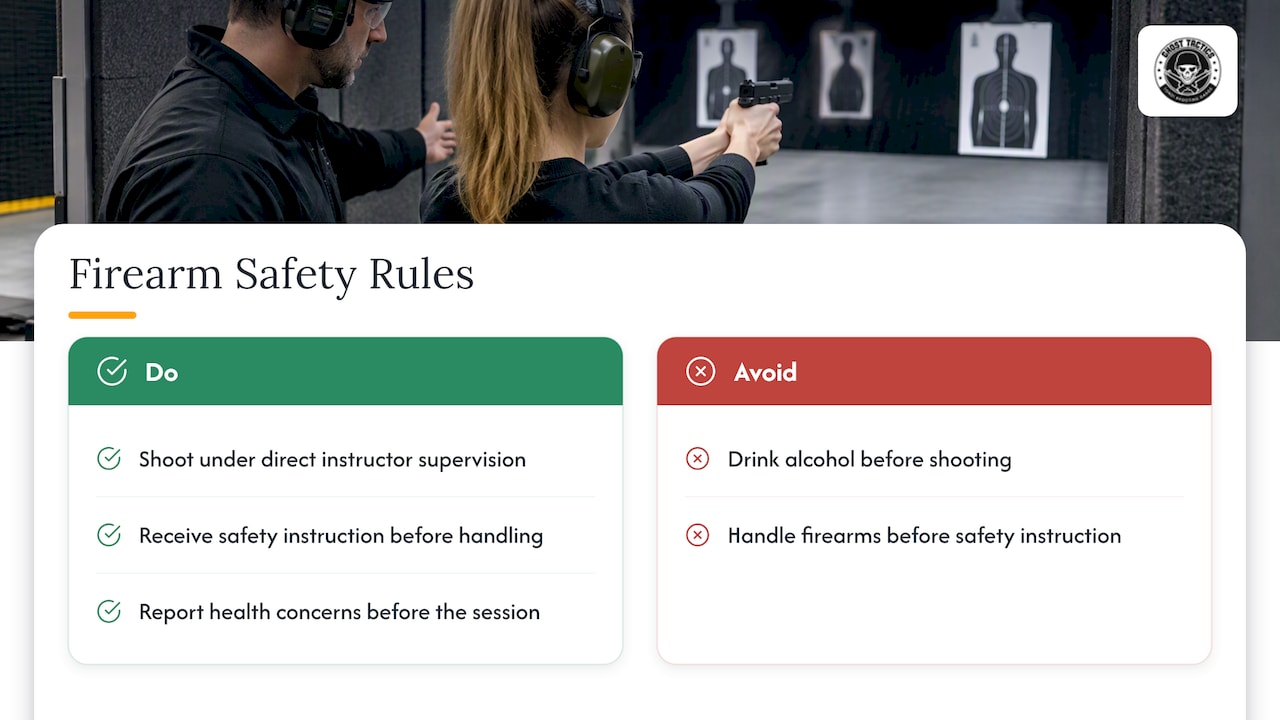
Anything involving firearms must be run with strict discipline. At our range, participants always shoot under direct instructor supervision, and safety instruction comes before any handling. Follow the instructor’s commands at all times, and tell us before the session about any health condition, medication or concern that could affect your participation, so we can adapt. We do not allow alcohol before shooting. If you are planning a celebration, keep the toast for after the session.
If you want to explore the topic of safe handling in depth, our article on why professional instruction matters explains what good instruction looks like.
For workplace scenarios that do not involve firearms, such as evacuation drills or incident-reporting exercises, rely on your organization’s safety officer and the procedures that apply to your premises.
We explain the booking process, lead times and what HR teams should prepare in our HR checklist for booking shooting training. If you are planning for the dark season, see our ideas for winter team events in Tallinn.
Our company programs are listed on the corporate events page. Current published prices:
We will help you match the program to your objective, your group size and your budget. Send us your goal, for example better communication between departments or a confident new team, and we will suggest a format. Groups planning something more personal, such as a birthday, can browse the gift card options, where “Minu esimene pauk” (my first shot) costs €45.
No. Most of our corporate guests are complete beginners. Safety training is included, and professional instructors supervise every session from the first minute. The activities are designed so that first-timers can succeed.
That depends on your objective and group size, but plan time for a briefing, the activity and a real debrief. A half-day usually allows all three without rushing. Tell us your goal when you inquire and we will suggest a realistic schedule.
Participation is always the person’s own choice. We agree on this in the briefing, and people can step back from any element. Many colleagues who start out hesitant become engaged once they see how structured and supervised the session is.
Yes. The range is indoors, so the weather does not affect the program. That makes it a dependable choice for team days in the Tallinn autumn and winter.
Set the objective beforehand, assign an observer, hold a structured debrief and agree actions with owners. Repeat a short exercise a few months later and compare what you see. Tracking communication and coordination is more reliable than judging by who scored highest.