IPSC Turvakursus aprillis 2021
- E-P 10.00 – 20.00
- +372 555 85 416
- sale@laskmine.ee





Pistol shooting drills are structured exercises designed to build accuracy, recoil control, and shooting speed through deliberate repetition. For beginners, the right drills create a measurable path from first-time pistol shooting steps to consistent, confident performance. Industry benchmarks like the Dot Torture scoring standard (47/50 at 3 yards signals solid foundational skill) give new shooters an objective target to chase. The three drills covered here, Dot Torture, the 1-2-3-6, and Half and Half, form a progressive training system that covers every core skill a beginner needs to develop.
The Dot Torture drill is the gold standard for beginner pistol training because it tests every fundamental skill without a timer. The setup is straightforward: 50 rounds at 3 yards on a target with 10 two-inch circles, each circle assigned a specific task. Those tasks include one-handed shooting, strong-hand only, weak-hand only, trigger control, and draw-to-fire sequences. No other single drill covers that range of fundamentals in one session.
Scoring tells you exactly where you stand. A score of 47/50 is solid for a beginner. Dropping below 40 points signals fundamental deficiencies that need correction before moving to speed-focused drills. That gap between 40 and 47 is where most beginners live, and it is the most productive place to train.
The drill works best when run cold, meaning no warmup shots before you begin. Cold drills reveal true readiness rather than warmed-up performance. This matters especially for anyone carrying a pistol for self-defense, because real situations never come with a warmup.
Pro Tip: Run Dot Torture as the very first thing you do at the range, before any other shooting. Your score reflects your actual skill level, not your best warmed-up performance.
The 1-2-3-6 drill is the best intermediate step between slow accuracy work and full-speed shooting. Developed by law enforcement trainer Jim Cirillo, it uses 12 rounds at 3 yards in a progressive sequence: fire 1 shot, then 2, then 3, then 6. Each string builds on the last, training your hands and eyes to manage recoil across increasing round counts.
The drill works for revolvers and concealed carry setups, making it one of the most practical examples of pistol training drills for real-world shooters. The short distance keeps the focus on recoil recovery and trigger reset rather than marksmanship under pressure. You learn to feel the gun return to alignment before pressing the trigger again.
Comparing this to the Bill Drill clarifies why the 1-2-3-6 is the right starting point. The Bill Drill requires 6 rounds in 2 seconds at 7 yards, a standard that overwhelms most new shooters. The 1-2-3-6 builds the same recoil management skills at a pace that lets you actually learn rather than just survive the drill.
Pro Tip: After completing the 6-shot string, pause and check your target before reloading. Identify which shots broke your sight picture and why. That analysis is where the real learning happens.
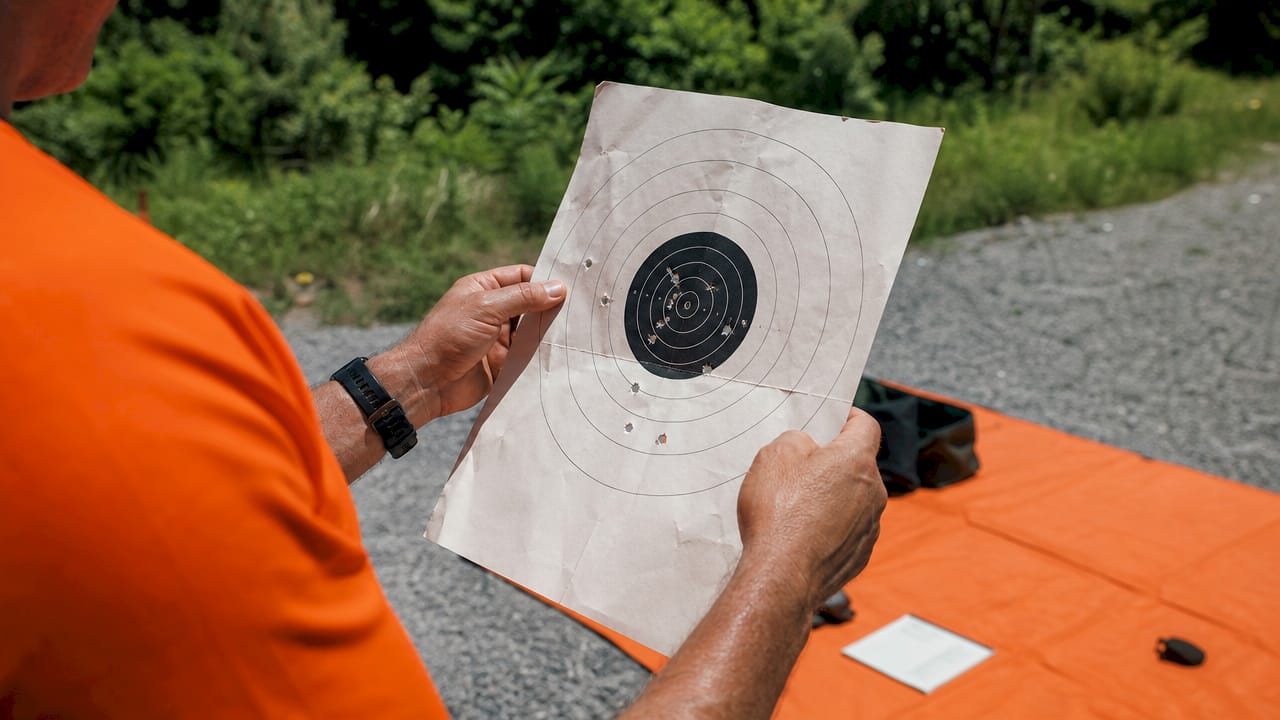
The Half and Half drill teaches beginners to balance speed and accuracy across multiple distances. The structure is direct: shoot from 20, 10, and 5 yards with par times of 12 seconds, 6 seconds, and 3 seconds respectively. Every hit must land in the A-zone of the target. As the distance cuts in half, so does your time.
| Distance | Par Time | Rounds | Requirement |
|---|---|---|---|
| 20 yards | 12 seconds | 10 rounds | All hits in A-zone |
| 10 yards | 6 seconds | 10 rounds | All hits in A-zone |
| 5 yards | 3 seconds | 10 rounds | All hits in A-zone |
The drill trains a skill that pure accuracy work misses entirely: mental pacing. At 20 yards you have time to be deliberate. At 5 yards you must trust your grip and sight picture to work fast. That shift in mental approach is what makes this drill so effective for building real-world shooting confidence.
Grip, stance, trigger press, and sight focus are the four fundamentals that determine how fast your drill scores improve. No drill produces results if the underlying technique is broken. A balanced stance and a firm, consistent grip reduce muzzle movement after each shot. Less muzzle movement means faster recovery and tighter groups.
Sight focus means placing your attention on the front sight, not the target. The target will appear slightly blurry. That is correct. A sharp front sight aligned with the rear sight produces accurate shots. Beginners who focus on the target instead of the front sight consistently shoot low and left (for right-handed shooters).
Trigger press is where most beginners lose points on Dot Torture. A smooth, straight-back press with no lateral movement keeps the sights aligned through the shot. Trigger reset, the point at which the trigger resets after firing, is equally important. Releasing only to reset rather than fully forward saves time and maintains control during multi-shot strings.
Eye movement leads the gun between targets, not the other way around. Train your eyes to move to the next target first, then let the gun follow. This single habit produces the biggest speed gains in target transition drills. It is the difference between reactive shooting and controlled shooting.
Pro Tip: Dry-fire practice at home, with an unloaded and verified-safe firearm, builds trigger control faster than live fire alone. Short, focused sessions several times a week produce measurable gains without range time or ammo cost.
Tracking scores and times is the only way to know whether your training is actually working. Logging drill results and shot times lets you identify specific weaknesses and set realistic improvement goals. Without records, you are guessing at your progress.
A shot timer is the most useful tool a beginner can add to their range kit. It measures par times for the Half and Half drill and records split times between shots in the 1-2-3-6. Split times reveal exactly where your recoil recovery slows down. That data tells you which part of the drill to focus on next session.
Speed emerges from efficient technique, not from trying to move faster. Instructor Mike Boyle’s principle is direct: draw, sight acquisition, and target transitions must each be efficient before speed can increase. Chasing speed before efficiency produces fast misses, not fast hits. Build the technique first, then let the speed follow naturally.
The most effective pistol shooting drills for beginners build accuracy first, then layer in speed through structured, measurable progression.
| Point | Details |
|---|---|
| Start with Dot Torture | Score 47/50 at 3 yards before moving to speed-focused drills. |
| Run drills cold | No warmup shots gives you an honest skill baseline every session. |
| Use the 1-2-3-6 before Bill Drill | Build recoil control progressively before attempting 6 rounds in 2 seconds. |
| Technique drives speed | Efficient grip, sight focus, and trigger press produce speed as a byproduct. |
| Track every session | Log scores and split times to identify weaknesses and set measurable goals. |
Here is the thing most beginners get wrong: they think shooting faster means trying harder to go fast. Every new shooter I have seen walk onto the range with that mindset shoots faster misses. That is not progress.
The real insight is that speed is a byproduct of efficiency. When your draw is clean, your grip is set before the gun clears the holster, and your eyes are already on the front sight, fast shots happen without forcing them. You do not shoot faster by rushing. You shoot faster by removing every wasted movement.
The other mistake I see constantly is skipping the cold drill. Shooters warm up, run a few magazines, then do Dot Torture and feel good about a 46. That score means nothing if you needed 50 rounds to get there. Run it cold. Accept the honest number. That is the only score worth tracking.
Beginners who focus on clean fundamentals and honest self-assessment improve faster than those chasing speed from day one. The Tondi Shooting Range challenges are built around exactly this principle: measurable benchmarks that reward accuracy and efficiency, not just raw speed. Start there. The speed will come.
— Tõnis
Laskmine’s Tondi Shooting Range in Tallinn gives beginners a structured environment to put these drills into practice with real coaching support. The range is set up for exactly the kind of focused, progressive training that Dot Torture, the 1-2-3-6, and Half and Half require.

Laskmine offers beginner shooting challenges that incorporate benchmark scoring standards, so you can measure your progress against real targets from your very first session. The facility supports both pistol and revolver shooters, making it a practical fit for anyone starting their training. If you are ready to move from reading about drills to running them with guidance, Tondi is the right place to start.
The Dot Torture drill is the best starting point. It tests accuracy, trigger control, and weak-hand shooting across 50 rounds at 3 yards with no time pressure.
Short, focused sessions several times a week produce better results than one long session. Dry-fire practice at home between range visits accelerates trigger control development.
A score of 47/50 is a solid beginner benchmark. Scoring below 40 indicates fundamental technique issues that need correction before advancing to speed drills.
Move to the Bill Drill after you can complete the 1-2-3-6 with all hits on target and consistent split times. The Bill Drill requires 6 rounds in 2 seconds at 7 yards, a significant step up in speed and distance.
A shot timer is not required for Dot Torture, which is accuracy-only. For the Half and Half drill and any speed-focused work, a timer is the only reliable way to measure par times and track real improvement.