Relvaloa taotleja koolitus septembris 2020
- E-P 10.00 – 20.00
- +372 555 85 416
- sale@laskmine.ee





Shot grouping is defined as the collective pattern of multiple consecutive bullet impacts on a target, where the tightness of that pattern measures precision and its displacement from the aim point measures accuracy. Every shooter who wants to improve needs to understand what is grouping in shooting before they can diagnose what is actually going wrong on the range. The two concepts, precision and accuracy, are not the same thing, and confusing them is one of the most common mistakes shooters make. Industry standards set clear benchmarks: big-game rifles are considered accurate at 1.5 MOA, small-game rifles target sub-MOA, and defensive handguns accept 4 to 5 inch groups at 25 yards. Knowing where your groups fall against those standards tells you exactly what to fix.
Shot grouping, also called a shot group or bullet group, is the pattern formed when a shooter fires multiple rounds at the same aiming point. The tighter the cluster of impacts, the higher the shooter’s precision. The closer that cluster sits to the intended point of aim, the higher the accuracy.
The standard measurement method is center to center: you measure the distance between the two holes that are farthest apart, then subtract one bullet diameter. That gives you the group size in inches or millimeters. A second method, the smallest enclosing circle, draws the tightest circle around all impacts and records its diameter. Both methods appear in competitive and military testing, and both have their place depending on what you are evaluating.
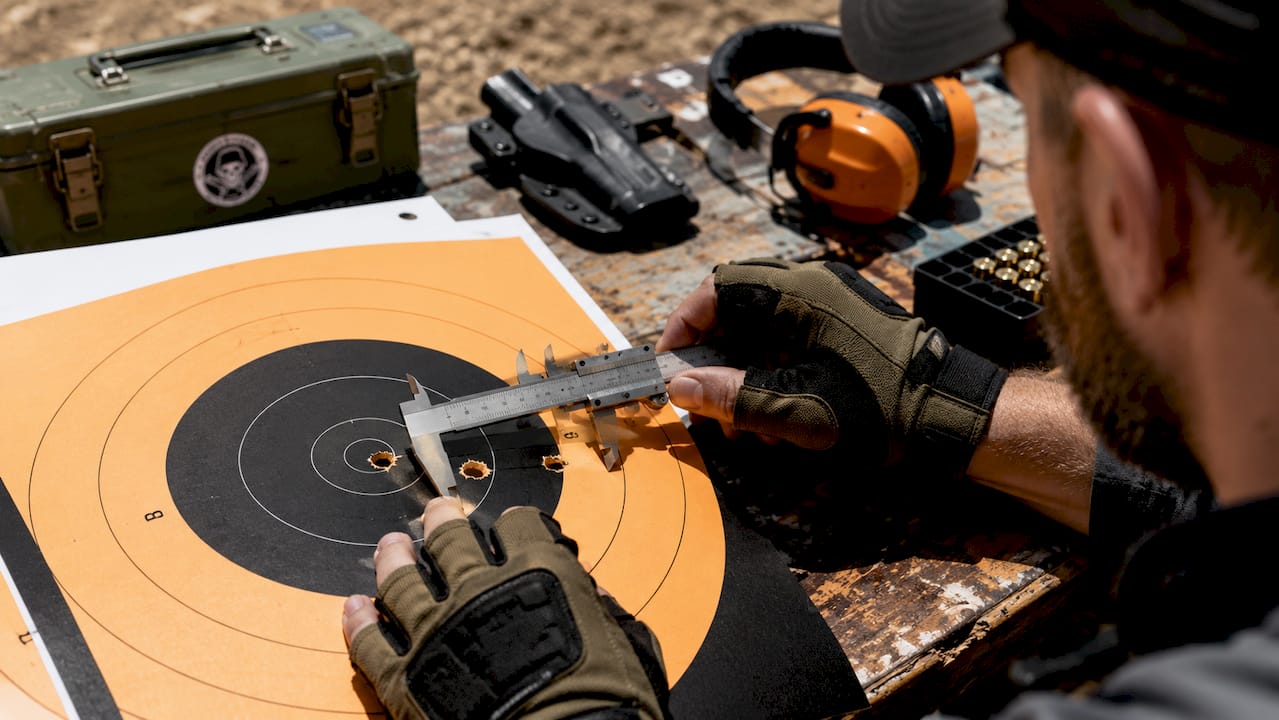
Angular measurement units matter when you compare groups fired at different distances. Minute of Angle (MOA) equals approximately 1.047 inches at 100 yards. Mils (milliradians) are used more commonly in military and long-range contexts. Converting your linear group size to MOA lets you compare a 50-yard group with a 200-yard group on equal terms.
Shot count changes everything about how you interpret a group. 3-shot groups are common for quick load checks, but 10-shot groups reveal systemic errors that small groups mask entirely. 50-shot groups run about 25% larger than 21-shot groups. That gap exists because more shots expose the outliers that a lucky 3-round string hides.
Pro Tip: Fire at least 10 shots before drawing conclusions about your group size. Three-shot groups feel satisfying but routinely flatter your real precision by hiding the fliers that a longer string would expose.
| Shot count | Best use | Limitation |
|---|---|---|
| 3 shots | Quick load or zero verification | Masks shooter errors and outliers |
| 5 shots | Standard field accuracy check | Still susceptible to lucky strings |
| 10 shots | Reliable technique diagnosis | Requires more time and ammo |
| 21+ shots | Statistical precision testing | Fatigue can influence later shots |
True marksmanship requires tight shot groups (precision) and the group centered on the target (accuracy). These are two separate skills, and a shooter can excel at one while failing at the other.
Precision is what your group size measures. A shooter who fires five rounds into a half-inch cluster is precise, regardless of where that cluster lands on the target. The firearm and the shooter are producing consistent results. Precision reflects mechanical consistency, trigger control, and repeatable form.
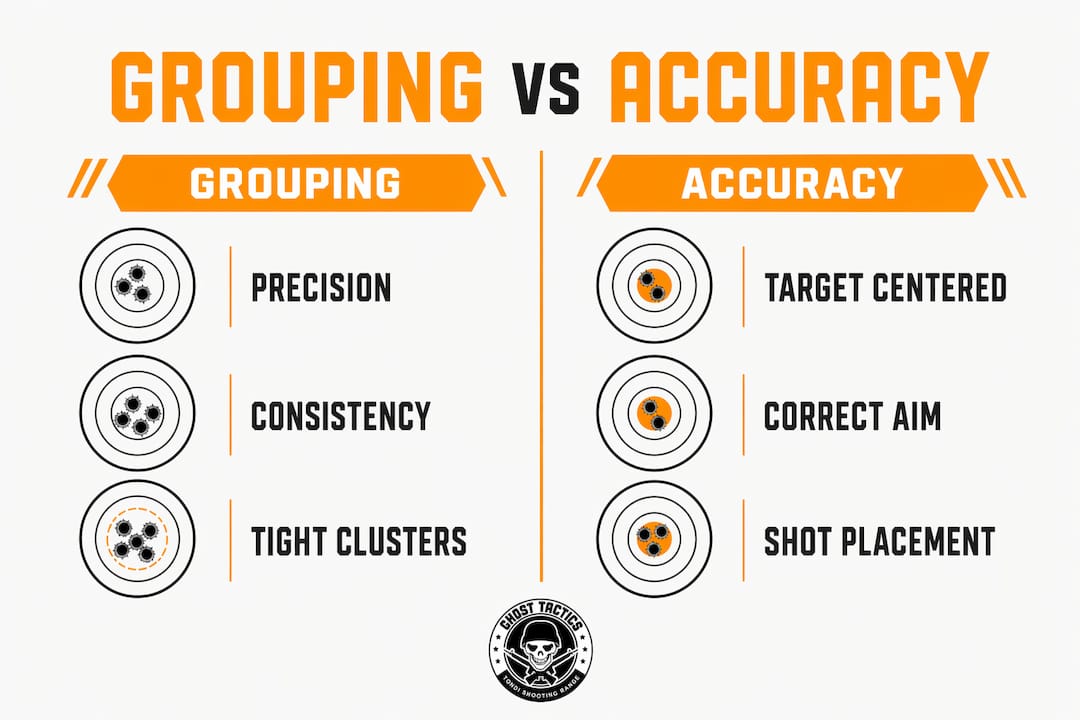
Accuracy is about where that cluster lands. A shooter who puts every round within an inch of the bullseye is accurate, even if the group itself is loose. Accuracy depends on correct sight alignment, zeroing, and the ability to replicate the same sight picture on every shot.
The practical problem is that these two qualities require different fixes. A tight group that sits three inches low and left tells you the shooter is consistent but the sights need adjustment, or the shooter has a consistent grip error. A centered but scattered group tells you the zero is correct but the technique is inconsistent.
“Shooters must achieve both tight groupings and correct sighting to balance precision with accuracy for effective marksmanship. One without the other produces a shooter who is either consistent in the wrong place or unpredictably right.”
For rifle shooters, precision failures usually trace back to inconsistent cheek weld, trigger pull variation, or ammo inconsistency. For handgun shooters, grip pressure and trigger finger placement are the most common culprits. Fixing the right problem requires knowing which one you actually have.
Group shape is a diagnostic tool. The pattern your shots form on paper tells you more than the size of the group alone.
A vertical string, shots scattered up and down, typically signals inconsistent follow-through or varying trigger pull speed. A horizontal string, shots spread left and right, often points to inconsistent grip pressure or wind that the shooter did not account for. A diagonal string combines both problems. A scattered group with no clear pattern suggests multiple simultaneous errors or an equipment issue worth investigating.
Common group size benchmarks give you a reference point:
Rest method changes what your group tells you. Resting a handgun directly on a surface leads to inconsistent impacts because the frame contacts the rest differently on each shot. Hand support, where the shooter’s hands contact the rest rather than the gun itself, preserves a realistic accuracy assessment. This matters when you are trying to separate shooter error from firearm error.
Pro Tip: Shoot one group from a solid rest and one group from your normal unsupported position. The difference in size between the two groups tells you exactly how much of your spread comes from technique versus the firearm itself.
To diagnose shooting errors from group patterns, compare groups shot with and without a rest, at different distances, and with different ammunition. Each variable you isolate gives you cleaner data.
Improving your groups is a process of isolating and fixing one variable at a time. Trying to fix everything at once produces noise, not progress.
Slow down your trigger press. Jerking the trigger and anticipating recoil are the primary causes of poor groups in new shooters. Slow-fire group shooting isolates these errors immediately. Press the trigger straight back with steady, increasing pressure until the shot breaks as a surprise.
Lock in a consistent position. Your shooting position is a platform. Any variation in stance, grip, or cheek weld introduces variation into your group. Standardize every contact point before you fire the first shot in a session.
Use consistent ammunition. Ammunition variation is a real source of group spread. Switching between different bullet weights or manufacturers mid-session contaminates your data. Pick one load and stick with it when testing your groups.
Increase your shot count. Shooters overestimate precision by relying on single small groups. Fire larger groups to establish your true baseline. A 10-shot group is a minimum for meaningful technique diagnosis.
Practice with a purpose. Random shooting builds random habits. Structure your sessions around specific drills that target the fault your groups reveal. Pistol shooting drills built around slow-fire group work are one of the most direct ways to tighten your groups.
Seek professional instruction. A qualified instructor watching you shoot can identify errors in seconds that you might spend months trying to self-diagnose. Professional instruction accelerates progress in a way that solo practice rarely matches.
Maintain your firearm. A dirty or worn barrel, loose scope rings, or a worn trigger spring all degrade group size. Clean and inspect your firearm regularly, and address mechanical issues before blaming your technique.
Regular slow-fire practice helps shooters identify and correct trigger jerking and flinching caused by recoil anticipation. These two faults account for the majority of group problems in shooters at every experience level.
Shot grouping measures precision through cluster tightness and accuracy through cluster placement, and improving both requires isolating technique, equipment, and ammunition as separate variables.
| Point | Details |
|---|---|
| Grouping defines precision | Group tightness measures consistency, not whether shots hit the intended point of aim. |
| Accuracy and precision differ | A tight group in the wrong place means a zeroing or technique error, not a precision failure. |
| Shot count changes results | Fire at least 10 shots per group to get data that reflects your real precision. |
| Group shape diagnoses errors | Vertical strings signal follow-through issues; horizontal strings point to grip or wind problems. |
| Benchmarks guide expectations | Sub-MOA for precision rifles, 1.5 MOA for hunting rifles, 4 to 5 inches at 25 yards for defensive handguns. |
I have watched a lot of shooters come through the range frustrated because their groups will not tighten. The pattern is almost always the same. They focus on the target, not the process. They fire three shots, see a tight cluster, and declare victory. Then they fire ten more and wonder why the group fell apart.
The hardest lesson to accept is that your best group is not your real group. Your real group is the average of many groups fired under realistic conditions. Shooters who understand this stop chasing lucky strings and start building repeatable technique instead.
The other thing I see constantly is shooters who fix the wrong problem. They adjust their sights when their technique is inconsistent, or they work on trigger control when the real issue is a loose scope mount. Group shape tells you where to look. A scattered group with no pattern almost always means something mechanical. A consistent string in one direction almost always means something the shooter is doing.
Patience is the actual skill. Tightening groups takes weeks of deliberate practice, not one good session. The shooters who improve fastest are the ones who treat every group as data, not as a verdict on their ability. Track your groups, note the conditions, and look for trends over time. That is how you build real precision.
— Tõnis
Laskmine’s Tondi Shooting Range gives you the controlled environment you need to work on your groups seriously. Consistent lighting, measured distances, and target systems that let you track every shot make the range a real training tool, not just a place to burn ammunition.

Laskmine offers structured sessions where you can work through slow-fire group drills with proper feedback. Whether you are zeroing a rifle, diagnosing a handgun problem, or building the trigger control that tightens your groups, shooting at the range with a clear plan produces results that casual practice does not. Book a session at Tondi Shooting Range and bring your targets home. Your groups will tell you exactly what to work on next.
A shot group is the pattern formed by multiple bullet impacts on a target fired at the same aiming point. The tighter the cluster, the higher the shooter’s precision.
Big-game rifles are considered accurate at 1.5 MOA, while precision rifles target sub-MOA performance. Factory hunting ammunition typically produces 2 to 3 MOA groups.
Ten shots is the minimum for reliable technique diagnosis. Three-shot groups are useful for quick checks but routinely mask the fliers that longer strings expose.
A vertical string typically signals inconsistent follow-through or varying trigger press speed. It means the shooter is applying different amounts of pressure or movement at the moment of firing.
Precision is how tightly your shots cluster together. Accuracy is how close that cluster sits to your intended point of aim. Effective marksmanship requires both.