Terms and conditions

Tondi Shooting Range user and customer conditions

Purpose:
1.1. The purpose of these User and Client Terms and Conditions is to provide the principles of the Shooting Range User Agreement with respect to the Client using the Shooting Range services.
1.2. The user and customer conditions apply to the contract entered into upon purchase of the Visiting Card and the one-time service.

Key terms:
2.1. In the Terms of Use and Customer, the following terms are used with the following meanings:
2.1.1. "Booking Rules" - the part of the user and customer conditions that stipulates the procedure and conditions of pre-registration when purchasing the service;
2.1.2. „Lasketiir“ - service provider Tondi Lasketiir OÜ;
2.1.3. "Customer" - a person using the services of the Shooting Range on the basis of purchasing a Visiting Card or a one-time service;
2.1.4. "Visiting Card" - a multiple card of the shooting range for a regular customer;
2.1.5. "Shooting Package" - the service offered by the Shooting Range, the rights of which are defined in the Price List and provided on the Shooting Range website.
2.1.6. "User and Customer Terms and Conditions" - these User and Customer Terms and Conditions, which apply to the Customer using the services of the Shooting Range in case of purchasing a Visitor Card or a one-time service.

Use of a shooting range
3.1. The Client has the right to use the Shooting Range and the services offered therein in accordance with the conditions set out in his Shooting Package or in accordance with the conditions valid for the Visiting Card. When using the Shooting Range, the Client follows the instructions of the Shooting Range staff.
3.2. The shooting range services are provided only by persons authorized by the shooting range. The Client is prohibited from providing any services to the Shooting Range to third parties without the written consent of the Shooting Range.
3.3. The shooting range can be used by persons from the age of 16. Persons aged 12-15 (incl.) Use the Shooting Range only with an adult and / or consent (eg Shooting Packs "Junior and Senior", "Children's Birthday" or "Youth Birthday"). Persons under the age of 12 are not allowed to use the Shooting Range.
3.4. The client can access the Shooting Range on the basis of a previous reservation. The shooting range has the right to demand the presentation of an identity document to confirm a previous reservation and / or to confirm the age of the Customer.
3.5. If the Customer is not able to use the service offered by the Shooting Range at the time previously booked, he must cancel his reservation in accordance with the procedure provided in the "Booking Rules".
3.6. The Client who does not have a reservation can use the services offered by the Shooting Range only if there are free times.
3.7. The shooting range has the right to make changes in the Shooting Packages and other services offered at any time.
3.8. For extraordinary or reasons beyond the control of the Shooting Range (eg in case of an instructor's illness, bomb threat, fire, accident, their danger, etc.), the Shooting Range has the right to cancel the times previously reserved for the use of the service or restrict the use of the service. The Client will be notified as soon as possible.
3.9. The staff of the shooting range advises and instructs the Client on issues related to the use of the services provided, including the equipment, and keeps the used equipment in working order. The client uses the equipment according to its intended use and instructions received from the shooting range staff.
3.10. The Client behaves in accordance with good manners in the Shooting Range and treats the property in the Shooting Range prudently. Smoking and the consumption of alcohol or stimulants are not allowed in the shooting range. Pets are not allowed on the shooting range. The personnel of the Shooting Range have the right to temporarily remove the Shooting Range from the Shooting Range or to file a claim for damages in violation of any previous obligation or rule.

Terms of purchase and sale
4.1. The Client of the Shooting Range pays the Shooting Range for the service on the basis of an invoice according to the amount of fees provided in the price list. It is possible to pay for the service in cash or by bank card at the shooting range on site. On the website of the shooting range, it is possible to pay for the time via a bank link.
4.2. In the event of a delay in the payment of any fee under the Agreement, the Shooting Range has the right to demand late payment interest of 0.15% of the amount payable per day for each day of delay in payment until full payment of the amount due.
4.3. The shooting range has the right to withdraw from the sales contract entered into via the e-store and not to deliver the ordered goods or provide the service in the following cases:
- the goods have run out of stock;
- the price or features of the goods have been displayed incorrectly in the e-shop due to a system error;
- if the Client does not meet the conditions established by the Shooting Range.
4.4. If it is not possible for the Shooting Range to fulfill the order, the Shooting Range will contact the Customer and return the paid amount when the Customer has managed to make an advance payment for the goods.
4.5. The delivery partner of the shooting range is Itella Estonia OÜ (Itella SmartPost). The maximum delivery time is 8 working days. The ordered product is delivered via the parcel machine service.


Payment
5.1. The prices of the products sold in the shooting range online store are given in Euros without transport costs. VAT will not be added. Prices in the online store and sales showroom in Tallinn may differ.
5.2. Payment can be made via Swedbank, SEB Pank, LHV Bank, Luminor, Pocopay and Coop Pank Internet Bank. Also Paypal
CLOSE

Frequently Asked Questions

With which public transport are it possible to come from the center of Tallinn to the Weapons and Tactics Training Center?

Trams no. 3 and 4, stop “Tondi”
b. Buses no. 5, 18, 36, stop “Kalev”
c. Taxi – Be sure to add an approximate cost.


What is SLICE?

The SLICE payment method allows you to pay interest and service fees in three equal installments for purchases of € 75-800. You don’t pay a cent more than the actual cost of the product! You can choose the SLICE payment method in the last stage of the purchase, ie on the checkout page, if the purchase amount is between 75-800 euros. You will make the first installment only one month after the purchase and the second and third installments in the following months. Paying with SLICE is quick and easy. The purchase is confirmed in a few moments and there is no need to sign a credit agreement. The option to pay with the SLICE payment method is marked with the SLICE logo on each product!

The service is provided by Inbank AS

CLOSE
en
Drone Racing for Beginners: How to Start Flying FPV

Drone Racing for Beginners: How to Start Flying FPV

25.11.2026

The fastest way to get into drone racing is to skip the crash-and-repair phase: practice on a simulator, learn the rules for flying in Estonia, and take your first real flights with someone who already flies. FPV (first-person view) flying is a skill, not a gadget purchase. At Tondi Shooting Range in Tallinn we run drone operation training, so you can try it indoors with supervision instead of finding out alone what a 100 km/h quad does to a living-room window.

This guide is for first-timers: visitors passing through Tallinn, friends planning a group activity, and teams from Estonia, Finland, Sweden, Denmark or the UK who want something new. No experience is assumed.

Tondi Shooting Range
Try supervised drone training
Tondi offers drone operation training in Tallinn, bringing guided drone experience to beginners and groups seeking a new activity.

Visit

TL;DR

  • FPV means flying by video feed through goggles or a screen, and the Estonian Aviation Academy describes it as substantially harder than piloting a common camera drone.
  • Start on a simulator with a real radio controller, then fly a small drone while watching it directly, and only then put on goggles.
  • In Estonia, open-category FPV needs an airspace observer, no spectators, no flight over people, a 120 m height limit and a pilot aged 16 or older.
  • Racing with spectators needs Transport Administration authorization and a designated area, so a supervised session is the easiest first taste.
  • Our drone training for companies starts from €85 per person, and groups can combine it with other Tondi activities.

Table of Contents

What drone racing actually is

In drone racing, pilots fly small, fast quadcopters through a course of gates and obstacles, timed against each other. The pilot does not look at the drone. A camera on the aircraft sends live video to goggles, so you see what the drone sees.

The Estonian Transport Administration defines FPV as piloting without direct sight of the aircraft, using goggles, a phone, a computer or another device. That definition matters for two reasons. It explains the thrill, because it feels like flying from the cockpit. It also explains the rules, because a pilot wearing goggles cannot see what is around the drone.

Two things separate FPV from the camera drone you may have flown on holiday. First, a racing drone is usually flown in manual mode, so there is no automatic hovering, and you control the angle and the throttle yourself. Second, the speed is high and the reaction time short. That is why the learning order below exists.
What drone racing actually is

Why learn FPV with a trainer instead of alone

Most beginner frustration comes from the same sequence: buy a drone, put on goggles, take off, crash within seconds, repeat. Each crash costs propellers or a motor, and some cost the whole airframe. The official guidance points to a better route.

  • The Aviation Academy’s FPV guide recommends practicing in a simulator before flying, and making the first flights together with an experienced remote pilot.
  • EASA, the EU aviation safety agency, recommends learning to fly while watching the drone directly before moving to goggles.
  • Both ask for a second person in the field: a helper who watches the aircraft and the sky while you watch the video feed.

A supervised, indoor session gives you all three at once: a trainer beside you, a controlled space, and no weather, no neighbors and no airspace questions. That is the reason we offer drone training indoors at the range. You spend your time learning stick control rather than searching for a legal field.

The beginner path, step by step

Step 1: Learn the four basic movements on a simulator

Every multirotor moves in four ways: throttle (up and down), yaw (rotate left or right), pitch (forward and back) and roll (tilt left or right). On a camera drone the software blends these for you. On a racing drone you blend them yourself, and your thumbs need hours of repetition before it feels natural.

A simulator lets you crash a thousand times for free. The Aviation Academy recommends this step before any real flight. Plug in a proper radio controller if you can, because the stick feel is what you are training. Plan on five to ten hours of practice at least before thinking about a real aircraft; treat that as a minimum, not a target. If you want help choosing, see our guide to the best drone simulators for FPV, including what Android users should know.
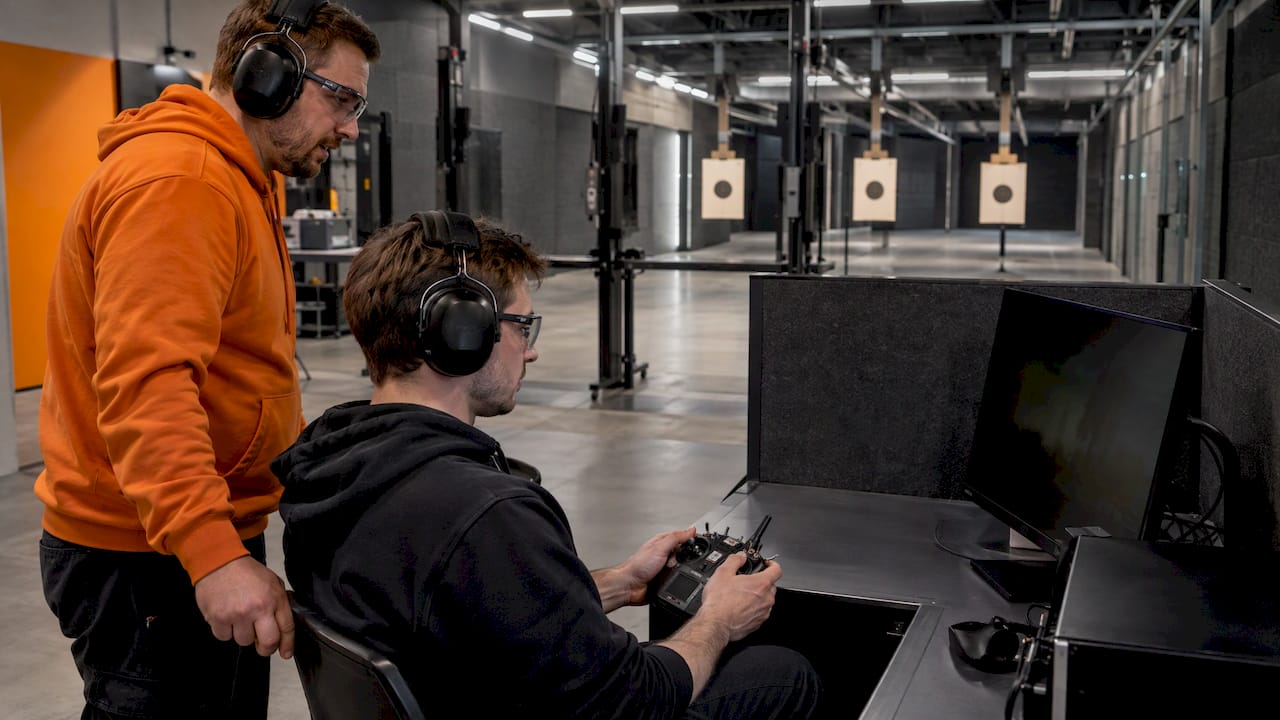
Beginner practicing FPV controls on a simulator

Where it goes wrong: beginners rush to speed. Spend the first sessions hovering, then flying slow squares, then figure eights. Gates and tricks come after that.

Step 2: Fly a small drone while looking at it

Once you can hover and land on the simulator without thinking, move to a small, light aircraft and fly it in line of sight. This follows the EASA order: direct view first, goggles second. You learn how a real drone drifts, how it reacts to your inputs and how the battery fades, without the extra load of the video feed.

Check the equipment before every flight, as the Aviation Academy advises: propellers undamaged and tight, battery charged and undamaged, radio connected, and the failsafe behavior understood.

Step 3: Put on the goggles, with a spotter

This is the moment FPV becomes FPV. Your sense of the drone’s position now comes from a small camera, and your awareness of your own surroundings drops. The Transport Administration notes that reduced direct awareness can delay a pilot’s reaction to hazards, including an approaching crewed aircraft.

That is why a visual observer is part of the setup. According to EASA, the observer stands beside you, watches the aircraft and the surrounding airspace, and speaks clearly so you can avoid a hazard or land. The guidance does not require a formal qualification for the observer, but they must know the rules. A friend who has read the same rules you have is a good choice.

Step 4: Build up to courses and racing

After the basics comes gate flying, tight turns, and finally lap times. Racing in Estonia has an organized scene, with the Drone Racing Team Estonia profile of a pilot who has competed in the Estonian Drone Racing League and in international events. Races are public events, so they run under a different regime from your practice flights, as explained below.

What equipment a beginner needs

A typical FPV starting setup has six parts:

  1. A radio controller, which you can first use with the simulator.
  2. An FPV drone.
  3. Goggles, or a screen, to see the video feed.
  4. Batteries and a compatible charger.
  5. Spare propellers and basic tools, since you will break propellers.
  6. A simulator.

Compatibility matters: radio, video system and aircraft must work together, so choose the radio and the drone as a pair, not as separate bargains. We do not quote prices for kit here because they change constantly and vary by shop; compare current offers when you are ready to buy.

This is also where trying before buying pays off. Our drone training lets you handle the controls and learn what you actually like before you commit to a controller and an aircraft.

The rules in Estonia, in plain language

Flying drones in Estonia is regulated by the Transport Administration (Transpordiamet), under EU rules. Visitors and residents follow the same rules. The points that matter to a beginner:

  • Registration. According to the Transport Administration’s drone page, operators of drones over 250 g must register. Operators of lighter drones must register if the drone has a camera, with some exceptions. FPV drones nearly always carry a camera.
  • Pilot competency. The same page says A1/A3 competency is mandatory for drones weighing 250 g or more. You get it by reading the official study materials and passing a multiple-choice test in the LOIS system.
  • FPV in the open category. The FPV page lists these conditions: an airspace observer, no flight over people, at least 150 m from populated areas, a maximum altitude of 120 m, no spectators, A3 compliance, and a pilot at least 16 years old.
  • Races with spectators. These fall into the specific category and need Transport Administration authorization. Competitions may be held only in designated areas.

The 150 m distance from populated areas is the one that surprises people. In Tallinn, most places a beginner would think of are inside or near built-up areas. Before any outdoor flight, check the map. Our pages on flying a drone in Tallinn, Estonian drone rules and the 120-meter limit and drone laws for residents and visitors walk through these checks. For safe habits, read drone safety rules in Estonia.

Rules can change, so confirm the current wording on the Transport Administration pages before you fly.

A simple first-month plan

Week Focus Where
1 Controls, hovering, soft landings Simulator
2 Slow squares, figure eights, yaw control Simulator
3 First real flights in direct view with an experienced pilot Supervised session
4 Goggles with an observer, simple lines and gates Supervised session

Treat this as a guide. If you are quick, move on; if hovering still wobbles, stay another week. The sequence matters more than the calendar.

Why a supervised session works for groups

Drone flying suits groups because everyone starts at the same level and the learning is visible. Someone clips a gate, someone else lands perfectly, and within an hour the room is talking. For companies this is a team exercise in communication: the pilot and the observer have to talk clearly, which is exactly what the safety guidance asks for.

If you are planning an evening for friends, a birthday or a bachelor party, it also pairs well with an indoor shooting experience at Tondi. Everything is indoors, supervised by professional instructors, and safety training is included. No experience is needed for either. Read about team building in Tallinn or the no-experience team event to see how a group day is put together.

For teams that want a security angle, we also describe drone training for security teams with indoor FPV tactics.

Book your first drone session at Tondi

Our initial drone training for companies, Esmane droonikoolitus ettevõttele, starts from €85 per person, and you can see it with our other group formats on the corporate events page. For the practical side of what the course covers, see drone operation training in Estonia and the event drone safety course for parties and teams.

If you would like to add shooting to the day, first-timers can start with My First Bang at €45, or Shooting Foreplay at €76. Both are on our gift card page, which also works if you are buying an experience for someone else. Our range is in Tallinn, it is indoors, and we have a wide selection of firearms.

Common beginner mistakes

  • Buying before learning. A controller and a simulator are the best first purchase, because the radio is the part that stays with you from aircraft to aircraft.
  • Skipping the observer. The goggles narrow your view. A second pair of eyes is part of the recommended setup, not an extra.
  • Flying near people. Open-category FPV does not allow flight over people, and you should keep well clear of anyone not involved in your flight.
  • Skipping the pre-flight check. Loose propellers and damaged batteries cause most avoidable failures.
  • Choosing a field by feel. Scout the site for obstacles and bystanders, as EASA recommends, and check the airspace map first.

FAQ

Is drone racing hard for a complete beginner?

It is harder than flying a camera drone, because you control the aircraft manually and see only through a video feed. The Estonian Aviation Academy describes FPV control as substantially more difficult than piloting common consumer camera drones. A simulator plus a supervised first flight makes the learning curve much gentler.

Do I need a license to fly an FPV drone in Estonia?

For drones weighing 250 g or more, A1/A3 pilot competency is mandatory, and you earn it by passing an online multiple-choice test. Registration is also required for drones over 250 g and for lighter drones with a camera, with some exceptions. Check the Transport Administration pages for the current rules.

Can tourists fly FPV drones in Estonia?

The same rules apply to visitors as to residents, including the observer, the height limit and the distance from populated areas. For a short stay, the simplest option is a supervised session indoors, where the setting is controlled. See our drone safety page for Estonia for the details.

Can I join a drone race right away?

Races with spectators need authorization from the Transport Administration and take place in designated areas, so they are organized events rather than something you set up yourself. Build your basics first, then look for local club or league events.

What should I practice first?

Start with hovering and landing on a simulator, then slow squares and figure eights. Add gates and speed only when the basics feel automatic.

Sources