Left Handed Shooting: Choose Your Shoulder With a 5 Shot Drill
- Mo-Su 10.00 – 20.00
- +372 555 85 416
- sale@laskmine.ee


The difference comes down to one question: what does the trigger do? In a single-action gun the trigger only releases a hammer that is already cocked. In a double-action gun one long pull both cocks the hammer and releases it. That is why double-action pulls feel longer and heavier, and single-action pulls feel short and light. You can read about it, but you understand it fastest with an instructor beside you. At our indoor range in Tallinn, first-timers can feel the difference themselves, no experience required, with professional instructors supervising every session.
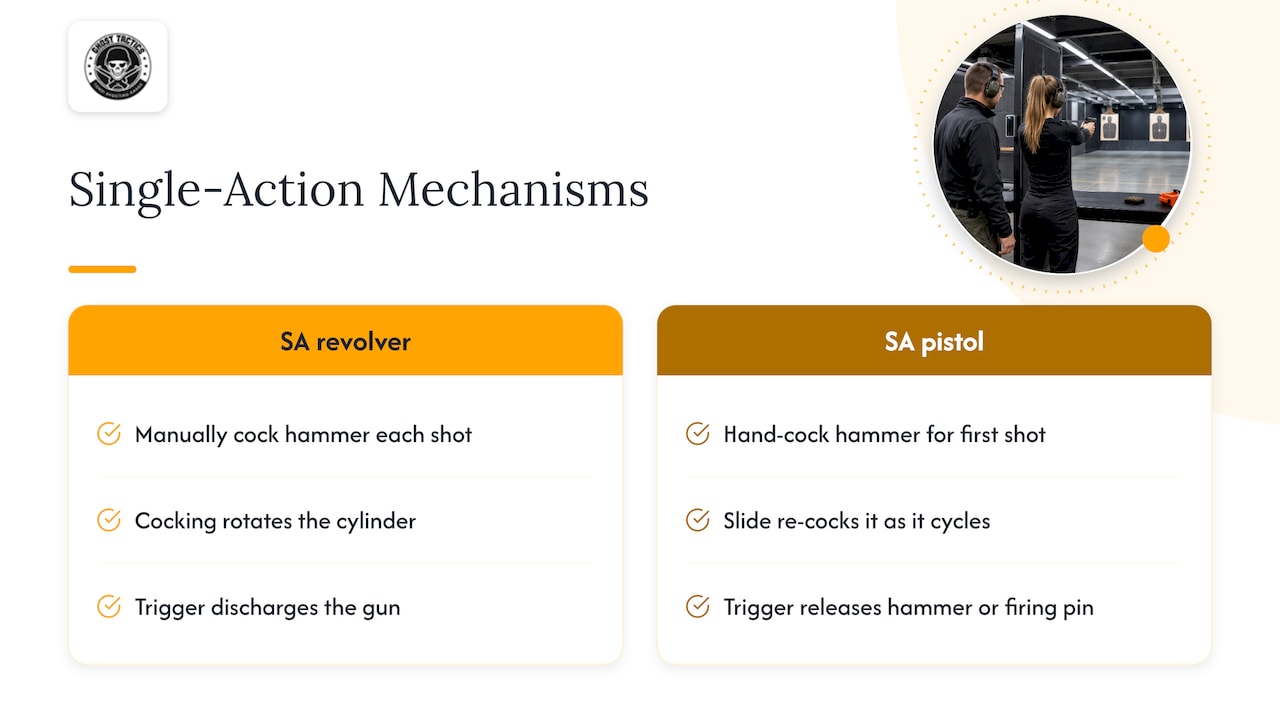
The name is literal: the trigger performs a single action. Glock’s pistol guide describes single-action as a trigger used only to release the hammer or firing pin, without cocking the mechanism.
On a classic revolver that means you thumb the hammer back before every shot. The NRA’s American Hunter explains that in a single-action revolver the hammer must be cocked manually to rotate the cylinder for each shot, and then the trigger discharges the gun. Think of a Colt Single Action Army or a Ruger Blackhawk, the guns you see in Westerns.
In a semi-automatic pistol, a single-action design such as the Colt Government model has its hammer cocked by hand for the first shot. After that, the slide re-cocks it as it cycles.
The work of cocking has already been done, so the trigger only has to let go. According to the NRA Shooting Sports Journal, a revolver in single-action mode releases after a very short pull at only 2 or 3 pounds. For a beginner this often means easier aiming, because there is less force to disturb the sights.
In a double-action gun the trigger does two jobs. The same NRA source says that in a double-action revolver the cylinder rotation, cocking and firing all happen in one trigger pull. Examples include the Smith & Wesson Model 10 and the Ruger GP100.
The trade-off is effort. The Shooting Sports Journal puts a double-action revolver pull at roughly 8 to 15 pounds, long and heavy. The upside is readiness: you do not have to cock anything, so the gun can be fired by simply pulling the trigger.
Usually yes. Most double-action revolvers can also be cocked by hand to fire in single-action mode, as the American Hunter article notes. Some are built to work only in double-action, with a shrouded or spurless hammer, as the Shooting Sports Journal explains. Ruger’s LCR is one: its manual describes a hidden hammer that cannot be cocked by hand.
The terms come from revolvers, then got stretched to semi-automatics. The Rifleman Q&A sorts pistols into a few families:
| Type | First shot | Following shots | Example |
|---|---|---|---|
| Single-action | Hammer cocked by hand | Light, short | Colt Government |
| DA/SA | Long, heavy pull (or hand-cocked) | Light, short | Beretta 92FS/M9 |
| Double-action-only (DAO) | Long, heavy pull | Same long pull every time | SIG P226R |
| Striker-fired | Same pull every time | Same pull every time | Glock |
The National Institute of Justice’s firearms examiner training explains that after a double-action first shot, the firing cycle cocks the gun for each next shot, so the rest are single-action. Ruger’s P95 manual says the hammer may also be cocked by hand before the first shot for greater accuracy, with the finger kept off the trigger while doing so.
The practical lesson for new shooters: the first shot and the second shot feel different. Expect a heavy first pull, then a much lighter one.
Striker-fired pistols use an internal striker instead of an external hammer. Per the Rifleman Q&A, the pull is the same weight and length every time, closer to single-action in feel, and “striker-fired” is the more proper name than DAO. Our guide on striker vs hammer fired pistols goes deeper.
There is no single winner; it depends on what you want to feel.
Finger position helps with each. American Rifleman suggests the pad of the finger on the trigger for single-action, and the first joint for double-action, with a slow “one-thousand-one” pull to start. Our article on trigger control shows how to build that habit, and dry fire practice is how you rehearse it between visits.
Whichever action you hold, the four basic rules from Smith & Wesson’s safety manual apply: treat every firearm as loaded, keep it pointed in a safe direction, keep your finger outside the trigger guard until ready to fire, and be sure of your target and what is beyond it. More on these in our firearm safety rules.
A few points specific to the action:
At our range, safety training is included in every session, and instructors supervise from the first shot. For more, see our handgun safety guide for beginners.
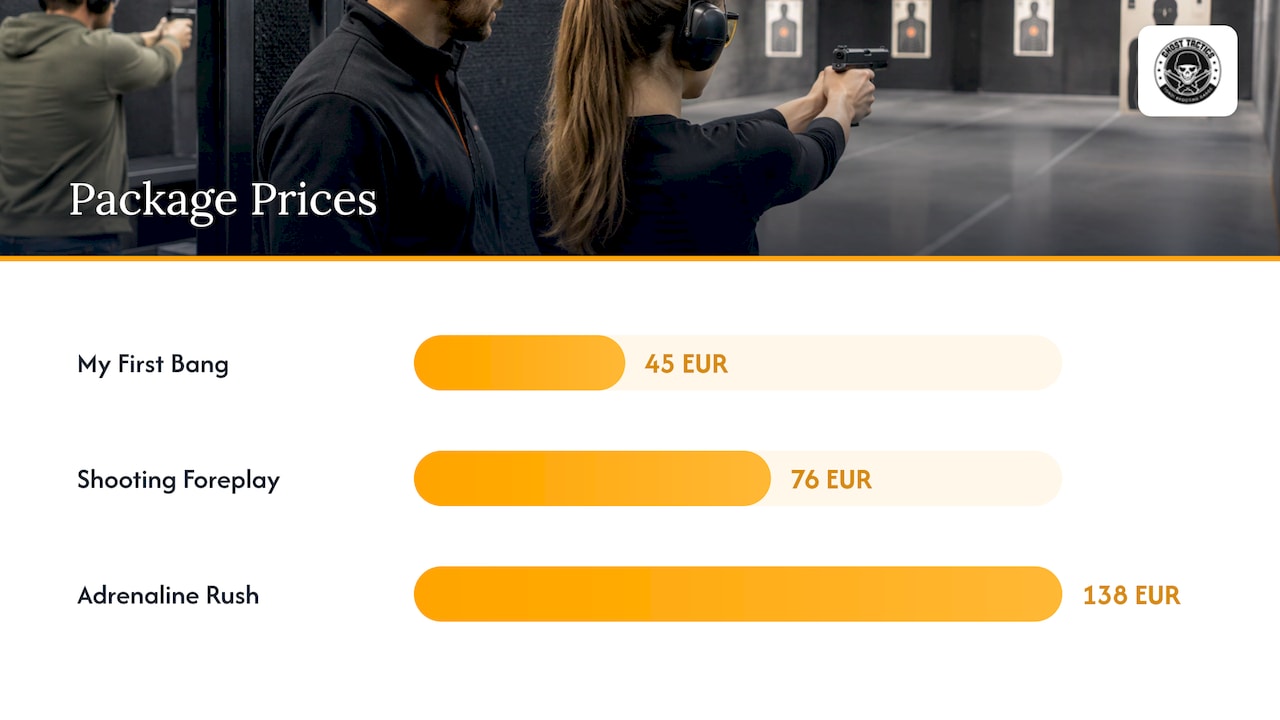
Reading about 3 pounds versus 12 pounds only gets you so far. Our indoor range in Tallinn offers a wide selection of firearms, so you can compare actions under supervision. The My First Bang package (listed as Minu esimene pauk, 45 EUR) is made for first-time shooters. Couples or friends who want more can look at Shooting Foreplay at 76 EUR, and the Adrenaline Rush at 138 EUR. All are also available as gift cards.
Groups are welcome too: birthdays, bachelor parties and corporate teams can see our team building options. Gun owners can find range rental and practice cards on our page for firearm owners.
Common beginner errors are covered in our handgun training mistakes article, and why professional instruction matters explains how coaching speeds this up.
Neither is better outright. Single action has a lighter, shorter pull that helps precision, while double action is simpler to operate because you only pull the trigger. With an instructor you can try both and decide which feels more natural.
In a single-action revolver you cock the hammer by hand before each shot, and the trigger only releases it. In a double-action revolver one trigger pull rotates the cylinder, cocks and fires. Most double-action revolvers can also be cocked by hand.
It means the first shot is fired double-action with a long, heavy pull, and the slide then cocks the hammer so later shots are single-action with a light pull. The change in feel between shots is the main thing to get used to.
It is its own category. The pull is the same every time and closer to single-action in feel, but the trigger alone readies and fires the gun, like a double-action-only revolver.
No. Sessions are for beginners too, run indoors in Tallinn, supervised by professional instructors, with safety training included.