Sniper Tikka T3X A1
- Mo-Su 10.00 – 20.00
- +372 555 85 416
- sale@laskmine.ee





Recoil control comes down to three things working together: a forward stance, a firm two-handed grip, and a trigger press followed through without flinching. Master that combination and felt recoil drops fast, even for someone who has never held a firearm.
Here’s what to do the moment you step up to the line for the first time:
Instructors at Mississippi State University Extension note that recoil anxiety fades quickly once shooters build a repeatable routine and get a few rounds of supervised feedback. It is a skill, not a personality trait.
Recoil control depends on a forward stance, a high two-handed grip or solid cheek weld, and a trigger press followed through without flinching, all of which improve fastest under direct instructor coaching.
| Point | Details |
|---|---|
| Stance comes first | Lean forward with weight on the balls of your feet so your body absorbs recoil instead of rocking back. |
| Grip and cheek weld matter most | A high, stacked-thumb pistol grip or a proper stock mount below the collarbone reduces felt recoil more than gun choice alone. |
| Flinch is diagnosable | Dummy-round drills reveal anticipation problems that dry-fire and slow live-fire progression can fix. |
| Start light, progress gradually | Reduced-recoil loads or heavier training firearms make a better starting point than jumping straight to a full-power cartridge. |
| Tondi Shooting Range fits beginners and groups | No experience is required, sessions are supervised indoors, and instructors split attention across group bookings like bachelor parties and corporate events. |
Show up prepared and the whole session goes toward learning tagasilöögi kontroll instead of hunting for gear or filling out forms at the counter. Bring a government-issued ID, closed-toe shoes, and clothing without a low or open collar, since hot brass can find its way in there. Tondi Shooting Range provides hearing and eye protection, so you do not need to own any before you arrive.
What to expect once you check in:
The range itself is indoor, climate-controlled, and set up so a first-timer and an experienced shooter can train side by side without either one feeling out of place.
Recoil is physics, not danger. When a firearm fires, the bullet gets pushed forward and the gun gets pushed back with equal momentum. The bullet is light and fast; the gun is heavier and slower, so the energy split is lopsided in the shooter’s favor. Physical analysis of small arms recoil shows the energy transferred to the firearm is typically a small fraction of the bullet’s own kinetic energy.
What actually changes how recoil feels:
Picture the shooter as a shock absorber sitting between the gun and the ground. A relaxed, well-positioned body soaks up energy the way a car’s suspension does over a bump. A stiff, poorly braced body just transmits the jolt straight through.
Good recoil control is built in a specific order, and skipping steps is exactly why most beginners flinch. Work through this sequence and you will feel the difference within your first magazine.
Three drills build this fast:
Your coachable checkpoint is simple: your sight picture should look the same the instant before recoil and the instant after it settles. If it does not, something in the grip or stance shifted mid-shot.
Pro Tip: Have your instructor call out “break” right before you’re expected to fire on a dummy-round drill. Hearing a verbal cue while not knowing if the round is live pulls your focus away from bracing for the bang and puts it back on your sight picture.
Pro Tip: Count your trigger press out loud during dry-fire, “one, two, press.” The rhythm slows down the jerk reflex that causes most beginner flinches.
You do not need months to get comfortable with recoil. One good supervised session plus a few weeks of light practice gets most beginners shooting confidently.
Session 1 (in-range):
Weeks 1 through 4:
For groups, tourists, bachelor parties, and corporate teams, instructors split attention across stations so everyone gets individual coaching without the whole group waiting on one shooter. One person might be running the dummy-round drill while another works dry-fire in a different bay, and the instructor rotates through both.
Track progress by watching your group size on target tighten and by noticing whether you still flinch on dummy rounds. When both improve, that is your cue to book a follow-up practice session and try a slightly heavier caliber.
The gun and load you pick matter as much as your technique, especially on your first visit. Heavier firearms soak up recoil impulse better than lightweight ones firing the same round, and reduced-recoil or .22-caliber loads are a smart starting point for a first-timer or a nervous group member. Recommendations for beginners handling recoil consistently point to starting light and working up gradually rather than jumping straight to a full-power cartridge.
A few accessories help too:
Always confirm what accessories and attachments are permitted before you bring your own gear. Range staff can tell you in seconds whether something is allowed, and it saves you from showing up with equipment you cannot use that day.
An instructor’s job is not just supervision. It is active coaching that catches the small mistakes you cannot feel yourself making. That means checking your grip before the first shot, adjusting your stance mid-drill, and calling out corrections the moment something drifts, rather than waiting until the end of the magazine.
Mental-game coaching matters just as much as the physical fixes. Instructors use dry-fire confidence drills, dummy-round exercises, and a gradual step up through calibers so a shooter builds comfort instead of dread. Many report that recoil anxiety is mostly mental, and repetition under supervision is what breaks the cycle.
No experience is required to book a session. Every visit at Tondi Shooting Range follows the “Õpi, korda, kinnita” cycle, learn, repeat, confirm, with an instructor walking alongside every step.
That structure is why first-timers, tourists, and entire corporate groups can shoot safely on the same afternoon without anyone feeling rushed or out of their depth.
Recoil itself is not regulated, but how you handle a firearm while managing it is. A flinch or an unexpected muzzle dip during recoil recovery is a safety issue the moment the muzzle sweeps toward anything other than the target, and that is treated seriously at any supervised range. This is why instructors watch muzzle direction as closely as grip and stance, especially with beginners still adjusting to a firearm’s kick.
Attaching aftermarket recoil-reduction devices, muzzle brakes, or compensators to a rented or personal firearm is subject to range policy and, in some cases, firearm-specific legal restrictions depending on the device and caliber. Never assume a modification is allowed just because you have seen it elsewhere. Always ask range staff first.
Group settings raise their own considerations. A bachelor party or corporate team on the line at the same time needs consistent spacing, clear command discipline, and an instructor-to-shooter ratio that keeps every position supervised, particularly for shooters managing recoil for the first time and prone to an unpredictable step back or a raised muzzle. This is one reason group bookings at a professionally run indoor range work better than an improvised outdoor setup: the lanes, backstops, and staffing are already built around exactly this risk.
Anyone shooting for the first time should treat instructor direction as final, not a suggestion. If an instructor tells you to stop, adjust your grip, or slow down, that call overrides whatever pace you had planned for yourself. That deference is what keeps recoil management sessions safe for beginners and experienced shooters sharing the same range.
Not every recoil-control technique applies equally across firearm types, and understanding why helps you set the right expectations before your session. A .22 pistol and a 12-gauge shotgun both “kick,” but the impulse shape, duration, and where the shock lands on your body are completely different.
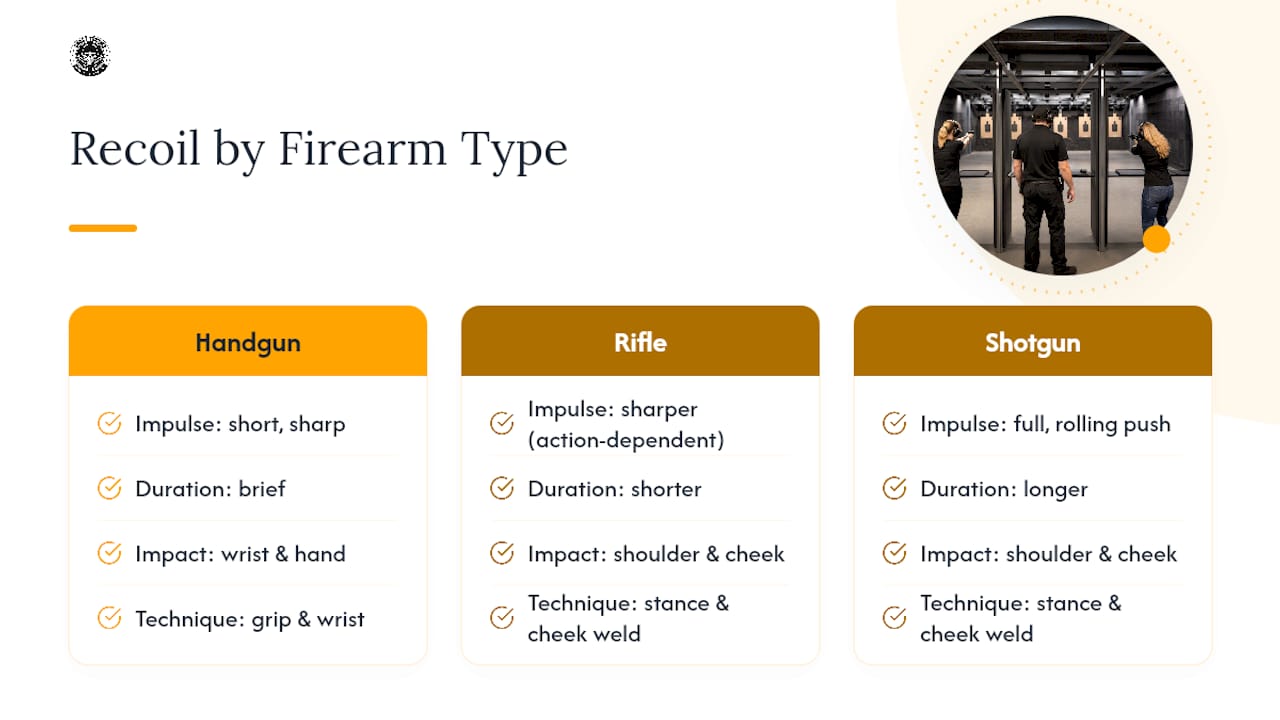
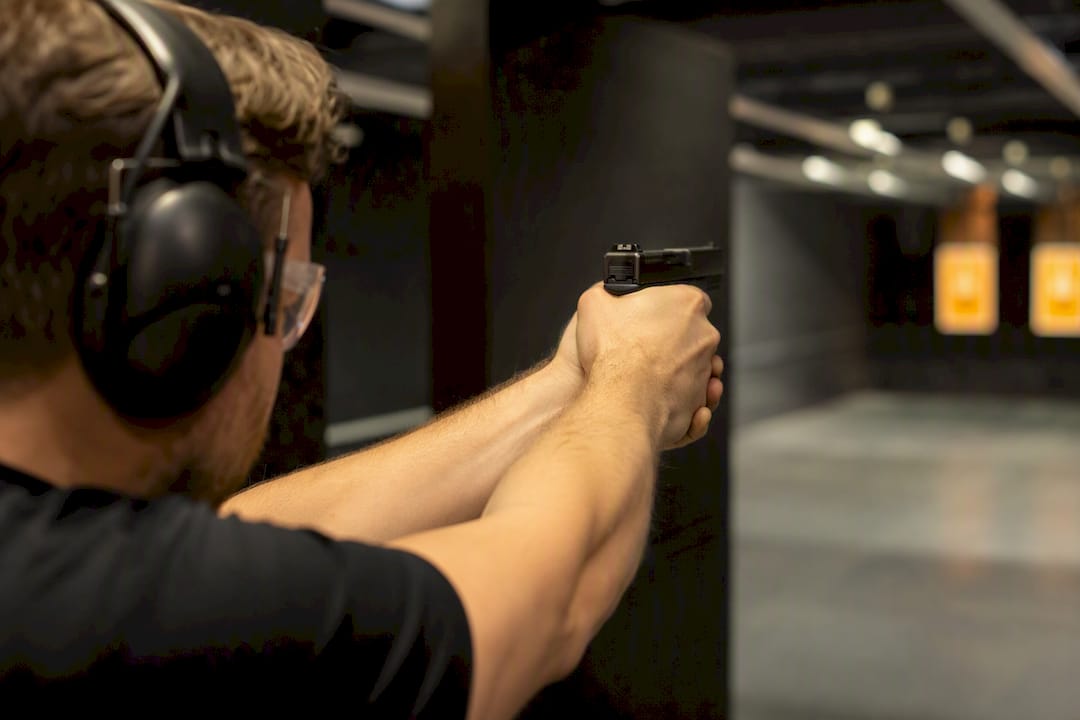
Handguns transmit recoil mostly through the wrist and hand, so grip technique, high hold, stacked thumbs, firm wrist, does most of the work. Heavier-caliber pistols amplify any grip weakness fast, which is why instructors usually start beginners on lighter calibers before moving to anything with more punch.
Rifles and shotguns push recoil into the shoulder and cheek instead, which shifts the technique priority toward stance and cheek weld rather than grip alone. A shotgun’s recoil impulse tends to feel like a fuller, rolling push, while a rifle’s can feel sharper depending on the action type. Semi-automatic actions in both categories usually feel softer than fixed-breech designs firing the same round, since some recoil energy goes into cycling the mechanism instead of the shooter’s shoulder.
This is exactly why instructor-guided caliber selection matters so much for a first-timer. What feels manageable on a heavier .22 rifle might feel jarring on a lightweight handgun in a stronger caliber, even though the two produce a similar physical impulse. Letting an instructor match your first firearm to your frame, grip strength, and comfort level solves most of the anxiety before it starts.
Reading about stance and grip only gets you so far. The fastest way to actually feel the difference is a supervised session where an instructor watches your first shots and corrects your form in real time, which is exactly what Tondi Shooting Range is built for. No experience is required, every session includes a full safety briefing, and the indoor range means weather never cancels your plans.

Whether you are booking a solo visit, planning a bachelor party, or organizing a corporate team-building event, instructors split their attention across shooters so nobody stands around waiting for coaching. Tondi Shooting Range offers a wide selection of firearms, so you can start on a lower-recoil option and work up only when your fundamentals are solid, no pressure to jump straight to something intimidating on day one.
Check available times and book your first supervised session on the shooting range booking page, or start with the beginner’s guide if you want to know exactly what your first hour on the range will look like.
A few resources round out what this guide covers if you want to practice specific pieces before your session. The trigger control guide breaks down the press-and-follow-through motion in more depth, and the dry-fire practice guide gives you drills to run at home between range visits.
If shoulder soreness after a longer session is a concern, especially for group events with multiple rounds fired, active recovery techniques built for athletes translate well to post-range mobility work.
For booking details, instructor availability, and course dates, the shooting range page is the fastest path to confirming a time slot.
No. Every session at Tondi Shooting Range starts with a full safety briefing and instructor-led dry-fire warmup, so first-timers are the norm, not the exception.
A lighter firearm accelerates more from the same recoil impulse, and a pistol’s grip transmits that shock straight into your wrist instead of spreading it across your shoulder like a rifle stock does.
Most beginners feel a real difference within their first supervised session, and a consistent four-week practice plan combining dry-fire and weekly live-fire builds lasting confidence.
Range policy governs what attachments and personal firearms are allowed, so always confirm with staff before your visit rather than assuming.
Yes. Handgun recoil control relies mostly on grip technique, while shotguns and rifles depend more on stance and a consistent cheek weld against the stock.