Cover vs Concealment: The Difference and Why It Matters
- Mo-Su 10.00 – 20.00
- +372 555 85 416
- sale@laskmine.ee


Moving target shooting is the skill of hitting something that will not be where it is now by the time your shot arrives. You solve that with a stable fundamentals first (stance, sight picture, trigger control) and then add one of a few lead methods. The fastest way to get there is to learn the basics under a professional instructor on an indoor range, and at Tondi Shooting Range in Tallinn you can do that with no experience at all, with every session supervised and safety training included.
This guide explains the three lead methods, what speed, direction and distance change, the mistakes that cause most misses, and how a first-timer, a visiting tourist or a group of friends can build toward this skill safely.
With a stationary target you only need to line up the sights and release the shot cleanly. With a moving one you add a second job: judging speed and direction, then deciding where to point. The NRA’s journal Shooting Illustrated states plainly that a stationary target is always easier to hit than a moving target, and that the time element, whether a par time in competition or the urgency of a real threat, is what sets moving-target shooting apart.
In practice, that means three things change:
The NRA Blog breaks the process into seeing the target, reacting, identifying its path, establishing the lead, getting a sight picture and following through. Each step can fail, which is why beginners are better off learning them one at a time rather than all at once.
Coaches use different names, but the same handful of ideas appear in almost every guide. The NRA Blog lists sustained, pass-through (also called swing-through), pull-away and intercept leads. The three below are the ones most beginners meet first.
You point ahead of the target and keep the muzzle moving along the same path at the same speed, holding that gap as you fire. It is smooth and consistent, but you have to judge the size of the gap by eye, and that judgment improves only with repetition.
You start behind the target, swing faster than it moves, pass it and fire as the sights move ahead. The lead comes from your own speed rather than from a measured gap. Many people find this more intuitive because you are tracking the target the whole time. The risk is slowing down at the moment of the shot.
You place the muzzle at a spot on the target’s path, wait for it to arrive and fire as it reaches that spot. The NRA Blog quotes Brett Simon, an NRA training coordinator and former national trap and skeet champion, explaining that this lead, used in practical pistol and 3-gun sports, works because you aim at a predictable point and fire as the target appears. It is a different logic from shotgun leads, where the barrel travels with the bird.
| Method | What you do | Best suited to | Main risk |
|---|---|---|---|
| Sustained lead | Move ahead of the target and hold the gap | Steady, predictable paths | Misjudging the gap |
| Swing-through | Start behind, pass the target, fire | Targets that cross at moderate speed | Slowing the swing at the shot |
| Intercept | Wait at a point on the path, fire on arrival | Targets with a known route or appearance point | Waiting too long or too short |
These three variables decide how much lead you need. The research for this topic had no single authoritative table of lead values, and for good reason: the right amount depends on the firearm, the ammunition, the distance and your reaction time. So treat the points below as principles, not numbers to memorize.
A simple rule of thumb for a beginner: start with slow, close, crossing targets, and increase only one variable at a time. If you change speed and distance together, you will not know which one caused the miss.
Follow-through means continuing to move the muzzle along the target’s path after the shot. The NRA Family article explains that coaches teach an exaggerated follow-through because the recoil reflex makes shooters flinch or stop the swing at the instant of firing. When that happens, the shot lands behind the target even though the lead was right.
The same article notes that reactive targets can help build follow-through because you see the target respond, and that top coaches stress keeping your eyes and mind on the target rather than on the barrel.
You can build the habit in three steps:
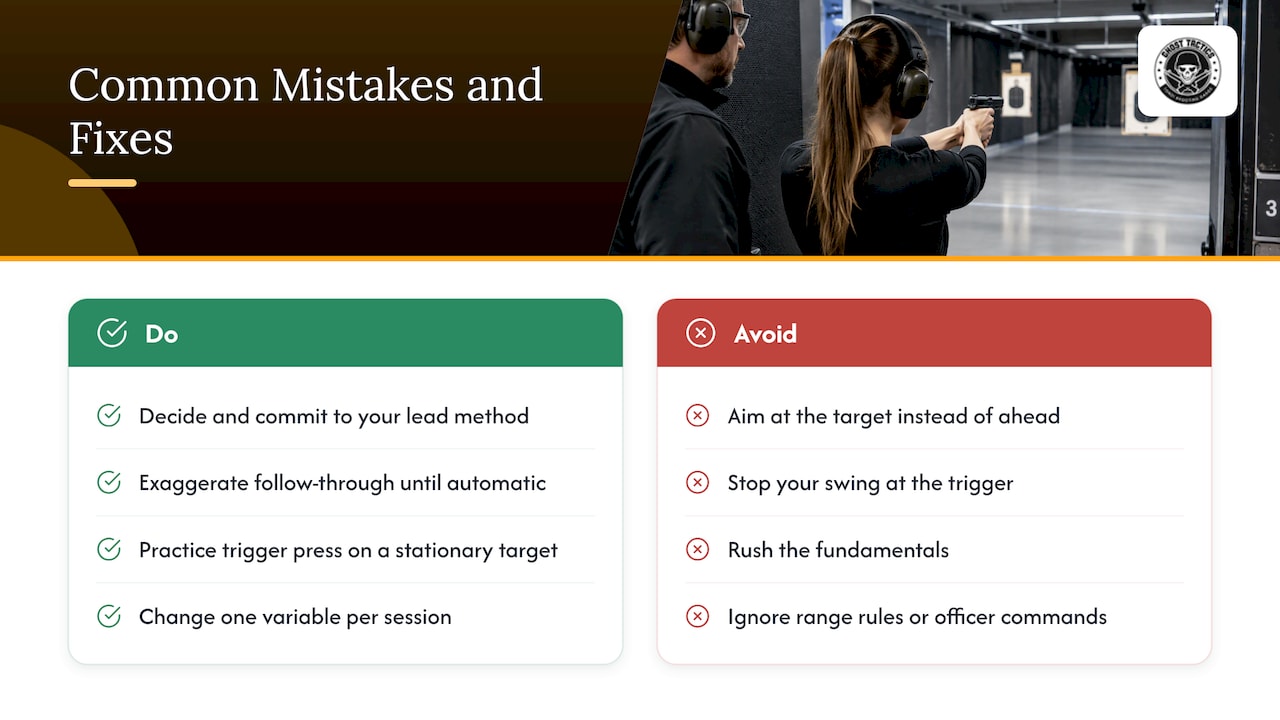
Aiming at the target instead of ahead of it. The shot lands behind. Fix: decide your lead method before you start and commit to it.
Stopping the swing at the trigger. See above. Fix: exaggerate the follow-through until it becomes automatic.
Rushing the fundamentals. Moving targets tempt you to hurry, but a jerked trigger pull ruins the shot whatever your lead. Fix: practice a clean trigger press on a stationary target first. Our pistol shooting basics guide covers grip, stance and sight alignment.
Changing too much at once. New speed, new distance, new method: nothing improves. Fix: change one variable per session.
Ignoring the range rules. Moving-target drills often involve faster movement and more attention on the target, which makes strict muzzle discipline more important. Follow your range officer’s commands exactly.
Moving-target practice does not change the basic rules: the muzzle stays pointed down range, your finger stays off the trigger until you are ready to fire, and you shoot only when the instructor says so.
Estonian law sets the framework. The Weapons Act defines a shooting range as a permanently used structure, room or territory for shooting competitions or practice, and requires that it be sited and equipped so that users and the surroundings are safe and outsiders and animals are kept out of the firing area. Safety requirements, internal rules and the name of the person responsible for shooting must be posted in a visible place. Detailed safety requirements are set by a regulation of the Minister of the Interior, which, for example, requires a backstop at least 4.4 m high for pistol or revolver shooting up to 25 m and for rifles within the stated distances.
What this means for you as a visitor: read the posted rules, follow the person responsible for the shooting, and never handle a firearm without supervision. Our pages on range rules for Tallinn visitors and range etiquette for first-timers take about ten minutes to read and make your first visit smoother. If you are wondering what to bring, most gear is provided.
Some of the training can happen away from live fire. The Estonian Weapons Owners’ Association describes virtual “smokeless” range practice in which a target’s size, speed and direction can be set, and where a target can switch to a no-shoot mark you must not fire at. It also describes IPSC-style courses with moving targets, falling metal targets and timed scoring. The point: reading the target and deciding when to fire are skills you can rehearse without a live round.
At home, dry fire practice builds the trigger control and smooth movement that every lead method depends on. Dry fire with an unloaded firearm applies only to owners with the legal right to have one, and for everyone else the first live step belongs on a supervised range.
Before you worry about leads, you need a steady hold, a clean trigger press and confidence around the firearm. That is what a first session is for.
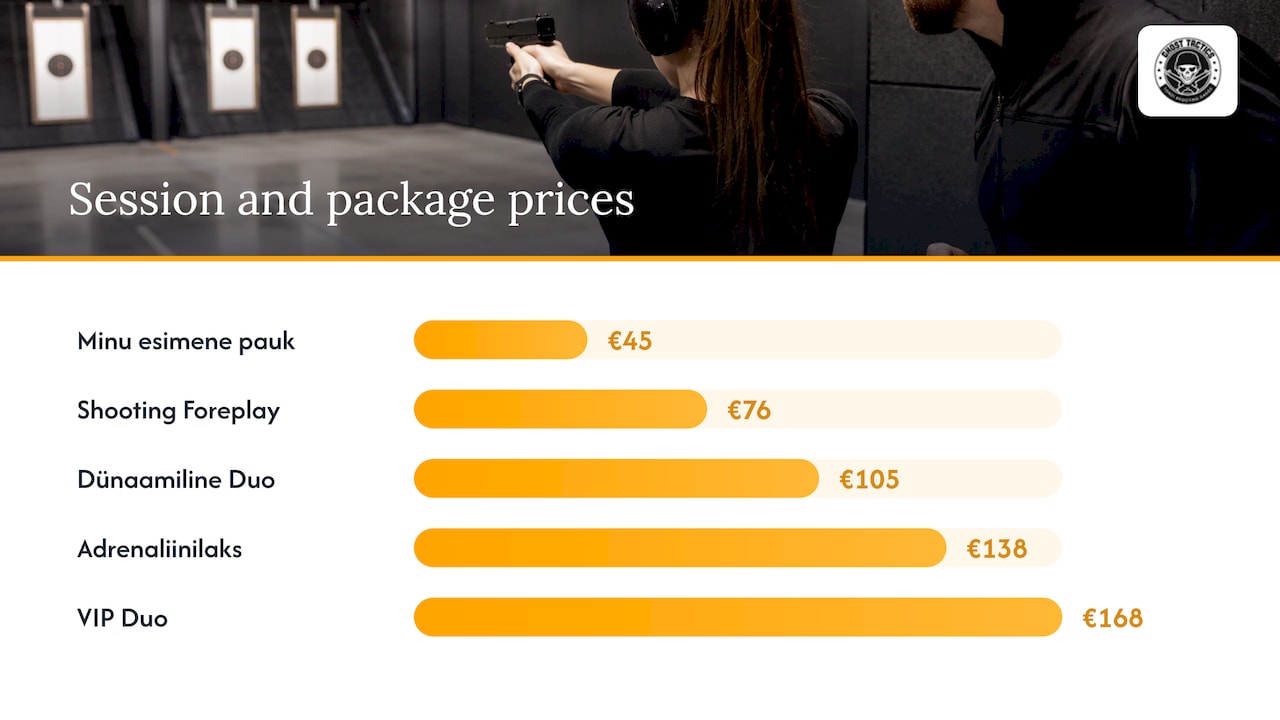
Tondi Shooting Range is an indoor range in Tallinn, billed as the largest shooting range in the Baltic region. You need no experience, all sessions are supervised by professional instructors, safety training is included, and there is a wide selection of firearms to try. For a first visit, Minu esimene pauk costs €45. If you want something bigger for a couple or a few friends, the same page lists packages such as Shooting Foreplay at €76, Dünaamiline Duo at €105, Adrenaliinilaks at €138 and VIP Duo at €168. They are also sold as gift cards, which suits a birthday or a surprise for a visitor.
If you already own a firearm and hold a permit, range rental and 10x and 20x cards are available: the 10x card costs €150 and the 20x card €200, and there is a handling course for €175.
We will help you choose a package that fits your group and your goals.
Shooting at a target that tests your timing and focus makes a good group activity, because everyone starts from the same level and each person’s progress is visible. The shooting events page lists bachelor party packages from €25 per person, a “build your own” colleague package from €25 per person and the Turvaline ettevõte program from €80 per person. If you plan a company outing, see our guides on team building at a shooting range and what a corporate team event costs. Planners can also review the safety rules for corporate events in advance.
For Estonia-based competitors, the national structure is worth knowing. The Estonian Weapons Owners’ Association explains that sport shooting is promoted by the Estonian Shooting Federation under the ISSF and covers many disciplines. The Federation’s development plan records Heili Lepp’s two third places in air-rifle moving-target events at the 2022 European Championships, which shows that moving-target disciplines are part of the Estonian sport scene. If you want to compete someday, our competition preparation guide is a useful next step.
Yes. A stationary target is always easier to hit, because movement adds a time element you must judge. Start with the fundamentals on a stationary target, then add movement slowly.
No. At Tondi Shooting Range no experience is required, sessions are supervised by professional instructors and safety training is included. The range is indoors, so weather does not affect your visit.
Most beginners find swing-through or sustained lead intuitive, because you track the target throughout. Intercept suits targets with a predictable path. Pick one method and stay with it for a few sessions so you can tell what works.
The Minu esimene pauk package costs €45. Larger packages for couples and groups are listed on our gift card and package page, and group event prices start at €25 per person.
Yes. Tondi Shooting Range welcomes tourists in Tallinn, and the packages are available as bookings or gift cards. Read the visitor checklist before you go.