Shooting Competition Preparation in Estonia: 2026 Guide
- Mo-Su 10.00 – 20.00
- +372 555 85 416
- sale@laskmine.ee


NRR and SNR both tell you how many decibels a pair of earmuffs or earplugs takes off the noise, measured in a laboratory. NRR (Noise Reduction Rating) is the American figure. SNR (Single Number Rating) is the European one. The two come from different test methods, so the same product usually shows a higher SNR than NRR, and you should not compare the two numbers directly. If you are in Estonia, Finland, Sweden, Denmark or the UK, the SNR on the label is the one built for your market. If you also want to know what protection means at a shooting range, read on: that is where these numbers matter most.
We run Tondi Lasketiir, an indoor shooting range in Tallinn, so we think about noise every day. This guide explains the two ratings in plain words, shows why they differ, and gives you a simple way to read a label that lists both.
Every hearing protector is tested in a lab to see how much sound it blocks. The result is boiled down to a single number so shoppers can compare products quickly. Two systems do this.
SNR stands for Single Number Rating. It is the European figure under the EN 352 product standard and is calculated following ISO 4869-2. It usually appears together with three more values, H, M and L, which describe the protection at high, medium and low frequencies. The EN 352-2 standard text defines SNR and H, M, L in exactly this way and requires the measured attenuation to be declared so users can choose suitable protectors.
NRR stands for Noise Reduction Rating. It is the US figure, required on US labels under EPA rules and measured to the ANSI S3.19 method. You will see it on products sold in North America and, increasingly, on packaging made for both markets.
Both numbers are in decibels (dB), the unit for sound level. Both say the same thing in principle: a bigger number means the protector reduces more noise in the lab.
The gap is not a marketing trick. It comes from how each number is calculated.
According to Bay Shore Safety’s guide:
The NRR method is more cautious, so its number comes out lower. The same guide notes the same plug typically shows an SNR 2–3 dB higher, with one banded earplug listed at NRR 24 and SNR 32. ACE PPE adds that the difference is systematic and that gaps of 6 dB or more are not uncommon, so the figures are not interchangeable.
| SNR | NRR | |
|---|---|---|
| Region | Europe (EN 352, ISO 4869) | United States (ANSI S3.19, EPA label) |
| Statistical margin | One standard deviation (about 84% of wearers) | Two standard deviations (about 98% of wearers) plus 3 dB |
| Fit in the test | Subject fit | Experimenter fit |
| Extra values | H, M, L frequency values | None |
| Typical result for the same product | Higher | Lower |
Not exactly. You will see rules of thumb online, such as “subtract 3 to 5 dB from the SNR”. They are only rough guides. The gap depends on the protector’s own attenuation curve, and a product that publishes only an SNR has no NRR at all.
So do not shop by arithmetic. Compare SNR with SNR, or NRR with NRR. If you are choosing between two products on a shelf in Tallinn, Helsinki, Stockholm, Copenhagen or London, compare the SNR values and the H, M, L values, because that is what the European standard declares.
In Estonia, the standard for earplugs is EVS-EN 352-2:2020+A1:2024, valid from 1 July 2024. It covers construction, design, performance, marking and user information, and refers to attenuation measured under EN ISO 4869-1:2018. The same national standards body lists EVS-EN 458:2025, guidance on selecting, using and maintaining hearing protectors, valid in Estonia from 31 December 2025.
The practical takeaway: in Europe the SNR with its H, M and L values is the number you are meant to use. NRR is a courtesy on dual-marked packaging for buyers who also sell or travel across the Atlantic.
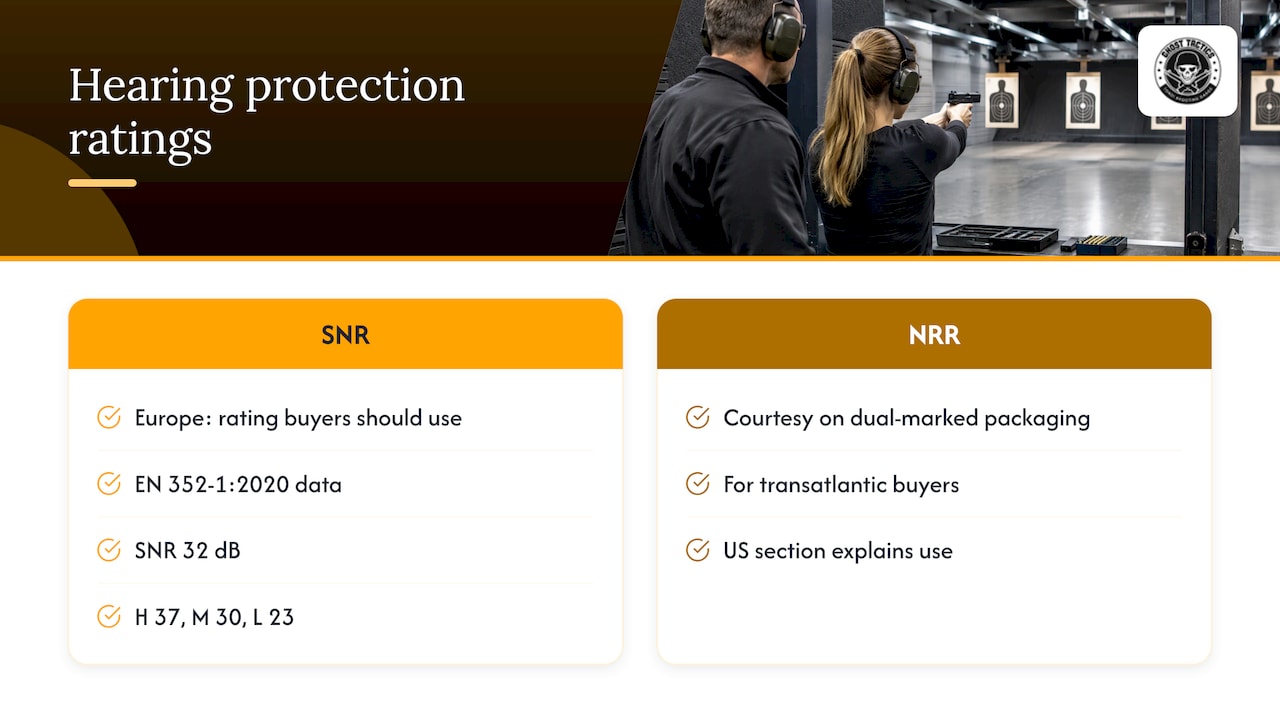
A real label shows how both sit side by side. One manufacturer’s 2025 earmuff manual lists the EN 352-1:2020 data as H 37, M 30, L 23 and SNR 32 dB, while its US section explains NRR use. Each figure comes from its own test. Dual marking is a convenience, not two separate claims.
Use this short routine when you pick up a box:
That last point matters at a range. The European Agency for Safety and Health at Work says attenuation depends on the protector and on the frequency of the noise, and that protection should suit the worst likely exposure without excessive attenuation. Moldex Europe makes the same point: insulation should be somewhat higher than strictly needed, but not so high that you cannot communicate or notice warnings. On a range, hearing your instructor clearly is part of safety.
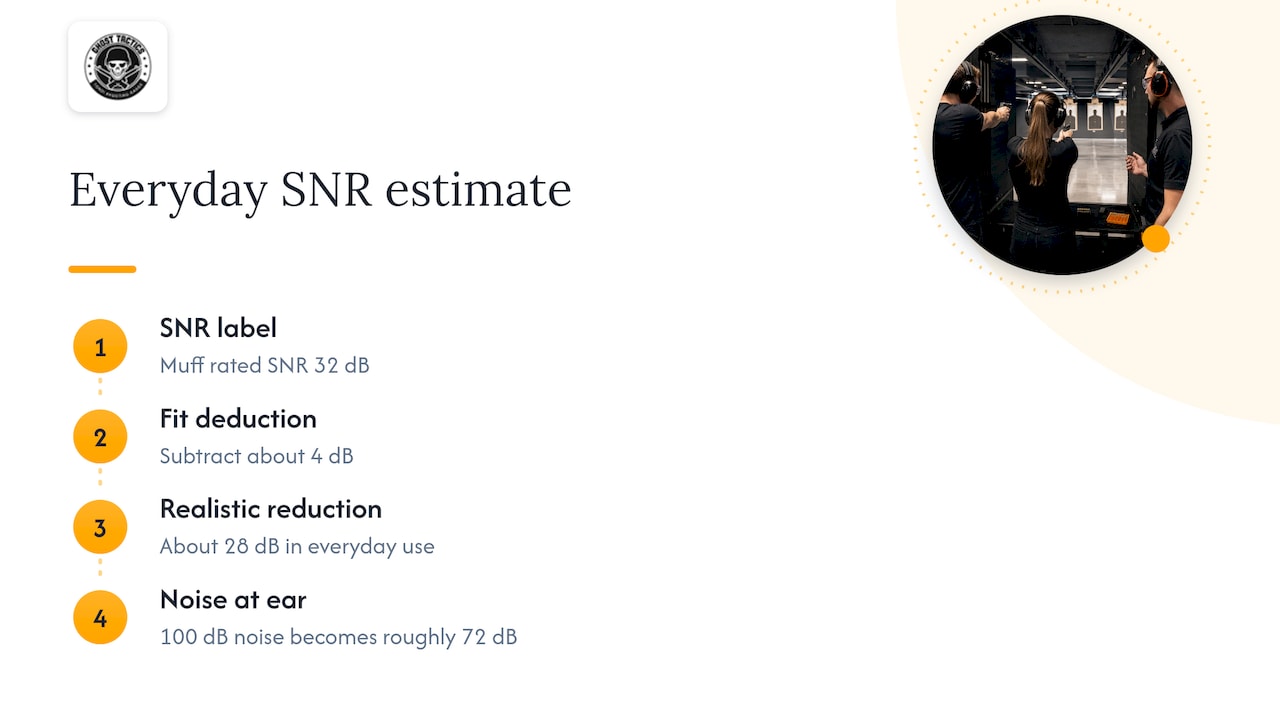
Laboratory ratings assume ideal fit. Real wearers rarely achieve it. Common derating practice is described in the ACE PPE guide: for NRR, subtract 7 and halve the result (an NRR of 33 becomes about 13 dB of realistic reduction), and for SNR, subtract about 4 dB for imperfect fit. Moldex notes that the UK Health and Safety Executive also suggests deducting 4 dB from the manufacturer’s predicted protection.
A worked example with SNR: a muff labeled SNR 32 gives you about 28 dB of reduction in everyday use after the 4 dB deduction. In a space where the noise reaches 100 dB, that brings the level at your ear to roughly 72 dB. This is a simplified illustration, not a measurement. The method the European agency describes uses the protector’s SNR and the measured C-weighted noise level, and the exact result depends on your noise.
The NRR is based on continuous noise. The same manual that prints both ratings warns that the NRR may not indicate protection against impulsive noise such as gunfire. The ISO standard behind SNR is similar: EVS-EN ISO 4869-2:2018 says its methods apply to steady noise and to noise with impulsive components, but may not suit peak sound-pressure measurements. For shooting, this means a rating is a starting point. Choose a protector made for shooting or loud impulse noise, wear it properly every time, and follow the briefing of the instructor on site.
If you are booking a corporate event, you may wonder how workplace noise rules relate. The EU noise-at-work directive, 2003/10/EC, sets a lower daily exposure action value of 80 dB(A), an upper action value of 85 dB(A) and an exposure limit of 87 dB(A). Protectors must be made available above the lower value and used at or above the upper value. For the limit value, the attenuation of the protector is taken into account. The European Commission’s summary puts it simply: workers must be given individual protectors, and wearing them is mandatory above the upper value.
These rules are about daily exposure at work across the EU. UK rules differ in detail, so UK readers should check the Health and Safety Executive’s own guidance for their employer duties.
Most people who search for this comparison are buying earmuffs for a hobby, a job or a trip. Visitors to Tallinn have a simpler situation: you do not need to master decibel math to enjoy a first session.
At Tondi Lasketiir:
If you want to understand who keeps a range safe, read about the range safety officer’s role in Estonia.
If you own a firearm and want to train regularly, the numbers in this article are the ones to know when choosing your own protectors. Compare SNR to SNR, check the H, M and L values against the kind of shooting you do, and make sure the fit is good. Our range rental and multi-visit cards are made for owners: lane rental is €125 per person, a 10x card is €150 and a 20x card is €200. For a breakdown of what a visit costs, see shooting range prices in Estonia.
For a bachelor party, a birthday, a date or a team day, the easiest start is our single first-shot package, Minu esimene pauk, at €45. Couples, friends and gift buyers can look through all packages and gift cards on our gift cards and experiences page. Companies can plan an event with us through our group events page, and our team building in Tallinn guide shows how a shooting range works for teams.
Neither is better. They measure the same thing with different methods, and NRR is the more cautious calculation. Use the one for your market: SNR in Europe, NRR in the United States.
No. For the same product, the SNR is typically 2–3 dB higher than the NRR, and sometimes more. There is no official conversion, so compare like with like.
You do not need experience or any special knowledge to book. Sessions are supervised by professional instructors and safety training is included, so you will be told how to handle everything before you shoot. If you have questions about equipment, ask when you book.
Not completely. The NRR is based on continuous noise and may not indicate protection against impulsive noise such as gunfire. Pick a protector meant for loud impulse noise, fit it carefully and follow instructor guidance.
They are the declared attenuation values for high, medium and low frequency noise under EN 352. Together with the SNR, they let you match a protector to the kind of noise you face.