Ensikertalaisen jännitys ammunnassa: näin rauhoitut radalla
- Mo-Su 10.00 – 20.00
- +372 555 85 416
- sale@laskmine.ee


Situational awareness is a skill, and you build it the way you build any other skill: by learning its three parts, practising them in short repeated sessions, and then testing them under mild, controlled pressure. Reading about it helps. Doing it with a task that demands your full attention, such as a supervised shooting session with an instructor beside you, helps more. This guide explains the idea in plain words, gives you exercises you can start today, shows how teams and employers use the training, and describes how we run it at Tondi Lasketiir, our indoor range in Tallinn, where no experience is needed.
The APA Dictionary of Psychology defines situational awareness as conscious knowledge of the immediate environment and the events occurring in it. It breaks the idea into three steps: perceiving the elements around you, comprehending what they mean and how they relate, and projecting their future state. The same entry notes that stress can influence it and that tunneling, where your attention narrows to one thing, can impair it.
The model most safety bodies use comes from researcher Mica Endsley. Australia’s aviation regulator describes three levels in its pilot human factors booklet: Level 1 is perception, Level 2 is understanding, and Level 3 is projection. Here is what each looks like outside a cockpit:
| Level | What it means | Everyday example |
|---|---|---|
| 1. Perception | Noticing the relevant cues | You see a bag left by a door and hear that the background noise has dropped |
| 2. Comprehension | Working out what the cues mean together | The bag has been there ten minutes and nobody is near it, so it is probably forgotten, not a threat |
| 3. Projection | Predicting what happens next | If this crowd leaves at once, this corridor will be blocked, so you note another exit |
The UK government’s Leading for safety guidance adds two more points to the chain: action and feedback. Awareness only matters if you act on it and then check whether the action worked. That is why good training is never just a lecture. You need to perceive, decide, act and review, again and again.
Most people do not lack awareness because they are careless. They lose it because the mind has limits. The same UK guidance says high-pressure or stressful situations can cause a loss of situational awareness. The Conversation’s overview of the research points to the same causes and cures: practice, fewer distractions, watching for fatigue and actively monitoring your surroundings.
Three habits do most of the work:
The same page gives a simple way to judge what deserves attention: risk is the probability of something happening multiplied by how severe it would be. A small chance of a minor problem is not worth your focus. A small chance of a serious one may be. This helps you avoid the opposite problem, which is seeing danger everywhere.
This is the section most readers come for. You do not need special equipment. You need repetition and honest review.
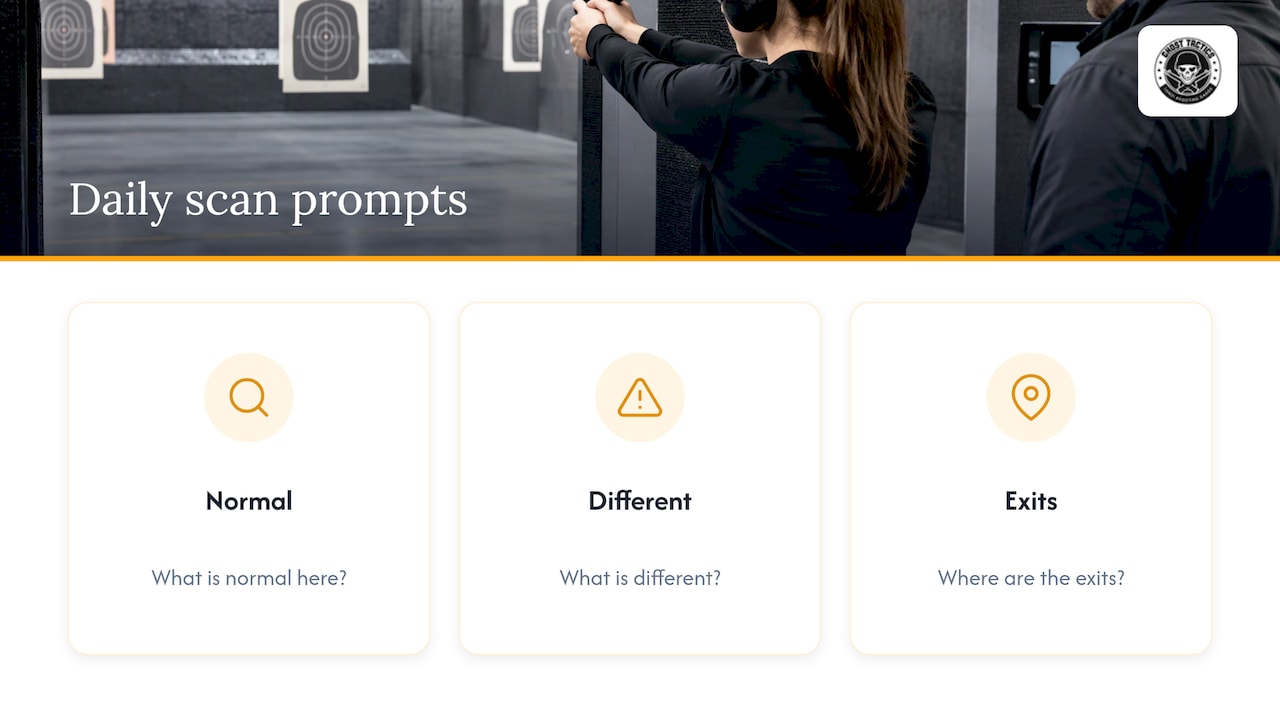
When you enter a room, a street or a venue, run through three questions: what is normal here, what is different, and where are the exits? Do it for the first week every day until it takes no effort. The goal is to build a baseline of normal sights and sounds, because you can only notice something unusual if you know what usual looks like. Pay attention to how long an odd thing lasts. A single loud noise is rarely meaningful. A pattern is.
In a café, hotel lobby or office, quietly ask what you would do if the lights went out or an alarm sounded. You are not predicting disaster. You are practising Level 3, projection. Aviation human-factors specialists describe this level as thinking ahead of the aircraft: building a mental model is an active, disciplined process, where you know what to look for, when and why.
After a walk, a meeting or an event, close your eyes and list what you saw: who was where, which doors you passed, what sounds you heard. Then check against reality the next time you visit. The gap between what you recalled and what was there shows you where your perception is weakest.
Three simple drills work well and are easy to repeat:
These are warm-ups for the habit, not the full skill. The full skill appears when you must keep scanning while doing something that needs concentration. That is where a structured, supervised activity beats a worksheet.
Our view at Tondi Lasketiir is that a controlled range combines the two things awareness needs: a task that holds your attention and clear rules that keep everyone safe. Handling a firearm demands focus on your hands, your target and the people near you. A range has strict procedures, a briefing, and an instructor watching the whole lane. In that setting, you practise noticing, following a routine and staying calm when your pulse rises a little.
This is also why our approach links shooting to mental well-being and security awareness. You learn to slow down, breathe and keep a clear head while the situation feels exciting. Our guide on mental focus in shooting covers how to stay calm and accurate, and the article on building awareness through tactical training explains the security side in more depth.
Everything starts with safety. Every session is supervised by professional instructors, and safety training is included before you handle anything. You do not need any previous experience. The range is indoors, so weather never changes your plans, and we have a wide selection of firearms so you can try different ones. If you want to know the rules every shooter follows, read our firearm safety rules explained.
If you want to prepare for your visit, our pistol shooting drills for beginners and shooting range warm-up drills show what the basics look like.
For employers, the question is how to make awareness a team habit and not a one-off slide deck. The UK guidance frames it as something leaders influence, because factors such as workload, pressure and communication shape what people notice. A few approaches show up repeatedly in practice.
The exercise creates the experience. The debrief creates the learning. Ask each person what they noticed, what they understood and what they expected next. Differences between answers are the lesson, because they show that two people in the same room were seeing different situations. Our article on security scenarios in team training explains how to design and debrief them, and workplace security awareness lists what to teach.
One well-known example is Kiken Yochi Training, a Japanese team activity where a group looks at a situation and predicts hazards before work starts. A 2017 safety conference presentation reported a 38% reduction in incidence rate, a 64% reduction in DART rate (days away, restricted or transferred) and a 98% reduction in lost work days in 2011 compared with 2010 at the organization it described. That is one company’s reported result, not a guarantee, but it shows the logic: teams that practise predicting problems together tend to see them earlier.
A 2020 randomized controlled trial in Frontiers in Psychiatry tested an intervention designed to raise situational awareness and a culture of mutual care among healthcare workers. The point for any employer is that awareness is partly social: people notice more when they feel responsible for each other.
Do not rely on a satisfaction survey. Track things you can count: how many risks or near misses staff report, how fast they report them, and whether a repeat exercise shows better recall and quicker decisions. Our guide to situational awareness at work lists what you can do right now without a budget.
At Tondi Lasketiir we host individuals, couples, friends and companies. These are the options most relevant to this topic, with the prices published on our site:
| Option | Who it suits | Price |
|---|---|---|
| Minu esimene pauk | First-time shooters who want a guided introduction | 45 EUR |
| Turvaline ettevõte | Companies building a safety and security awareness habit | from 80 EUR per person |
| Vali ise kolleegidele pakett | Teams that want to choose their own format | from 25 EUR per person |
| Esmane droonikoolitus ettevõttele | Teams that want to add drone operation | from 85 EUR per person |
The corporate shooting events page lists the team formats, and you can book a first shot or give one as a present through our gift cards. If you are planning a company event, our team event cost planner breaks down what to budget, and no experience needed: corporate team event explains how a first-timer group is guided from the first briefing.
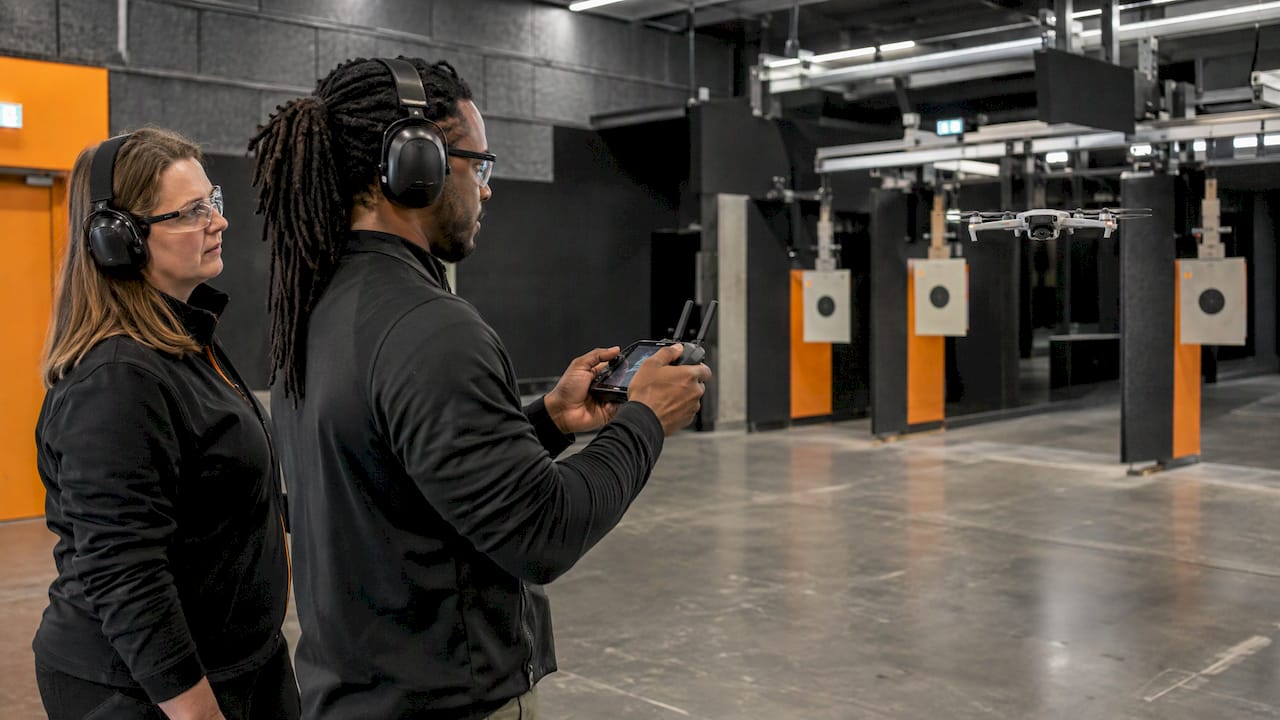
Flying a drone, especially a first-person-view one, forces you to hold two pictures at once: what the drone sees and what is happening around you in the room. It is a very direct lesson in tunneling. Our drone safety course lets parties and teams fly the same day, and the piece on drone training for security teams describes five indoor modules.
Tourists and visitors in Tallinn. If you are in the city for a few days, an indoor session is a self-contained activity that does not depend on the weather. Instructors supervise, safety training is included and you need no experience. Winter visitors can also read about indoor team ideas in Tallinn.
Couples and friends. Birthdays, bachelor and bachelorette parties and group trips suit a shared challenge where everyone is a beginner together. Packages such as Poissmeesteõhtu start from 25 EUR per person.
Corporate and team-building groups. Teams from Estonia, Finland, Sweden, Denmark and the UK visit for a shared experience that builds communication and trust. See why a shooting range works for team building in Tallinn and how our OSH-aligned corporate events are organized.
First-time shooters. You will not be handed a firearm and left alone. You get a briefing, safety training and an instructor at your side. If you want to know what to expect beforehand, read what a shooting course is.
Gun owners. If you already own a firearm, our range rental and 10x and 20x cards give you regular access. The gun owners page has the details, and our guide on common handgun training mistakes helps you get more from each visit.
One worry readers raise is that practising awareness will make them jumpy. It should do the opposite. Awareness is a way to spend less energy on worry, because you have a baseline and a method. If something is unusual, you check how long it lasts, assess its probability and severity, and then decide. If nothing needs action, you let it go.
A few guidelines keep the habit healthy:
This is the same rhythm you practise on a range: focus, check, act, release. It is why our instructors teach slow, calm routines first. Breathing matters too, and our breath control technique guide shows how it steadies your hands and your attention. If you want to go further into movement and accuracy later, see movement in shooting training and shooting accuracy improvement drills.
For week four, a first session at our range is a natural step. Pick a package or, for a group, ask about team formats. Come as you are, with no experience, and leave with a clearer sense of how you handle focus.
Most models use three levels: perception, comprehension and projection. The UK government guidance extends this to five key points by adding action and feedback, so you can count four or five elements depending on the source. In practice the order is the same: notice, understand, predict, act, and check the result.
Practise short daily scans, rehearse “what if” scenarios, reduce distractions and review what you noticed after an event. Then test the skill in an activity that needs concentration, such as a supervised session at our indoor range, where instructors guide you and safety training is included.
No. First-time shooters are welcome. Professional instructors supervise every session, safety training comes first, and the range is indoors. Minu esimene pauk costs 45 EUR and is designed as a guided introduction.
Yes. Shared exercises followed by a debrief build communication and a common picture of risk. Our Turvaline ettevõte format starts from 80 EUR per person, and Vali ise kolleegidele pakett starts from 25 EUR per person. Drone training for companies starts from 85 EUR per person.
Simple habits start to feel natural within a few weeks of daily practice. The gains last only if you keep reviewing, because awareness drops when you are tired, rushed or distracted.