Valentine’s Month at Tondi Shooting Range!
- Mo-Su 10.00 – 20.00
- +372 555 85 416
- sale@laskmine.ee


If you are new to shooting, book a supervised beginner slot on a weekday evening or weekend morning when instructors have more one-on-one time. If you are maintaining skills, pick quieter weekday mornings or reserve a private lane. If you are prepping for competition, book longer blocks close to your event date. Safety briefings and instructor supervision shape how early a first-timer can realistically start, so plan around those sessions first.
TL;DR:
- Beginners should book supervised 30 to 45 minute sessions on weekend mornings or weekday evenings, when instructors can cover safety fundamentals without rushing.
- Returning shooters should reserve 60 to 90 minutes during quiet weekday mornings or off peak evenings, and practice weekly or biweekly to maintain consistency.
- Competition shooters should book 90 minutes or more near event dates, using the first 15 to 20 minutes for warm ups before focused drills.
- Groups should book 2 to 3 weeks ahead and check the range calendar, since competitions, maintenance, and private events can remove lanes.
- Indoor ranges avoid weather and daylight disruptions, while outdoor facilities may close during storms or poor visibility, so verify conditions before traveling.
Not every visit to a shooting range serves the same purpose, and the right time to go depends almost entirely on what you are trying to get out of the session. A first-timer needs patience and instructor attention. A returning shooter needs consistency and quiet. A competition shooter needs intensity and realistic pressure. Matching your goal to the right slot changes the whole experience.
Beginners should prioritize safety instruction over convenience. The best slots for a first visit are ones where an instructor has time to walk through firearm handling, stance, grip, and the range commands before you ever load a round. Weekend mornings tend to work well because staff are fresh and the pace is unhurried, but weekday evenings right after work hours can be just as good if the range is not hosting a group event. The goal here is not speed. It is building a habit of safe handling that will carry into every future visit.
Returning or maintenance shooters already know the fundamentals and are usually practicing to keep a skill sharp rather than to learn something new. For this tier, quiet matters more than instructor availability. Weekday mornings, particularly outside lunch hours, and off-peak evenings before the after-work rush tend to have fewer people on the line, which means more uninterrupted repetitions. A weekly or biweekly rhythm works better than occasional long sessions because consistency builds muscle memory faster than intensity does.
Competition-focused shooters need a different approach entirely. Training close to an event date should mimic the pressure and pacing of the actual competition, which means booking longer blocks, sometimes 90 minutes or more, rather than short practice windows. A useful pattern is to separate warm-up time from focused training time within the same booking: the first 15 to 20 minutes for loosening up fundamentals, the rest for drills that match the discipline you are preparing for. Low-distraction windows, usually midweek, let you run drills without pausing for crowd noise or waiting for a lane.
A few trade-offs are worth weighing before you lock in a time:
Whichever tier you fall into, the underlying principle stays the same: match the energy of the time slot to the goal of the session. A loud, busy afternoon suits a celebration. A quiet weekday morning suits a serious practice block.
Booking ahead is the single biggest factor in landing the time slot you actually want, especially if you are coordinating a group or need a specific instructor.
Lead times vary by booking type. A single supervised beginner slot can often be arranged within a few days, but group or corporate events need more runway, generally 2 to 3 weeks to guarantee the date, lane count, and instructor coverage a larger group requires.
Range calendars are worth a close look before you commit to a date. Competitions and scheduled test shoots can block off lanes entirely, and some clubs post these dates publicly along with contact information for private bookings outside the main schedule, as seen in examples like competition date listings from other Estonian clubs. Maintenance closures are less predictable but usually posted in advance, so a quick check before finalizing travel plans or group logistics saves a wasted trip.
Cancellation and rescheduling policies also shape how flexible your timing can be. Booking a slot you are not fully committed to and then canceling last minute makes it harder for others, including instructors, to plan their day, so treat a confirmed booking as a firm commitment once it is made. If your plans shift, reaching out as early as possible to reschedule keeps the slot usable for someone else.
If you need a same-week or last-minute booking, midweek availability is almost always your best shot. Afternoons right after lunch and slots that avoid Friday evenings or weekend mornings tend to have more openings, since those are the times most people request first.
Good preparation before you arrive makes the actual session smoother, safer, and more useful, whether it is your first time or your fiftieth.
Paperwork and identification. Most ranges require a valid photo ID for every visitor, and if you plan to bring your own firearm rather than use range equipment, you will typically need to show the relevant firearm license or permit so staff can verify you are legally allowed to possess and handle it. First-timers using range-supplied firearms generally only need standard identification, since no license is required to try a supervised beginner session.
Clothing and protective equipment. Closed-toe shoes are standard, and clothing that is not overly loose around the neckline helps avoid hot brass catching where it shouldn’t. Eye and ear protection are typically provided on-site, but if you have prescription eyewear or prefer your own hearing protection, bringing it adds comfort without any downside.
Ammunition and firearm rules. Many visitors use range-supplied ammunition matched to the firearm they are renting, which avoids caliber mismatches and keeps things simple for a first visit. If you are bringing a personal firearm, caliber restrictions and permitted ammunition types are typically spelled out in range rules and regulatory guidance, so checking ahead prevents an awkward situation at check-in. Firearms should always be transported unloaded and secured, a rule that applies everywhere regardless of experience level.
At-home preparation. Dry-fire practice, meaning rehearsing grip, trigger press, and sight alignment without live ammunition, is one of the most useful things a first-timer or returning shooter can do before a booked session. A short routine the night before or morning of your visit helps build comfort with the motions so the live session focuses on refinement rather than basics. Our guide on dry-fire practice at home walks through simple exercises that translate directly to range time.
A quick pack-and-check list for the day of your visit:
Pro Tip: Arrive 10 to 15 minutes before your slot starts so the safety briefing and paperwork don’t eat into your actual shooting time.
Shooting ranges operate under strict safety frameworks that directly affect when and how sessions can run, and understanding the basics helps you avoid surprises around scheduling.
Core safety procedures exist to protect everyone on the line, and they shape how a session unfolds more than most visitors expect. The Laskeharjutuste läbiviimise ohutuseeskiri 2.0 outlines mandatory requirements for supervision, handling, and the conditions under which a live exercise must stop immediately, including a clear “STOP” command that halts all shooting the moment it is called. Outdoor or semi-outdoor ranges also follow specific lighting and visibility rules, and shooting during thunderstorms is commonly prohibited outright because of lightning risk.
Legal and technical constraints that shape timing:
Weather and daylight matter more for outdoor or semi-outdoor ranges than for fully indoor ones. An indoor range controls lighting and is shielded from wind, rain, and lightning, which means scheduling is rarely disrupted by seasonal conditions. Outdoor ranges, by contrast, can face closures during storms or reduced visibility, which is one reason an indoor setup offers more predictable year-round scheduling for anyone trying to plan around work or travel.
Statistic Callout: Technical requirements set by Riigi Teataja specify minimum safety berm heights and layout standards that every licensed range must meet, a baseline that directly shapes how and where shooting can safely take place.
Scheduled closures also affect availability beyond weather. Maintenance work, competitions, and private corporate bookings can take lanes offline for part or all of a day, and a government proposal reported in August 2026 aims to ease some requirements for opening smaller, low-use ranges in remote areas. Over time, that kind of change could reduce peak-time pressure at larger, busier ranges by giving shooters more locations to choose from.
A supervised shooting session follows a fairly predictable structure, and knowing the stages helps you choose a slot length that actually fits your goal.
Instructors gauge readiness throughout the session rather than at a single checkpoint. If a first-timer needs more guided repetition before moving to less supervised shooting, that extra time is built into the session rather than treated as a failure, and it’s one more reason beginner slots should never be booked back-to-back with something else.
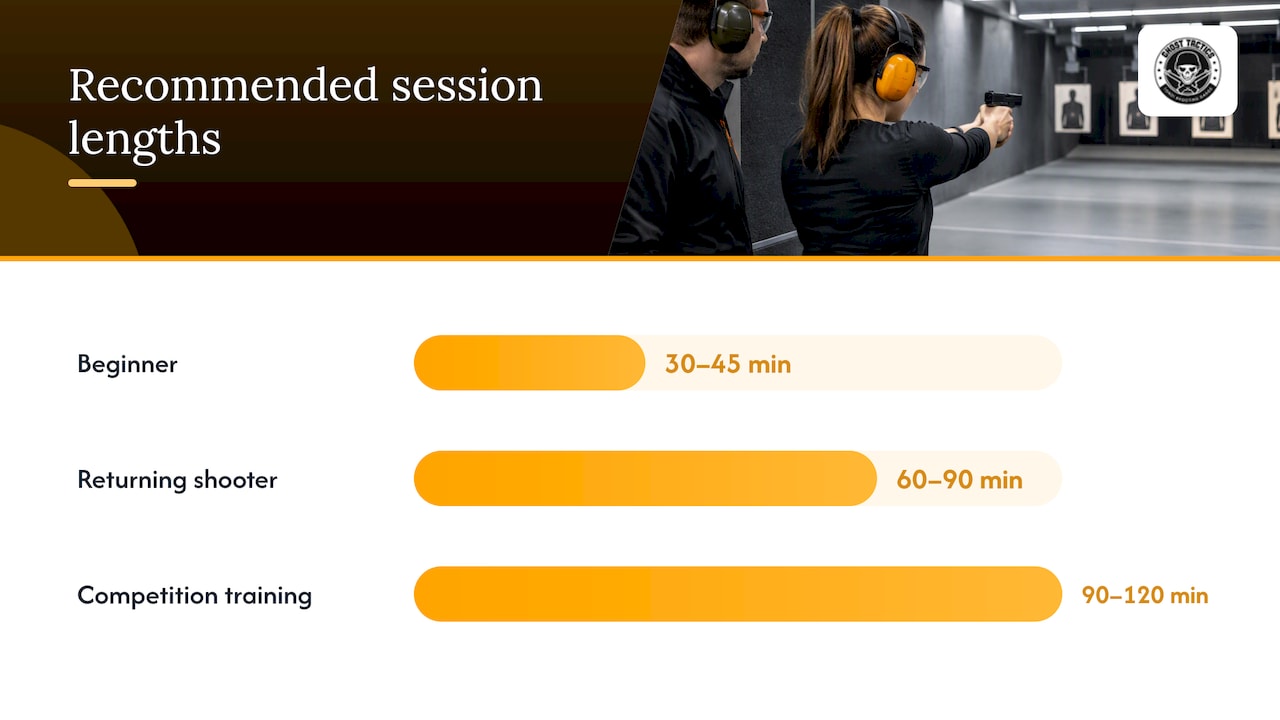
Recommended session lengths follow naturally from preparation level. A first-timer’s introductory session typically runs 30 to 45 minutes, long enough to cover safety fundamentals and a reasonable number of supervised shots without overwhelming a new shooter. A returning shooter doing maintenance practice often benefits from about one to one and a half hours, enough time to warm up and then run focused repetitions. Competition-focused training tends to need around an hour and a half to two hours, giving room for a proper warm-up followed by drills that mirror actual event pacing.
Time of day also affects training quality in ways that are easy to overlook. Morning sessions tend to favor precision work, since concentration is typically sharper before the day’s fatigue sets in. Evening sessions work well for social or group-oriented visits, like a birthday celebration or a night out with friends, where the atmosphere matters as much as the shooting itself. Mental fatigue builds faster than physical fatigue in shooting, so even a dedicated practice shooter benefits from stopping a session once focus starts to slip rather than pushing through for the sake of time already booked.
After running sessions for everyone from nervous first-timers to competitive shooters fine-tuning their technique, a few patterns hold up consistently. Beginners do best when they stop worrying about speed and focus entirely on the fundamentals an instructor walks them through, since confidence with the basics is what makes every future visit easier. Groups, whether it’s a bachelor party, a birthday celebration, or a corporate team-building event, get the most out of a slot booked with enough lead time that everyone can be paired with proper supervision rather than rushed through. Competition-focused shooters benefit most from treating practice sessions like a rehearsal for the real event, matching pacing and pressure as closely as possible.
No prior experience is ever required to book a session with us. Every visit, from a first-timer’s introductory slot to a full corporate event, is supervised by professional instructors who build safety training into the session itself, not as an afterthought. Our range is indoors, which means weather and daylight never affect your booking, and we offer a selection of firearms to suit different preferences.
A few practical takeaways worth keeping in mind:
If you want to see what a first visit actually involves before booking, our guide on shooting range basics for first-timers covers what to expect from start to finish, and booking a session takes just a few minutes once you know your preferred time.
General hygiene practices remain part of normal operations, including clean equipment between uses and sanitizing stations available for visitors who want them. Staff follow standard illness protocols, meaning anyone feeling unwell is encouraged to reschedule rather than attend a booked session, which also helps keep lanes and shared equipment clean for everyone else. There are no special capacity limits or mask requirements currently in effect, and booking, check-in, and the supervised session itself proceed the same way they would for any other visit. If you have specific health concerns or need an accommodation, reaching out before your booked time lets staff prepare accordingly.
Once you know which timing tier fits you, booking the right package makes the rest easy. First-timers and anyone looking for a structured introduction can start with Minu esimene pauk, priced at 45 EUR, a straightforward way to experience a supervised session without any prior experience. Couples or small groups wanting a shared experience often go for Dünaamiline Duo at 105 EUR or the VIP Duo at 168 EUR for a more elevated session.
Planning a bachelor party or celebration? Poissmeesteõhtu starts from 25 EUR per person and is built around a fun, social atmosphere rather than strict repetition. Corporate teams and groups focused on team-building can look at Turvaline ettevõte, from 80 EUR per person, which pairs shooting with the kind of structured, confidence-building format that works well for larger teams.
Every session, regardless of package, is supervised by professional instructors and requires no prior experience. Our indoor range offers a selection of firearms, so weather, daylight, and skill level never limit what you can book.
Ready to lock in your slot? Book your session and choose the time that matches your goal, whether that’s a quiet morning, a social evening, or a focused practice block.
Weekend mornings or weekday evenings tend to work best for beginners, since instructors usually have more time for one-on-one guidance during these windows. A supervised introductory session requires no prior experience and includes a full safety briefing before any shooting begins.
Group and corporate events generally need 2 to 3 weeks of lead time to guarantee enough lanes and instructor coverage for everyone attending. Smaller individual bookings can often be arranged within just a few days.
Weather mainly affects outdoor or semi-outdoor ranges, which can face closures during storms or low visibility. An indoor range avoids this issue entirely, since lighting and conditions stay consistent regardless of the season.
Session length depends on preparation level: beginner sessions usually run 30 to 45 minutes, maintenance practice runs 60 to 90 minutes, and competition-focused training often runs 90 minutes or more. Each length reflects how much supervised instruction or drill time the session includes.
No, range-supplied firearms and ammunition are available and are the standard choice for first-timers and casual visitors. If you bring your own firearm, caliber restrictions and permitted ammunition types follow national safety regulations, so checking ahead is worth doing.