Ampumaseuran jäsenyyden edut: mitä kerho antaa harrastajalle
- Mo-Su 10.00 – 20.00
- +372 555 85 416
- sale@laskmine.ee


A laskekoolituse sertifikaat is a private course completion document that proves you trained at a range, not an official credential that satisfies the Police and Border Guard Board. For a weapon permit, the PPA requires a medical certificate and an approved first-aid certificate, neither of which a private range can replace. For hands-on exam preparation in Tallinn, we offer supervised practice built around the actual test format.
TL;DR:
- Submit a medical certificate issued within three months, a qualified provider’s first aid certificate covering 16 hours, valid identification, and the completed application.
- The theory result remains valid for two months; the combined exam costs €90 at the PPA, while a practical retest costs €75.
- Pistol and revolver applicants must load and fire three shots within 15 seconds, scoring at least two hits, after passing the handling check.
- If a practical retest may be needed, allow for the minimum gap of five days between attempts when booking around other permit deadlines.
Applying for a weapon permit in Estonia means assembling a specific set of documents before you ever touch the state exam. The Police and Border Guard Board requires a medical certificate from your GP that is no older than three months at the time of application, plus a first-aid training certificate covering at least 16 hours of instruction from a qualified provider. You will also need valid identification and the completed application itself.
The exam itself runs in two parts. You sit a theory test first, and if you pass, you move to the practical shooting test, known as the laskekatse. The theory result stays valid for two months, so the practical portion needs to happen within that window. The PPA notes that the combined theory and practical fee runs 90 €, while a practical-only retest costs 75 €.
The practical test enforces strict timing: pistol and revolver applicants must load and fire three shots, landing at least two hits, within 15 seconds. That single detail catches many first-time applicants off guard, which is exactly why supervised practice matters before exam day. Rifle shooters using .22 LR fire from 25 meters, and every weapon type starts with a handling check performed before any live rounds are loaded.
A certificate issued by a shooting range typically lists the course name, the number of training hours completed, the instructor’s name and signature, and notes on supervised live-fire practice. It’s a record of what you did and how you did it, useful for your own reference and occasionally for conversations with the PPA about your preparation history.
What it does not do is substitute for the statutory documents. A range certificate carries no legal weight as a replacement for your GP’s medical certificate or the 16-hour first-aid certificate the PPA mandates for every permit application. Think of it as evidence of preparation rather than a prerequisite.
Our own shooting course certificate follows this same format: a record of what you trained on, not a legal substitute for the mandatory paperwork.
Training that mirrors the actual exam format beats generic range time. The goal is to walk into the laskekatse having already felt the clock, the hit requirements, and the handling checks under supervision.
Pro Tip: Simulate the 15-second pistol drill with a stopwatch running during practice, not just during the real exam. Reacting to real time pressure is what separates a smooth pass from a fumbled first attempt.
Our pistol shooting drills guide breaks these movements down further if you want extra reps between sessions.
We built our training sessions around the exam format itself, not generic range time. Every course starts with a safety briefing, moves into supervised live-fire drills, and finishes with a timed-exam simulation that mirrors the 15-second pistol loading requirement you’ll face at the state test. Our instructors sign off on your hours and the modules you covered, giving you a certificate that reflects real exam-relevant practice.
No experience is required to book a session with us. Every session runs under the supervision of professional instructors, our range sits entirely indoors regardless of Tallinn’s weather, and safety training is built into every package before anyone picks up a firearm. We also keep a wide selection of firearms on hand, so you can train on the type you’ll actually use during your permit application.
Whether you’re a first-time applicant, a tourist curious about the experience, or a company planning a team event, the same supervised structure applies. Our firearm safety rules guide covers the handling behaviors examiners check before you ever fire a shot.
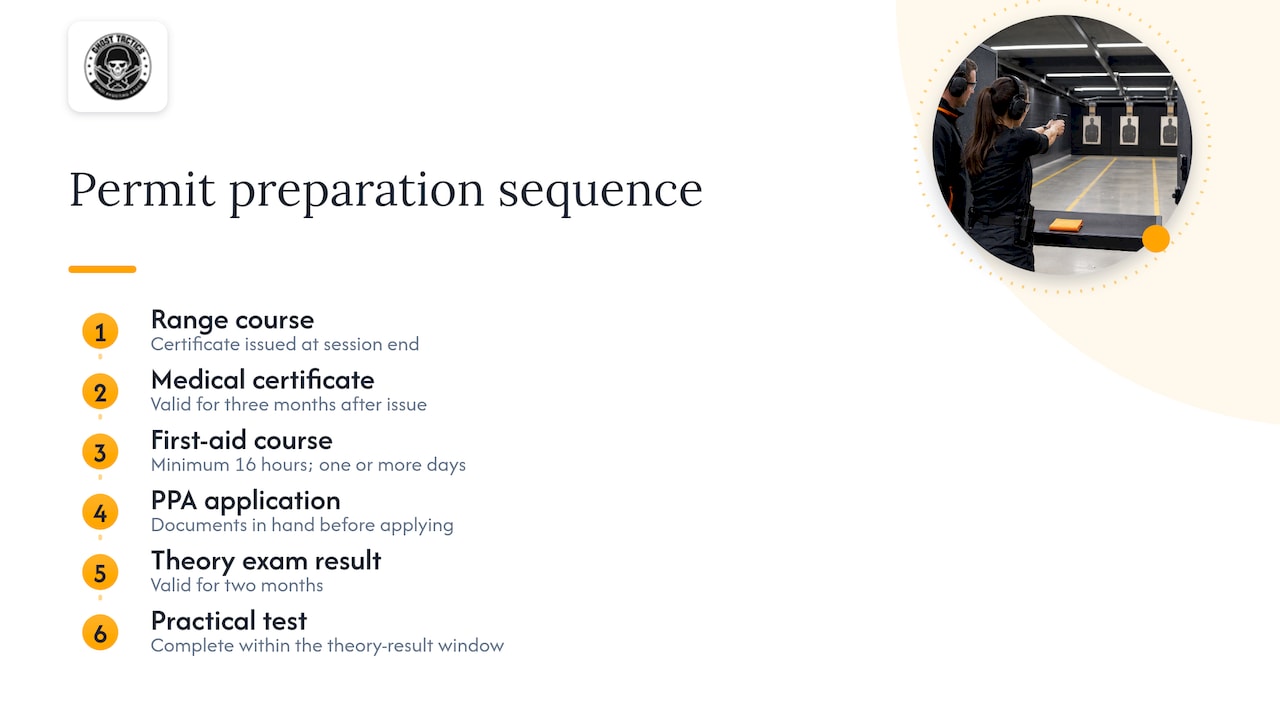
Getting your documents in order early saves you from the short shelf life of a medical certificate. Here’s a practical sequence to follow.
Lining these steps up in order avoids the common trap of a medical certificate expiring before the rest of the paperwork catches up.
A private range certificate itself carries no statutory expiration date since it isn’t a legal document tied to permit validity. In practice, though, most ranges treat the certificate as a record of a specific course taken on a specific date, and its usefulness as evidence of recent practice fades the longer it sits in a drawer.
The documents that do carry hard expiration dates are the ones the PPA actually requires: your medical certificate needs to be no older than three months at the point of application, and your theory exam result stays valid for only two months before you need to retake it if the practical portion isn’t completed in time.
Weapon permits themselves require renewal on a schedule set by the PPA, and renewal applications follow the same submission process as initial applications, through PPA’s self-service portal or in person. If a renewal or an additional weapon category requires a fresh practical shooting test, booking supervised practice beforehand puts you back in exam-ready shape rather than relying on skills that may have gone rusty since your last session.
A private training certificate from a range is recognized for exactly what it is: documentation of hours trained and skills practiced under supervision. It is not a credential that the PPA formally reviews or files as part of your permit application, and no authority treats it as interchangeable with the medical or first-aid certificates that are legally required.
Where a private certificate does carry weight is in informal contexts. Some employers running security-related roles, some gun clubs evaluating new member applications, and some insurance conversations around firearm ownership may ask for evidence of training history, and a signed certificate with hours and modules listed serves that purpose well.
It’s worth keeping that distinction clear going into your application: the certificate supports your preparation story, while the PPA’s own required documents are what actually move your permit application forward.
Training certificates vary depending on what you’re preparing for. A course built around pistol handling will emphasize the timed loading and firing drills tied to the 15-second requirement, while a course focused on rifle shooting trains the standing unsupported stance and distance work used in the .22 LR portion of the exam.
Purpose matters too. Someone training purely for personal safety purposes may focus on a single weapon category, while hunters preparing for a hunting license need training that aligns with the specific firearm types permitted for hunting use. Instructor licensing itself sits in a separate category entirely: becoming a certified shooting instructor requires a formal training program well beyond the hours covered in a standard preparation course, and that distinction matters if you’re ever asked whether your certificate qualifies you to teach rather than just to shoot.
For most applicants, the practical difference comes down to matching your training to the weapon category listed on your permit application, since the exam itself tests you on the specific firearm type you intend to carry or own.
Even though a private certificate doesn’t satisfy the PPA’s legal requirements on its own, holding one still pays off in ways that go beyond paperwork. The most direct benefit is confidence: walking into the state exam having already felt the 15-second pistol drill under supervision means you’re not experiencing that pressure for the first time when it counts.
A certificate also gives you a reference point if you decide to pursue additional weapon categories later, since you’ll have a documented training history to build from rather than starting from zero. For hunters, club members, or anyone involved in group shooting activities, a certificate can support applications for club membership or participation in organized events where some proof of prior training is expected.
There’s a quieter benefit too: supervised practice tends to catch bad habits early, the kind of inconsistent grip or rushed trigger control that’s hard to self-correct without someone watching. A certificate from a course that included that kind of feedback is worth more than the paper it’s printed on.
Course costs vary depending on what you’re training for and how much supervised time you want. On our own range, a single introductory session like Minu esimene pauk runs 45 €, while a more involved experience such as Dünaamiline Duo or Eriüksuslane runs 105 €. For applicants specifically preparing for a permit, our Relvaloa taotleja koolitus gift card option is priced at 280 €.
Gun owners looking for independent practice have separate options. Our Relvakäsitsemise koolitus handling course runs 175 €, and range rental for practice is 125 € per person. For repeated visits, our 10x card runs 150 € and our 20x card runs 200 €, both better value than booking single sessions if you’re planning multiple rounds of exam prep.
Beyond course fees, budget for the state exam itself: the PPA charges 90 € for the combined theory and practical test, or 75 € for a practical-only retest. Add your GP visit for the medical certificate and your first-aid course fee, and the full path to a permit involves several separate costs beyond the shooting training itself.
Booking a training session at a range is typically the fastest part of the whole permit process. Once you reserve a slot, the session itself runs for a set block of time, a safety briefing followed by supervised drills, and your instructor issues the certificate at the end of that same session, covering the hours completed and the modules you trained on.
The slower parts of the timeline sit outside the range entirely. Your GP appointment for the medical certificate may take days or weeks to schedule depending on availability, and that certificate only stays valid for three months once issued. Your first-aid course, covering a minimum of 16 hours, typically runs over one or more days depending on the provider’s schedule.
Once your documents are in hand, the PPA application process itself moves at its own administrative pace, and the theory exam result only stays valid for two months, which means your practical laskekatse needs to be booked and completed within that window. Planning backward from your target exam date, with your medical certificate and first-aid course timed to stay valid through the process, keeps the whole sequence from stalling.
We make exam preparation straightforward. Our Relvakäsitsemise koolitus handling course and Relvaloa taotleja koolitus gift card option both build directly toward the skills the state exam actually tests, and our 10x and 20x multipack cards let you keep practicing without rebooking every time.
No experience is required to start, every session runs under professional instructor supervision, and our indoor range in Tallinn stays open regardless of the season. We keep a wide selection of firearms available, so you can train on the exact type you plan to carry.
Beyond permit prep, we host bachelor parties, birthdays, corporate team-building days, and group visits for tourists and friends, all with the same safety-first structure. Check gift card options or explore range rental and gun owner packages to book your next session.
No. The PPA requires a medical certificate and a first-aid certificate for a permit application, not a private range certificate. A private certificate documents your training but doesn’t replace either statutory requirement.
The practical test checks safe handling first, then live-fire performance matched to your weapon type. Pistol and revolver shooters must load and fire three shots within 15 seconds with at least two hits, while rifle shooters fire rimfire cartridges from 25 meters.
The combined theory and practical exam costs 90 €, and a practical-only retest costs 75 €. These fees are separate from any private training course you take beforehand.
No. If you don’t own an allowed firearm, the PPA provides one for the state exam, and our range offers a wide selection of firearms so you can train on different options before deciding what to apply for.
The timeline depends mostly on your GP and first-aid course scheduling, since your medical certificate only stays valid for three months. Booking supervised practice sessions with us can happen as soon as you’re ready, often within the same week you reserve a slot.