Mental Focus in Shooting: How to Stay Calm and Accurate
- Mo-Su 10.00 – 20.00
- +372 555 85 416
- sale@laskmine.ee


Stress inoculation training (SIT) teaches you to stay effective under pressure by learning coping skills first and then meeting stress in small, controlled doses. It works only when the pressure is graded, the setting is safe and someone experienced is watching. A supervised indoor shooting session is one practical way to feel that kind of pressure without risk. At Tondi Shooting Range in Tallinn, no experience is required, and professional instructors supervise every session.
The idea is borrowed from vaccination. A small, manageable dose of stress now builds resistance to a bigger one later. Psychologist Donald Meichenbaum developed the approach in the 1970s. The APA Dictionary of Psychology describes it as a stress-management program used within cognitive behavioral therapy, based on the theory that exposure to moderately stressful events builds coping resources and resilience.
Meichenbaum’s own paper calls it a flexible, individually tailored form of cognitive-behavioral therapy. He links it to hormesis, the biological finding that small, brief exposures to a stressor build repair mechanisms that protect against later, stronger ones. SIT applies this at the psychological level: you meet milder forms of stress, your coping skills and confidence grow, and the next challenge feels more manageable.
It began as a clinical method, so you will meet it in therapy rooms. It has since spread to emergency medicine, firefighting, the military, sports and workplace training, because the underlying logic is the same everywhere: learn the skills, then test them under pressure.
Descriptions vary slightly between sources. The US Psychological Health Center of Excellence evidence brief describes three phases, while the APA dictionary splits the same material into four. Here is the three-phase version in plain terms.
You learn what stress does to your body and thinking: racing heart, shallow breathing, tunnel vision, harsh self-talk. You also identify which situations trigger it for you. Knowing what is happening makes it more predictable, and predictability gives a sense of control. In a simulation-based trial protocol for emergency medicine and surgery residents, this education block lasted 60 minutes.
Where it goes wrong: skipping straight to the exciting part. People who are thrown into pressure without this groundwork often just feel overwhelmed.
The evidence brief lists the core skills: relaxation training, cognitive restructuring (spotting and replacing unhelpful thoughts), problem-solving training and positive self-statements. In everyday terms: slow your breathing, notice the thought “I’m going to fail,” swap it for something workable, and break the task into the next small step.
Where it goes wrong: practicing the skills only while calm. Phase 2 prepares you, but it is not yet proof that the skills hold up.
Now you use the skills in situations of increasing difficulty, through imagery, role play or real-life practice. In the trial protocol above, this was the longest block, 180 minutes of simulated scenarios at gradually increasing stress. Follow-through matters too: Meichenbaum’s framework treats a stumble as a learning opportunity rather than a catastrophe, and uses booster sessions to keep the skills fresh.
Where it goes wrong: raising the pressure too fast. More on that below.
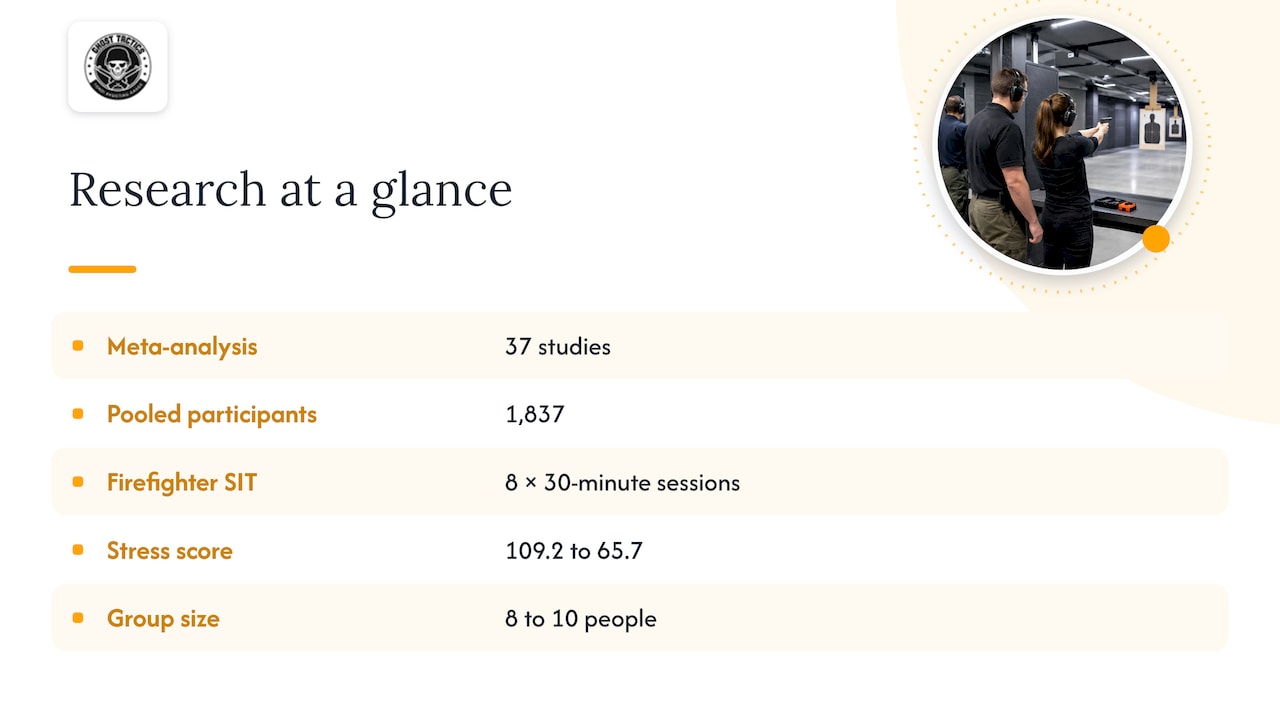
The broadest evidence comes from workplace and performance settings. A 1996 meta-analysis by Saunders and colleagues pooled 37 studies with 1,837 participants. It found SIT effective for reducing performance anxiety and state anxiety and for improving performance under stress, with no significant limits tied to trainer experience, setting or type of trainee.
A more recent example: a 2025 quasi-experimental study of Ecuadorian firefighters, reported in the Iranian Journal of War and Public Health, gave 30 firefighters eight 30-minute SIT sessions, twice weekly. Their occupational stress scores fell from 109.2 to 65.7, with drops in salivary cortisol and resting heart rate, while a 30-person control group barely changed. It is one small study, but it shows how short and structured a program can be.
The trial protocol mentioned earlier adds a practical point: SIT works with groups of 8 to 10 people, does not need an inordinate number of sessions, and its benefits are described as carrying over to new stress conditions and new tasks. That group format is why it suits team programs so well.
If you are dealing with a diagnosed condition such as PTSD, SIT belongs in the hands of a licensed clinician, who will choose the approach with you. This article is about building everyday composure and performance under pressure, not treating a medical condition.
You may also see the term stress exposure training (SET). A 2025 systematic review of SET in surgery explains that it uses SIT’s principles to prepare people for the psychological and physiological effects of acute stress so they can perform at their best. It has three stages:
The simplest way to separate them: SIT started as a clinical therapy that teaches coping skills, while SET takes a skill you already have and rehearses it in stressful, distracting conditions. In real life the two overlap, and good training programs borrow from both.
The same review suggests the skills-acquisition phase works best within four to seven regular sessions led by people with first-hand experience of the stressors. It proposes a program of six to eight weeks with gradually increasing stressors.
The National Strength and Conditioning Association’s TSAC report on stress inoculation gives requirements that apply far beyond the gym:
It also warns that SIT only works when you can first perform the target task in a non-stressed environment, and that coaches should keep trainees in their “zone of optimal challenge,” stepping the exercise back as soon as fatigue or stress starts to degrade performance.
Three practical lessons follow:
Most people cannot easily recreate real pressure on demand. A shooting range can: the situation is unfamiliar, the equipment demands full attention, and the rules are strict. That combination raises your pulse in a way that is controlled and entirely voluntary. Meanwhile the thing you are asked to do is simple and measurable: breathe, focus, and place a shot.
That maps neatly onto the rules above. The task is learnable in minutes with instruction, so you can perform it calmly first. Pressure can then be added in small steps, such as a slower or faster pace, a new position or someone watching. Results are visible immediately, so you can see how your composure affects your accuracy. Our guide to mental focus in shooting goes deeper on staying calm and accurate, and the article on breath control technique covers one of the simplest relaxation skills you can use between shots.
If the thought of a first visit makes you nervous, that is itself a good small dose to work with. Our piece on staying calm on your first visit to a shooting range walks through what to expect.
To be clear about what this is: a range session is not therapy, and we do not present it as a clinical program. It is a safe, supervised way to practice the habits that stress inoculation is built on: noticing tension, breathing, refocusing and carrying on.
Tondi Shooting Range in Tallinn is the largest shooting range in the Baltic region, and our range is indoors, so weather and season do not matter. A few things shape every visit:
That order mirrors the training logic above: learn first, perform the simple task calmly, then add challenge as you feel ready. Our article on pistol shooting drills for beginners shows the type of simple, repeatable exercises that help you build the base. If you want to see how lasting confidence grows from instruction, read why shooting courses build confidence.
With your instructor, you could structure a visit like this:
That is a light version of the application phase, and it is what many people find most memorable about their first visit: the moment they notice they stayed steady.
Stress inoculation was designed to work in groups, and teams are where it pays off at work. When people share a mildly challenging task, they have to communicate clearly, support each other and handle small mistakes together. Our team programs are built around communication, teamwork and individual confidence, with security awareness and mental well-being as part of the focus.
If you organize events, the article on practicing pressure together in a team day covers how to frame it, and why a shooting range works for team building in Tallinn explains the format. For colder months, see winter team event ideas in Tallinn: an indoor range keeps everything on schedule.
Programs on our events page include:
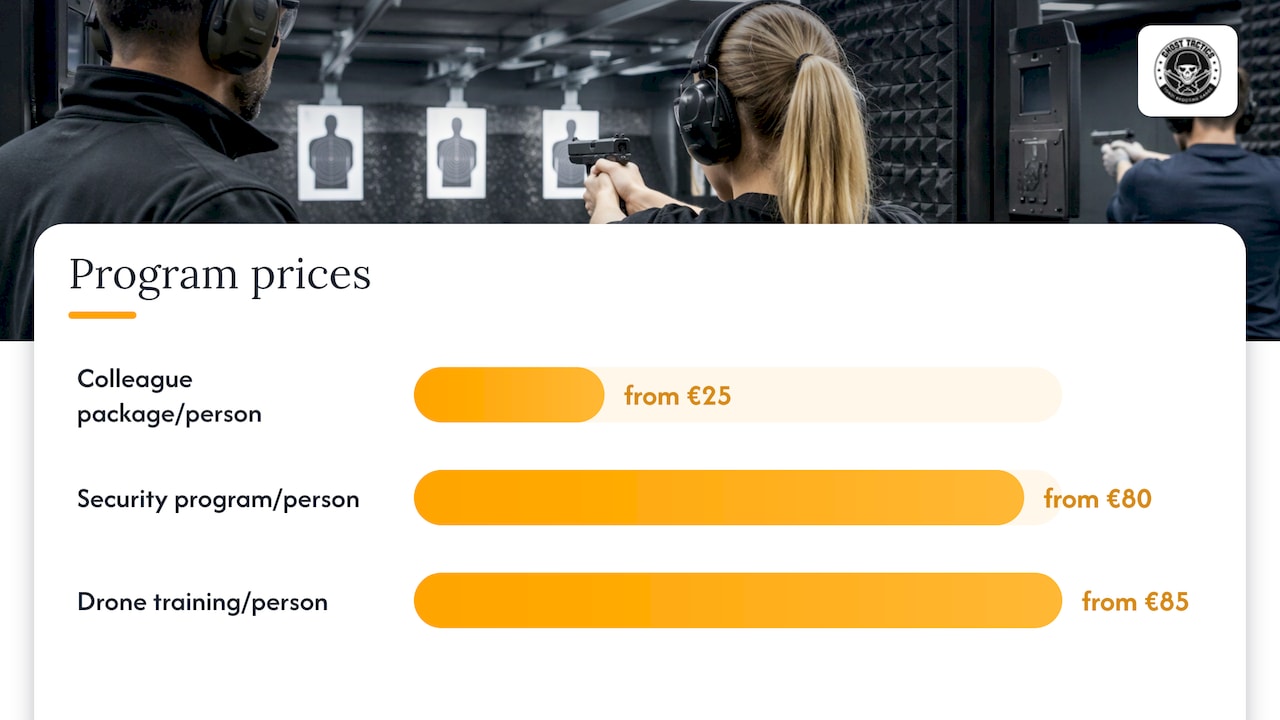
| Program | Price |
|---|---|
| Vali ise kolleegidele pakett (build-your-own package for colleagues) | from €25 per person |
| Turvaline ettevõte (security awareness for companies) | from €80 per person |
| Esmane droonikoolitus ettevõttele (introductory drone training for companies) | from €85 per person |
The drone training adds a second kind of challenge: a new technology to learn together, which gives teams another way to practice staying composed with something unfamiliar.
The easiest entry for one person or a couple is the Minu esimene pauk (“my first shot”) experience at €45, available through our gift cards and experiences page. The same page also covers packages for birthdays and special occasions, and it works as a gift for someone who would enjoy a challenge. For groups, bachelor parties and company days, see the events page, where Poissmeesteõhtu (bachelor party) starts from €25 per person. If you plan a company outing, our cost planner helps you budget.
If you are already a firearm owner, the range access page lists range rental and multi-visit cards for regular practice, which suits repeating the small-steps routine described above.
They are conceptualization (learning about stress and identifying your triggers), skill acquisition and rehearsal (relaxation, cognitive restructuring, problem-solving and positive self-statements), and application and follow-through (using those skills in progressively harder situations and preventing relapse). Some sources, such as the APA dictionary, describe four phases covering the same ground.
Research suggests it can. A meta-analysis of 37 studies found SIT reduced performance and state anxiety and improved performance under stress. The key is gradual, supervised exposure that stays challenging without becoming overwhelming.
Stress inoculation training began as a clinical, skills-teaching therapy with graduated exposure. Stress exposure training applies the same principles to performance: you rehearse an existing skill under increasingly stressful, distracting conditions. Both follow the same education, skills and practice pattern.
No. At Tondi, no experience is required, safety training is included and professional instructors supervise every session. Everything takes place indoors in Tallinn, so you can start with a calm, simple task and build from there.
No. A range session is a supervised activity for building composure and confidence, not a medical treatment. If you live with PTSD or another condition, speak to your doctor or a licensed therapist about the right approach.