What Is Grouping in Shooting: A Practical Guide
- Mo-Su 10.00 – 20.00
- +372 555 85 416
- sale@laskmine.ee





Precision shooting is defined as the discipline of consistently placing shots on a small target through deliberate control of trigger press, body positioning, breathing, and sight alignment. Mastering these fundamentals separates competitive marksmen from casual shooters. The examples of precision shooting techniques covered here draw from National High Power champions, established marksmanship standards, and structured training methods that produce measurable accuracy gains. Whether you shoot at 50 yards or 1,000, the same core principles apply.
Trigger control is the single most impactful skill in precision shooting. A poor trigger press moves the muzzle before the bullet leaves the barrel, scattering your shot group regardless of how steady your hold is.
The correct technique is a smooth, continuous rearward press with the pad of your index finger. You never jerk or slap the trigger. Trigger slapping is a bad habit commonly carried over from handgun shooting, and it destroys consistency in precision rifle work.
Two-stage triggers help here. A two-stage trigger with a 2.9-pound first stage and a 1.2-pound second stage minimizes creep and gives you a clear break point. That separation between stages lets you pre-load the trigger and fire with far less disturbance to your sight picture.
Pro Tip: Try pulling the trigger with your middle finger during dry-fire. It feels awkward and immediately reveals any lateral pressure or alignment issues you did not know you had.
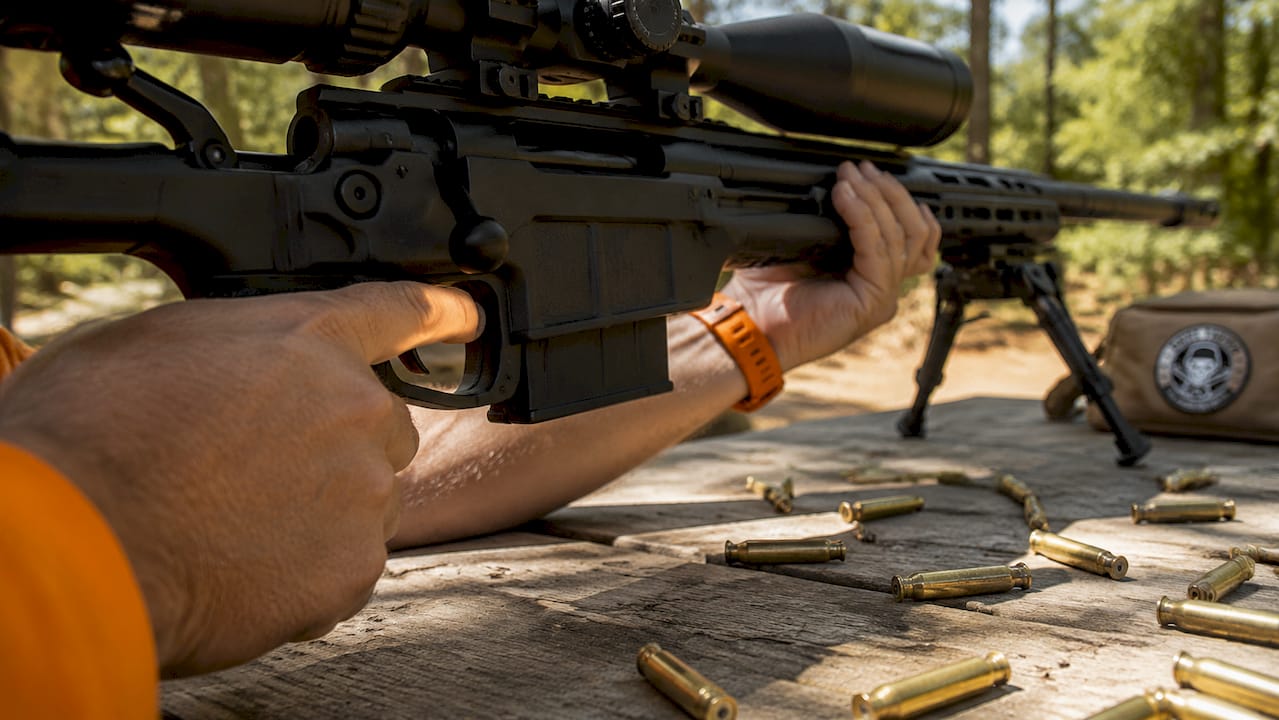
Your natural point of aim is where your relaxed body naturally points the rifle when all muscle tension is released. Muscling the rifle onto target instead of adjusting your body position is the most common cause of inconsistent shot placement.
Finding and using your natural point of aim (NPA) takes a few deliberate steps:
A stable position with correct NPA means your body does the work, not your arms. Adjusting your body instead of the rifle reduces shooter strain and increases shot repeatability across an entire match or training session.
National High Power Champion Carl Bernosky uses a 4-inch hold window in the standing position as his precision benchmark. That means his sights stay within a 4-inch circle throughout the shot process. If your hold is larger than that, your position needs work before your trigger technique matters.
Pro Tip: After every shot, close your eyes and let your body return to its natural rest position. Open your eyes and check where the sights point. That tells you exactly how well your NPA is set.
Breathing moves your entire torso, and that movement transfers directly to your sight picture. Controlling your breath cycle is not optional in precision shooting. It is a core technique.
The correct method is straightforward:
Shooting beyond the 3–5 second window causes oxygen depletion, which makes your muscles tremble and your vision blur. That window is not arbitrary. It is the point where your body is most stable and your reticle movement is at its lowest.
Breathing and trigger press must work together. You reach the respiratory pause, begin your trigger press, and fire before the pause ends. Practicing this timing in dry-fire builds the coordination faster than any amount of live-fire alone.
The largest factor in improving precision rifle performance is intentionality in training, not gear. Purposeful practice targeting specific weaknesses outperforms simply burning through ammunition every time.
Dry-fire is the foundation of that intentional practice:
Live-fire sessions at long range require discipline in volume. For 800–1,000 yard training, limit yourself to 20–30 rounds per session with weekly intervals. That constraint forces you to treat every round as a deliberate event. Shooters who fire 100 rounds without analysis rarely improve as fast as those who fire 25 with full attention to each shot.
After each live-fire shot, call your shot before looking at the target. A shot call is your prediction of where the bullet hit based on where your sights were at the moment of firing. If your call and the actual impact consistently match, your technique is sound. If they do not match, you have a flaw to diagnose. Laskmine’s shooting courses build this shot-calling habit from the first session.
The hold window is the period during which your sights are close enough to the target to produce an acceptable hit. Advanced marksmen do not wait for a perfect sight picture. They fire within the window when the trigger is ready.
“Maintaining a consistent hold window and consciously firing within it is more effective than relying on the ‘surprise break’ in advanced shooting. The surprise break works for beginners, but experienced shooters know when they are going to fire and do it deliberately.” — Carl Bernosky, National High Power Champion
Chasing the reticle is the most destructive habit at this level. It happens when you pause your trigger press because the sights drift off center, then slap the trigger the moment they return. The result is a rushed, disturbed shot that lands worse than if you had fired during the drift.
Over-holding leads to fatigue and poor performance. If your hold window passes without a shot, lower the rifle, reset, and start the process again. Firing a fatigued shot is always worse than taking a fresh attempt. Experienced shooters treat a reset as a neutral event, not a failure.
Understanding shot grouping helps you evaluate whether your hold management is working. Tight groups that are off-center point to an NPA problem. Wide groups point to trigger or breathing issues.
Precision shooting accuracy depends on trigger control, natural point of aim, breathing timing, and deliberate practice structured around shot analysis rather than round count.
| Point | Details |
|---|---|
| Trigger control is foundational | Press smoothly and continuously; slapping or jerking the trigger scatters your shot group. |
| NPA eliminates muscle tension | Adjust your body, not the rifle, so sights rest naturally on target without effort. |
| Breathe and fire within 3–5 seconds | Shoot at the natural respiratory pause before oxygen depletion causes tremor. |
| Dry-fire daily for 30 minutes | Snap cap dry-fire builds trigger mechanics and removes flinch faster than live-fire alone. |
| Limit long-range rounds per session | 20–30 rounds at 800–1,000 yards with full analysis beats high-volume unfocused shooting. |
The shooters I have watched improve the fastest share one trait: they treat every single shot as a test, not a repetition. They are not trying to get through a box of ammunition. They are trying to answer a specific question about their technique.
The biggest mental barrier I see is the belief that more rounds equal more progress. They do not. Firing 200 rounds with poor trigger technique just reinforces the flaw. Thirty focused dry-fire repetitions with honest self-assessment do more in a week than most shooters accomplish in a month of range visits.
The techniques in this article work together. Trigger control without NPA gives you a clean press on a misaligned rifle. NPA without breathing control means your stable position collapses the moment you inhale. Breathing without shot timing means you fire at the wrong point in the cycle. The system only works when all the parts run together.
My honest advice: pick one technique per session and work it until it feels automatic. Then add the next. Trying to fix everything at once produces nothing. Seeking professional instruction at the right stage accelerates this process significantly because a qualified coach sees what you cannot see yourself.
— Tõnis
Knowing the techniques is the first step. Applying them under real conditions is where the skill actually forms. Laskmine offers range facilities and structured training courses designed for shooters who want to move beyond guesswork and build accuracy through deliberate practice.

At Laskmine’s shooting range, you get the space and conditions to work through trigger control, NPA setup, and breathing drills with proper feedback. Courses cover everything from shooting fundamentals to advanced marksmanship, with instructors who can diagnose your specific errors and correct them before they become habits. If you are serious about improving your precision, the range is where the work gets done.
Precision shooting is the discipline of consistently placing shots on a small target through controlled trigger press, proper body positioning, breathing technique, and sight alignment. It applies across rifle, pistol, and competitive shooting formats.
Get into your shooting position, close your eyes, relax completely, and open your eyes to see where your sights point naturally. Move your entire body until the sights rest on target without any muscle effort.
30 minutes of daily dry-fire with snap caps is the standard recommendation for building trigger technique and eliminating flinch without using live ammunition.
The hold window is the period during which your sights are close enough to the target to produce an acceptable hit. Advanced shooters fire deliberately within this window rather than waiting for a perfect sight picture that may never arrive.
Chasing the reticle causes you to slap the trigger the moment the sights return to center, which disturbs the muzzle and produces inconsistent shot placement. Steady trigger pressure throughout the hold is always more accurate.