OSH Aligned Corporate Shooting Events for Planners at Tondi Lasketiir
- Mo-Su 10.00 – 20.00
- +372 555 85 416
- sale@laskmine.ee





The Arctic Warfare Police (AWP) is the police-oriented variant of Accuracy International’s Arctic Warfare sniper family, typically a bolt-action rifle chambered in 7.62×51mm with a shorter 24-inch barrel intended for law-enforcement marksmen. It shares its chassis and action with the military AW but trades barrel length and some configuration choices for a profile suited to shorter engagement distances. The sections ahead cover its lineage, specs, variants, and where it actually gets used in the field.
TL;DR:
- The AWP is a shorter, police-specific variant of the military Arctic Warfare rifle, typically chambered in 7.62×51mm NATO with a 24-inch barrel, designed for urban and close-range engagement.
- It features a rigid aluminum chassis, a short-throw bolt with a visible cocking indicator, a three-position safety, and a full-length optics rail, all built for durability in harsh environments.
- The rifle’s effective range is around 800 meters, with a 10-round magazine capacity in typical police chambers, but models in magnum cartridges are built for longer distances with fewer rounds.
- Prices vary significantly based on included optics and accessories, and legal ownership depends on local firearms regulations; always verify compliance before purchasing.
- Most police use the AWP for high-precision, short- to moderate-range scenarios like urban overwatch or hostage support, where maneuverability and first-shot accuracy are prioritized.
The AWP sits inside a bigger product line built by Accuracy International, a British manufacturer that has spent decades refining bolt-action precision rifles for military, police, and competitive shooters. “Arctic Warfare” is the family name. “Police” marks the specific variant built with law enforcement marksmen in mind rather than long-range military overwatch.
Where the standard military AW commonly runs a 26-inch barrel, the AWP is usually built with a 24-inch (610mm) barrel, chambered most often in 7.62×51mm NATO/.308 Winchester or .243. That shorter barrel trims a bit of muzzle velocity and outright reach, but it also shortens the overall rifle, which matters when a marksman is moving through a stairwell, a vehicle, or a cramped observation position rather than lying prone on a mountainside. Cold-weather roots aside, the AWP’s real selling point for police work is handling in tight, unpredictable spaces.
Confusingly, not every black Accuracy International rifle you see for sale is actually an AWP. The company also produced an AE variant with a similar dark finish, and both share visual DNA with the green-stocked military AW. Barrel length, chambering markings, and receiver engravings are what reliably separate an AWP from its siblings, not the paint job.
Accuracy International traces its rifle-building roots to target-shooting competition heritage, not battlefield contracts. The company built its reputation on rifles designed for extreme first-shot precision, and that competition pedigree is part of why the design later translated so well to tactical and police use.
The Arctic Warfare line grew out of the earlier Precision Marksman/L96 platform, developed as the British Army looked for a bolt-action sniper system that could handle brutal weather without losing zero or reliability. Cold, wet, sandy, and salt-air environments punish rifles in ways that a fair-weather range gun never has to survive: metal contracts, lubricants gum up, and wood stocks warp. Accuracy International’s answer was a rifle built around a rigid aluminum chassis bonded into a synthetic stock, a combination that resists the warping and swelling that plagued older wood-stocked sniper rifles.
That engineering choice is why “Arctic Warfare” isn’t just a marketing name. The rifle was built from the outset to keep functioning in punishing cold, and that same rigidity turned out to matter just as much in desert heat or coastal humidity.
A few milestones shaped where the AWP fits in that story:
That last point matters for anyone researching the rifle today. Accuracy International’s current catalog has moved on considerably from the original AWP-era designs, so treat older spec sheets as historical reference rather than a shopping guide for what the company sells now.
The AWP’s handling characteristics come down to a handful of design choices that Accuracy International has stuck with across the whole AW family, with variant-specific tweaks layered on top.
Chassis and stock. The rifle is built around an aluminum chassis rather than a traditional wood or single-piece polymer stock. That chassis is bonded into a synthetic stock shell, which gives the rifle a stiff, consistent bedding surface for the barreled action. A stiff chassis matters more than most buyers realize: any flex between the action and stock shows up downrange as inconsistent grouping, especially past 300 yards. Folding stock options are common on the AW family, useful for police tactical teams that need to fit a precision rifle into a vehicle trunk or a breach kit bag.
Bolt and action. The bolt runs a fairly short, positive throw with a cocking indicator that lets the shooter confirm the rifle’s state at a glance rather than by feel alone, which is a small but genuinely useful detail during a high-stress callout. A three-position safety allows the shooter to lock the bolt closed, keep it safe but operable, or go fully hot, giving a tactical team more granular control than a simple on/off safety.
Feeding system. Ammunition feeds from a detachable box magazine rather than an internal magazine, which speeds reloads and lets an operator carry pre-loaded spares. Capacity depends on chambering. This is worth knowing before you assume every AW-family rifle holds the same round count.
Rails and attachments. A full-length optics rail runs along the receiver, giving armorers flexibility to mount a wide range of scope types and, on many configurations, night-vision or thermal add-on units ahead of the main optic. Quick-detach sling points and bipod studs are standard, letting police marksmen switch quickly between a supported prone position and a hasty rest against a wall or vehicle.
Cold-weather and corrosion resistance. Accuracy International’s own brochure literature stresses corrosion-resistant materials and protective finishes built for marine, desert, or arctic operating conditions. In practice that means coated metal components and a stock system that doesn’t absorb moisture the way older wood stocks did, so the rifle holds zero through temperature swings that would throw off a less rugged system.
Pro Tip: If you’re ever handed a black Accuracy International rifle and told it’s an AWP, check the barrel length and the chambering stamp before you take that at face value. Finish color alone has fooled plenty of buyers into overpaying for the wrong model.
Numbers get thrown around loosely in secondhand listings and old forum posts, so it helps to separate what’s commonly cited for the standard AW from what’s specific to the Police variant.
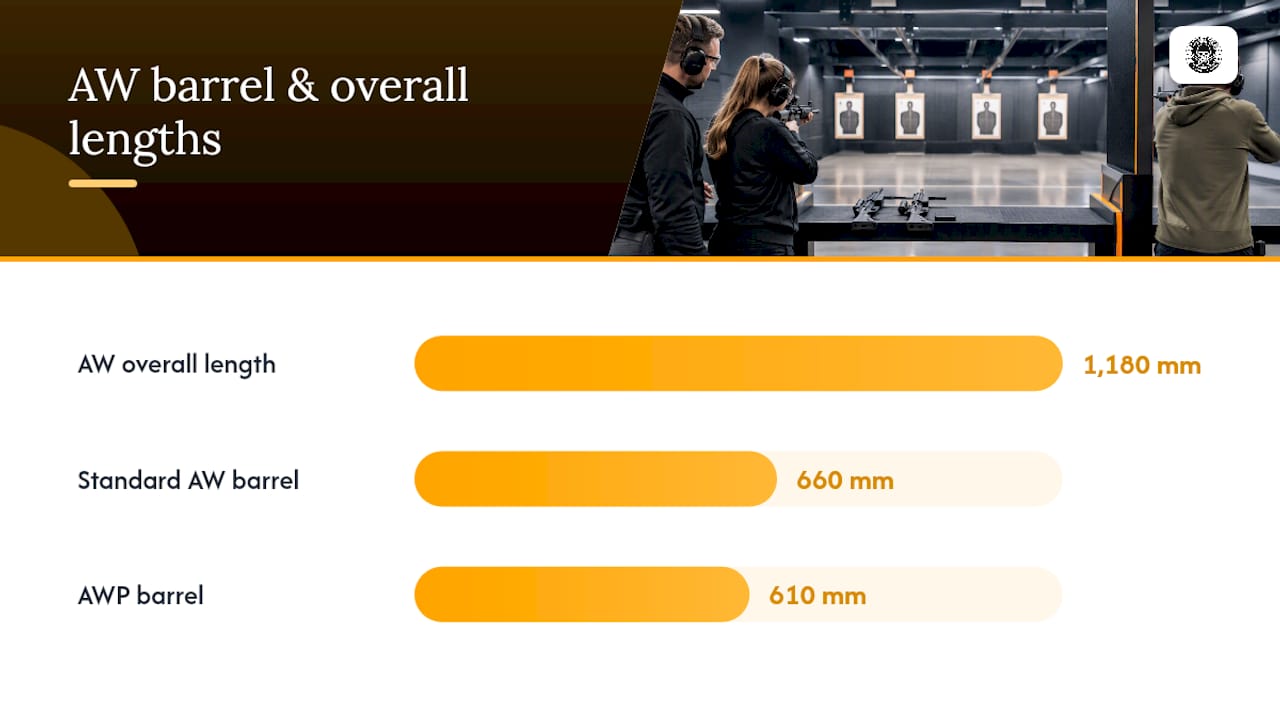
A standard 7.62mm AW is generally listed around 6.5kg (14.3lb), with an overall length near 1,180mm, a 660mm (26-inch) barrel, muzzle velocity near 850 m/s, and an effective range around 800 meters. Those are the figures most often quoted for the baseline military configuration, and they show up repeatedly in reference sources.
The AWP breaks from that baseline in one key dimension: barrel length. It typically runs a 24-inch (610mm) barrel instead of the 26-inch military spec, a two-inch trim that shortens the rifle’s overall footprint for indoor and urban work. Expect a corresponding, modest drop in muzzle velocity and maximum effective range compared to the longer-barreled AW, though for the distances most police engagements actually happen at, that tradeoff rarely matters in practice.
Chambering and magazine capacity are the other places where confusion creeps in:
That magazine difference is a useful identification shortcut on its own. A rifle chambered in .300 Win Mag or .338 Lapua with a 5-round magazine is not going to be a Police-spec gun. It’s built for a different mission entirely.
AW Magnum and long-range variants exist specifically to stretch effective range well past what the 7.62×51mm Police configuration offers. These magnum-chambered rifles are built around the AW’s chassis but tuned for a different job: sustained long-range precision at distances where a police marksman would rarely be asked to take a shot. If you see a listing advertising an “AW” with a 1,000-plus-meter effective range claim, you’re almost certainly looking at one of these longer-range siblings, not an AWP.
Third-party listings and older manufacturer literature don’t always agree on exact figures, and that’s normal rather than a red flag. Accuracy International has continued developing the AW platform for decades, so a spec sheet printed in an early production run won’t necessarily match what a current dealer lists. When you’re comparing numbers across sources, treat barrel length and chambering as your anchor facts. Weight and velocity figures can shift slightly between production runs and testing conditions, but barrel length and cartridge are what actually define which variant you’re looking at.
Police departments and specialist units gravitate toward the AWP for a specific reason: most law enforcement precision shots happen at distances well under what a military designated marksman deals with. A shorter, more maneuverable rifle with slightly less reach is a fair trade when the job is watching a barricaded suspect from an adjacent rooftop or covering a hostage negotiation from 150 yards, not engaging a target at 900 meters.
Limitations show up mainly at the range extremes. A unit that regularly needs to reach past 800 meters, or that operates in wide-open terrain rather than urban settings, is generally better served by one of the magnum-chambered AW variants or a different bolt-action platform entirely. Some tactical teams also weigh bolt-action precision against semi-automatic sniper systems that trade a bit of first-shot accuracy for faster repeat shots, a tradeoff that depends heavily on the specific mission rather than any universal “better” answer.
Prices for AWP-configuration rifles swing widely, and almost none of that swing comes down to the base rifle alone. Whether it’s new or used matters, obviously, but the bigger factor is what comes bundled with it. A bare action commands a fraction of what the same rifle sells for once it’s paired with a quality optic, a night-vision module, and a hard case.
Market signal: A Holts Auctioneers listing for an AWP example shows exactly this pattern in practice: bid activity and final pricing tied closely to what optics and accessories were included in the lot, not just the rifle’s base configuration.
Import margins and dealer markups add another layer of variability depending on where a buyer is located and what transfer regulations apply locally. A rifle that’s readily available through a licensed dealer in one market may require significant paperwork, waiting periods, or outright be unavailable through ordinary retail channels in another. Buyers should always confirm what’s legal to purchase and transfer in their own jurisdiction before assuming a listing price reflects what they’ll actually pay to bring the rifle home.
Before committing to any purchase, confirm a short list of details:
A precision bolt-action rifle holds its accuracy through consistent care, not through the manufacturer’s engineering alone. Even a chassis built for harsh environments needs a routine.
Barrel cleaning after every range session, with particular attention to copper fouling buildup, keeps groups tight over the long run. Bolt lug and action screw torque should get checked periodically, since a chassis system relies on consistent contact pressure between the action and stock to deliver repeatable accuracy. Corrosion-resistant finishes reduce maintenance demands but don’t eliminate them entirely, especially in genuinely wet or salty conditions.
Optic and ammunition choice affect real-world performance as much as anything mechanical. A magnified scope with a reticle suited to shorter police engagement distances, rather than one built for extreme long-range work, generally serves law enforcement marksmen better given the ranges most callouts actually involve. Match-grade ammunition consistent with the rifle’s chambering matters more for group consistency than almost any other single variable a shooter controls.
Spare parts and service typically route through licensed dealers and armorers familiar with the platform, and aftermarket modifications can affect factory warranty coverage, so it’s worth checking with a qualified armorer before swapping components. Building solid fundamentals matters just as much as gear, and our guide to precision shooting techniques covers the trigger and positioning basics that make any precision rifle perform closer to its potential.
Pro Tip: A scope built for 1,000-yard magnum work is often the wrong choice for a rifle set up like a Police-spec AWP. Match your optic’s reticle and magnification range to the distances you’ll actually shoot, not the distances the rifle theoretically could reach.
Specs on a page tell you almost nothing about what a rifle feels like in your hands. At Tondi Shooting Range, the first thing most people notice when they pick up a heavy, precision bolt-action rifle for the first time is balance, not weight. A rifle built around an aluminum chassis carries its mass differently than a lighter sporting rifle, and that changes how it settles into a supported position.
Recoil perception surprises people too. A rifle chambered in 7.62×51mm with proper weight and a well-designed stock transmits far less felt recoil than shooters expect, which matters enormously for follow-through and calling your own shot accurately.
Supervised sessions demystify the parts of precision shooting that specs sheets can’t teach:
Reading about barrel lengths and chamberings is a fine starting point, but nothing replaces time behind a rifle with an instructor correcting your position in real time. If you’re genuinely curious about precision shooting after learning the specs, a supervised clinic teaches you more in an afternoon than another hour of research ever will. Our piece on diagnosing shooting errors is a good next read if you want to understand the common mistakes before you ever pull a trigger.
Precision sniper rifles inevitably attract scrutiny, and the Arctic Warfare family is no exception. Much of the public attention around AW-pattern rifles traces back to their adoption by military snipers in high-profile conflicts, where extreme-range engagements using magnum-chambered AW variants drew media coverage and, at times, public debate about the ethics and reach of long-range sniping technology.
For the Police-specific variant, controversy tends to center less on the rifle itself and more on how law enforcement precision rifles get deployed generally. Any use of a precision rifle by police in a hostage situation or barricaded-suspect standoff draws public and media attention, and debates over police use-of-force policy inevitably touch the equipment involved, even when the rifle’s role was purely observational rather than an active discharge.
It’s worth separating the tool from the incident. The AWP itself hasn’t been the subject of manufacturer recalls or documented design failures tied to any particular event. Most scrutiny around AW-family rifles in the public record relates to policy questions, how and when tactical units are authorized to deploy lethal precision force, rather than to any flaw in the rifle’s engineering or reliability. That distinction gets lost easily in headlines that name the rifle rather than the policy decision behind its use.
Ownership rules for a rifle like the AWP vary enormously by country, and there is no single global answer to whether a civilian can legally buy one. In many jurisdictions, bolt-action rifles chambered in common calibers like .308 Winchester face far fewer restrictions than semi-automatic platforms, since regulation typically hinges on action type, magazine capacity, and overall configuration rather than the rifle’s tactical reputation alone.
Police departments and government agencies generally acquire these rifles through direct manufacturer or authorized-dealer contracts, following procurement rules specific to their jurisdiction. Those transactions sit entirely outside ordinary civilian retail channels.
For a private individual, whether an AWP-configuration rifle can be legally owned depends on local firearms law: some countries permit civilian ownership of this type of bolt-action rifle with a standard firearms license, while others restrict certain configurations, barrel lengths, or magazine capacities regardless of the rifle’s police or military branding. A rifle’s “police” designation carries no special legal status for a civilian buyer; it’s simply the product name for that particular barrel length and chambering combination.
Anyone considering a purchase, whether new or on the used market, should confirm their own country and region’s specific requirements with a licensed dealer or local firearms authority before assuming a listing is legally available to them. Import and transfer paperwork can add significant time and cost on top of the purchase price itself, and rules differ sharply even between neighboring countries.
Police departments choosing a precision rifle generally weigh three things: accuracy at realistic engagement distances, reliability across a range of conditions, and how easily the rifle integrates into a tactical team’s existing gear and training.
The AWP’s chassis-based construction gives it an edge in weather resistance and long-term accuracy retention compared to older wood-stocked bolt-action designs still in service with some smaller agencies. Its 24-inch barrel and common 7.62×51mm chambering put it squarely in the same performance category as most other police-issue bolt-action sniper rifles, which also tend to favor .308 Winchester for its balance of accuracy, ammunition availability, and manageable recoil.
Where the AWP and its peers genuinely differ from each other comes down to smaller details: trigger design, stock adjustability, magazine interface, and how each manufacturer handles barrel changes and maintenance. None of these differences tend to be dramatic enough to make one bolt-action police rifle clearly superior to another in the same caliber class; agencies often choose based on existing familiarity, parts availability, and armorer support as much as raw specifications.
The more meaningful comparison isn’t between different bolt-action .308 rifles at all. It’s between bolt-action and semi-automatic platforms. Bolt-action rifles like the AWP generally deliver tighter first-shot groups, which matters most in the single-shot precision role police marksmen usually fill. Semi-automatic sniper systems trade some of that precision for faster follow-up shots, a tradeoff that only matters in scenarios where a second immediate shot is a realistic requirement.
Law enforcement marksmen typically deploy an AWP-pattern rifle in situations defined by short notice, close-to-moderate range, and a need for absolute first-shot precision rather than sustained volume of fire.
Overwatch during high-risk warrant service is the most common scenario. A marksman positions at a distance, often under 150 yards in dense urban environments, providing cover for an entry team and ready to respond if a threat to entry-team safety emerges.
Hostage and barricade situations call for a different posture entirely: extended, static observation. Here, the rifle’s role is frequently passive for hours at a time, with the marksman relaying visual intelligence to command while remaining ready for a precision shot only if negotiations fail and a clear, justified threat emerges.
Perimeter security at high-profile events uses the same skill set in a lower-tension context, positioning trained marksmen at elevated or covered positions to monitor crowds and respond to emerging threats. Rural fugitive searches occasionally call for AWP-pattern rifles too, though these scenarios sometimes favor the longer-barreled AW variants when engagement distances stretch beyond typical urban ranges.
Across nearly all these scenarios, the AWP’s combination of maneuverability and accuracy at moderate range is exactly why departments choose it over longer, heavier magnum-chambered alternatives built for a different job entirely.
Reading about barrel lengths and chassis engineering only gets you so far. If the AWP’s design has you curious about what a precision rifle actually feels like to shoot, a shooting range can provide a way to find out that doesn’t require buying a rifle, navigating import paperwork, or guessing at your own technique alone. No experience is required, every session is supervised by professional instructors, and full safety training is built into every package before a single shot is fired.
Our indoor range in Tallinn puts a wide selection of firearms in your hands under expert guidance, whether you’re a first-time shooter, a tourist looking for something memorable, or organizing a bachelor party, birthday, or corporate team-building event. Browse our gift card packages if you’d rather give someone else the experience, or check out shooting at the range to see exactly what a booked session looks like from arrival to your last round downrange. Book your session today and find out what precision shooting actually feels like, under proper supervision, indoors, and with zero experience required.
The technical claims throughout this article draw on a small set of manufacturer and reference sources worth checking directly if you want to dig deeper into specific numbers.
Yes, the AWP is a real bolt-action rifle manufactured by Accuracy International, built as the police-oriented variant of the company’s Arctic Warfare family. It’s typically chambered in 7.62×51mm NATO with a 24-inch barrel.
The L96A1 is the earlier Precision Marksman platform that led directly to the Arctic Warfare family, and it earned a strong reputation for accuracy and reliability during its military service life. Its core design principles, chassis rigidity and cold-weather engineering, carried forward into the AW and AWP that succeeded it.
Prices vary widely based on condition, included optics, and market, since a bare rifle sells for far less than one bundled with a quality scope and accessories, as shown in listings like the Holts Auctioneers AWP example. There’s no single universal price, and buyers should always confirm what’s included before comparing listings.
Whether a civilian can legally purchase an AWP-configuration rifle depends entirely on local firearms law, since bolt-action rifles in common calibers face different restrictions than semi-automatic platforms in most jurisdictions. Anyone interested should check with a licensed dealer or local firearms authority rather than assume any listing applies to their own region.
Tondi Shooting Range offers supervised indoor sessions where no experience is required and professional instructors handle all safety training before you shoot. Check available packages and book a session to experience precision shooting fundamentals firsthand.