Visitor Checklist: 5–10 min Safety Rules for Estonian Shooting Ranges
- Mo-Su 10.00 – 20.00
- +372 555 85 416
- sale@laskmine.ee


You can fly a drone in Tallinn, but not everywhere. Much of the city lies inside or near the Tallinn Control Zone, so before every flight you check the official Drone Map, stay at or below 120 m, keep the drone in sight and stay away from crowds. Near the airport, flying is allowed only with special authorisation. This guide covers the rules for residents and visitors, what to register, what to check before takeoff, and how to learn to fly with an instructor.
The short version: Tallinn is not an open field for drones. The capital sits under controlled airspace around the airport, with extra restrictions around heliports and during temporary events. The Transport Administration tells pilots to check the zone requirements and temporary restrictions in the official application while planning and again immediately before flying.
In practice, three things decide whether a spot works:
On 18 April 2024 EANS introduced a reduced Tallinn Control Zone, which excluded some locations from its boundaries. Operating instructions for drones are in the Drone Map. That is a good reason not to rely on an old forum post or a screenshot from a few years ago. Rules and boundaries change, and the live map is the only version that counts.
For a deeper walk-through of the basics, see our guide to Estonia drone rules and the 120 meter limit.
The tool to use is the Drone Map from EANS, the Estonian air navigation service. It is available as a web application at utm.eans.ee and as mobile apps. It displays Estonian drone rules, NOTAMs, altitude limits and operating conditions, and it lets you coordinate flights near Tallinn Airport, according to EANS.
A simple routine that works:
An open-category flight generally does not need a Drone Map operation plan, except at heliports. EANS still recommends submitting one, so that other pilots and air-traffic services can see what you plan to do. It costs a minute and makes everyone’s airspace safer.
We also cover this routine in three checks before every flight: LOIS, competency and the Estonian Drone Map.
This is the question that trips up the most visitors, because Ülemiste is a busy business district that feels like ordinary urban space. It is not. The Transport Administration identifies a zone close to Tallinn Airport with a maximum height of 0 metres, where unmanned aircraft may fly only under specific-category operational authorisation. Treat Ülemiste and the airport vicinity as closed to casual flying.
At the marked heliports in Tallinn, you use the application to notify Tallinn Tower and obtain take-off clearance. For a heliport, or any operation above open-category limits, EANS says to select your submitted plan in Drone Map up to one minute before take-off and not to lift off until clearance is granted. If the airspace is not available, the controller tells you and you must resubmit the plan.
If any open-category condition is not met, the operation falls into the specific category. The Transport Administration says an application needs an operations manual and a risk assessment under Commission Regulation (EU) 2019/947. The review fee is €250, and a decision may take up to 90 days when the application is complete and the fee is paid. This route suits professional operators planning a recurring job, not a tourist who wants a skyline shot. For a weekend visit, pick a launch spot outside the restricted areas instead.
Estonia follows the common EU framework, so the questions are the same as in other member states: does your drone need operator registration, and does the pilot need a competency certificate?
Operator registration. According to the Transport Administration, you register as an operator for:
You display the operator number on the aircraft and upload it to the remote identification system. The operator also designates a remote pilot and takes care of operating procedures, pilot competence and geographical-zone information.
Pilot competency. The Transport Administration’s drone information booklet states that A1/A3 competency is mandatory for drones over 250 g. For a sub-250 g camera drone it is generally not mandatory, although operator registration still generally applies unless the drone is a qualifying toy. A1/A3 competency comes from studying the materials and passing an online multiple-choice test. A2 competency requires studying the materials and taking a multiple-choice test at a Transport Administration bureau.
If you are unsure which class your drone belongs to, our explainer on EASA drone categories breaks it down by operator type.
The open-category baseline, as the Transport Administration lists it:
| Rule | What it means |
|---|---|
| Visual line of sight | Keep the drone in view, or use an unmanned-aircraft observer |
| Weight | Under 25 kg |
| Height | No higher than 120 m above ground or water |
| Cargo | No dangerous goods, and nothing dropped |
| Local limits | Zones may impose lower height limits |
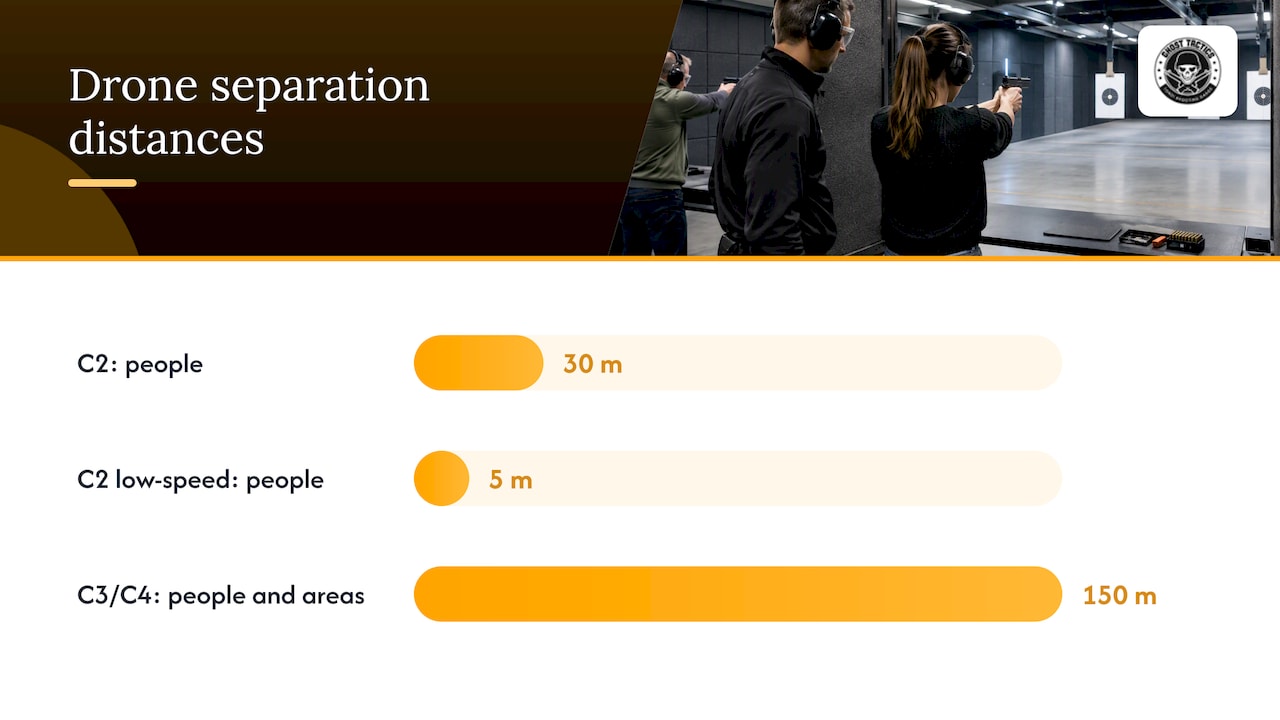
Do not fly directly over crowds. The distance you keep from people depends on the drone class. According to the same booklet, C2 drones can be flown at a horizontal distance of at least 30 m from people, reducible to 5 m in low-speed mode, and an A2 certificate is mandatory. C3 and C4 drones can be flown at least 150 m from uninvolved people and from residential, commercial, industrial and recreational areas, with A1/A3 competency.
In a compact city like Tallinn, that 150 m figure matters. The Old Town, the seafront promenade and Kadriorg on a sunny weekend are exactly the kind of places where a heavier drone has no legal room to fly. If exceeding any of these conditions is part of your plan, it becomes a specific-category operation, which the Transport Administration treats as risk-based and authorised case by case.
For safety habits beyond the legal minimum, read what to know before you fly in Estonia.
Bringing your own drone is common for visitors from Finland, Sweden, Denmark and elsewhere in Europe. EASA member states share a legal framework, but the Transport Administration notes that requirements may differ, so you should check the Estonian rules before you fly. European laws do not apply to third countries. If you come from the UK or another non-EU country, the Transport Administration recommends contacting the authority directly to ask what applies to you.
A sensible visitor checklist:
Our page on drone laws in Estonia for residents and visitors goes into more detail.
Print this or save it on your phone:
If communication is lost and the drone flies uncontrolled, contact air-traffic control straight away. The Transport Administration says to notify Tallinn Tower at +372 625 8260. EANS asks you to give the direction of flight, the maximum remaining flight time based on the battery, and the maximum speed. Have those three numbers in mind before you ever need them.
Tallinn has seen how seriously this is taken: in March 2026, a lost drone caused flights to pause until it was found in a tree and brought down with the Rescue Board’s help. Do not hesitate to call. A quick call is far better than a closed runway.
More on what to do right now is in our drone safety guide for Estonia.
Reading rules is one thing. Feeling how a drone behaves in the air is another. At Tondi Shooting Range in Tallinn, we offer an introductory drone training for companies, Esmane droonikoolitus ettevõttele, from €85 per person. It suits teams who want a hands-on, supervised first experience of drone operation, and it fits naturally into a team day alongside our other activities.
No experience is required. Sessions are supervised by professional instructors, and safety training is included. You can combine drone training with a shooting program indoors at our range, so the day works in any weather. If you are planning something bigger, see why a shooting range works for team building in Tallinn, or what a corporate team event costs.
For groups of friends, bachelor parties and birthdays, our event packages start from €25 per person (Poissmeesteõhtu and Vali ise kolleegidele pakett), and you can browse them on the events page. Looking for a gift? Our gift cards start at €45 for Minu esimene pauk, a first-shot experience for beginners.
Estonian weather can end a drone session quickly: wind, rain and short winter days all affect flying. Our range is indoors, so a shooting session goes ahead whatever the sky does. If rain cancels your outdoor plans, read why indoors wins, or see how our indoor winter shooting works, with no license needed. We have a wide selection of firearms, and our instructors explain every step. Before your visit, our range rules for Tallinn visitors tell you what to expect. Curious about filming your session? Check what is allowed when filming at the range.
Ready to book? Choose a package on our events page or get in touch through laskmine.ee and we will help you plan a day for your group.
Only where the Drone Map allows it and only within open-category rules. Much of the city lies in or near controlled airspace, and local height limits can be lower than 120 m. Check the map before every flight, and never fly directly over crowds.
No, not without authorisation. Close to the airport there is a zone with a 0-metre maximum height, where unmanned aircraft may fly only with specific-category operational authorisation. Treat the whole airport vicinity as restricted.
Often yes. Operator registration generally applies to drones of at least 250 g and to camera drones that can capture personal data, unless they are toys. Drones over 250 g also need A1/A3 competency. Check the Transport Administration’s pages for your exact model.
EASA member states share a common framework, but requirements may differ, so check Estonia’s rules before you travel. For non-EU countries, European laws do not apply, and the Transport Administration recommends contacting the authority directly.
No. No experience is required, and professional instructors supervise every session. Safety training is included, and you can pair the drone session with an indoor shooting program for your group.