Tingimused

Tondi Shooting Range user and customer conditions

Purpose:
1.1. The purpose of these User and Client Terms and Conditions is to provide the principles of the Shooting Range User Agreement with respect to the Client using the Shooting Range services.
1.2. The user and customer conditions apply to the contract entered into upon purchase of the Visiting Card and the one-time service.

Key terms:
2.1. In the Terms of Use and Customer, the following terms are used with the following meanings:
2.1.1. "Booking Rules" - the part of the user and customer conditions that stipulates the procedure and conditions of pre-registration when purchasing the service;
2.1.2. „Lasketiir“ - service provider Tondi Lasketiir OÜ;
2.1.3. "Customer" - a person using the services of the Shooting Range on the basis of purchasing a Visiting Card or a one-time service;
2.1.4. "Visiting Card" - a multiple card of the shooting range for a regular customer;
2.1.5. "Shooting Package" - the service offered by the Shooting Range, the rights of which are defined in the Price List and provided on the Shooting Range website.
2.1.6. "User and Customer Terms and Conditions" - these User and Customer Terms and Conditions, which apply to the Customer using the services of the Shooting Range in case of purchasing a Visitor Card or a one-time service.

Use of a shooting range
3.1. The Client has the right to use the Shooting Range and the services offered therein in accordance with the conditions set out in his Shooting Package or in accordance with the conditions valid for the Visiting Card. When using the Shooting Range, the Client follows the instructions of the Shooting Range staff.
3.2. The shooting range services are provided only by persons authorized by the shooting range. The Client is prohibited from providing any services to the Shooting Range to third parties without the written consent of the Shooting Range.
3.3. The shooting range can be used by persons from the age of 16. Persons aged 12-15 (incl.) Use the Shooting Range only with an adult and / or consent (eg Shooting Packs "Junior and Senior", "Children's Birthday" or "Youth Birthday"). Persons under the age of 12 are not allowed to use the Shooting Range.
3.4. The client can access the Shooting Range on the basis of a previous reservation. The shooting range has the right to demand the presentation of an identity document to confirm a previous reservation and / or to confirm the age of the Customer.
3.5. If the Customer is not able to use the service offered by the Shooting Range at the time previously booked, he must cancel his reservation in accordance with the procedure provided in the "Booking Rules".
3.6. The Client who does not have a reservation can use the services offered by the Shooting Range only if there are free times.
3.7. The shooting range has the right to make changes in the Shooting Packages and other services offered at any time.
3.8. For extraordinary or reasons beyond the control of the Shooting Range (eg in case of an instructor's illness, bomb threat, fire, accident, their danger, etc.), the Shooting Range has the right to cancel the times previously reserved for the use of the service or restrict the use of the service. The Client will be notified as soon as possible.
3.9. The staff of the shooting range advises and instructs the Client on issues related to the use of the services provided, including the equipment, and keeps the used equipment in working order. The client uses the equipment according to its intended use and instructions received from the shooting range staff.
3.10. The Client behaves in accordance with good manners in the Shooting Range and treats the property in the Shooting Range prudently. Smoking and the consumption of alcohol or stimulants are not allowed in the shooting range. Pets are not allowed on the shooting range. The personnel of the Shooting Range have the right to temporarily remove the Shooting Range from the Shooting Range or to file a claim for damages in violation of any previous obligation or rule.

Terms of purchase and sale
4.1. The Client of the Shooting Range pays the Shooting Range for the service on the basis of an invoice according to the amount of fees provided in the price list. It is possible to pay for the service in cash or by bank card at the shooting range on site. On the website of the shooting range, it is possible to pay for the time via a bank link.
4.2. In the event of a delay in the payment of any fee under the Agreement, the Shooting Range has the right to demand late payment interest of 0.15% of the amount payable per day for each day of delay in payment until full payment of the amount due.
4.3. The shooting range has the right to withdraw from the sales contract entered into via the e-store and not to deliver the ordered goods or provide the service in the following cases:
- the goods have run out of stock;
- the price or features of the goods have been displayed incorrectly in the e-shop due to a system error;
- if the Client does not meet the conditions established by the Shooting Range.
4.4. If it is not possible for the Shooting Range to fulfill the order, the Shooting Range will contact the Customer and return the paid amount when the Customer has managed to make an advance payment for the goods.
4.5. The delivery partner of the shooting range is Itella Estonia OÜ (Itella SmartPost). The maximum delivery time is 8 working days. The ordered product is delivered via the parcel machine service.


Payment
5.1. The prices of the products sold in the shooting range online store are given in Euros without transport costs. VAT will not be added. Prices in the online store and sales showroom in Tallinn may differ.
5.2. Payment can be made via Swedbank, SEB Pank, LHV Bank, Luminor, Pocopay and Coop Pank Internet Bank. Also Paypal
SULGE

Frequently Asked Questions

With which public transport are it possible to come from the center of Tallinn to the Weapons and Tactics Training Center?

Trams no. 3 and 4, stop “Tondi”
b. Buses no. 5, 18, 36, stop “Kalev”
c. Taxi – Be sure to add an approximate cost.


What is SLICE?

The SLICE payment method allows you to pay interest and service fees in three equal installments for purchases of € 75-800. You don’t pay a cent more than the actual cost of the product! You can choose the SLICE payment method in the last stage of the purchase, ie on the checkout page, if the purchase amount is between 75-800 euros. You will make the first installment only one month after the purchase and the second and third installments in the following months. Paying with SLICE is quick and easy. The purchase is confirmed in a few moments and there is no need to sign a credit agreement. The option to pay with the SLICE payment method is marked with the SLICE logo on each product!

The service is provided by Inbank AS

SULGE
et
Droonikategooriad Eestis: kust alustada ja mida teha enne esimest lendu

Droonikategooriad Eestis: kust alustada ja mida teha enne esimest lendu

18.10.2026

Eestis kehtib EASA raamistik, kus droonitoimingud jagunevad avatud, erikategooriaks ja sertifitseeritud kategooriaks. Kui sinu droon kaalub 250 grammi või rohkem või kannab kaamerat, registreeri end LOIS-is käitajana ja sooritasid A1/A3 teooriaeksam. Enne lendu kontrolli geograafilisi alasid ja NOTAM-e ning hoia droon 120 meetri piires ja silmside kaugusel.


Lühidalt:

  • Alla 250 grammi kaaluv droon vajab käitaja registreeringut, kui sellel on kaamera või andur, välja arvatud mänguasi, millel on CE tähis; registreering kehtib viis aastat.
  • A2 pädevuse saamiseks pead esmalt omama kehtivat A1/A3 tunnistust, läbima iseseisva praktilise väljaõppe ja sooritama lisaeksami; tunnistused kehtivad viis aastat.
  • Üldine kõrguspiir on 120 meetrit, kuid lennujaamade ja AFIS piirkondade lähedal võib lubatud kõrgus olla väiksem, seega kontrolli kaarti enne lendu.
  • Kontrolli lisaks kehtivaid NOTAM teateid, sest ajutised piirangud ei pruugi kaardil kajastuda; geograafilises alas lennuks küsi luba ala valdajalt, kes võib vastata viie tööpäeva jooksul.
  • Kui lend väljub avatud kategooria piiridest, näiteks toimub väljaspool vaateulatust, vajad Transpordiameti käitamisluba ja riskianalüüsi ning pead loa aegsasti taotlema.

Tondi Lasketiir
Avasta droonitehnoloogia praktiliselt
Tondi Lasketiir ühendab droonitehnoloogia avastamise traditsioonilise laskmise ning professionaalse väljaõppega.

Sisukord

Mida tähendavad avatud, erikategooria ja sertifitseeritud kategooria?

Kategooriad põhinevad riskil: mida ohtlikum lend, seda rangemad nõuded. Nii ei pea hobipiloot läbima sama protseduuri kui ettevõte, kes lennutab drooni asustatud linnas.

Avatud kategooria on madala riskiga lendude jaoks. Eelnevat lennuluba ei küsita, kuid tingimused on kindlad: droon ei lenda otse inimmasside kohal, piloot hoiab drooni vaateulatuses ja maksimaalne lubatud kõrgus on 120 meetrit. Drooni mass jääb alla 25 kg. Enamik hobilende kuulub just siia.

Erikategooria tuleb mängu siis, kui lend ületab avatud kategooria piire. Näiteks soovid lennata väljaspool vaateulatust või kohas, kus avatud tingimused ei kehti. Siis on vaja Transpordiameti käitamisluba ja riskianalüüsi. Luba saab taotleda mitut teed pidi: standardstsenaariumi, eeldefineeritud riskihinnangu, täieliku SORA hindamise või LUC-sertifikaadi kaudu, mis väljastatakse juriidilisele isikule ja annab laiemad õigused.

Sertifitseeritud kategooria on kõrge riskiga tegevuste jaoks, näiteks inimeste vedu või ohtlike kaupade transport. Seal kehtivad lennukitele sarnased sertifitseerimisnõuded nii droonile kui käitajale. Hobi- ja tavakasutaja puutub selle kategooriaga kokku harva, aga põhimõte on oluline: risk määrab bürokraatia hulga, mitte drooni välimus.
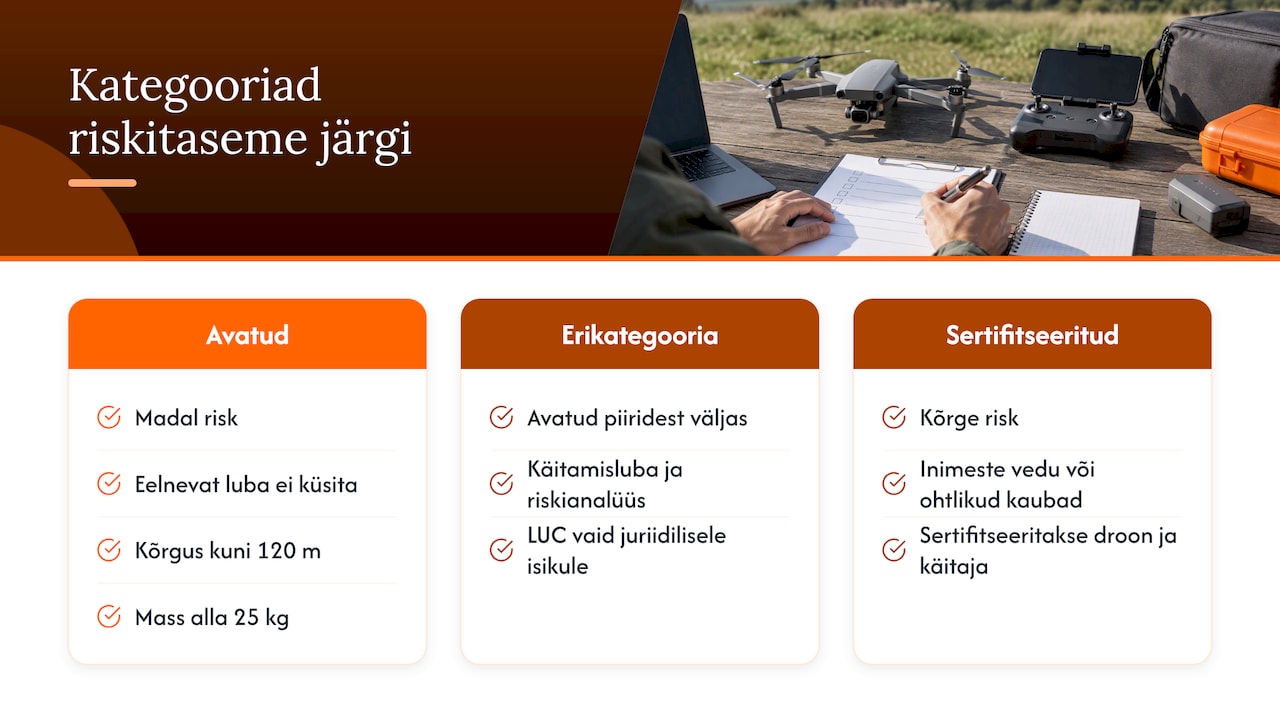
Mida tähendavad avatud, erikategooria ja sertifitseeritud kategooria? — overview diagram

Millised on avatud kategooria alamkategooriad A1, A2 ja A3 ning CE-klassid?

Avatud kategooria jaguneb alamkategooriateks A1, A2 ja A3. Alamkategooria sõltub drooni CE-klassist (C0–C4) või massist ning see määrab, kus tohib lennata. Klassimärgistus on tootja poolt droonile kantud ja kehtib sõltumata sellest, kui kogenud sa oled.

Lihtsustatult: kergemad droonid (C0, C1) sobivad A1 tingimustele, kus võib lennata ka inimeste lähedal, kuid mitte nende kohal kogunenud rahvahulgas. C2 klassi droone saab kasutada A2 all ja C3 ning C4 klassi droone A3 all, kus lend toimub inimestest eemal.
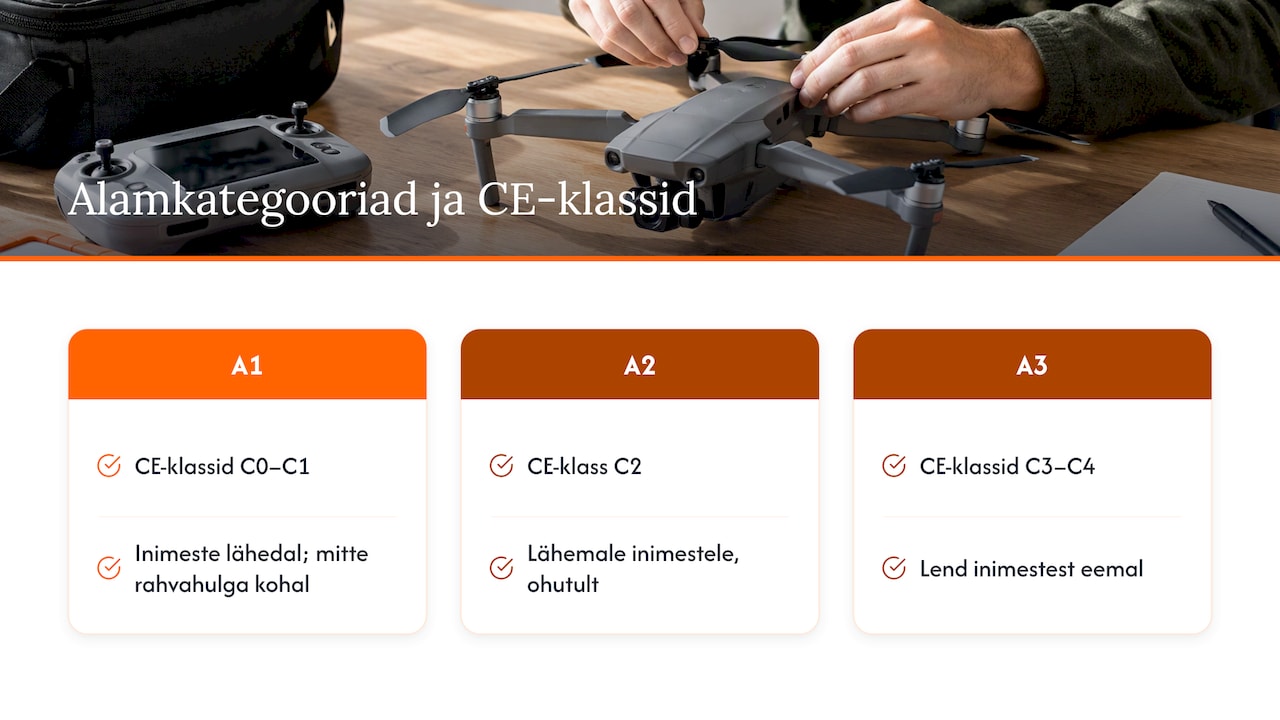
A1, A2 ja A3 seos drooni CE-klassidega

250 grammi piir on praktikas kõige olulisem. Kui droon kaalub 250 g või rohkem või kui sellel on kaamera või muu andur (välja arvatud CE-märgistusega mänguasi), peab käitaja end registreerima. Seega ka kergem droon, kuid kaameraga, ei pääse registreerimisest.

A2 alamkategooria nõuab rohkem. Sul peab olema A1/A3 pädevus, lisaks iseseisev praktiline väljaõpe ja täiendav teooriaeksam. Nii pääsed lähemale inimestele, kuid mitte neid ohtu seadmata. A1/A3 ja A2 tunnistused on tavaliselt 5-aastase kehtivusega, seega pane uuendamine kalendrisse.

Ülevaate EASA kategooriatest leiad ka meie selgitavast artiklist.

Kuidas registreerida end käitajana LOIS-is ja saada pädevustunnistus?

Registreerumine käib Transpordiameti infosüsteemis LOIS. Käitajaks pead hakkama, kui droon kaalub 250 g või rohkem või omab kaamerat või andurit (välja arvatud CE-märgistusega mänguasi). Registreering kehtib 5 aastat, samuti kehtib sama aja A1/A3 tunnistus. Registreering on ühekordne ja kehtib kogu Euroopa Liidus.

Sammud on lihtsad:

  1. Logi LOIS-i ja registreeri end inimese või organisatsioonina.
  2. Saa unikaalne käitaja number.
  3. Kleebi number kõigile oma droonidele nähtavalt.
  4. Kui droonil on remote ID funktsioon, lisa number ka sinna.

Seejärel hangi pädevus. A1/A3 jaoks tutvu Transpordiameti õppematerjalidega ja sooorita LOIS-is valikvastustega teooriaeksam. Praktilist eksamit avatud kategoorias tavaliselt ei nõuta. Test on tasuta, kui teed selle Transpordiameti infosüsteemis, ja tunnistus väljastatakse elektrooniliselt. A2 jaoks lisanduvad iseseisev praktiline väljaõpe ja täiendav eksam.

Täpsema samm-sammulise juhendi leiad meie artiklist drooni registreerimise kohta.

Kuidas kontrollida geograafilisi alasid ja kõrguspiiranguid?

Üldine lagi on 120 meetrit, kuid lennujaamade ja AFIS-alade läheduses kehtivad madalamad piirid. Seetõttu ei piisa kõrguse meelespidamisest: tuleb vaadata ka asukohta.

Enne igat lendu ava Eesti kaardirakendus. See näitab geograafilisi alasid ja kõrguspiiranguid ning sealt näed, kas sinu lennukoht on vaba, piiratud või keelatud. Kontrolli lisaks kehtivaid NOTAM-e, sest ajutised piirangud ei pruugi kaardil püsivalt kajastuda.

Kui lend on plaanitud geograafilisse alasse, tuleb luba küsida ala valdajalt. Esita taotlus koos vajalike andmetega (lennu aeg, koht, kõrgus, drooni andmed). Otsus võib tulla viie tööpäeva jooksul, seega ära jäta taotlemist viimasele minutile.

Eritingimused kehtivad näiteks Tallinna ja Ämari kontrollalal, eriti lennujaamade ja sõjaväeobjektide lähedal. Mõnel alal on vaja Kaitseväe luba. Privaatsuse ja kaamerakasutuse kohta loe lisaks meie artiklist drooni ohutusest ja privaatsusest.

Mida kontrollida enne igat lendu?

Kontroll-loend hoiab ära enamiku vigu. Käi see läbi iga kord, ka tuttavas kohas.

  • LOIS-i käitaja number on droonil nähtaval kleebisena ja remote ID-s, kui see on olemas.
  • Sul on kaasas A1/A3 või A2 tunnistus, mis on kehtiv ja elektrooniliselt kättesaadav.
  • Oled kontrollinud kaardirakendust ja NOTAM-e ning lennuala pole piiratud.
  • Droon püsib silmside kaugusel ja sa väldid inimeste kohal lendamist.
  • Sul on varuplaan, kui side katkeb või aku kiiresti tühjeneb.
  • Vajadusel on olemas ala valdaja luba.
  • Oled veendunud, et lend mahub avatud kategooria piiridesse, mitte erikategooria alla.

Professionaalne nõuanne: Salvesta tunnistus ja käitaja number telefoni ning tee kaardikontroll kohapeal uuesti, sest ajutised piirangud võivad muutuda päeva jooksul.

Sama loogikat kordab ka meie lühijuhend kolme asja kontrolliks enne lendu.

Miks tasub nõuetest kinni pidada?

Reeglite järgimine pole bürokraatia pärast, vaid lennu sujuvuse ja turvalisuse pärast. Kui käitaja number, pädevus ja kaardikontroll on korras, ei pea sa lennu ajal muretsema trahvi või konfiskeerimise pärast. Transpordiameti esindajad on rõhutanud, et registreerimine ja algpädevus tõstavad teadlikkust ja ohutust, sest droonide kasutamine on muutunud massilisemaks. Abi leiad LOIS-ist ja Transpordiameti juhenditest. Praktilisem tugi tuleb koolitusest: meie pakume droonikoolituse kinkekaarte neile, kes tahavad drooniga tegelemist juhendaja käe all alustada.

— Instructor TO

Korduma kippuvad küsimused

Kas iga drooni peab Eestis registreerima?

Ei, kuid enamik droone vajab seda. Registreerimine on kohustuslik, kui droon kaalub 250 g või rohkem või kannab kaamerat või andurit (välja arvatud CE-märgistusega mänguasi). Registreering kehtib 5 aastat.

Kas A1/A3 tunnistuse saamiseks peab sooritama praktilise eksami?

Tavaliselt mitte. Avatud kategoorias piisab LOIS-is tehtavast teooriaeksamist Transpordiameti õppematerjalide põhjal. Test on tasuta, kui teed selle Transpordiameti infosüsteemis.

Kui kõrgele tohib avatud kategoorias lennata?

Üldine lubatud maksimumkõrgus on 120 meetrit. Lennujaamade ja AFIS-ala läheduses võivad kehtida madalamad piirid, mille leiad kaardirakendusest.

Millal on vaja erikategooria luba?

Siis, kui lend ei mahu avatud kategooria tingimustesse, näiteks väljaspool vaateulatust või riskantsemas kohas. Luba taotletakse Transpordiametilt riskihindamise alusel.

Allikad

Soovitused