Shoot Famous Guns in Tallinn: Experiences for Groups & Tourists
- Mo-Su 10.00 – 20.00
- +372 555 85 416
- sale@laskmine.ee





Point shooting is defined as firing a firearm without using the weapon’s sights, relying instead on muscle memory, hand-eye coordination, and spatial awareness to hit a target. Also called instinctive shooting, this method prioritizes speed over precision and works best at close range in high-stress situations. Law enforcement trainers and defensive shooting instructors recognize it as a legitimate skill, though not a replacement for traditional sighted shooting. If you want to understand what is point shooting and whether it belongs in your training, this guide covers the technique, the science, and the safest way to practice it. Tondi Lasketiir in Tallinn offers a controlled indoor environment where beginners and experienced shooters alike can develop both methods safely.
Point shooting is a tactical firing method where the shooter focuses on the target rather than the weapon’s sights. The firearm stays in the shooter’s peripheral vision while the eyes lock onto the threat. This is not aimless shooting. It is a different aiming system that uses the body’s natural spatial awareness instead of visual alignment through iron sights or optics.
The mechanics rely on three physical systems working together: proprioception (your body’s sense of its own position), hand-eye coordination, and muscle memory. When you point your finger at an object, your nervous system aligns your arm without conscious thought. Point shooting attempts to replicate that same reflex with a firearm. The key difference is that a firearm is not your finger, so the alignment must be trained deliberately over many repetitions.
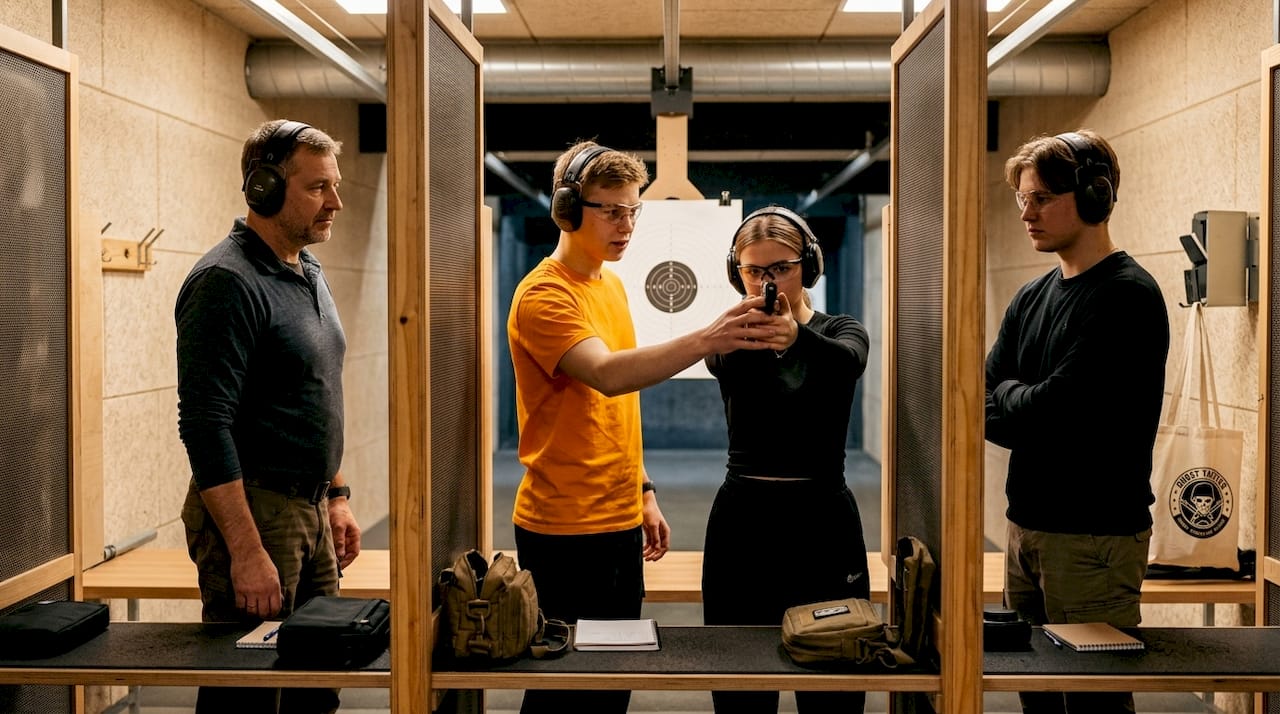
Focusing on the target rather than the front sight also means the shooter does not need to rapidly shift focus between the target and the weapon. That shift costs time. At very close distances, where most defensive encounters occur, that fraction of a second matters significantly.
Consistent grip is the foundation of the point shooting technique. An unstable or shifting grip changes the angle of the barrel relative to your hand, which breaks the muscle memory loop the technique depends on. Your hand must meet the grip the same way every single time.
Stance matters for the same reason. A squared, forward-facing position gives your body a repeatable reference point. When your feet, hips, and shoulders align consistently, your extended arm points to roughly the same spot each time you raise the weapon. Vary your stance and your point of aim drifts unpredictably.
Pro Tip: Practice your grip and draw from a holster in front of a mirror before ever firing a round. If the barrel does not point at your reflection’s center every time, your grip is inconsistent.
Point shooting excels in specific conditions. It is not a universal upgrade over sighted shooting. Understanding when each method applies is what separates a well-rounded shooter from one who has mastered only half the skill set.
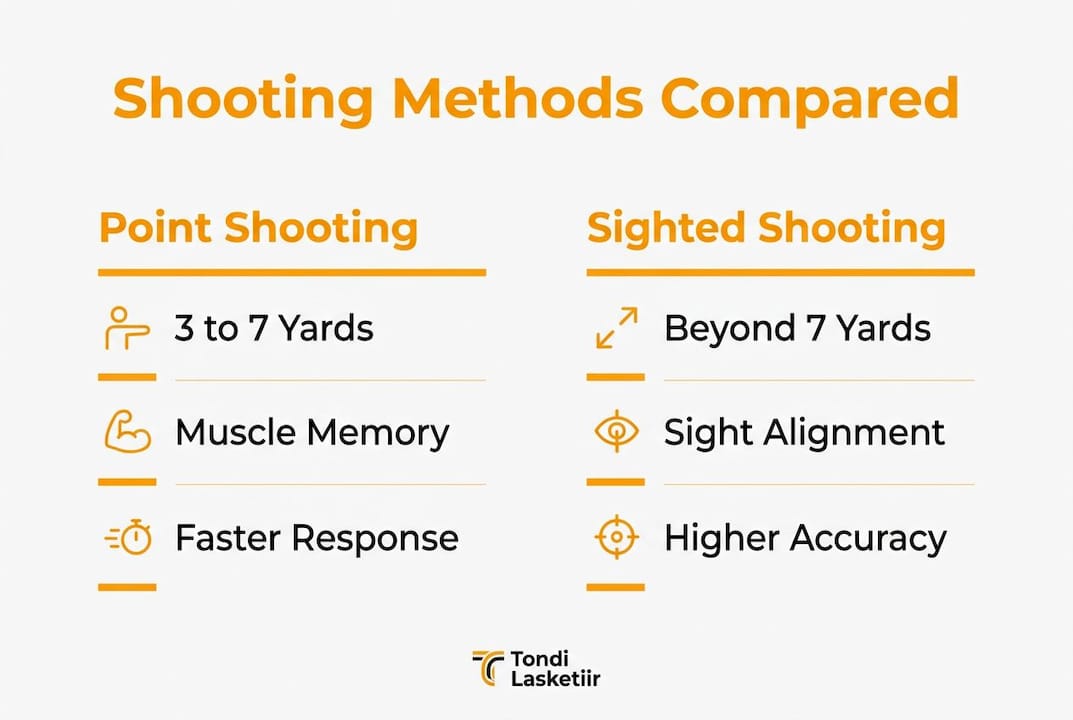
Modern training treats point shooting as a contingency skill, not the primary method. Sighted shooting remains the gold standard for accuracy, especially at distances beyond a few yards. Point shooting fills the gap when raising the weapon to eye level and aligning the sights is not practical or fast enough.
| Situation | Point shooting | Sighted shooting |
|---|---|---|
| Distance | Best within 3–7 yards | Reliable at 10+ yards |
| Speed | Faster draw-to-fire | Slower but more accurate |
| Lighting | Usable in low light | Requires visible sights |
| Body position | Works from awkward angles | Requires stable, upright stance |
| Skill requirement | Demands heavy repetition | Learnable with less drilling |
The biggest advantage is speed. Skipping the sight picture shortens the time between recognizing a threat and firing. At close range, that speed advantage is real and measurable.
Point shooting also works from positions where sighted shooting fails. If you are behind cover, seated, or shooting from an unusual angle, raising the weapon to eye level may not be possible. The point shooting technique is particularly useful for shooters with age-related vision changes, since it eliminates the need to rapidly refocus between a near-field front sight and a distant target.
Accuracy drops sharply as distance increases. Beyond 7 yards, most untrained shooters using point shooting will miss more than they hit. The technique also degrades faster than sighted shooting when practice lapses. Because it relies on feel rather than visual confirmation, the skill fades without regular reinforcement. These are not reasons to avoid learning it. They are reasons to train it consistently and pair it with sighted shooting practice.
Learning to point shoot follows a clear progression. Skipping steps produces bad habits that are harder to unlearn than to avoid in the first place.
Pro Tip: Soft-air training tools are excellent for building repetitions, but always return to live-fire sessions regularly. The recoil management and trigger weight of a real firearm require their own muscle memory.
For structured beginner drills that complement point shooting practice, the pistol drills guide from Laskmine covers foundational exercises worth working through before your first range session.
The biggest myth about point shooting is that it comes naturally. It does not. Humans are not naturally accurate at pointing a firearm at a target. Pointing a finger is accurate because the finger is part of your body and your nervous system has mapped it since childhood. A firearm is an external object, and that mapping must be built from scratch through deliberate practice.
A second myth is that point shooting is only for experts or military operators. The opposite is true. Beginners benefit from learning the basics of point shooting early because it builds body awareness and grip discipline that improves all shooting skills.
A third common misconception is that point shooting means never using sights. That is not the definition. Point shooting involves target-focused concentration with the firearm in peripheral vision, and as distance increases, the weapon is progressively raised until sights come into play. It is a spectrum, not a binary choice.
“Successful point shooting depends on consistent grip and muscle memory, not natural instinct alone. It is a skill developed through thousands of practiced repetitions. An unstable grip leads to inconsistent aiming despite training.” — Firearms training research, Paragraph4
The instinct myth also leads shooters to underestimate how quickly the skill degrades without practice. Point shooting requires near-constant reinforcement because it relies on feel rather than visual verification. Miss a few weeks of practice and your point of aim drifts noticeably. This is not a flaw in the method. It is simply the nature of any motor skill that depends on proprioception.
Aging also affects the technique in ways most guides ignore. Vision changes reduce the ability to track a fast-moving front sight, which is one reason point shooting gains relevance for older shooters. The technique sidesteps the focus-shift problem entirely, which can actually make it more accessible as a shooter’s eyesight changes over time.
Archery offers a useful parallel here. Instinctive aiming in compound bow shooting follows the same principle: the archer focuses on the target, not the arrow, and the body’s spatial memory does the alignment work. The training logic is identical. Repetition builds the map; the map guides the shot.
Tondi Lasketiir is Tallinn’s professional indoor shooting range, and it is one of the best places in Estonia to develop both point shooting and sighted shooting skills in a safe, supervised setting.

Whether you are a first-time visitor curious about firearms or an experienced shooter looking to sharpen your instinctive technique, Laskmine’s shooting range packages cover every level. Expert instructors guide you through proper grip, stance, and target focus so you build real skills from your first session. Group bookings, bachelor party packages, and gift cards are all available. If you want a memorable Tallinn experience that goes beyond the typical tourist activity, a session at Tondi Lasketiir delivers exactly that.
Point shooting is a trainable skill built on consistent grip, muscle memory, and target focus, not natural instinct, and it works best when combined with traditional sighted shooting practice.
| Point | Details |
|---|---|
| Core definition | Point shooting means firing without using sights, relying on muscle memory and spatial awareness. |
| Best range | The technique is most effective within 3–7 yards, where speed matters more than precision. |
| Not a replacement | Sighted shooting remains the accuracy standard; point shooting is a contingency skill. |
| Training requirement | Consistent repetitions are required to build and maintain the muscle memory the technique depends on. |
| Vision advantage | Point shooting benefits shooters with age-related vision changes by removing the need to focus on sights. |
Point shooting is firing a firearm without aligning the sights, using your body’s natural spatial awareness and muscle memory to aim at the target instead.
Point shooting is most reliable within 3–7 yards. Beyond that range, accuracy drops and sighted shooting becomes the better choice.
Point shooting requires more repetitions to build the muscle memory it depends on, but the basics are accessible to beginners with proper instruction and consistent practice.
No. Integrating both methods produces better overall performance than relying on either technique alone. Point shooting fills close-range, high-speed gaps that sighted shooting cannot always cover.
Yes. An inconsistent grip changes the barrel angle relative to your hand, which breaks the muscle memory alignment the technique relies on. Consistent grip is the single most important physical variable in point shooting.