Estonia: 5 Shooting Range Rules Tallinn Visitors Must Know
- Mo-Su 10.00 – 20.00
- +372 555 85 416
- sale@laskmine.ee


Recoil is the push you feel in your hands and shoulders when a firearm fires. For most first-timers it is far milder than expected: a firm, quick shove, not a violent jolt. At Tondi Shooting Range in Tallinn, no experience is required, every session is supervised by professional instructors, safety training is included, and the range is indoors. You learn how to handle recoil before you ever press a trigger.
This guide explains what recoil is, what it actually feels like, how stance and grip tame it, and what to expect on your first visit.
Recoil is basic physics. When a cartridge fires, the bullet leaves the barrel in one direction, and an equal force pushes the firearm back toward you. Heavier guns, lighter bullets and lower-powered cartridges all produce a gentler push. Lighter guns and stronger cartridges push harder.
Two things happen at once:
Both are small and predictable. A trained shooter does not fight them. They set up the grip and stance so the firearm returns to the same spot after each shot.
That is why recoil is a skill topic and not a danger topic. Nothing about it is unexpected once you know what is coming.
People arriving at a range for the first time tend to imagine something dramatic from films. The real sensation is closer to a sharp, short push. Many first-timers say the surprise is the sound and the sense of occasion, not the kick.
Here is a rough guide to what you may notice:
| Sensation | What causes it | What helps |
|---|---|---|
| A quick push into the palms or shoulder | The firearm moving backward | Firm grip, forward-leaning stance |
| The muzzle lifting after the shot | Force traveling above your hand | Locked wrists, eyes on the front sight |
| A startled blink or tense shoulders | Anticipating the bang | Relaxation, calm breathing, dry practice with the instructor |
| Ringing or muffled hearing without protection | Loud noise in an enclosed space | Properly fitted hearing protection |
The last row matters. We cover it below, because noise is the factor beginners should take seriously.
The most common beginner mistake has a name: flinching. When you brace for the bang, your body tenses at the moment of the shot. You push the muzzle down, jerk the trigger or close your eyes. The result is a shot that lands low, and the shooter blames the gun.
Flinching is not a flaw of character. It is a normal reflex. The fix is also simple:
A good instructor does not tell you to “just be brave.” They change the setup: a different firearm, a different calibre, a different stance cue, or a few calm dry repetitions first. If you want to practice the trigger squeeze before you visit, our dry fire practice guide for beginners explains how to do it safely without ammunition, and only with the instruction it describes.
Stance is where most of the recoil management happens. You do not need to be strong. You need to be balanced.
The slight forward lean is the key detail. If you stand upright or lean back, the firearm pushes you off balance, and you waste time recovering. Leaning in lets your body absorb the push and return to position.
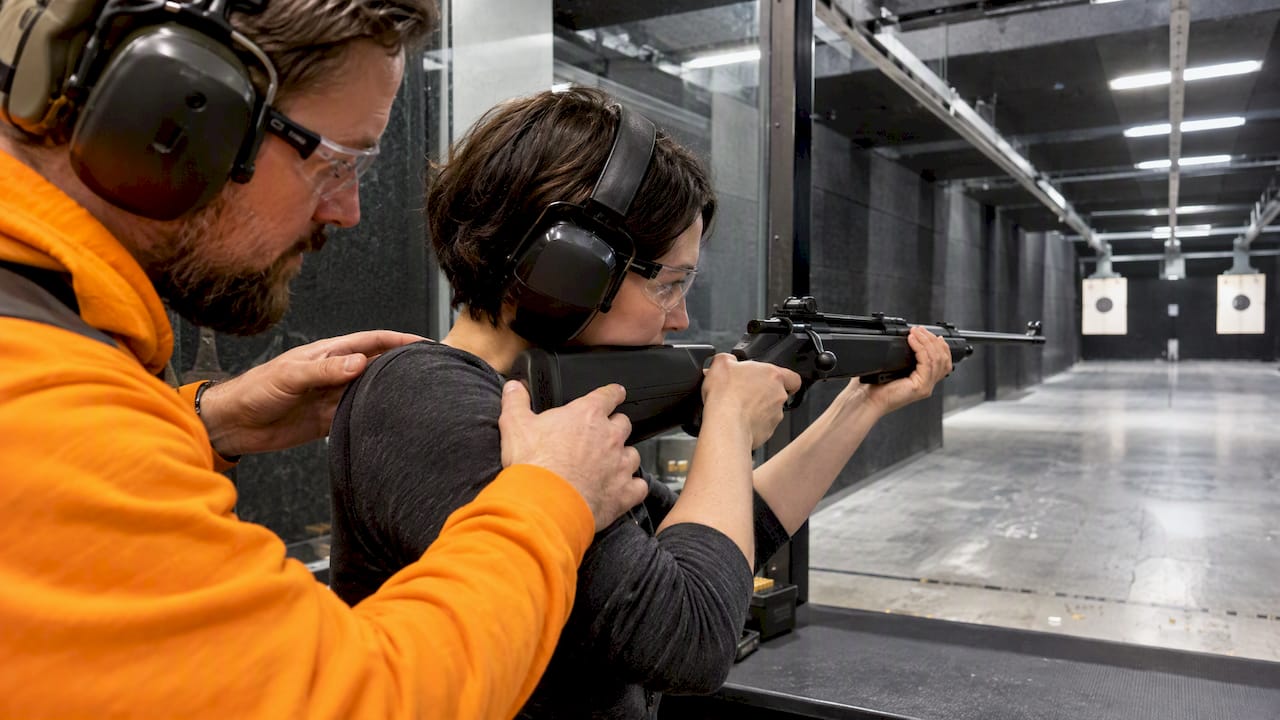
With a rifle or carbine, the stock sits firmly in the pocket of your shoulder. A loose stock moves around and feels harsher; a snug one feels like a steady push. Your instructor sets the position, checks your cheek weld and makes sure you are comfortable before you fire.
On a handgun, grip decides how much the barrel rises and how fast you recover.
You will not need to memorize any of this. Your instructor stands next to you, adjusts your hands and gives short cues between shots. Within a few magazines most beginners find a rhythm. For those who want to take the next step toward accuracy afterwards, see our guide to precision shooting techniques and our pistol drills for beginners.
Worrying about the kick is natural, but range discipline is the part that actually keeps everyone safe. The rules are few and consistent:
These ideas match the general approach of Estonian authorities, who stress that a firearm brings responsibility and that its owner must learn to handle it safely. Ranges are also regulated: Estonia has a safety regulation for shooting ranges and shooting places that sets requirements for how ranges are built and used, including closed (indoor) ranges.
If you want a short briefing before you arrive, read our five shooting range rules for Tallinn visitors or the visitor checklist of 5 to 10 minutes. Parents travelling with teenagers can start with four rules for parents visiting Tallinn.
In an indoor range, sound is louder and more concentrated than most people expect. Loud noise in enclosed spaces is a known physical risk factor, and Estonia’s Health Board treats noise as a physical hazard to health that has to be managed with appropriate protection.
At Tondi, hearing protection is part of the experience and you wear it throughout your session. That is a rule, not a suggestion. Ear protection also helps with recoil anxiety: much of the “jolt” a beginner feels comes from the bang, and muffling it makes the whole shot feel calmer.
If you have a particular hearing concern, mention it when you book or at the start of your session. If you have a medical condition that affects your hearing or balance, ask your own doctor whether the activity suits you.
Our range in Tallinn is indoors, so weather and daylight do not change your plans. Here is how a typical first session runs.
Your instructor explains the range rules and the commands used during shooting. Safety training is included, and no prior experience is needed. You can ask anything, including how hard the firearms kick.
You are fitted with hearing protection and shown how each firearm works. We offer a wide selection of firearms, so the instructor can match the choice to your comfort level. Smaller, lighter-recoiling options are a natural starting point if you are nervous, and you can step up as you grow comfortable.
You practice stance and grip, then take your first shots under direct supervision. The instructor corrects small things as you go: a lower elbow, a tighter wrist, a calmer breath.
As the session continues, most people notice the recoil fades into the background and their grouping on the target improves. That is the moment people tell us they came to see what it was about and left wanting a second visit.
Not sure what to wear? Our guide on what to wear at the range explains what you need, and what is provided on site. Visiting in the cold months? Check winter shooting prep too.
Different visitors want different things, and recoil comfort is a good way to choose. Prices below are as published on our site.
| Experience | Price | Good for |
|---|---|---|
| Minu esimene pauk | €45 | First-timers who want a simple, supervised introduction |
| Juunior ja seenior | €55 | Two generations shooting together |
| Shooting Foreplay | €76 | Couples and friends looking for a lively date or evening |
| Dünaamiline Duo | €105 | Two people who want something more active |
| Eriüksuslane | €105 | Visitors who like the idea of a special-forces style session |
| Adrenaliinilaks | €138 | Thrill-seekers wanting a bigger dose of action |
| VIP Duo | €168 | A premium experience for two |
You can see the details and buy any of these as a gift card on our experiences and gift cards page. If you like the idea of a session built around a special-forces theme, read about the Special Forces shooting package.
Recoil is also a social subject. Groups tend to settle each other’s nerves: when the person next to you laughs after the first shot, it becomes a lot easier to relax.
We also run drone sessions for teams and parties. If you want something different alongside the shooting, take a look at the event drone safety course.
If you already own a firearm or plan to apply for a license, recoil control is something you want to practice regularly. Our range rental is “Laskeraja rent” at €125 per person, and “Relvaomanik sõbraga tiiru” is €15 per person. If you shoot often, the 10x card is €150 and the 20x card is €200. A handling course, “Relvakäsitsemise koolitus”, is €175. All of these are listed on our gun owner page.
If you are choosing an instructor elsewhere or want to know what a good one looks like, our article on three checks to vet a shooting instructor is useful. For budgeting a course, see what shooting training costs in Estonia.
The fastest way to stop wondering about recoil is to feel it in a controlled setting with someone beside you who does this every day. Our indoor range in Tallinn is built for exactly that. A first session, “Minu esimene pauk”, costs €45. If you are shopping for someone else, every experience above is available as a gift card. Choose yours on our experiences page, or start from laskmine.ee.
For most first-timers it does not. You feel a quick push, not pain, and a correct grip and stance keep it comfortable. If something feels unpleasant, tell your instructor, who can adjust your position or switch to a gentler firearm.
No. Beginners are welcome, safety training is included, and every session is supervised by professional instructors. You will be shown how to stand, hold and shoot before your first shot.
Yes, our range in Tallinn is indoors, so your session does not depend on weather or daylight. You wear hearing protection throughout, and the instructors manage the range from start to finish.
Our “Juunior ja seenior” experience, priced at €55, is designed for two generations shooting together. Check the age requirements and details on the experiences page before booking, and read our rules for parents if you are bringing a younger visitor.
That depends on you, and your instructor will help you pick. We offer a wide selection of firearms, and a lighter-recoiling option is a common and sensible place to begin. You can move up once you feel comfortable.