Halloween and zombies hunt in Tallinn
- Mo-Su 10.00 – 20.00
- +372 555 85 416
- sale@laskmine.ee


In Estonia you can fly a drone legally if you do four things. Register as an operator when your drone needs it. Hold the right pilot certificate. Stay within the open-category limits (120 meters maximum, always in line of sight). Check the official drone map for geographical zones before every flight. The rules are EU-wide, so a registration from Finland, Sweden or Denmark is recognized here, but the local no-fly and restricted zones are Estonian and you have to check them yourself.
This guide goes through each requirement in plain words, with a checklist you can use at the car park or on the ferry, and a few mistakes we see people make. We are Tondi Shooting Range in Tallinn, and we run drone safety training alongside our shooting programs, so we care about drones being flown well.
Drone rules in Estonia come from the European framework and are enforced locally by the Estonian Transport Administration (Transpordiamet). The EU rules sort flights into categories by risk. Almost every hobby flight, and many simple commercial ones, falls into the open category, which is the main reference for leisure drone flying and low-risk work.
That is good news for visitors. You do not need to learn a separate Estonian system. You need to know the shared EU rules and then the Estonian layer on top: the geographical zones, which are managed locally. For a deeper look at the categories, see our explainer on EASA drone categories.
In Estonia you register yourself as the operator, not each drone separately. The operator is the owner of the drone (or the person or company that leases it). The operator can also be the pilot, but does not have to be.
According to the Transport Administration, registration is required in these cases:
The second point trips up many people. A small camera drone is not exempt from the rules just because it is light. The Transport Administration’s guidance makes clear that the camera changes the classification and makes operator registration mandatory.
The state fee for an operator registration number is 10 EUR. The registration is valid for one year and is renewed annually in LOIS, the Aviation Safety Information System. Renewing does not mean a new application: you extend the existing one.
Once you have the number, it must be marked on your drone. Our step-by-step page on drone registration in Estonia through LOIS walks through the screens.
If you are already registered as an operator in another EASA member state, the Transport Administration says you can fly in Estonia under the same rules, though you must still check local geographical restrictions. This applies whether you arrive from Helsinki on the ferry, from Stockholm or from Copenhagen. Visitors from outside the EU should check the Transport Administration’s page for their own situation before they travel, because this guide covers the standard EU/EASA case.
Registration is about who is responsible for the drone. Competence is about who is flying it. A person flying the drone is the remote pilot, and the remote pilot does not need to be the owner.
If you hold an A1/A3 certificate from another EU country, it is recognized across the union. Larger drones that you want to fly closer to people, or in populated areas, fall under further subcategories. For example, the Transport Administration places drones with a takeoff mass of 500 g to 2 kg flown in populated areas under open subcategory A2, which needs the additional A2 certificate. If your drone is in that range, read the competency requirements before the trip, not at the take-off spot.
The key numbers are short enough to memorize:
| Rule | What it means |
|---|---|
| Maximum altitude | 120 m above ground. Some areas have lower limits, shown on the drone map. |
| Line of sight | You or an unmanned aircraft observer must see the drone directly. Seeing it through the camera does not count. |
| Weight | Under 25 kg in the open category. |
| Prohibited | Carrying dangerous goods, or causing harm to people or property. |
All of these appear on the Transport Administration’s Flying Drones in Estonia page. The line-of-sight rule matters most for FPV pilots. Goggles put you in the camera view, so a second person acting as observer is the legal way to fly, not a formality.
Having the paperwork does not mean you can fly anywhere. Estonia publishes geographical zones for security and environmental protection, and you must follow them even in the open category. The common categories are areas around airports, military sites and nature reserves.
Two practical points:
The zone rules took a new form with the General Precept of Unmanned Aviation, which took effect on 1 March 2023, and they are the part of Estonian drone law that changes most often. That is the reason we tell people to look at the live map instead of relying on an article, including this one.
Our short pre-flight routine is on the page about the three checks before every flight: LOIS, competence and the Estonian drone map.
Print it, screenshot it, or keep it in the drone case.
If you cannot answer one of these with confidence, you are not ready to take off from that spot. Move, or skip the flight.
“It is under 250 grams, so no rules.” The weight only decides the pilot certificate requirement. A camera still means you must register as an operator, unless the drone is a toy.
“My home registration is enough everywhere.” It is recognized in Estonia, but it does not remove the local zones. Airports, military areas and nature reserves still need checking.
“I watched it on the screen, so I had it in sight.” Camera view is not visual line of sight under the rules.
“I will ask permission on the day.” When a zone needs written permission, the lead time is at least 5 business days. A spontaneous flight in such a zone is not possible.
“I will skip the training because the drone is small.” Small drones crash into people and fences too. The basic principles do not shrink with the weight, which is why we recommend the same training for lighter drones that the Transport Administration does.
A drone is an aircraft. The best protection against a fine, a lost drone or an injury is a pilot who knows the rules and has practiced the controls. Three things help most:
For more on reading alerts and what to do if you see a drone where it should not be, see our page on drone safety in Estonia.
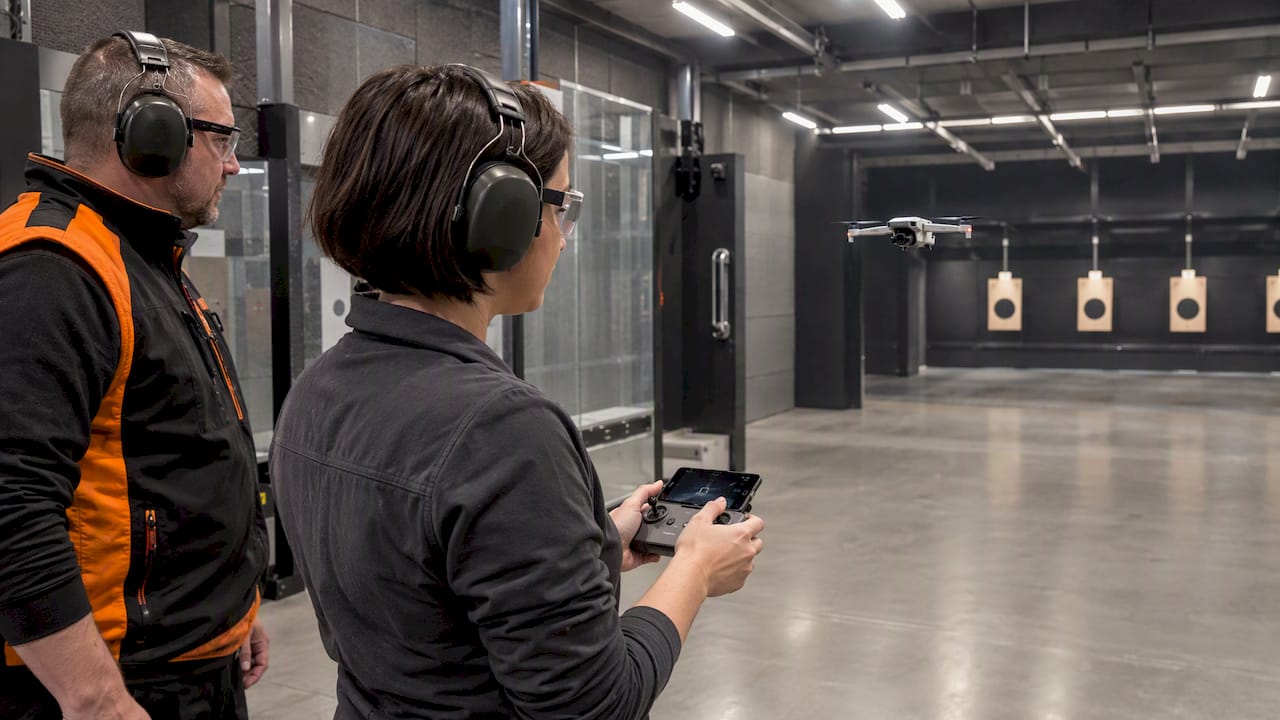
Tondi Shooting Range is the largest shooting range in the Baltic region, and we also teach drone operation. Our drone safety offering is built for groups: companies, teams and parties who want a hands-on session with trained instructors, with no experience needed and all sessions supervised by professional instructors. Safety training is part of the program, and we do it indoors.
The first-time drone course for companies, Esmane droonikoolitus ettevõttele, starts from 85 EUR per person. You can see it, along with our other team formats, on the corporate events page. If you want to see what a same-day session looks like, read about our event drone safety course for parties and teams. Security teams may also like the indoor FPV tactics modules.
A drone session also pairs well with a shooting package for a bachelor party, a birthday or a team day. Ask us about combining formats and we will help you plan the afternoon.
Decide before you pack. If your drone weighs 250 g or more, or has a camera, register in LOIS first (10 EUR), or confirm that your home-country registration is valid under EU rules. Bring your certificate. In Tallinn and on the coast, open the drone map for each spot, because the old town, ports and nearby airspace are the kinds of places where restrictions are likely. The map gives the real answer, not our guess.
A child under 16 can fly in the open category only under the exceptions listed above, such as supervision by a qualified person. A toy-classified drone is treated differently from a camera drone, so check the product’s classification before you buy. Our drone safety page is a good place to start with the family.
If the drone is owned or leased by the company, the company is the operator, and a legal person can register as an operator. Pilots still need the correct competency. If you want your staff to become comfortable with drones, training them together is cheaper and faster than doing it one by one, and it works as a team activity too.
Our experts at the range think about safety every day, and the habits transfer. The same discipline you use before a drone flight, which is checking, confirming and only then acting, is what we teach on the range. If you are curious about the shooting side, read about shooting range rules Tallinn visitors must know or about building security awareness through tactical training.
It depends on the camera. If a drone under 250 g has a camera and is not a toy, you must register as an operator. A sub-250 g drone without a camera does not need registration, but the Transport Administration still recommends the A1/A3 certificate for safety.
The state fee is 10 EUR for the operator registration number. It is valid for one year and you extend it in LOIS each year without filing a new application.
Yes, if they meet the same requirements as residents: registration where needed, the right certificate, and compliance with the open-category limits. Tourists must also check the drone map for geographical zones before each flight, because those are managed locally and some require permission requested at least 5 business days ahead.
In the open category the maximum is 120 m above ground. Some areas have lower limits, and those are shown on the Estonian drone map, so the lower number wins.
Yes, operators registered in another EASA member state can fly in Estonia under the same rules. You still need to follow Estonian geographical restrictions, so check the drone map before you launch.